



'Indian election getting more attention in the US than ever'

April 30, 2014

Normal 0 false false false EN-US X-NONE X-NONE MicrosoftInternetExplorer4

/* Style Definitions */
table.MsoNormalTable
{mso-style-name:"Table Normal";
mso-tstyle-rowband-size:0;
mso-tstyle-colband-size:0;
mso-style-noshow:yes;
mso-style-priority:99;
mso-style-qformat:yes;
mso-style-parent:"";
mso-padding-alt:0in 5.4pt 0in 5.4pt;
mso-para-margin-top:0in;
mso-para-margin-right:0in;
mso-para-margin-bottom:10.0pt;
mso-para-margin-left:0in;
line-height:115%;
mso-pagination:widow-orphan;
font-size:11.0pt;
font-family:"Calibri","sans-serif";
mso-ascii-font-family:Calibri;
mso-ascii-theme-font:minor-latin;
mso-fareast-font-family:"Times New Roman";
mso-fareast-theme-font:minor-fareast;
mso-hansi-font-family:Calibri;
mso-hansi-theme-font:minor-latin;
mso-bidi-font-family:"Times New Roman";
mso-bidi-theme-font:minor-bidi;}
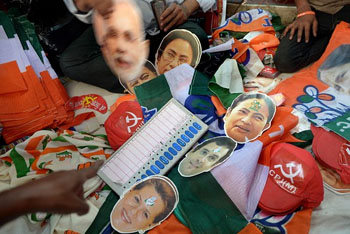
US_election_attentionWashington, Apr 30: India's general election is getting more attention in the US than ever before, a former top American diplomat who played a key role in revival of Indo-US ties after India's 1998 nuclear tests, has said.

"My impression is that this election in India is getting more attention in the United States than any other in a very long time," Strobe Talbott, president of the leading American think-tank Brookings Institute told a Washington audience at a panel discussion on Indian elections.

"This is basically a good thing. We Americans have over the decades have not paid attention to India that we should. More Americans are paying attention to it," said Talbott, who was Deputy Secretary of State under President Bill Clinton and held crucial talks with the then External Affairs Minister Jaswant Singh.

Talbott's comment on much greater attention towards the Indian election in the US, comes at a time when there has been criticism of lack of adequate coverage of Indian elections in the US media.

Normal 0 false false false EN-US X-NONE X-NONE MicrosoftInternetExplorer4

'Indian election getting more attention in the US than ever'

Washington, Apr 30: India's general election is getting more attention in the US than ever before, a former top American diplomat who played a key role in revival of Indo-US ties after India's 1998 nuclear tests, has said.

"My impression is that this election in India is getting more attention in the United States than any other in a very long time," Strobe Talbott, president of the leading American think-tank Brookings Institute told a Washington audience at a panel discussion on Indian elections.

"This is basically a good thing. We Americans have over the decades have not paid attention to India that we should. More Americans are paying attention to it," said Talbott, who was Deputy Secretary of State under President Bill Clinton and held crucial talks with the then External Affairs Minister Jaswant Singh.

Talbott's comment on much greater attention towards the Indian election in the US, comes at a time when there has been criticism of lack of adequate coverage of Indian elections in the US media.

Comments

Add new comment

  • Coastaldigest.com reserves the right to delete or block any comments.
  • Coastaldigset.com is not responsible for its readers’ comments.
  • Comments that are abusive, incendiary or irrelevant are strictly prohibited.
  • Please use a genuine email ID and provide your name to avoid reject.
News Network
June 19,2020

Jun 19: Billionaire Mukesh Ambani on Friday announced that his oil-to-telecom conglomerate Reliance Industries is now net debt-free after raising a record Rs 1.69 lakh crore from global investors and a rights issue in under two months.

Reliance raised Rs 1.15 lakh crore from global tech investors by selling a little less than a quarter of the firm's digital arm, Jio Platforms Ltd, and another Rs 53,124.20 crore through a rights issue in the past 58 days.

Taken together with last year's sale of 49 per cent stake in fuel retailing venture to BP Plc of UK for Rs 7,000 crore, the total fund raised is in excess of Rs 1.75 lakh crore, the company said in a statement.

Reliance had a net debt of Rs 1,61,035 crore as on March 31, 2020. "With these investments, RIL has become net debt-free," it said.

"I have fulfilled my promise to the shareholders by making Reliance net debt-free much before our original schedule of March 31, 2021," Ambani said.

Jio Platforms - which houses the country's youngest but largest telecom firm Reliance Jio, raised Rs 1,15,693.95 crore from leading global investors including Facebook, Silver Lake, Vista Equity Partners, General Atlantic, KKR, Mubadala, ADIA, TPG, L Catterton and PIF since April 22, 2020.

Saudi Arabian sovereign wealth fund PIF buying 2.32 per cent stake in the unit for Rs 11,367 crore on June 18 "marks the end of Jio Platforms' current phase of induction of financial partners," the statement said.

Alongside, Reliance launched India's biggest right issue, which was subscribed to 1.59 times.

Though the rights issue size was Rs 53,124 crore, the company has got only 25 per cent of the money as the remaining is to be paid only next fiscal.

Ambani had at the company's annual general meeting on August 12, 2019, announced a roadmap for Reliance to become a net debt-free company before March 31, 2021.

"We have a very clear roadmap to becoming a zero net-debt company within the next 18 months that is by March 31, 202," he had said last year highlighting strong interest from strategic and financial investors in consumer businesses, Jio and Reliance Retail.

In the statement on Friday, he said he was both delighted and humbled to announce the fulfillment of the promise.

"Exceeding the expectations of our shareholders and all other stakeholders, again and yet again, is in the very DNA of Reliance," he said.

"Therefore, on the proud occasion of becoming a net debt-free company, I wish to assure them that Reliance in its Golden Decade will set even more ambitious growth goals, and achieve them," he added.

He said over the past few weeks, phenomenal interest was received from the global financial investor community in partnering with Jio.

"As our fundraising milestone from financial investors is achieved, we sincerely thank the marquee group of financial partners and warmly welcome them into Jio Platforms," he said.

"I also express my heartfelt gratitude to all the retail and institutional investors, both domestic and foreign, for their overwhelming participation in our record-setting Rights Issue," he added.

Comments

Add new comment

  • Coastaldigest.com reserves the right to delete or block any comments.
  • Coastaldigset.com is not responsible for its readers’ comments.
  • Comments that are abusive, incendiary or irrelevant are strictly prohibited.
  • Please use a genuine email ID and provide your name to avoid reject.
News Network
January 12,2020

Patna, Jan 12: Prashant Kishor, national vice-president of the Janata Dal (United), a key ally of the BJP-led NDA, has thanked Congress general secretary Priyanka Gandhi and former AICC chief Rahul Gandhi for their support in opposing CAA (Citizenship Amendment Act) and NRC (National Register of Citizens).

Perceived as one of the closest associates of Bihar Chief Minister Nitish Kumar, who is also the party’s national president, PK (as Prashant is fondly called) also assured the two top Congress leaders that the contentious legislation would not be implemented in Bihar where JD (U) is ruling the State with the support of the BJP.

“I join my voice with all to thank #Congress leadership for their formal and unequivocal rejection of #CAA_NRC. Both @rahulgandhi and @priyankagandhi deserve special thanks for their efforts on this count….also would like to reassure to all – CAA/NRC won’t be implemented in Bihar,” tweeted PK on Sunday.

The development assumes significance as a day back, the Congress Working Committee (CWC) meeting, chaired by Sonia Gandhi, had strongly opposed CAA/NRC/NPR as it was aimed at “sinister design of the present regime to divide Indian people into religious lines.”

The latest tweet by PK is also being seen as a rebuff to the BJP, which again recently reiterated that “the BJP should project its own chief ministerial candidate during the 2020 Bihar Assembly elections.”

The JD (U) had taken umbrage over such provocative statements by BJP leaders and asked the saffron camp to rein in its ‘loudmouths’ as BJP chief Amit Shah had already made it clear that the next Assembly polls in Bihar would be fought under the leadership of Nitish.

Of late, PK has been quite vocal about his opposition to the Centre’s policies, particularly the contentious issues of NRC and CAA. Besides, he even dubbed senior BJP leader Sushil Modi as the man who became Bihar’s Deputy Chief Minister due to ‘circumstances’ as the BJP was decisively decimated during the 2015 Assembly elections.

Nitish never reprimanded PK for his jibe against Modi, thereby giving rise to speculations whether Bihar was again heading for a political churning ahead of Assembly polls slated for October this year.

Comments

Add new comment

  • Coastaldigest.com reserves the right to delete or block any comments.
  • Coastaldigset.com is not responsible for its readers’ comments.
  • Comments that are abusive, incendiary or irrelevant are strictly prohibited.
  • Please use a genuine email ID and provide your name to avoid reject.
Agencies
June 29,2020

From March through May, around 1 crore migrant workers fled India’s megacities, afraid to be unemployed, hungry and far from family during the world’s biggest anti-Covid-19 lockdown.

Now, as Asia’s third-largest economy slowly reopens, the effects of that massive relocation are rippling across the country. Urban industries don’t have enough workers to get back to capacity, and rural states worry that without the flow of remittances from the city, already poor families will be even worse off -- and a bigger strain on state coffers.

Meanwhile, migrant workers aren’t expected to return to the cities as long as the virus is spreading and work is uncertain. States are rolling out stimulus programs, but India’s economy is hurtling for its first contraction in more than 40 years, and without enough jobs, a volatile political climate gets more so.

“This will be a huge economic shock, especially for households of short-term, cyclical migrants, who tend to come from vulnerable, poor and low-caste and tribal backgrounds,” said Varun Aggarwal, a founder of India Migration Now, a research and advocacy group based in Mumbai.

In the first 15 days of India’s lockdown, domestic remittances dropped by 90%, according to Rishi Gupta, chief executive officer of Mumbai-based Fino Paytech Ltd., which operates the country’s biggest payments bank.

By the end of May, remittances were back to around 1750 rupees ($23), about half the pre-Covid average. Gupta’s not sure how soon it’ll fully recover. “Migrants are in no hurry to come back,” Gupta said. “They’re saying that they’re not thinking of going back at all.”

If workers stay in their home states long term, policymakers will have more than remittances to worry about. If consumption falls and the new surplus of labor drives wages down, Agarwal said, “there will also be a second-order shock to the local economy. Overall, not looking good.”

India announced a $277 billion stimulus package in May and followed it up with a $7 billion program aimed at creating jobs for 125 days for migrants in villages across 116 districts. Separately, local authorities are also looking for solutions.

Officials in Bihar have identified 2,500 acres of land that could be made available to investors, said Sushil Modi, deputy chief minister of Bihar, a state in east India. “We can use this crisis as an opportunity to speed up reforms,” he said.

The investors haven’t materialised yet, and in the meanwhile, state governments are relying on the national cash-for-work program that guarantees 100 days worth of wages per household.

Skilled workers don’t want to do manual labor offered through the program, and even if they did, says Amitabh Kundu of RIS, many think of it as beneath their station. “There will be an increase in social tensions,” he predicts. “Caste may again start playing a role. It’s absolute chaos.”

For skilled workers, initiatives vary:

* Uttar Pradesh, which received 3.2 million people, is compiling lists of skilled workers who need employment and trying to place them with local manufacturing and real estate industry associations. So far, the government says, it’s placed 300,000 people with construction and real estate firms.

* Bihar has placed returners in state-run infrastructure projects and hired others to stitch uniforms and make furniture for government-run schools, even as they waited in quarantine centres, said Pratyay Amrit, head of the state’s disaster management department.

* The eastern state of Odisha announced an urban wage employment program aimed at putting as many as 450,000 day labourers to work through September. Some 25,000 people have been employed, so far, under the scheme, G. Mathivathanan, principal secretary for housing and urban development said.

Attracting Investments

It’s not clear any of this will be enough to make a dent, says Ravi Srivastava, professor at New Delhi-based Institute of Human Development, adding that the states don’t have much of a track record on economic development.

“It was the failure of these states to improve governance and put development plans in place that led to the out-migration in the first place,” he said.

But officials and workers’ rights advocates see opportunity. Uttar Pradesh has established liaisons to encourage companies from the US, Japan and South Korea to establish manufacturing in the state. There and in Madhya Pradesh and Rajasthan, the government has made labour laws more friendly to employers, making it easier to hire and fire workers.

Modi, the minister from Bihar, said the migration may also give workers--historically a disenfranchised group--new power, particularly as urban centres struggle. “The way industries treated workers during the lockdown -- didn’t pay them, the living conditions were poor -- now these industries will realize the value of this force,” Modi said.

“In the days to come, labour will emerge as a force that can’t be ignored anymore,” he added. “That’s the new normal. We will work out how to ensure dignity, rights to our people who are going to work in other states.”

Bihar is due for elections by November, a vote that could be an early test of the mass migration’s political consequences. The state is currently governed by a coalition that includes Prime Minister Narendra Modi’s Bharatiya Janata Party. Amitabh Kundu, a fellow at the Research and Information System for Developing Countries, a New Delhi-based government think-tank, said migrant workers are likely to be angry voters.

“Chief ministers are telling these migrants that they will not have to go back for work,” he said. “But their capacity to do something miraculous in the next four to five months is doubtful. If they can retain even one-fourth of the migrants, I would call it a success.”

Comments

Add new comment

  • Coastaldigest.com reserves the right to delete or block any comments.
  • Coastaldigset.com is not responsible for its readers’ comments.
  • Comments that are abusive, incendiary or irrelevant are strictly prohibited.
  • Please use a genuine email ID and provide your name to avoid reject.