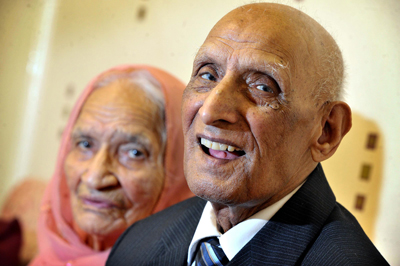
Indian-origin Karam Chand in world's longest marriage dies at 110

October 3, 2016

London, Oct 3: An Indian-origin man in the UK, believed to hold the record for the world's longest marriage, has died.

Karam Chand, 110, died of natural causes in hospital last week – just six weeks short of celebrating his 111th birthday.

KaramChand and his wife Kartari, 103, became celebrities last year following their 90th wedding anniversary. The couple never argued, according to their family.

They lived at home in Girlington, near Bradford, West Yorkshire, along with their son Paul – who was devastated at the death of his father, the metro.co.uk reported.

"We're absolutely devastated at his passing – not many people live to that age," Paul said.

Karam was born in 1905 into a farming family in Punjab during the British Raj, at a time when it took six weeks to reach India via the Suez Canal.

He had an arranged marriage to Kartari and they tied the knot in a Sikh ceremony in 1925. The couple came to Bradford in 1965 when Chand replaced his hard work as a farmer – with the city's woollen mills.

Their now four generation-strong family is huge stretching down from Karam and includes eight children, 27 grandchildren and dozens of great-grandchildren.

"Eat and drink what you want but in moderation. I have never held back from enjoying my life," Previously speaking about his life, Chand had said.

Chand had said he had given up his one cigarette a day – but still enjoyed an occasional tot of whisky.

"We have always eaten good wholesome food, there's nothing artificial in our diet but things like butter, milk and fresh yoghurt are what we like," he had said.

"We know that being married for 86 years is a blessing – but equally we will be ready to go when it's time. It's all up to the will of God, but we really have lived a good life," Chand had said.

Chand's death, last week means his marriage lasted 90 years and 291 days in total.

Although this was believed to be the world record it had never officially been recognised by Guinness World Records.

The oldest Guinness-recorded marriage is the 86-year union of American couple Herbert and Zelmyra Fisher, both of whom have since died.

The oldest man in the UK is an anonymous resident of Claygate, Surrey, who is 111, according to the website Oldest in Britain. The oldest British woman is Bessie Camm, of Rotherham, South Yorkshire, who is 112.

Comments

Add new comment

  • Coastaldigest.com reserves the right to delete or block any comments.
  • Coastaldigset.com is not responsible for its readers’ comments.
  • Comments that are abusive, incendiary or irrelevant are strictly prohibited.
  • Please use a genuine email ID and provide your name to avoid reject.
Agencies
May 14,2020

Social media platform WhatsApp assured the Supreme Court on Wednesday that it will not roll out its payment services without complying with all payment regulations and norms in the country.

A bench headed by Chief Justice S.A. Bobde and comprising Justices Indu Malhotra and Hrishikesh Roy took up the matter through video conferencing. Senior advocate Kapil Sibal, representing the social media platform, said "WhatsApp Inc makes a statement on behalf of his client that they will not go ahead with the payments' scheme without complying with all the regulations in force."

The statement was made during the hearing of a petition seeking a ban on payment through WhatsApp, as it does not conform to the data localization norms. The top court took the assurance made by WhatsApp on record.

WhatsApp made the statement during the hearing of a plea seeking a ban on its payment service, for not being in line with data localization norms.

In 2018, WhatsApp was granted a beta licence to launch its payment service, but a dedicated and separate app is yet to be launched. A petition was moved in the apex court that WhatsApp's existing model for its payments service should be declared inconsistent with the Unified Payment Interface (UPI) Scheme, as a separate dedicated app has not been offered by the company.

The petitioner NGO, Good Governance Chambers, argued that the National Payments Corporation of India (NPCI) and the Reserve Bank of India (RBI) must change its model on the lines of the UPI payment scheme, and its operations may be suspended until these conditions are met.

The apex court today asked the Centre, Facebook and WhatsApp to file their replies within three weeks and it will take up the matter thereafter. The court noted that the government may process the applications filed by WhatsApp in accordance with the law and there is no stay on the same. Facebook was represented by senior advocate Arvind Datar.

The petitioner argued that lapses have been found in relation to WhatsApp's claims of having a secure and safe technological interface for securing sensitive user data.

Comments

Add new comment

  • Coastaldigest.com reserves the right to delete or block any comments.
  • Coastaldigset.com is not responsible for its readers’ comments.
  • Comments that are abusive, incendiary or irrelevant are strictly prohibited.
  • Please use a genuine email ID and provide your name to avoid reject.
Agencies
February 27,2020

Feb 27: With the window to submit comments on India's proposed personal data protection law closing on Tuesday, a period of anxious wait for final version of the Bill started for social media firms.

This comes even as global Internet companies have called on the government for improved transparency related to intermediary Guidelines (Amendment) Rules and allay fears about the prospect of increased surveillance and prompting a fragmentation of the Internet in India that would harm users.

As per the proposed amendments, an intermediary having over 50 lakh users in the country will have to be incorporated in India with a permanent registered office and address.

When required by lawful order, the intermediary shall, within 72 hours of communication, provide such information or assistance as asked for by any government agency or assistance concerning security of the state or cybersecurity.

This means that the government could pull down information provided by platforms such as Wikipedia, potentially hampering its functioning in India.

In the open letter to IT Minister Ravi Shankar Prasad, leading browser and software development platform like Mozilla, Microsoft-owned GitHub and Cloudflare earlier called for improved transparency by allowing the public an opportunity to see a final version of these amendments prior to their enactment.

According to a Business Insider report, Indian users may lose access to Wikipedia if the new intermediary rules for internet and social media companies are approved.

Since the rules would require the website to take down content deemed illegal by the government, it would require Wikipedia to show different content for different countries.

Anusha Alikhan, senior communications director for Wikimedia told Business Insider that the platform is built though languages and not geographies. Therefore, removing content from one country, while it is still visible to other country users may not work for the company’s model.

India is one of Wikipedia’s largest markets. Over 771 million Indian users accessed the site in just November 2019.

Also read: Explained: What is the Personal Data Protection Bill and why you should care

The Personal Data Protection Bill, 2019, which was introduced in Lok Sabha in the winter session last year, was referred to a Joint Parliamentary Committee (JPC) of both the Houses.

The government last month decided to seek views and suggestions on the Bill from individuals and associations and bodies concerned and the last date for submitting the comments was on Tuesday.

Prasad, while introducing the Personal Data Protection Bill, 2019, in the Lok Sabha on December 11, announced that the draft Bill empowers the government to ask companies including Facebook, Google and others for anonymised personal data and non-personal data.

There was a buzz when the Bill's latest version was introduced in the Lok Sabha, especially the provision seeking to allow the use of personal and non-personal data of users in some cases, especially when national security is involved.

Several legal experts red-flagged the issue and said the provision will give the government unaccounted access to personal data of users in the country.

In their submission to the JPC, several organisations also flagged that the power to collect non-personal and anonymised data by the government without notice and consent should not form part of the Bill because of issues regarding effective anonymisation and potential abuse.

"Clauses 35 and 36 of the Bill provide unbridled access to personal data to the Central Government by giving it powers to exempt its agencies from the application of the Bill on the basis of various broad worded grounds," SFLC.in, a New Delhi-based not-for-profit legal services organisation, commented.

The Software Alliance, also known as BSA, a trade group which includes tech giants such as Microsoft, IBM and Adobe, among others said that the current version of the privacy bill pose substantial challenges, including the sweeping new powers for the government to acquire non-personal data, restrictions on data transfers, and local storage requirements.

"We urge the Joint Parliamentary Committee, as it considers revisions to the Bill, to eliminate provisions concerning non-personal data from the Personal Data Protection Bill and to remove the data localisation requirements and restrictions on international data flows," said Venkatesh Krishnamoorthy, Country Manager-India, BSA.

The Personal Data Protection (PDP) Bill, 2019 draws its origins from the Justice B.N. Srikrishna Committee on data privacy, which produced a draft of legislation that was made public in 2018 ("the Srikrishna Bill").

The mandatory requirement for storing a mirror copy of all personal data in India as per Section 40 of the Srikrishna Bill has been done away with in the PDP Bill, 2019, meaning that companies like Facebook and Twitter would be able to store data of Indian users abroad if they so wish.

But the bill prohibits processing of sensitive personal data and critical personal data outside India.

What is more, what constitutes critical data has not been clearly defined.

As per the proposals, social media companies will have to modify their application as they are required to have a system in place by which a user can verify themselves.

So legal experts believe that some system to upload identification documents should be there and something like the Twitter blue tick mark should be there to identify verified accounts.

"The 2019 Bill introduces a new category of data fiduciaries called social media intermediaries ('SMIs'). SMIs are a subcategory of significant data fiduciaries ('SDFs') and will be notified by the Central government after due consultation with the DPA, or the Data Protection Authority. Clause 26(4) of the Bill defines SMIs as intermediaries who primarily or solely enable online interaction between two or more users," SFLC.in said.

"On a plain reading of the definition, online platforms like Facebook, Twitter, YouTube, TikTok, ShareChat and WhatsApp are likely to be notified as SMIs under the Bill," it added.


Comments

Add new comment

  • Coastaldigest.com reserves the right to delete or block any comments.
  • Coastaldigset.com is not responsible for its readers’ comments.
  • Comments that are abusive, incendiary or irrelevant are strictly prohibited.
  • Please use a genuine email ID and provide your name to avoid reject.
Agencies
June 27,2020

Mumbai, Jun 27: The Bombay High Court observed that COVID-19 patients from poor and indigent sections cannot be expected to produce documentary proof to avail subsidised or free treatment while getting admitted to hospitals.

The court on Friday was hearing a plea filed by seven residents of a slum rehabilitation building in Bandra, who had been charged ₹ 12.5 lakh by K J Somaiya Hospital for COVID-19 treatment between April 11 and April 28.

The bench of Justices Ramesh Dhanuka and Madhav Jamdar directed the hospital to deposit ₹10 lakh in the court.

The petitioners had borrowed money and managed to pay ₹10 lakh out of ₹12.5 lakh that the hospital had demanded, after threatening to halt their discharge if they failed to clear the bill, counsel Vivek Shukla informed the court.

According to the plea, the petitioners were also overcharged for PPE kits and unused services.

On June 13, the court had directed the state charity commissioner to probe if the hospital had reserved 20% beds for poor and indigent patients and provided free or subsidised treatment to them.

Last week, the joint charity commissioner had informed the court that although the hospital had reserved such beds, it had treated only three poor or indigent persons since the lockdown.

It was unfathomable that the hospital that claimed to have reserved 90 beds for poor and indigent patients had treated only three such persons during the pandemic, advocate Shukla said.

He further argued that COVID-19 patients, who are in distress, cannot be expected to produce income certificate and such documents as proof.

However, senior advocate Janak Dwarkadas, who represented the hospital, said the petitioners did not belong to economically weak or indigent categories and had not produced documents to prove the same.

A person who is suffering from a disease like COVID-19 cannot be expected to produce certificates from a tehsildar or social welfare officer before seeking admission in the hospital, the bench noted and asked the hospital to deposit ₹10 lakh in court within two weeks.

Comments

Add new comment

  • Coastaldigest.com reserves the right to delete or block any comments.
  • Coastaldigset.com is not responsible for its readers’ comments.
  • Comments that are abusive, incendiary or irrelevant are strictly prohibited.
  • Please use a genuine email ID and provide your name to avoid reject.