


Indian origin MPs conspicuous by their absence at UK Kashmir debate

September 13, 2014

London, Sep 13: Out of the 10 odd MPs of Indian-origin in Britain's House of Commons, eight were missing from action in India's hour of need at a potentially embarrassing debate on the political and humanitarian situation in Kashmir in Britain's parliament Thursday afternoon.
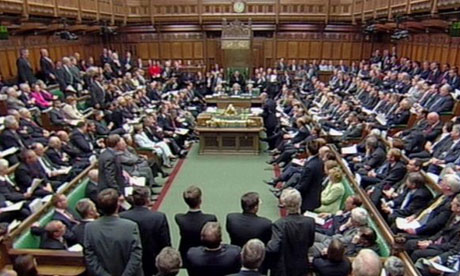
house-of-commonsThe two who were present were Virendra Sharma, an opposition Labour party MP who was present three years ago as well to speak in a debate on the same subject and Paul Uppal, a first time MP belonging to the ruling Conservative Party, who made his maiden appearance to defend India's corner.

His dig at his colleagues debating Kashmir was not without impact. "I cannot help but be struck by the irony that most of the contributors to this debate, although not all of them, have been white, middle-aged men talking about what we should be doing in such conflicts," he said.

As for Sharma, he was quite categorical. "Jammu and Kashmir is an integral part of India, the largest democracy in the world, one that is secular and with elected representation from all the country's main religions," he said.

"The elections in Jammu and Kashmir have not reflected any determination for separatism. It is for us to respect the democratic choice of the citizens of Jammu and Kashmir, not to question it," he added.

Keith Vaz of Labour is the longest serving MP of Indian-origin who has uninterruptedly been a member of the House of Commons for 27 years.

Yet he has not stood up to be counted on issues uncomfortable to India such as Kashmir either last time or on this occasion.

His sister Valerie Vaz (Labour), also an MP, was absent too, as were Alok Sharma (Conservative), Seema Malhotra (Labour) and Priti Patel (Conservative), among others. The last mentioned came to the committee room where the debate was being held for a few minutes, spent most of her time looking at or sending messages on her mobile phone and then departed without bothering to contribute to the discussion.

Patel's non-participation was surprising because she was supposed to be the "UK India Diaspora Champion", as appointed by British Prime Minister David Cameron.

On the other hand, "white, middle-aged" he may be, but Greg Barker, minister for business engagement with India, was not only one of the debaters, he frequently rebutted baseless criticism of India and in his speech itself remarked: "Jihadi elements and terrorists are infiltrating into India from Pakistan as part of a terror campaign... (Indian) Soldiers are there not simply to intimidate but to protect the integrity of not only Jammu and Kashmir but the whole Indian nation, which has been subject to vile terrorist attacks."

He concluded by saying: "We in Westminster should concern ourselves with forging a new relationship that looks firmly to the future, not with the internal affairs of that great democracy (India)."

Although the MPs of Indian descent did not show up when it mattered, Pakistan's attempt to get British MPs to censure India on Kashmir backfired as lawmakers who are indigenous Britons turned up in strength to demonstrate their solidarity with India. The pro-Pakistan speakers were, thus, squeezed into a minority.

Comments

Add new comment

  • Coastaldigest.com reserves the right to delete or block any comments.
  • Coastaldigset.com is not responsible for its readers’ comments.
  • Comments that are abusive, incendiary or irrelevant are strictly prohibited.
  • Please use a genuine email ID and provide your name to avoid reject.
News Network
April 26,2020

Washington/Seoul, Apr 26: A special train possibly belonging to North Korean leader Kim Jong Un was spotted this week at a resort town in the country, according to satellite images reviewed by a Washington-based North Korea monitoring project, amid conflicting reports about Mr. Kim's health and whereabouts.

The monitoring project, 38 North, said in its report on Saturday that the train was parked at the “leadership station” in Wonsan on April 21 and April 23. The station is reserved for the use of the Kim family, it said.

Though the group said it was probably Kim Jong Un's train, Reuters has not been able to confirm that independently, or whether he was in Wonsan.

“The train's presence does not prove the whereabouts of the North Korean leader or indicate anything about his health but it does lend weight to reports that Kim is staying at an elite area on the country's eastern coast,” the report said.

Speculation about Mr. Kim's health first arose due to his absence from the anniversary of the birthday of North Korea's founding father and Mr. Kim's grandfather, Kim Il Sung, on April 15.

North Korea's state media last reported on Mr. Kim's whereabouts when he presided over a meeting on April 11.

China has dispatched a team to North Korea including medical experts to advise on Kim Jong Un, according to three people familiar with the situation.

A third-generation hereditary leader who came to power after his father's death in 2011, Kim has no clear successor in a nuclear-armed country, which could present major international risk.

On Thursday, U.S. President Donald Trump downplayed reports that Mr. Kim was ill. “I think the report was incorrect,” Mr. Trump told reporters, but he declined to say if he had been in touch with North Korean officials.

Mr. Trump has met Mr. Kim three times in an attempt to persuade him to give up a nuclear weapons program that threatens the United States as well as its Asian neighbors. While talks have stalled, Mr. Trump has continued to hail Mr. Kim as a friend.

Reporting from inside North Korea is notoriously difficult because of tight controls on information.

A Trump administration official said continuing days of North Korean media silence on Mr. Kim's whereabouts had heightened concerns about his condition, and that information remained scant from a country U.S. intelligence has long regarded as a ”black box.”

The U.S. State Department did not immediately respond to questions about the situation on Saturday.

Daily NK, a Seoul-based website that reports on North Korea, cited one unnamed source in North Korea on Monday as saying that Kim had undergone medical treatment in the resort county of Hyangsan north of the capital Pyongyang.

It said that Mr. Kim was recovering after undergoing a cardiovascular procedure on April 12.

Since then, multiple South Korean media reports have cited unnamed sources this week saying that Mr. Kim might be staying in the Wonsan area.

On Friday, local news agency Newsis cited South Korean intelligence sources as reporting that a special train for Mr. Kim's use had been seen in Wonsan, while Mr. Kim's private plane remained in Pyongyang.

Newsis reported Mr. Kim may be sheltering from COVID-19, the respiratory disease caused by the novel coronavirus.

Mr. Kim, believed to be 36, has disappeared from coverage in North Korean state media before. In 2014, he vanished for more than a month and North Korean state TV later showed him walking with a limp.

Speculation about his health has been fanned by his heavy smoking, apparent weight gain since taking power and family history of cardiovascular problems.

Comments

Add new comment

  • Coastaldigest.com reserves the right to delete or block any comments.
  • Coastaldigset.com is not responsible for its readers’ comments.
  • Comments that are abusive, incendiary or irrelevant are strictly prohibited.
  • Please use a genuine email ID and provide your name to avoid reject.
News Network
May 27,2020

Washington, May 27: Most viruses and other germs do not spread easily on flights, the US Center for Disease Control and Prevention has said in its COVID-19 guidelines which do not recommend following social distancing between two passengers inside a plane or keeping the middle seat unoccupied.

As a result of coronavirus pandemic, air traffic inside the US has come to a near halt. Air traffic is said to be down to about 90 per cent. For all travellers coming from overseas, the Center for Disease Control and Prevention (CDC) has recommended 14 days quarantine.

"Most viruses and other germs do not spread easily on flights because of how air circulates and is filtered on aeroplanes," the CDC has said in its set of COVID-19 guidelines for air travellers.

However, it noted that the air travellers were not risk-free especially in the time of the coronavirus pandemic and recommended Americans to avoid travel as far as possible.

"Air travel requires spending time in security lines and airport terminals, which can bring you in close contact with other people and frequently touched surfaces," it said.

"Social distancing is difficult on crowded flights, and you may have to sit near others (within six feet), sometimes for hours. This may increase your risk for exposure to the virus that causes COVID-19," the CDC said.

But instead of recommended social distancing inside commercial planes, the CDC has advised a series of preventive and hygienic measures to be taken by the airlines pilot and crew to prevent the spread of coronavirus.

The US Department of Transportation and Federal Aviation Administration in its latest safety alerts for operators on May 11 said that air carriers and crews conducting flight operations having a nexus to the US, including both domestic and foreign air carriers, should follow CDC's occupational health and safety guidance.

The CDC issued its guidelines in first guidelines for the airlines and airline crew on March and again in May.

The CDC, which has issued an exhaustive social guideline measures in various sections, is silent on keeping the middle seat of a plane unoccupied so as to maintain the six feet distance between two passengers.

It calls for the plane crew to report to the CDC a traveller with specific COVID-19 symptoms like fever, persistent cough, difficulty in breathing and appearing unwell.

Asking the airlines and cabin crew to review infection control guidelines for cabin crew, the CDC recommends several measures for cabin crew to protect themselves and others, manage a sick traveller, clean contaminated areas, and take actions after a flight.

Prominent among them include washing hands often with soap and water for at least 20 seconds, particularly after assisting sick travellers or touching potentially contaminated body fluids or surfaces and use of alcohol-based hand sanitizer (containing at least 60 per cent alcohol) if soap and water are not available.

Airlines should consider providing alcohol-based hand sanitizer to cabin and flight crews for their personal use, it said.

The CDC guidelines do not recommend following social distancing inside a plane between two passengers or keeping the middle seat unoccupied. But it asks to minimise contact between passengers and cabin crew and the sick person.

"If possible, separate the sick person from others (by a distance of 2 meters or 6 feet, ideally) and designate one crew member to serve the sick person. Offer a facemask, if available and if the sick person can tolerate it. If a facemask is not available or cannot be tolerated, ask the sick person to cover their mouth and nose with tissues when coughing or sneezing," said the CDC guidelines.

If no symptomatic passengers were identified during or immediately after the flight, the CDC recommends airlines to follow routine operating procedures for cleaning aircraft, managing solid waste, and wearing PPE.

"If symptomatic passengers are identified during or immediately after the flight, routine cleaning procedures should be followed, and enhanced cleaning procedures should also be used," it said.

Clean porous (soft) surfaces (e.g, cloth seats, cloth seat belts) at the seat of the symptomatic passengers and within 6 feet of the symptomatic passengers in all directions, it added.

Comments

Add new comment

  • Coastaldigest.com reserves the right to delete or block any comments.
  • Coastaldigset.com is not responsible for its readers’ comments.
  • Comments that are abusive, incendiary or irrelevant are strictly prohibited.
  • Please use a genuine email ID and provide your name to avoid reject.
Agencies
February 7,2020

Washington DC, Feb 7: United States on Thursday asked all countries to speak out against mistreatment of Muslims living in China especially in Xinjiang region by Chinese authorities.

Alice G. Wells, Principal Deputy Assistant Secretary for the Bureau of South and Central Asian Affairs, while talking to reporters appreciated the steps taken by Central Asian states to ensure that no ethnic Kazakh, Uighur, Kyrgyz is refouled to China and that the human rights of individuals who reach Central Asia are observed.

"As a matter of principle we urge all countries, not just Central Asian countries, to speak out against human rights abuses that are evident against Muslims in all of China but certainly in Xinjiang. And the countries of Central Asia, several of the countries of Central Asia have deep first-hand knowledge of those abuses given the direct impact it has on their own populations who have loved ones, family members, that are swept up in these detention centers," Wells said.

"We appreciate steps by Central Asian states to ensure that no ethnic Kazakh, Uighur, Kyrgyz is refouled to China, that the human rights of individuals who reach Central Asia are observed. And we also appreciate I think what countries like Kazakhstan can do to promote the free and safe travel of compatriots, ethnic compatriots across the border," she added.

China has been accused of oppressing the Uighurs by sending them to mass detention camps, interfering in their religious activities and sending the community to undergo some form of forceful re-education or indoctrination. However, Pakistan has stayed mum over this issue.

As many as 1 million people, or about 7 per cent of Xinjiang's Muslim population, have been incarcerated in a sprawling network of "political re-education" camps, according to US and UN studies.

In 2018, the New York-based Human Rights Watch released a report accusing Beijing of a "systematic campaign of human rights violations" against Uighur Muslims in Xinjiang.

Beijing says its camps in Xinjiang are "vocational training centres."

Last year, several documents leaked revealed details about Beijing's fears about religious extremism and its wholesale crackdown on Uighurs.

The US had called on the Chinese government to "immediately release all of those who are arbitrarily detained and to end its draconian policies that have terrorised its own citizens in Xinjiang."

Comments

Add new comment

  • Coastaldigest.com reserves the right to delete or block any comments.
  • Coastaldigset.com is not responsible for its readers’ comments.
  • Comments that are abusive, incendiary or irrelevant are strictly prohibited.
  • Please use a genuine email ID and provide your name to avoid reject.