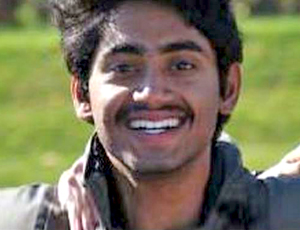
Indian-origin student missing since Wednesday found dead in US

May 20, 2017

New York, May 20: A 20-year-old Indian-origin Cornell University student was found dead here after going missing this week.

aalaapaAalaap Narasipura, asenior electrical engineering student at Cornell's College of Engineering was reported missing since Wednesday.

Cornell University Police, working with the New York State Police, the Ithaca Police Department and the Ithaca Fire Department, recovered his body yesterday from Fall Creek, a short distance upstream from Ithaca Falls.

Cornell University Police confirmed Narasipura's identity. Police said the circumstances of Narasipura's death are still under investigation, but no foul play is suspected. No other information is available at this time.

Police had searched gorges and adjacent natural areas in Ithaca. Earlier authorities had issued an advisory describing Narasipura as a dark-skinned male, 5-feet-9 inches tall.

He was last seen in the early morning of May 17 on Cornell's campus and was wearing shorts and a flannel shirt with bright blue socks and leather sandals. Vice President for Student and Campus Life Ryan Lombardi expressed"profound sadness" at the death of Narasipura.

He described Narasipura as an "ambitious student" who was scheduled to graduate early this December.

"He was active on the Ultimate Frisbee team, enjoyed taking photos, and planned to continue at Cornell to pursue a Master of Engineering degree," he said in a statement.

Comments

Add new comment

  • Coastaldigest.com reserves the right to delete or block any comments.
  • Coastaldigset.com is not responsible for its readers’ comments.
  • Comments that are abusive, incendiary or irrelevant are strictly prohibited.
  • Please use a genuine email ID and provide your name to avoid reject.
News Network
January 23,2020

Jan 23: Hundreds of Central Americans trying to reach the United States were stuck at the Mexico-Guatemala border on Wednesday after the Mexican government beefed up security to meet US demands to contain migrant flows.

Under sustained pressure from President Donald Trump, Mexico's government has adopted tougher measures to reduce the number of people heading towards the U.S. border.

Migrants in Tecun Uman, on the Guatemalan side of the border, were taken by surprise.

"We thought we'd be allowed through just like with the October caravan when they reached Tijuana," said Honduran migrant Ritzy Anabel, who did not give her surname.

"People from Mexico and Guatemala treated them well. But now it's changed because Mexicans don't want (us) to enter."

Many Central Americans migrants heading north are fleeing economic hardship and violence at home. A large caravan of migrants crossed into Mexico and went north in October 2018. Migrants crossing into Mexico earlier this week faced tear gas from security forces, who delivered a firmer response than in previous mass movements at the border.

Even so, about 1,000 migrants, most of them from Honduras, managed to reach Mexican soil on Tuesday. Mexican Foreign Minister Marcelo Ebrard said several hundred of the new arrivals were immediately deported on planes and buses.

On Wednesday, Mexican authorities said that 460 Honduran migrants were deported throughout the day. Other migrants from the group, including families traveling with children, were pondering their next moves.

Honduran Carlos Amador said that while some of his compatriots were returning home, others were hoping for positive news.

Trump has repeatedly threatened to punish Mexico and Central American countries if they fail to clamp down on the migrant flows. That has resulted in a series of agreements aimed at delivering on Trump's campaign promises to curb immigration.

Department of Homeland Security Acting Secretary Chad Wolf called the measures put in place by the Mexican National Guard "effective", adding that dozens of his personnel was on the ground in Central America assisting local immigration and security officials. Trump tweeted: "Sorry, if you come you will be immediately sent back!"

Comments

Add new comment

  • Coastaldigest.com reserves the right to delete or block any comments.
  • Coastaldigset.com is not responsible for its readers’ comments.
  • Comments that are abusive, incendiary or irrelevant are strictly prohibited.
  • Please use a genuine email ID and provide your name to avoid reject.
Agencies
June 13,2020

Washington, Jun 13: America's first-ever Hindu lawmaker Tulsi Gabbard has said that in this chaotic time, one can find certainty, strength, and peace in Bhagavad Gita.

In her message during a virtual commencement address, the 39-year-old Congresswoman from Hawaii said that it is a chaotic time and no one can say with certainty what tomorrow looks like.

"... but we find certainty, strength, and peace in the practice of Bhakti Yoga and Karma Yoga taught to us by Krishna in the Bhagavad Gita," Tulsi Gabbard told the 'Class of 2020 for Hindu students''.

Her address came amidst protests in the US against the killing of African-American George Floyd by a white police officer in Minneapolis.

The country has been swept by protests since George Floyd's custodial death on May 25 with thousands of people mounting pressure for changes to the law enforcement practices.

The first-ever virtual Hindu commencement was organised by the Hindu Students Council on June 7, which drew thousands of viewers on Facebook and YouTube Live, all coming together in solidarity during the ongoing COVID-19 crisis.

According to Johns Hopkins Coronavirus Resource Center, the contagion has infected over 76,00,000 people and killed more than 4,25,000 across the world. The US is the worst affected country with over 2.04 million cases and more than 1,14,000 deaths.

The COVID-19, which originated in China''s Wuhan city in December last year, has also battered the world economy with the International Monetary Fund saying that the global economy is bound to suffer a "severe recession".

Scientists are racing against time to find a vaccine or medicine for its treatment.

Hundreds of graduates from the US, Canada, the UK, India and Australia attended to commemorate their graduation in a unique way - by celebrating their shared Hindu values.

Professor Subhash Kak served as the ceremony's Grand Marshall.

"As you think about this new chapter in your lives, ask yourself what is my purpose in life? It is a deep question that if you can recognise now that your purpose is to serve God and God''s children, practicing Karma Yoga, then you can lead a truly successful life," Tulsi Gabbard said.

"Success is not defined by temporary material things, trinkets, glittery objects or accomplishments - but a deeply successful and happy life centered around service," she added.

The Iraq war veteran ended her presidential campaign in March and offered her full support to former vice president Joe Biden, 77, who is all set to challenge Republican incumbent Donald Trump, 73, in November elections.

The commencement address focused heavily on themes from the Bhagavad Gita, a timeless historical text that many Hindus consider their moral framework.

Professor Kak, Regent Professor at Oklahoma State University and 2019 Padma Shri recipient, read out the names of the graduating students.

"I exhort you - the graduating students - to be the leaders of the new world where education is less of the mind of a vessel to be filled with information (usually forgotten after the semester is over), and more of a flame that is lit as envisioned by our Vedic sages," he said.

The student speakers were from many university campuses, including the Massachusetts Institute of Technology, Princeton, and Stanford.

Listen to the latest songs, only on JioSaavn.com

The programme included offerings of Hindu prayers, recitation of a traditional graduation message from the Upanishads, and a symbolic conferral of degrees to high school and college graduate.

Founded in 1990, Hindu Students Council is North America''s largest pan-Hindu youth organisation. 

Comments

Add new comment

  • Coastaldigest.com reserves the right to delete or block any comments.
  • Coastaldigset.com is not responsible for its readers’ comments.
  • Comments that are abusive, incendiary or irrelevant are strictly prohibited.
  • Please use a genuine email ID and provide your name to avoid reject.
News Network
June 4,2020

Jun 4: A malaria drug President Donald Trump took to try to prevent COVID-19 proved ineffective for that in the first large, high-quality study to test it in people in close contact with someone with the disease.

Results published Wednesday by the New England Journal of Medicine show that hydroxychloroquine was no better than placebo pills at preventing illness from the coronavirus.

The drug did not seem to cause serious harm, though -- about 40% on it had side effects, mostly mild stomach problems.

 “We were disappointed. We would have liked for this to work,” said the study leader, Dr. David Boulware, an infectious disease specialist at the University of Minnesota.

“But our objective was to answer the question and to conduct a high-quality study,” because the evidence on the drug so far has been inconclusive, he said.

Hydroxychloroquine and a similar drug, chloroquine, have been the subject of much debate since Trump started promoting them in March.

Hydroxychloroquine has long been used for malaria, lupus, and rheumatoid arthritis, but no large studies have shown it or chloroquine to be safe or effective for much sicker patients with coronavirus, and some studies have suggested the drugs may do harm.

Trump took a two-week course of hydroxychloroquine, along with zinc and Vitamin D, after two staffers tested positive for COVID-19, and had no ill effects, according to results of his latest physical released by his doctor Wednesday.

Federal regulators have warned against hydroxychloroquine's use except in hospitals and formal studies because of the risk of side effects, especially heart rhythm problems.

Boulware's study involved 821 people in the United States and Canada living with someone diagnosed with COVID-19 or at high risk of getting it because of their job -- doctors, nurses, ambulance workers who had significant exposure to a sick patient while not wearing full protective gear.

They were randomly assigned to get either the nutrient folate as a placebo or hydroxychloroquine for five days, starting within four days of their exposure. Neither they nor others involved in the research knew who was getting which pills.

After 14 days in the study, 12 per cent on the drug developed COVID-19 symptoms versus 14 per cent in the placebo group, but the difference is so small it could have occurred by chance, Boulware said.

“There's basically no effect. It does not prevent infection,” he said of the drug. Even if it were to give some slim advantage, “we'd want a much larger effect” to justify its use and risk of side effects for preventing illness, he said.

Results were no different among a subgroup of participants who were taking zinc or vitamin C, which some people believe might help make hydroxychloroquine more effective or fight the coronavirus.

There are some big caveats: The study enrolled people through the Internet and social media, relying on them to report their own symptoms rather than having them tracked in a formal way by doctors.

Participants were not all tested for the coronavirus but were diagnosed as COVID-19 cases based on symptoms in many cases. And not all took their medicines as directed.

The results “are more provocative than definitive,” and the drug may yet have prevention benefits if tried sooner or in a different way, Dr. Myron Cohen of the University of North Carolina at Chapel Hill wrote in a commentary in the journal.

Others were glad to see a study that had a comparison group and good scientific methods after so many weaker reports on hydroxychloroquine.

“This fits with everything else we've seen so far which suggests that it's not beneficial," said Dr. Peter Bach, director of a health policy center at Memorial Sloan Kettering Cancer Center in New York.

This study was in younger relatively healthy people, but the results “would make me very discouraged about trying to use this in older people” who are most vulnerable to serious illness from the coronavirus, Bach said.

“If it does work, it doesn't work very well.” Dr. Dan Culver, a lung specialist at the Cleveland Clinic, said there's still a chance that giving the drug sooner than four days after someone's exposure to the virus may help prevent illness.

But the study “takes 'home run' off the table” as far as hopes for the drug, he said.

The study was mostly funded by David Baszucki, founder of Roblox, a California-based game software company, and other private donors and the Minnesota university.

Boulware also is leading a study testing hydroxychloroquine for treating COVID-19. The study is finished and results are being analyzed now.

On Tuesday, the journal Lancet posted an “expression of concern” about a study it published earlier this month of nearly 15,000 COVID-19 patients on the malaria drugs that tied their use to a higher risk of dying in the hospital or developing a heartbeat problem.

Scientists have raised serious questions about the database used for that study, and its authors have launched an independent audit.

That work had a big impact: the World Health Organization suspended use of hydroxychloroquine in a study it is leading, and French officials stopped the drug's use in hospitals. On Wednesday, the WHO said experts who reviewed safety information decided that its study could resume.


Comments

Add new comment

  • Coastaldigest.com reserves the right to delete or block any comments.
  • Coastaldigset.com is not responsible for its readers’ comments.
  • Comments that are abusive, incendiary or irrelevant are strictly prohibited.
  • Please use a genuine email ID and provide your name to avoid reject.