



Indian-origin woman sells home for 2 pounds

January 31, 2017

London, Jan 31: A 43-year-old Indian-origin teacher in the UK has sold her home, which has a market value of 250,000 pounds, for a token of mere 2 pounds to ensure that she cannot be evicted from the property.
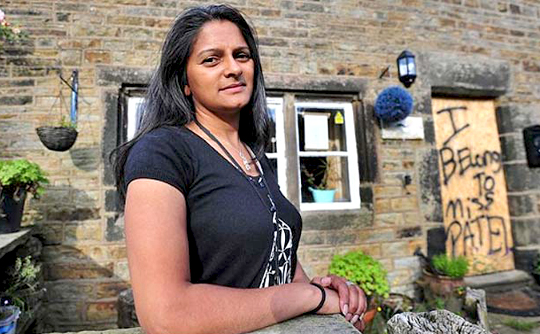
rekha

Rekha Patel has been locked in a feud with her neighbour over some building work dating back six years on the home. She spent 200,000 pounds buying the dilapidated two-bedroom cottage in 2010 in Simmondley village in Glossop and turning it into her dream home.

A court order had directed that the home be sold to recover legal fees and costs of around 76,000 pounds.

"I realised I will have more rights as a tenant than the owner so I decided to sever all legal ties with the house in order to live in peace in my own home," she said.

She sold the home, built in the early 18th century, to two private companies recently and has signed a 10-year tenancy agreement with them to carry on living in the property for a monthly rent of 50 pounds.

"I had tried everything possible and had no other choice. There are proper agreements in place with the two private companies and these are people I trust. The people of this village have been absolutely lovely. Many have taken days off work to come out and support me," she said.

Patel, who was born in the UK to an Indian family from Navsari in Gujarat, got embroiled in a dispute with her next door neighbour over some roof stones that got damaged during renovation work on the two-bedroom house, which has a market value of 250,000 pounds.

The dispute landed in court, which ordered Patel to pay damages and legal costs to her neighbour. While she paid part of the amount, Patel disputes the remaining bill imposed on her.

She was evicted from her home in June last year over non-payment but re-entered a month later and has since been fighting against a court order for her home to be sold. She applied for the legal bill to be quashed by Manchester County Court last week.

"I feel the justice system needs to be fairer and accessible to everyone. I want to now put this entire matter behind me and move on. I want to travel to India and try and work on a book that would help educate others who get caught in a similar situation of being scared out of their own homes," said the maths teacher, who works at Glossopdale Community College in Glossop.

"Forgiveness is the way forward. It is between her and her conscience, she knows what she did was not right," she said, in reference to her neighbour.

Comments

Add new comment

  • Coastaldigest.com reserves the right to delete or block any comments.
  • Coastaldigset.com is not responsible for its readers’ comments.
  • Comments that are abusive, incendiary or irrelevant are strictly prohibited.
  • Please use a genuine email ID and provide your name to avoid reject.
Agencies
May 22,2020

Kochi, May 22: During the nationwide COVID-19 lockdown, Kerala recorded the highest number of cyber attacks followed by Punjab and Tamil Nadu, a study by anti-virus software firm K7 Computing said on Thursday.

In a statement issued in Chennai, the company said its K7 Computing's Cyber Threat Report, a comprehensive analysis of cyber attacks during the lockdown has found that Kerala recorded the highest number of cyber attacks during this period. The report analyses various cyber attacks within India during the pandemic and reveals that threat actors targeted the state with COVID-themed attacks aimed at exploiting user trust.

In Kerala, regions like Kottayam, Kannur, Kollam, and Kochi saw the highest hits with 462, 374, 236, and 147 attacks respectively, while the state as a whole saw around 2,000 attacks during the period - the highest thus far in the country.

This was followed by Punjab with 207 attacks and Tamil Nadu with 184 attacks, the company said.

The sudden surge in the frequency of attacks witnessed from February 2020 to mid-April 2020 indicates that scamsters across the world were exploiting the widespread panic around coronavirus at both the individual and corporate level.

These attacks aimed to compromise computers and mobile devices to gain access to users' confidential data, banking details, and cryptocurrency accounts.

The key threats seen during this period ranged from phishing attacks to rogue apps disguised as COVID-19 information apps that targeted users' sensitive data. Phishing attacks were noticed more in Tier-II and Tier-III cities while the metros fared better. Smaller cities saw over 250 attacks being blocked per 10,000 users.

Users from Ghaziabad and Lucknow seem to have faced almost 6 and 4 times the number of attacks as Bengaluru users.

According to the statement, a majority of the recorded attacks were phishing attacks with sophisticated campaigns that could easily snare even the most educated users. These attacks were aimed at heightening users' fears and creating a sense of urgency to take action.

K7 Labs noticed phishing attacks where scamsters posed as representatives of the United States Department of Treasury, the World Health Organization (WHO), and the Centres for Disease Control and Prevention (CDC), the company said.

Users were encouraged to visit links that would automatically download malware on the host computer such as the Agent Tesla keylogger or Lokibot information-stealing malware, infamous banking Trojans such as Trickbot or Zeus Sphinx, and even disastrous ransomware.

Other attacks included infected COVID-19 Android apps like CoronaSafetyMask that scam users with promises of masks for an upfront payment; the spyware app Project Spy; and seemingly genuine apps that are infected with dangerous malware like banking Trojans such as Ginp, Anubis and Cerberus.

"Covid-19 has created an ideal situation for various threat actors to target individuals and enterprises alike. The panic caused by the stringent lockdown measures and rapid spread of this virus has left many people looking for more information on the situation," J. Kesavardhanan, Founder and CEO of K7 Computing was quoted as saying in the statement.

"Threat actors exploit this fear to their advantage and scam users into downloading malicious software and divulging sensitive information like banking codes. The need to be cyber cautious has never been greater. This is more so in the case of corporates who have adopted a work from home policy hurriedly without adequate cyber hygiene. We have seen an increase in attacks on enterprises and SME employees as well," he added.

Such attacks are expected to continue till normalcy returns. Social engineering attacks targeted at winning users' trust will gain momentum.

Healthcare institutions, well-known government offices, and international organisations will continue to be a prime target throughout the pandemic, the statement said.

Comments

Add new comment

  • Coastaldigest.com reserves the right to delete or block any comments.
  • Coastaldigset.com is not responsible for its readers’ comments.
  • Comments that are abusive, incendiary or irrelevant are strictly prohibited.
  • Please use a genuine email ID and provide your name to avoid reject.
Agencies
January 3,2020

Giving each and every app access to personal information stored on Android smartphones such as your contacts, call history, SMS and photos may put you in trouble as bad actors can easily use these access to spy on you, send spam messages and make calls anywhere at your expense or even sign you up for a premium "service", researchers from cybersecurity firm Kaspersky have warned.

But one can restrict access to such information as Android lets you configure app permissions. 

Giving an app any of these permissions generally means that from now on it can obtain information of this type and upload it to the Cloud without asking your explicit consent for whatever it intends to do with your data.

Therefore, security researchers recommend one should think twice before granting permissions to apps, especially if they are not needed for the app to work. 

For example, most games have no need to access your contacts or camera, messengers do not really need to know your location, and some trendy filter for the camera can probably survive without your call history, Kaspersky said. 

While decision to give permission is yours, the fewer access you hand out, the more intact your data will be.

Here's what you should know to protect your data.

SMS: An app with permission to send and receive SMS, MMS, and WAP (Wireless Application Protocol) push messages, as well as view messages in the smartphone memory will be able to read all of your SMS correspondence, including messages with one-time codes for online banking and confirming transactions.

Using this permission, the app can also send spam messages in your name (and at your expense) to all your friends. Or sign you up for a premium "service." You can see and conrol which apps have these rights by going to the settings of your phone.

Calendar: With permission to view, delete, modify, and add events in the calendar, prying eyes can find out what you have done and what you are doing today and in the future. Spyware loves this permission.

Camera: Permission to access the camera is necessary for the app to take photos and record video. But apps with this permission can take a photo or record a video at any moment and without warning. Attackers armed with embarrassing images and other dirt on you can make life a misery, according to Kaspersky.

Contacts: With permission to read, change, and add contacts in your address book, and access the list of accounts registered in the smartphone, an app can send your entire address book to its server. Even legitimate services have been found to abuse this permission, never mind scammers and spammers, for whom it is a windfall.

This permission also grants access to the list of app accounts on the device, including Google, Facebook, and many other services.

Phone: Giving access to your phone means permission to view and modify call history, obtain your phone number, cellular network data, and the status of outgoing calls, add voicemail, access IP telephony services, view numbers being called with the ability to end the call or redirect it to another number and call any number.

This permission basically lets the app do anything it likes with voice communication. It can find out who you called and when or prevent you from making calls (to a particular number or in general) by constantly terminating calls. 

It can eavesdrop on your conversations or, of course, make calls anywhere at your expense, including to pay-through-the-nose numbers, Kaspersky warned.

Comments

Add new comment

  • Coastaldigest.com reserves the right to delete or block any comments.
  • Coastaldigset.com is not responsible for its readers’ comments.
  • Comments that are abusive, incendiary or irrelevant are strictly prohibited.
  • Please use a genuine email ID and provide your name to avoid reject.
Agencies
April 17,2020

New Delhi, Apr 17: The Indian Railways turned 167 years old on Thursday and for the first time ever, its trains did not carry any passengers on its birthday and instead stood idle in the yards waiting for the nationwide lockdown to end.

On this day 167 years ago, the wheels of the first passenger train in the country from Mumbai to Thane started rolling.

In 1974, Indians experienced life without trains for the first time. In May 1974 during the strike of the railways that lasted for around three weeks, drivers, station masters, guards, track staff and many others went on 'chakka jam' demanding fixed working hours for train drivers and an across-the-board pay hike.

"I can recall those times vividly. I remember that our leader George Fernandes had almost secured a deal with the then railway minister, but it fell through when it was taken to the then Prime Minister Indira Gandhi," All India Railwaymens Federation General Secretary Shiv Gopal Mishra, who was an apprentice in the railways at that time, told PTI.

"Fernandes was arrested in Lucknow. The workers went through a lot at that time. But those were days that angry workers had refused to give in and took great risks to get their demands met," he said.

However, just like this time, four decades ago too freight trains carrying essential supplies were run and the unions agreed to let some passenger trains run on the trunk routes like the Kalka Mail from Howrah to Delhi.

"Never ever in its history, there has been such a long interruption of services. Not during the World Wars, not during the 1974 railway strike, or any other national calamity or natural disaster," a railway spokesperson said.

The first Indian Railways passenger train was flagged off on April 16, 1853, from Mumbai to nearby Thane.

On Thursday, the Railway Ministry wished the railways a happy birthday on Twitter - "Today, 167 years ago with the zeal of 'never to stop' the wheels of the first passenger train from Mumbai to Thane started rolling. For the first time, passenger services are stopped for your safety. Stay indoors & make the nation victorious," it said.

Railway has suspended all passenger services since March 25 till May 3 due to the coronavirus outbreak. Around 15,523 trains run by the railways have been affected including 9,000 passenger trains and 3,000 mail express services which are run daily. It caters to over 20 million passengers every day.

According to the Union health ministry, the death toll due to coronavirus rose to 414 and the number of cases to 12,380 in the country on Thursday.

Comments

Add new comment

  • Coastaldigest.com reserves the right to delete or block any comments.
  • Coastaldigset.com is not responsible for its readers’ comments.
  • Comments that are abusive, incendiary or irrelevant are strictly prohibited.
  • Please use a genuine email ID and provide your name to avoid reject.