



Indian peacekeepers prevented more casualties in S Sudan: UN official

December 22, 2013

Indian_peacekeepers

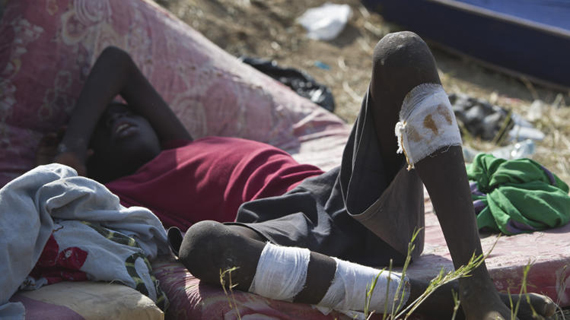
United Nations, Dec 22: The bravery of 43 Indian peacekeepers stationed at a UN base in South Sudan, which was attacked by about 2,000 rebels this week, prevented more casualties, a top UN official said as she lauded the dedication shown by Indian troops in peacekeeping missions.

Two Indian soldiers Warrant Officers Dharmesh Sangwan and Kumar Pal Singh were killed in the December 19 attack on the UN base in the Jonglei state town of Akobo in South Sudan.

A third soldier Indian Battalion Warrant Officer Mondal Shabul was wounded in the chest during the attack and was flown to Malakal where he was?reported to be in stable condition.

The UN Mission in South Sudan (UNMISS) held a memorial ceremony in Juba yesterday for the two Indian Battalion peacekeepers killed in the attack.

Special Representative of the UN Secretary-General (SRSG) for South Sudan Hilde Johnson paid tribute to Sangwan and Singh as "brave and courageous soldiers"?and extended her condolences to the families and loved ones of the fallen peacekeepers.

"As a mission, we are inspired by the dedication shown by the Indian troops," said Johnson, who laid wreaths on the coffins of the slain peacekeepers during the ceremony which was held at the Mission's compound adjacent to Juba International Airport.

"Had it not been for their bravery, the death toll at the (UNMISS base) could have been higher."

Johnson cited the press statement of the Security Council which condemned the attack in the strongest terms and called on the Government of South Sudan to swiftly investigate the incident.

She also emphasised the resolve of the peacekeeping mission to carry out its mandate to support South Sudan and help protect its people.

"This horrendous act...Will not stop us from carrying out our work," she said.

"To anyone who wants to threaten us, attack us or put obstacles in our way, our message remains loud and clear: we will not be intimidated."

South Sudan's Minister of Foreign Affairs and International Cooperation Barnaba Marial Benjamin reaffirmed his government's commitment to fully investigate the incident and bring the perpetrators to justice.

"The people of South Sudan deeply regret the irresponsible and cowardly act that has led to the loss of life of these great soldiers," Benjamin said.

Comments

Add new comment

  • Coastaldigest.com reserves the right to delete or block any comments.
  • Coastaldigset.com is not responsible for its readers’ comments.
  • Comments that are abusive, incendiary or irrelevant are strictly prohibited.
  • Please use a genuine email ID and provide your name to avoid reject.
News Network
February 1,2020

Washington, Feb 1: The Indian economy experienced some abrupt slowdown in 2019 due to turbulence in non-banking financial institutions and major reform measures such as GST and demonetisation, but it is not in a recession, IMF Managing Director Kristalina Georgieva has said.

"The Indian economy indeed has experienced an abrupt slowdown in 2019. We had to revise our growth projections, downwards to four percent for last year. We are expecting 5.8 per cent (growth rate) in 2020 and then an upward trajectory to 6.5 percent in 2021," Georgieva told a group of foreign journalists here on Friday.

"It appears that the main reason for this slowdown was the non-banking financial institutions experiencing a turbulence," she said on the eve of Union Finance Minister Nirmala Sitharaman presenting the annual budget in Parliament on Saturday.

She said India had undertaken some important reforms that over the longer term would be beneficial for the country, but they do have some short-term impact.

"For example, coming with the unified tax system, and the demonetisation that took place. These are steps that over time are beneficial, but of course they might, might be somewhat disruptive over short term," Georgieva said in response to a question.

The International Monetary Fund (IMF) Managing Director said that there is not a lot of fiscal space in India. “But we also recognise that the policies of the government on that side, on the fiscal side have been prudent. We will see how the reading of the budget, the submission of the budget goes, tomorrow,” she said.

In the medium-term, she said, the IMF remains optimistic about India. “This is why we see that upswing potential for the growth in the country,” she said.

Georgieva said that the current economic slowdown cannot be described as a recession. "No.... You're far from that. But it is a significant slowdown, not the recession," she said.

The IMF managing Director noted that the consumption in India also slowed down and that contributed to the overall slowdown in the economy. The IMF would be keen to see what India does to get relatively sound macroeconomic fundamentals to pay off in terms of better growth trajectory, she said ahead of the budget.

One thing that is important for India is that budgetary revenue have been below target. "The country knows that. The finance minister knows it. They need to increase budgetary revenue collection so they can improve their fiscal position. I said it's tight on the spending side, but I also want to stress that there is room to improve collection on the revenue side," she said.

Comments

Add new comment

  • Coastaldigest.com reserves the right to delete or block any comments.
  • Coastaldigset.com is not responsible for its readers’ comments.
  • Comments that are abusive, incendiary or irrelevant are strictly prohibited.
  • Please use a genuine email ID and provide your name to avoid reject.
Agencies
June 7,2020

Moscow, Jun 7: OPEC, Russia and allies agreed on Saturday to extend record oil production cuts until the end of July, prolonging a deal that has helped crude prices double in the past two months by withdrawing almost 10% of global supplies from the market.

The group, known as OPEC+, also demanded countries such as Nigeria and Iraq, which exceeded production quotas in May and June, compensate with extra cuts in July to September.

OPEC+ had initially agreed in April that it would cut supply by 9.7 million barrels per day (bpd) during May-June to prop up prices that collapsed due to the coronavirus crisis. Those cuts were due to taper to 7.7 million bpd from July to December.

“Demand is returning as big oil-consuming economies emerge from pandemic lockdown. But we are not out of the woods yet and challenges ahead remain,” Saudi Energy Minister Prince Abdulaziz bin Salman told the video conference of OPEC+ ministers.

Benchmark Brent crude climbed to a three-month high on Friday above $42 a barrel, after diving below $20 in April. Prices still remain a third lower than at the end of 2019.

“Prices can be expected to be strong from Monday, keeping their $40 plus levels,” said Bjornar Tonhaugen from Rystad Energy.

Saudi Arabia, OPEC’s de facto leader, and Russia have to perform a balancing act of pushing up oil prices to meet their budget needs while not driving them much above $50 a barrel to avoid encouraging a resurgence of rival U.S. shale production.

It was not immediately clear whether Saudi Arabia, the United Arab Emirates and Kuwait would extend beyond June their additional, voluntary cuts of 1.18 million bpd, which are not part of the deal.

BULGING INVENTORIES

The April deal was agreed under pressure from U.S. President Donald Trump, who wants to avoid U.S. oil industry bankruptcies.

Trump, who previously threatened to pull U.S. troops out of Saudi Arabia if Riyadh did not act, spoke to the Russian and Saudi leaders before Saturday’s talks, saying he was happy with the price recovery.

While oil prices have partially recovered, they are still well below the costs of most U.S. shale producers. Shutdowns, layoffs and cost cutting continue across the United States.

“I applaud OPEC-plus for reaching an important agreement today which comes at a pivotal time as oil demand continues to recover and economies reopen around the world,” U.S. Energy Secretary Dan Brouillette wrote on Twitter after the extension.

As global lockdowns ease, oil demand is expected to exceed supply sometime in July but OPEC has yet to clear 1 billion barrels of excess oil inventories accumulated since March.

Rystad’s Tonhaugen said Saturday’s decisions would help OPEC reduce inventories at a rate of 3 million to 4 million bpd in July-August. “The quicker stocks fall, the higher prices will get,” he said.

Nigeria’s petroleum ministry said Abuja backed the idea of compensating for its excessive output in May and June.

Iraq, with one of the worst compliance rates in May, agreed to extra cuts although it was not clear how Baghdad would reach agreement with oil majors on curbing Iraqi output.

Iraq produced 520,000 bpd above its quota in May, while overproduction by Nigeria was 120,000 bpd, Angola’s was 130,000 bpd, Kazakhstan’s was 180,000 bpd and Russia’s was 100,000 bpd, OPEC+ data showed.

OPEC+’s joint ministerial monitoring committee, known as the JMMC, will meet monthly until December to review the market, compliance and recommend levels of cuts. JMMC’s next meeting is scheduled for June 18.

OPEC and OPEC+ will hold their next scheduled meetings on Nov. 30-Dec. 1.

Comments

Add new comment

  • Coastaldigest.com reserves the right to delete or block any comments.
  • Coastaldigset.com is not responsible for its readers’ comments.
  • Comments that are abusive, incendiary or irrelevant are strictly prohibited.
  • Please use a genuine email ID and provide your name to avoid reject.
Agencies
April 25,2020

From loudspeakers on the roof of a Minnesota mosque, the Islamic call to prayer echoed for the first time ever throughout a Minneapolis neighbourhood late on Thursday as the Muslim community there prepared to begin the holy month of Ramadan.

It echoed again on Friday morning and will continue five times a day during the holy month. 

The simple, short call - known as the adhan - marked an historical moment for Minneapolis and major cities across the United States, community members said. While the adhan is commonly broadcast throughout the Middle East, North Africa and other places, for many Muslims in the US, it is only heard inside mosques or community centres.

"There's definitely a lot of excitement," said Imam Abdisalam Adam, who is on the board of the Dar al-Hijrah mosque, from where the adhan will be broadcast.
"Some people see it as historic," Adam told Al Jazeera. "To the point ... that they're not doing it, able to see it in their lifetime." 

Recited by different representatives from mosques around the city, the call to prayer is expected to reach thousands in the Cedar-Riverside neighbourhood in Minneapolis, according to Jaylani Hussein, the executive director of Minnesota's Council on American-Islamic Relations (CAIR).

While Hussein says the community had discussed broadcasting the call for years, it became even more pressing this year when the coronavirus pandemic forced mosques to shut their doors and residents to stay inside. The coronavirus has infected more than 870,000 people nationwide and killed at least 50,000.
"We wanted to touch those individuals who frequent this mosque and this community," Hussein said. "If we cannot be physically together, at least this echo, this voice, this call to prayer can be an extension of us being together at this difficult time. To give some people some solace."
Ramadan - Minnesota.

The Dar al-Hijrah mosque in the Cedar-Riverside neighbourhood of Minneapolis, Minnesota [Courtesy of Abdisalem Adam] 
Ramadan is traditionally a time when Muslims worldwide regularly attend mosques for daily prayers and break their fasts together. But this year, most have been told to pray at home and forgo community iftars in favour of staying safe from the COVID-19 crisis.

Adam, the imam, said while the Muslim community is experience loss this Ramadan, they hope the call to prayer broadcast will create a "semblance of normalcy".

"With the loss of Friday prayers and the regular congregational prayers, we are hoping that this will give a sense of solace and connection to the spiritual needs of community members," he added. 

An avenue to greater investment?

The Cedar-Riverside neighbourhood is a densely populated area of Minneapolis that has historically been an entry point for many immigrants and today is home to large Somali and Oromo communities.

Ramla Bile, a Somali American who lives in a neighbourhood adjacent to Cedar-Riverside, has been active in the community for years. She welcomed the broadcast of the call to prayer, saying it will help people "feel the spirit of Ramadan in a way that is meaningful".

But she also hopes the city of Minneapolis, which provided the noise permit for the broadcast, will make bigger strides to invest in the community in even more tangible ways.

"There's been a lot of need and a lot hurt in the community in light of the COVID-19 pandemic. And then there's the ongoing conversation you've been having," she said, pointing to deep-seated Islamophobia, systemic racism and the need for infrastructure projects like sprinkler systems in high-rise buildings. 

"We need to see greater investments to support the most vulnerable members of our community," Bile said referring to the neighbourhood's elders, undocumented individuals, low-income families and others.

"Right now, we're waiting for a bailout for our micro-businesses who comprise our Somali malls, or a rent freeze for neighbourhood residents," she added.

For CAIR's Hussein and Imam Adam, they hope this Ramadan's call to prayer helps encourage other communities around the US to take similar steps.

"This will hopefully inspire others … to think about what could happen in future Ramadans and beyond," Hussein said.

Adam added that while the virus has devastated communities and upended daily life, it has also shown that "we're in this together".

"It just shows the significance of the global village and how interconnected and interdependent we are as a world community," he said. "I think that there will be a lot of change in our way of life for the better. I hope so."


Comments

Add new comment

  • Coastaldigest.com reserves the right to delete or block any comments.
  • Coastaldigset.com is not responsible for its readers’ comments.
  • Comments that are abusive, incendiary or irrelevant are strictly prohibited.
  • Please use a genuine email ID and provide your name to avoid reject.