


International Cricket Council set to dispense with batting powerplay in ODIs

May 19, 2015

Mumbai, May 19: The International Cricket Council (ICC) looks set to make a string of changes to the rules of the 50-overs game to redress the balance between bat and ball in favour of the fielding team.
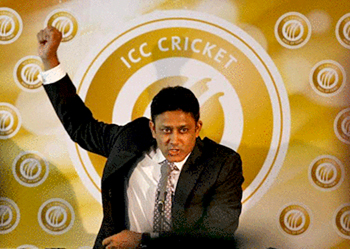
ICCAfter a World Cup of record scores by individuals and teams earlier this year, the ICC's Cricket Committee has recommended the batting powerplay be removed and two other tweaks to rules which currently restrict the fielding team.

Under the recommendations, fielding teams would no longer have an obligation to have two stationary fielders in catching positions in the first 10 overs of an innings.

The committee, chaired by former India captain Anil Kumble, also recommended the fielding captain be able to place five fielders outside the 27-metre circle rather than the existing four for the last 10 overs of the innings.

"The committee (acknowledged) the attractive and attacking brand of cricket that was played during the tournament," said an ICC statement.

"It also felt that there were times towards the end of an ODI innings that bowlers and fielding captains appeared to have limited defensive options available to them.

"The committee was very encouraged by some of the attacking captaincy displayed during the World Cup, and believes these changes will allow fielding captains greater freedom to both attack and defend when required."

Batsmen like South Africa's AB de Villiers and Australia's Glenn Maxwell lit up the World Cup with an incredible rate of scoring, particularly in the last few overs of their innings.

The batting powerplay, which allowed the fielding team to have only three players outside the 27-metre circle for five overs, only contributed to the inflated scoring.

The statement said the ICC would not impose a limit on the size of bats but would reiterate that boundaries must be set at the maximum size at international venues.

Among other recommendations were that all no-balls in limited overs cricket be followed by a free hit for the batsman, rather than, as now, just for no-balls where the bowler has overstepped the mark.The committee also urged match referees to consider suspensions rather than fines for bowlers who repeatedly abused dismissed batsmen with a "send off," or for physical contact between opposing players.

The committee's recommendations will be considered by the ICC board during its annual conference in Barbados in June.

Comments

Add new comment

  • Coastaldigest.com reserves the right to delete or block any comments.
  • Coastaldigset.com is not responsible for its readers’ comments.
  • Comments that are abusive, incendiary or irrelevant are strictly prohibited.
  • Please use a genuine email ID and provide your name to avoid reject.
Agencies
April 2,2020

Lausanne, Apr 2: The postponement of the Tokyo Olympics and the shutdown of the sporting calendar because of the coronavirus pandemic are going to hit international sports federations hard financially.

Many sports that are part of the Games depend heavily on the payouts every four years from the International Olympic Committee (IOC).

"The situation is tense and very gloomy. An assessment will be made, but clearly some posts are under threat," said an official of a major international federation.

The 28 international federations (IF) of the sports that were due to be present at the Tokyo Olympics, would have received substantial sums from the IOC.

However, the postponement of the Games until 2021 could lead to a freeze of their payment.

"We have a lot of IF with substantial reserves, but others work on a different business model, they have income from major events which are suspended, which can be a problem for the cashflow if they don't have enough reserves," said Andrew Ryan, director general of the Association of International Olympic Summer Sports Federations (ASOIF), which is responsible for distributing this money.

The five additions to the Tokyo Games programme - karate, surfing, skateboarding, climbing and baseball/softball - are not eligible.

The Olympic payout totalled 520 million after the Rio Games, four years ago.

"The Olympic money could be less than for Rio 2016," Ryan warned before adding: "My advice is to budget the same as in Rio".

The federations receive money on a sliding scale determined by their audience and size.

The three largest (athletics, swimming and gymnastics) can expect approximately 40 million.

For the second tier, made up of cycling, basketball, volleyball, football and tennis, the sum is 25 million.

For group three, which contains eight sports, including boxing, rowing, judo and table tennis, it is 17 million.

The nine sports in the next level (including sailing, canoing and fencing) receive 12 million.

For the three in the last category (rugby, golf, modern pentathlon) the payout is 7 million.

For the largest associations, such as football's FIFA which has a 1.5 billion nest egg, or basketball body FIBA which has CHF 44.4 million (42 million euros) in reserves, IOC aid represents a small proportion of their income.

For others, it is vital.

"Some IF probably don't have the cashflow to survive one year," said Ryan.

For most federations, the postponement of the Olympic Games has a domino effect, forcing them to reschedule their own money-earning competitions.

"The revenues from these events will eventually come in," said Ryan. "But this impacts the cashflow." World Athletics has already postponed the 2021 World Championships in Eugene, Oregon to 2022.

The International Swimming Federation (FINA) will have to do the same for its World Championships scheduled for next summer in Fukuoka, Japan, when they would probably clash with the Tokyo Games.

"One edition of the World Championships means for us 10 million in revenues," said one sports federation official, speaking on condition of anonymity.

"If this income is postponed, totally or partially, for a year, we will face major problems, especially if the IOC money, originally expected in September, is not paid out."

The Singapore-based International Table Tennis Federation has already taken steps, with "the Executive Committee agreeing to reduce their expenses and senior staff offering to take a salary reduction," said marketing director Matt Pound, but, he added,"further cuts will take place if needed."

- 'Significant loss of revenue' -

The ITTF has suspended all its competitions until June and that is costly.

Kim Andersen, the Danish president of London-based World Sailing, said commercial revenues are not immune.

"The IOC will eventually pay out its aid, but what weighs most heavily is the uncertainty about whether our competitions will be held and whether our sponsors will be maintained," he said.

The IOC is not prepared to go into details of what it plans.

"It is not possible at this stage to assess the overall impact" of the postponement of the Tokyo Olympics, an official told AFP.

"It depends on a number of variables that are currently being studied." According to an official of one federation: "the IOC will discuss on a case-by-case basis, sport by sport".

Another option is for the federations to ask for a share of the public aid set up to deal with the coronavirus crisis, in Switzerland, where 22 ASOIF members are based and also in the United Kingdom, home of World Sailing.

"Can sports federations benefit from federal aid? The answer is yes, in principle," Philippe Leuba, State Councillor of the canton of Vaud, in charge of the economy and sport, told.

Comments

Add new comment

  • Coastaldigest.com reserves the right to delete or block any comments.
  • Coastaldigset.com is not responsible for its readers’ comments.
  • Comments that are abusive, incendiary or irrelevant are strictly prohibited.
  • Please use a genuine email ID and provide your name to avoid reject.
News Network
January 9,2020

Kuala Lampur, Jan 9: Saina Nehwal and reigning world champion P V Sindhu produced dominating performances to progress to the women's singles quarterfinals of the Malaysia Masters Super 500 badminton tournament here on Thursday.

Sixth seed Sindhu notched up a commanding 21-10 21-15 victory over Japan's Aya Ohori in a pre-quarterfinal match lasting just 34 minutes. It was Sindhu's ninth successive win over Ohori.

The 24-year-old Indian, who won the World Championships in Basel last year, will take on world number 1 Tai Tzu Ying in the quarterfinals after the Chinese Taipei shuttler got the better of South Korea's Sung Ji Hyun 21-18 16-21 21-10.

Saina, who had won the Indonesia Masters last year before going through a rough patch, dispatched eight seed An Se Young of South Korea 25-23 21-12 after a thrilling 39-minute contest to make the last eight.

This is Saina's first win over the South Korean, who got the better of the Indian in the quarterfinals of the French Open last year.

The two-time Commonwealth Games champion will next take on Olympic champion Carolina Marin.

Saina had defeated Lianne Tan of Belgium 21-15 21-17 in the opening round on Wednesday.

In the men's singles, India's challenge ended after both Sameer Verma and HS Prannoy crashed out in the second round.

While Verma lost to Malaysia's Lee Zii Jia 19-21 20-22, Prannoy was shown the door by top seed Kento Momota of Japan 14-21 16-21.

Comments

Add new comment

  • Coastaldigest.com reserves the right to delete or block any comments.
  • Coastaldigset.com is not responsible for its readers’ comments.
  • Comments that are abusive, incendiary or irrelevant are strictly prohibited.
  • Please use a genuine email ID and provide your name to avoid reject.
News Network
February 11,2020

Melbourne, Feb 11: Opener David Warner received Allan Border Medal, while all-rounder Ellyse Perry bagged Belinda Clarke medal in the 2020 Australian Cricket Awards on Monday.

Warner secured his third (2016, 2017, 2019) Allan Border Medal and Perry a trio of Belinda Clarke Awards (2016, 2018, 2019) as voted by their peers, umpires and the media across all forms and every game of international cricket in 2019.

Warner dominated the ICC World Cup with 647 runs including a highest score of 166 at an average of 71.88, including three centuries. He then rebounded from a challenging Ashes series to dominate at home in the T20I series against Sri Lanka and Pakistan, the Test series against Pakistan - which included his memorable innings of 335 not out in Adelaide - and the Test series against New Zealand.

Warner (194) outpolled Ashes hero Steve Smith by a single vote for the Allan Border Medal with paceman Pat Cummins, the ICC International Cricketer of the Year, third in the polling with 185 votes.

Perry enjoyed an incredible year with both bat and ball, starting with dominant Ashes performances which included an innings of 116 in the Test in Taunton and 11 wickets in the three ODIs.

Her figures of 7-22 at Canterbury were the best ODI figures by an Australian woman's player. She backed that up against the West Indies by taking 3-17 in the opening ODI and then scoring 112 not out in Antigua before finishing the year with a solid series against Sri Lanka at home. Perry (161) was a comfortable winner of her third Belinda Clarke Award from Alyssa Healy (153) and Jess Jonassen (87) taking second and third place respectively in the voting.

Breakout batsman Marnus Labuschagne's superlative Test summer and Ashes series secured him the Male Test Player of the Year. Having replaced Steve Smith as a concussion substitute in the Lord's Test, Labuschagne went on to make 353 runs at 50.42 in the Ashes.

His outstanding form continued at home with a first-up 185 against Pakistan at the Gabba and a Test high 215 against New Zealand in Sydney. He scored 347 runs at an average of 173.5 against Pakistan and 549 runs at 91.5 against New Zealand. Limited overs captain Aaron Finch (38) capped a stellar year by being voted the Men's One-Day International Player of the Year ahead of Usman Khawaja (33) and Warner (24).

Finch's year included a massive series against Pakistan in the UAE with 451 runs at 112.75, including knocks of 116, 153 not out and 90. He then dominated the World Cup with 507 runs at 50.7, including 153 against Sri Lanka and 100 against England at Lords. Warner (19) continued his magical year in the T20I game to become the Men's T20 International Player of the Year from Glenn Maxwell (16). Kane Richardson and Steve Smith (8) tied for third.

Alyssa Healy claimed top honours as the women's One-Day International Player of the Year with 39 votes ahead of Perry (33) and Jonassen (19). Healy scored a double by also claiming the women's T20 Player of the Year with 18 votes, ahead of Jonassen and Meg Lanning who were tied on 15. It was the second consecutive year that Healy has won the women's ODI and T20 Awards.

West Australian veteran Shaun Marsh was voted Men's Domestic Player of the Year with 1322 runs at 52.88 in all forms of the game, including the highest score of 214, while breakout paceman Wes Agar was named the Bradman Young Cricketer for his 41 wickets at 22.62 in the year.

Molly Strano and Tayla Vlaeminck took the prized Women's Domestic Player of the Year and Betty Wilson Young Cricketer of the Year awards respectively.

Strano took 28 wickets in 22 games while Vlaeminck's 19 wickets for the year reinforced her enormous potential.

Former Hobart Hurricane Corrine Hall was named Community Champion for her work as an Ambassador of the Kindness Factory, grassroots cricket, and upcoming book Victress, which features 35 iconic female athletes and their stories. Each portrait is accompanied by the athlete's story, with a particular focus on how kindness impacted their journey.

The awards for international cricket are based on votes from players, umpires and the media on a 3-2-1 basis from each match. For the domestic awards, the votes are collected from all players.

Comments

Add new comment

  • Coastaldigest.com reserves the right to delete or block any comments.
  • Coastaldigset.com is not responsible for its readers’ comments.
  • Comments that are abusive, incendiary or irrelevant are strictly prohibited.
  • Please use a genuine email ID and provide your name to avoid reject.