



Iranian deal offers no relief to India on oil imports

November 24, 2013

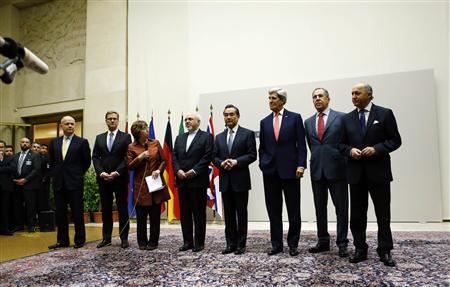
Nuclear_dealWashington, Nov 24: Countries like India would have to continue reducing oil imports from Iran despite a deal with the world powers over its controversial nuclear programme, according to a US fact sheet which also said Tehran would get a relief of USD 7 billion under the agreement.

Under the agreement reached in Geneva, Iran has committed to halt enrichment above five per cent, neutralise its stockpile of near-20 per cent uranium and halt progress on its enrichment capacity, to halt progress on the growth of its 3.5 per cent stockpile and committed to no further advances of its activities at Arak and to halt progress on its plutonium track.

In response, the US and five other major world powers have agreed to provide limited, temporary, targeted, and reversible relief while maintaining the vast bulk of the sanctions, including the oil, finance, and banking sanctions architecture. "If Iran fails to meet its commitments, we will revoke the relief," the US fact sheet said.

"Sanctions affecting crude oil sales will continue to impose pressure on Iran's government. Working with our international partners, we have cut Iran's oil sales from 2.5 million barrels per day (bpd) in early 2012 to 1 million bpd today, denying Iran the ability to sell almost 1.5 million bpd," the fact sheet said.

"That's a loss of more than USD 80 billion since the beginning of 2012 that Iran will never be able to recoup. Under this first step, the EU crude oil ban will remain in effect and Iran will be held to approximately 1 million bpd in sales, resulting in continuing lost sales worth an additional USD 4 billion per month, every month, going forward," it said.

India has slashed import of crude oil from Iran by over 26.5 per cent in the financial year ended March 31 as US and European sanctions made it difficult to ship oil from the Persian Gulf nation.

India imported about 13.3 million tonnes of crude oil from Iran in 2012-13 fiscal, down from 18.1 million tonnes shipped in the previous financial year.

Oil sanctions alone will result in approximately USD 30 billion in lost revenues to Iran – or roughly USD 5 billion per month – compared to what Iran earned in a six month period in 2011, before these sanctions took effect.

Iran used to be India's second-largest supplier, but is now fifth or sixth. The US said the approximately USD 7 billion in relief is a fraction of the costs that Iran will continue to incur during this first phase under the sanctions that will remain in place.

The vast majority of Iran's approximately USD 100 billion in foreign exchange holdings are inaccessible or restricted by sanctions.

In the next six months, Iran's crude oil sales cannot increase.

While Iran will be allowed access to USD 4.2 billion of its oil sales, nearly USD 15 billion of its revenues during this period will go into restricted overseas accounts.

"In summary, we expect the balance of Iran's money in restricted accounts overseas will actually increase, not decrease, under the terms of this deal," the US said.

Further sanctions affecting petroleum product exports to Iran, which result in billions of dollars of lost revenue, will remain in effect.

The vast majority of Iran's approximately USD 100 billion in foreign exchange holdings remain inaccessible or restricted by the sanctions.

The P5+1 countries have committed not impose new nuclear-related sanctions for six months, if Iran abides by its commitments under this deal, to the extent permissible within their political systems; and suspend certain sanctions on gold and precious metals, Iran's auto sector, and Iran's petrochemical exports, potentially providing Iran approximately USD 1.5 billion in revenue.

It also agreed to license safety-related repairs and inspections inside Iran for certain Iranian airlines and allow purchases of Iranian oil to remain at their currently significantly reduced levels – levels that are 60 per cent less than two years ago. USD 4.2 billion from these sales will be allowed to be transferred in installments if, and as, Iran fulfills its commitments.

"The concessions Iran has committed to make as part of this first step will also provide us with increased transparency and intrusive monitoring of its nuclear programme. In the past, the concern has been expressed that Iran will use negotiations to buy time to advance their program," the US said.

Comments

Add new comment

  • Coastaldigest.com reserves the right to delete or block any comments.
  • Coastaldigset.com is not responsible for its readers’ comments.
  • Comments that are abusive, incendiary or irrelevant are strictly prohibited.
  • Please use a genuine email ID and provide your name to avoid reject.
News Network
June 12,2020

Jun 12: The global number of COVID-19 cases has increased to over 7.5 million, while the death toll was nearing 421,000, according to the Johns Hopkins University.

As of Friday morning, the overall number of cases stood at 7,500,777, while the deaths increased to 420,993, the University's Center for Systems Science and Engineering (CSSE) revealed in its latest update.

The US continues with the world's highest number of confirmed cases and deaths at 2,022,488 and 113,803, respectively, according to the CSSE.

In terms of cases, Brazil comes in the second place with 802,828 infections.

This was followed by Russia (501,800), the UK (292,860), India (286,605), Spain (242,707), Italy (236,142), Peru (214,788), France (192,493), Germany (186,691), Iran (180,156), Turkey (174,023), Chile (154,092), Mexico (133,974), Pakistan (125,933) and Saudi Arabia (116,021), the CSSE figures showed.

Regarding fatalities, the UK continues in the second position after the US with 41,364 COVID-19 deaths, which also accounts for the highest number of fatalities in Europe.

The other countries with over 10,000 deaths are Brazil (40,919), Italy (34,167), France (29,349), Spain (27,136) and Mexico (15,944).

Comments

Add new comment

  • Coastaldigest.com reserves the right to delete or block any comments.
  • Coastaldigset.com is not responsible for its readers’ comments.
  • Comments that are abusive, incendiary or irrelevant are strictly prohibited.
  • Please use a genuine email ID and provide your name to avoid reject.
News Network
January 10,2020

Washington, Jan 10: It is “highly likely” that Iran shot down the civilian Ukrainian jetliner that crashed near Tehran late Tuesday, killing all 176 people on board, U.S., Canadian and British officials declared Thursday.

They said the fiery missile strike could well have been a mistake amid rocket launches and high tension throughout the region.

The crash came just a few hours after Iran launched a ballistic attack against Iraqi military bases housing U.S. troops in its violent confrontation with Washington over the U.S. drone strike that killed an Iranian Revolutionary Guard general. The airliner could have been mistaken for a threat, said four U.S. officials, speaking on condition of anonymity to discuss sensitive intelligence.

Canadian prime minister Justin Trudeau, whose country lost at least 63 citizens in the downing, said in Toronto: “We have intelligence from multiple sources including our allies and our own intelligence. The evidence indicates that the plane was shot down by an Iranian surface-to-air missile.”

Likewise, U.K. prime Minister Boris Johnson and Australian prime minister Scott Morrison offered similar statements. Morrison also said it appeared to be a mistake. “All of the intelligence as presented to us today does not suggest an intentional act,” he said.

The assessment that 176 people were killed as collateral damage in the Iranian-U.S. conflict cast a new pall over what had at first appeared to be a relatively calm aftermath following the U.S. military operation that killed Iranian Gen. Qassem Soleimani.

At the White House, U.S. president Donald Trump suggested he believed Iran was responsible for the shootdown and dismissed Iran's initial claim that it was a mechanical issue with the plane.

“Somebody could have made a mistake on the other side.” Trump said, noting the plane was flying in a “pretty rough neighborhood."

Comments

Add new comment

  • Coastaldigest.com reserves the right to delete or block any comments.
  • Coastaldigset.com is not responsible for its readers’ comments.
  • Comments that are abusive, incendiary or irrelevant are strictly prohibited.
  • Please use a genuine email ID and provide your name to avoid reject.
Agencies
May 25,2020

The Japan government on Monday decided to lift the state of emergency for COVID-19 in Tokyo and four other prefectures of the country, the only places where the measure implemented to curb the pandemic had remained in force.

The lifting of the alert was backed by the coronavirus advisory panel and will be formally approved by the government later day, the economic revitalization minister and head of the working group to coordinate Japan's fight against COVID-19, Yasutoshi Nishimura, said.

The Japanese authorities made the decision after taking into account the number of infections and the situation of the health system in Tokyo, the three neighbouring prefectures of Chiba, Kanagawa and Saitama and the northern Hokkaido, the only ones where the state of emergency declared more than a month ago to control the pandemic remained in effect, reports Efe news.

The health alert was initially declared in Tokyo and six other prefectures on April 17 and subsequently extended across the country.

It allowed local authorities to ban large-scale public events and close bars and restaurants at night, among other measures, while the government has launched a campaign to encourage teleworking and staying at home.

The government resorted to this measure for the first time in the country's recent history to contain the spread of the virus and is now withdrawing it after a sustained slowdown in infections throughout the archipelago, where around 16,600 confirmed COVID-19 cases and 839 deaths have been recorded, according to the latest data.

The group of experts advising the government appreciated the efforts made by citizens to comply with the recommendations to achieve the target of reducing interpersonal contact by 80 percent, top government spokesperson Yoshihide Suga said at a press conference on Monday.

The recommendation for citizens to avoid unnecessary trips outside and the request for non-essential businesses to close were not mandatory nor accompanied by fines or other penalties for non-compliance, unlike the stricter containment measures implemented in other countries.

The government plans to formally approve the lifting of the state of emergency on Monday after consulting with other political parties in parliament and another meeting with the advisory panel, following which Japanese Prime Minister Shinzo Abe will hold a press conference.

The government had already decided to lift the emergency in 39 prefectures on May 14 after they reported a marked decrease in the number of infections, leaving out the more populated regions such as Tokyo and Osaka.

To avoid new outbreaks of the virus, Abe has urged people to become accustomed to a "new lifestyle" that includes maintaining social distancing, the use of masks outside as well as a series of guidelines for the reopening of shops, restaurants and public facilities.

Comments

Add new comment

  • Coastaldigest.com reserves the right to delete or block any comments.
  • Coastaldigset.com is not responsible for its readers’ comments.
  • Comments that are abusive, incendiary or irrelevant are strictly prohibited.
  • Please use a genuine email ID and provide your name to avoid reject.