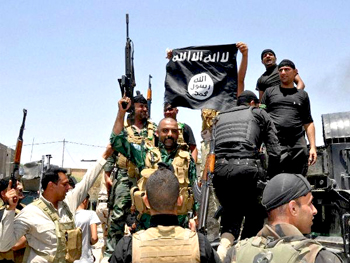
Iraq presses counter-offensive, ISIL declares 'caliphate'

June 30, 2014

Baghdad, Jun 30: Iraqi forces pressed a counter-attack on Saddam Hussein's hometown Tikrit today as jihadists who led a blistering Sunni militant offensive that captured swathes of territory declared a "caliphate".

CaliphateRussia meanwhile delivered warplanes to aid Baghdad in a crisis said to rival Iraq's brutal sectarian war of 2006-2007, with more than 1,000 killed and hundreds of thousands displaced in a matter of weeks.

Alarmed world leaders have urged a speeding up of government formation following April elections, warning the conflict driven by sectarian divides cannot be resolved militarily.

And while beleaguered Prime Minister Nuri al-Maliki has conceded a political solution is necessary to end the crisis, his security spokesman has for days touted the Tikrit operation, which could be crucial not only tactically, but also for morale in the security forces.

"The security forces are advancing from different areas" around Tikrit, Lieutenant General Qassem Atta told reporters. "There are ongoing clashes."

Atta said troops had detonated bombs planted along routes into the city, which militants took more than two weeks ago.

Witnesses reported waves of government air strikes in various areas of central Tikrit and Saddam's palace compound in the city.

The Iraqi forces, according to Atta, are coordinating with recently-arrived US military advisers in "studying important targets".

Maliki's national reconciliation adviser, Amr Khuzaie, told AFP the crisis is even more dangerous than the brutal period of Sunni-Shiite sectarian violence years earlier that left tens of thousands dead.

Comments

Add new comment

  • Coastaldigest.com reserves the right to delete or block any comments.
  • Coastaldigset.com is not responsible for its readers’ comments.
  • Comments that are abusive, incendiary or irrelevant are strictly prohibited.
  • Please use a genuine email ID and provide your name to avoid reject.
Agencies
July 8,2020

Washington, Jul 7: President Donald Trump on Tuesday formally started the withdrawal of the United States from the World Health Organization, making good on threats to deprive the UN body of its top funding source over its response to the coronavirus.

Public health advocates and Trump's political opponents voiced outrage at the departure from the Geneva-based body, which leads the global fight on maladies from polio to measles to mental health -- as well as Covid-19, at a time when cases have again been rising around the world.

After threatening to suspend the $400 million (Dh1.47 billion) in annual US contributions and then announcing a withdrawal, the Trump administration has formally sent a notice to UN Secretary-General Antonio Guterres, a State Department spokesperson said.

The withdrawal is effective in one year -- July 6, 2021 -- and Joe Biden, Trump's presumptive Democratic opponent, is virtually certain to stop it and stay in the WHO if he wins the November election.

A spokesman for Guterres and the global health body itself confirmed that the United States, a key founding WHO member, gave its notice.

In a speech earlier in the day, WHO chief Tedros Adhanom Ghebreyesus said of Covid-19, "National unity and global solidarity are more important than ever to defeat a common enemy."

In line with conditions set when the WHO was set up in 1948, the United States can leave within one year but must meet its remaining assessed financial obligations, the UN spokesman said.

'Total control'

In late May, Trump said that China exerted "total control" over the WHO and accused the UN body led by Tedros, an Ethiopian doctor and diplomat, of failing to implement reforms.

Blaming China for the coronavirus, Trump, a frequent critic of the UN, said the United States would redirect funding "to other worldwide and deserving, urgent, global public health needs."

Democratic lawmakers have accused Trump of seeking to deflect criticism from his handling of the pandemic in the United States, which has suffered by far the highest death toll of any nation despite the president's stated hope that the virus will disappear.

"To call Trump's response to Covid chaotic and incoherent doesn't do it justice," said Senator Robert Menendez, the top Democrat on the Foreign Relations Committee.

"This won't protect American lives or interests -- it leaves Americans sick and America alone," he wrote on Twitter.

Representative Ami Bera, himself a physician, said that the United States and World Health Organization had worked "hand in hand" to eradicate smallpox and nearly defeat polio.

"Our cases are increasing," Bera said of Covid-19. "If the WHO is to blame: why has the US been left behind while many countries from South Korea to New Zealand to Vietnam to Germany return to normal?"

Even some of Trump's Republican allies had voiced hope that he was exerting pressure rather than making a final decision to abandon the World Health Organization.

The investigative news outlet ProPublica reported last month that most of Trump's aides were blindsided by the WHO withdrawal announcement, which he made during an appearance about China. 

The Trump administration has said that the WHO ignored early signs of human-to-human transmission in China, including warnings from Taiwan -- which, due to Beijing's pressure, is not part of the UN body.

While many public health advocates share some criticism of the WHO, they question what other options the world body had other than to work with China, where Covid-19 was first detected late last year in the city of Wuhan.

The anti-poverty campaign ONE said the United States should work to reform, not abandon, the WHO.

"Withdrawing from the World Health Organization amidst an unprecedented global pandemic is an astounding action that puts the safety of all Americans the world at risk," it said.

Comments

Add new comment

  • Coastaldigest.com reserves the right to delete or block any comments.
  • Coastaldigset.com is not responsible for its readers’ comments.
  • Comments that are abusive, incendiary or irrelevant are strictly prohibited.
  • Please use a genuine email ID and provide your name to avoid reject.
News Network
January 3,2020

Islamabad, Jan 3: The United Arab Emirates has extended USD 200 million aid to Pakistan for the development of the small and medium-sized enterprises in the country, Finance Adviser to Prime Minister Imran Khan said.

The announcement came after Abu Dhabi Crown Prince Sheikh Mohamed Bin Zayed Al Nahyan concluded his one-day visit to the country on Thursday.

"The money will be spent on small business promotion and jobs. This support is testimony to the expanding economic relations and friendship between our countries," the adviser, Abdul Hafeez Shaikh, on Thursday said.

The Crown Prince directed the Khalifa Fund for Enterprise Development to allocate USD 200 million in order to assist the Pakistani government's efforts to create a stable and balanced national economy that will help achieve the country's sustainable development, Dawn News reported on Friday.

During the visit, the prince met Prime Minister Khan and held talks on bilateral, regional and international issues.

The UAE is Pakistan's largest trading partner in the Middle East and a major source of investments. The UAE is also among Pakistan's prime development partners in education, health and energy sectors.

It hosts more than 1.6 million expatriate Pakistani community, which contributes remittances of around USD 4.5 billion annually to the GDP.

This is the Crown Prince's second visit to Pakistan since Khan took office in August 2018. He had last visited Pakistan on January 6 last year, just weeks after his country offered USD 3 billion financial assistance to Pakistan to deal with its balance of payment crisis.

The Crown Prince's visit was considered by experts as an attempt to woo Pakistan against the backdrop of recent developments when Saudi Arabia and UAE apparently used pressure to stop Pakistan from attending the Kuala Lumpur summit held last month.

The summit from December 19-21 was seen by Saudis as an attempt to create a new bloc in the Muslim world that could become an alternative to the dysfunctional Organisation of Islamic Cooperation led by the Gulf Kingdom.

Comments

Add new comment

  • Coastaldigest.com reserves the right to delete or block any comments.
  • Coastaldigset.com is not responsible for its readers’ comments.
  • Comments that are abusive, incendiary or irrelevant are strictly prohibited.
  • Please use a genuine email ID and provide your name to avoid reject.
News Network
April 26,2020

Apr 26: The remarkable story of an airman who overcame prejudice to become one of only a handful of Indian fighter pilots in the First World War has emerged in newly-released archive files by the UK's Commonwealth War Graves Commission (CWGC).

Lieutenant Shri Krishna Chanda Welinkar is one of the thousands of moving stories from the war preserved in family correspondence and being brought alive as part of a digitisation project.

The never-before-published files contain thousands of letters, pictures and other papers sent between the Commission and the next of the kin of First World War dead.

Among them is the story of Welinkar, who hailed from Bombay in colonial India. After much hardship and discrimination, he eventually became a pilot and went missing while on patrol over the skies above the Western Front in June 1918.

His family had to wait nearly three years before they finally knew for certain that he had died, and his grave was located.

“For everyone who died in the First World War, there was inevitably a partner, parent or child back home who had questions. The heartbreaking letters in CWGC's archive give us an insight into what it was like for those families trying to come to terms with their loss,” said Andrew Fetherston, chief archivist for CWGC.

“They are stories that show desperate searches for closure, former enemies uniting and, on many occasions, the sad realisation that a missing loved one would always remain so. We are pleased to be able to make this invaluable piece of World War history accessible to a new generation and help deepen our understanding of how the First World War impacted those who were left behind,” he said.

Welinkar was one of the 1.3 million Indians who answered the call to fight for the British Empire. Nearly 74,000 never saw their homeland again and are remembered today in cemeteries and memorials throughout the world, including France, Belgium, the Middle East and Africa.

Welinkar was a well-educated man studying at Cambridge University. He trained to become an aviator in Middlesex and wished to join the Royal Flying Corps, later known as the Royal Air Force.

Upon attempting to enlist, Welinkar encountered the same prejudices as his other fellow Indian airmen and was encouraged to become an air mechanic instead.

He was eventually given a commission in the Royal Flying Corps as an Officer. In 1918, he was posted to France and patrolled the skies above the Western Front.

In June 1918, Lieutenant Welinkar embarked on what would be his final patrol; he did not return and was reported missing. His fate remained unknown for many months afterwards.

The newly-released e-files chronicle the remarkable discovery of Welinkar and his final resting place long after the war had ended. Colonel Barton, who knew Welinkar, acted on behalf of his mother and helped find her missing son. They spoke to former enemies and honed their search to the grave of an unidentified man, buried by the Germans as “Oberleutnant S.C. Wumkar” in a grave in Rouvroy, Belgium.

The body was later moved and reinterred in Hangard Communal Cemetery Extension but it wasn't until the vital clue, found in the original German burial records in February 1921, that it was confirmed beyond doubt this grave was of Welinkar's.

In May 1921, Colonel Barton, on behalf of Welinkar's mother, requested that a Commission headstone be placed on the grave with the following personal inscription: “To the Honoured Memory of One of the Empire's Bravest Sons”.

This records – known as Enquiry Files – are part of a collection of nearly 3,000 files which have never been made available to the public before. Nearly half have been digitised so far, alongside a previously unreleased collection of more than 16,000 photographs held in negatives in the Commission's archive.

The files, internally referred to simply as E-Files, contain correspondence between the CWGC and the next of kin of the war dead. They often contain letters, typed memos between Commission staff and on occasion photos, maps and diagrams.

CWGC only holds an enquiry file for a small proportion of the 1.7 million people it commemorates from the Commonwealth. Today it is only possible to release those surviving records from the First World War because correspondence with families of Second World War casualties often involves people still alive today and cannot be made public for many years, due to the UK's data protection rules.

To date, more than 1,300 of the surviving 3,000 First World War enquiry files have been digitised.

The CWGC commemorates the 1.7 million Commonwealth servicemen and women who died during the two World Wars. It also holds and updates an extensive and accessible records archive, while operating over 23,000 locations in more than 150 countries and territories.


Comments

Add new comment

  • Coastaldigest.com reserves the right to delete or block any comments.
  • Coastaldigset.com is not responsible for its readers’ comments.
  • Comments that are abusive, incendiary or irrelevant are strictly prohibited.
  • Please use a genuine email ID and provide your name to avoid reject.