



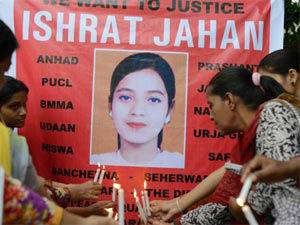
Ishrat Jahan encounter: four IB officials chargesheeted; Amit Shah gets breather

February 6, 2014

Ishrat_JahanNew Delhi, Feb 6: Former IB officer Rajendra Kumar has been named as the main accused, while three serving IB officials--- P Mittal, MK Sinha and Rajiv Wankhede--- too have been charged with murder and criminal conspiracy.

HT had first reported on December 2 that the CBI supplementary chargesheet may not name Shah due to lack of evidence. HT also first reported on December 17 about the findings that worked in Shah’s favour: he was not present in Ahmedabad when the fake encounter occurred.

DG Vanzara, who was then deputy commissioner of the Ahmedabad Crime Branch, and who has been named in the first chargesheet has alleged that Shah was aware of the encounter and the policemen were only following government orders.

Ishrat Jahan, a 19-year-old college student, was killed along with Pranesh Pillai, Amjad Ali and Zeeshan Johar on the outskirts of Ahmedabad on June 15, 2004 by a team of the Gujarat Police’s Crime Branch.

The police had claimed that the IB had informed them that the four persons were terrorists on a mission to kill Gujarat chief minister Narendra Modi.

The naming of Kumar, who retired on July 31, had created a row between the CBI and the home ministry and IB, with the latter insisting the officers had done their job by passing on the intelligence and its officer did not authorize or participate in the staged gunfight.

The CBI in July last year said that Kumar, a 1979 batch IPS officer of Manipur-Tripura cadre, went beyond generating input and actively participated in the conspiracy to kill Ishrat and others.

His juniors in Ahmedabad IB office picked Ishrat and her former employer Javed from a toll plaza and illegally confined them where Kumar interrogated them.

The agency has alleged that Kumar was instrumental in arranging weapons that were planted at the encounter site.

Director Intelligence Bureau Asif Ibrahim had reportedly personally ran from pillar to post to get justice to Rajender Kumar and shield the over 150-year-old institution from CBI's intrusive eyes.

Comments

Add new comment

  • Coastaldigest.com reserves the right to delete or block any comments.
  • Coastaldigset.com is not responsible for its readers’ comments.
  • Comments that are abusive, incendiary or irrelevant are strictly prohibited.
  • Please use a genuine email ID and provide your name to avoid reject.
Agencies
July 20,2020

New Delhi, Jul 20: Reiterating that China has still occupied India's territory, Congress leader Rahul Gandhi on Monday attacked Prime Minister Narendra Modi saying that he has fabricated a fake strongman image to come to power which has now become India's biggest weakness as he has to protect the idea of 'Chhapan Inch'.

Taking to Twitter, the Congress leader posted a video message and wrote, "PM fabricated a fake strongman image to come to power. It was his biggest strength. It is now India's biggest weakness."

In the video message, speaking on "China's Strategic Game Plan" the Congress leader said: "What is China's strategic and tactical game plan? It is simply not a border issue. The worry I have is that the Chinese are sitting in our territory today. Chinese don't do anything without thinking about it strategically."

"In their mind, they have mapped out the world and they are trying to shape the world. That's the scale of what they are doing. That's what Gwadar is, that is what belt and road is. It is a restructuring of the planet. So when you are thinking about the Chinese you have to understand that that is the level at which they are thinking," he added.

Now at the tactical level, they're trying to improve their position. Whether it is Galwan, whether it's Demchok or whether it is Pangong Lake. The idea is to position themselves, he said.

"They are disturbed by our highway they want to make our highway redundant and if they are thinking larger scale, they want to do something with Pakistan in Kashmir. So it is not simply a border issue. It is a border issue designed to put pressure on the Prime Minister of India," the Congress leader said.

"And they are thinking of putting pressure in a very particular way. And what they are doing, is that they are attacking his image. They understand that it in order for Mr Narendra Modi to be an effective politician; in order for Mr Narendra Modi to survive as a politician, he has to protect the idea of--Chhapan Inch. And this the real idea the Chinese are attacking. They are basically telling Mr Narendra Modi that if you do not do what we say, we will destroy the idea of Mr Narendra Modi as a strong leader," he added.

Gandhi continued saying, now the question is, how will PM Narendra Modi react. Will he take them on? Will he take on the challenge and say absolutely not, I'm the Prime Minister of India. I do not care about my image I'm going to take you on. Or will he succumb to them?

"The worry I have so far is that the Prime Minister has succumbed. The worry I have is, the Chinese are sitting in our territory today and the Prime Minister has said publicly they are not, which to me tells me that is worried about his image and defending his image," said Gandhi.

"And if he allows the Chinese to understand that they can manipulate him because of his image, the Indian Prime Minister will no longer be worth anything for India," he added.

Comments

Add new comment

  • Coastaldigest.com reserves the right to delete or block any comments.
  • Coastaldigset.com is not responsible for its readers’ comments.
  • Comments that are abusive, incendiary or irrelevant are strictly prohibited.
  • Please use a genuine email ID and provide your name to avoid reject.
Agencies
February 10,2020

New Delhi, Fevb 10: Of the countries most at risk of importing coronavirus cases, India ranks 17th, researchers have found on the basis of a mathematical model for the expected global spread of the virus that originated in China's Wuhan area in December 2019.

So far, India has reported three coronavirus positive cases -- all from Kerala.

Among the airports in India, the Indira Gandhi International Airport in New Delhi is most at risk, followed by airports in Mumbai, Kolkata, Bengaluru, Chennai, Hyderabad and Kochi, according to the model.

The new model for predicting global novel coronavirus cases has been developed by researchers from Humboldt University and Robert Koch Institute in Germany.

"The spread of the virus on an international scale is dominated by air travel," said the study.

"Wuhan, the seventh largest city in China with 11 million residents, was the relevant major domestic air transportation hub with many connecting international flights before the city was effectively quarantined on January 23, 2020, and the Wuhan airport was closed. By then the virus had already spread to other Chinese provinces as well as other countries," it added.

The researchers said that it is possible to estimate how likely it is that the virus spreads to other areas by looking at air travel passenger numbers.

"The busier a flight route, the more probable it is that an infected passenger travels this route. Using these probabilistic concepts, we calculate the relative import risk to other airports. When calculating the import risk, we also take into account connecting flights and travel routes that involve multiple destinations," said the study.

The top 10 countries and regions at risk of importing coronavirus cases are: Thailand, Japan, South Korea, Hong Kong, Taiwan, USA, Vietnam, Malaysia, Singapore and Cambodia, according to the model.

While Thailand's national import risk is 2.1%, it is 0.2% for India, found the research.

The foundation of the model is the worldwide air transportation network (WAN) that connects approximately 4,000 airports with more than 25,000 direct connections.

The model accounts for both, the current distribution of confirmed cases in mainland China as well as airport closures that were implemented as a mitigation strategy.

This network theoretic model is based on the concept of effective distance and is an extension of a model introduced in the 2013 paper "The Hidden Geometry of Complex, Network-Driven Contagion Phenomena" published in the journal Science.

The current outbreak of the 2019-nCoV virus started in Wuhan city, Hubei province, China. While the first cases were reported as early as December 8, 2019, the outbreak gained global attention on December 31, 2019, when the World Health Organization was alerted to "several cases of pneumonia" by an unknown virus.

The new virus was soon identified as a novel coronavirus and named 2019-nCOV. It belongs to the family of viruses that include the common cold and viruses such as SARS and MERS. On January 20, 2020, it was confirmed that the coronavirus can be transmitted between humans, greatly increasing the risk of a global spread.

The death toll due to the novel coronavirus outbreak in China has increased to 811 on Sunday, surpassing that of the Severe Acute Respiratory Syndrome (SARS) epidemic in 2003.

Although about 20 countries have confirmed cases, China has accounted for about 99 per cent of those infected. The first foreign victims of the virus both died on Saturday in Wuhan.

Comments

Add new comment

  • Coastaldigest.com reserves the right to delete or block any comments.
  • Coastaldigset.com is not responsible for its readers’ comments.
  • Comments that are abusive, incendiary or irrelevant are strictly prohibited.
  • Please use a genuine email ID and provide your name to avoid reject.
News Network
June 6,2020

Thiruvananthapuram, Jun 6: The Sabarimala Temple in Kerala is set to reopen from June 14 for devotees for monthly pooja and festival.

The temple will be open for the five-day monthly rituals in the Malayalam month of Midhunom that begins on June 15. From June 19-28 is the Sabarimala festival

A virtual queue system has been put in place in which 200 people will be allowed to register within an hour, Devasom Minister Kadakampally Surendran said.

To avoid crowding, only 50 devotees will be allowed to be present in front of the temple.

Before entering the premises, people will be scanned in Pampa and Sannidhanam. As a precautionary measure, people have been asked to wear mask and sanitation would be carried out at regular intervals.

Notably, no accommodation will be provided to the devotees in Sabarimala.

According to the Devasom Minister the administration has made two slots for the temple visit-- 4 am to 1 pm and 4 pm to 11 pm.

Also, the vehicles will only be allowed till Pampa. People coming from other states are required to register at government COVID Jagrata pass registration portal. Moreover, Appam and Arvana will be provided only through online booking.

Also, the devotees coming from other states will have to upload Indian Council of Medical Research (ICMR) labs certificate as a proof that they have not been infected with the lethal infection.

Also for the Guruvayoor Temple, the district collector, police and temple administration will hold a meeting to decide on the re-opening of the Temple. Here too devotees have to get themselves registered online.

In a single day, 600 people would be allowed to offer prayers at this shrine. Each hour, 150 people will be allowed to enter the premises.

Also, the time slot will be provided to people. In one batch 50 people will be allowed for 15 minutes inside the premises

Not only that, but marriages can also again be solemnised with divine blessings at the Guruvayoor temple. The administration will allow only 60 marriages in a day.

Weddings were stopped at the temple, due to the COVID-19 lockdown that was in place since March 24.

A marriage group should not have more than 10 people, including the bride and the groom and it is mandatory for the group to abide by the social distancing norm.

Comments

Add new comment

  • Coastaldigest.com reserves the right to delete or block any comments.
  • Coastaldigset.com is not responsible for its readers’ comments.
  • Comments that are abusive, incendiary or irrelevant are strictly prohibited.
  • Please use a genuine email ID and provide your name to avoid reject.