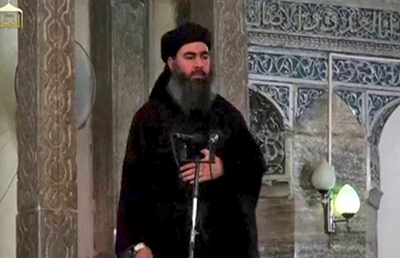
ISIS chief Abu Bakr al-Baghdadi ill after assassin ‘poisons' food: Report

October 4, 2016

Baghdad, Oct 4: The IS terrorist group ringleader was reportedly seriously ill after having his food poisoned by an assassin, a media report said.

abu-bakrMeals prepared for Baghdadi and three other commanders of the terrorist organisation were allegedly poisoned in Nineveh's Be'aaj district, the Daily Mail reported on Monday.

It quoted an Iraqi news agency as saying that four militants, including Baghdadi, were suffering from “severe poisoning” and “have been transferred to an unknown location under strict measures”.

The IS terror group has reportedly launched a campaign of arrests to track down those responsible for poisoning the food.

The identities of the three other commanders is unknown.

Baghdadi is credited with transforming the breakaway al-Qaeda group and turning it into the independent IS group that is arguably the most powerful and wealthiest jihadi organisation in the world.

Al-Baghdadi's movements are known only by his inner circle, and the Caliph, as he is known to his followers, is constantly on the move, changing locations in Iraq and Syria to avoid airstrikes.

Under the leadership of Baghdadi, the group spearheaded a militant offensive that expanded into Syria in 2013 and overran much of Iraq's Arab heartland.

Baghdadi has been wounded multiple times in air strikes and been reported dead, but has re-surfaced each time.

Earlier this year, there were reports he had been killed by US-led coalition air strikes, but they turned out to be inaccurate, the Daily Mail reported.

Baghdadi — whose real name is Ibrahim Awad Ibrahim — is thought to have been born in Samarra, north of Baghdad, in 1971.

In October 2011, the US officially designated Baghdadi as “terrorist” and offered a $10 million reward for information leading to his capture or death.

Under Baghdadi's leadership, IS militants have shocked the world with their sadistic beheadings of captured foreign journalists and civilians.

Comments

Add new comment

  • Coastaldigest.com reserves the right to delete or block any comments.
  • Coastaldigset.com is not responsible for its readers’ comments.
  • Comments that are abusive, incendiary or irrelevant are strictly prohibited.
  • Please use a genuine email ID and provide your name to avoid reject.
News Network
April 22,2020

London, Apr 22: The toll from coronavirus in the United Kingdom has jumped above 18,000 after 759 more deaths were reported in the last 24 hours, the Department of Health and Social Care announced in a statistical bulletin on Wednesday.

In total, 18,100 people have died in the UK hospitals after contracting COVID-19 as of 16:00 GMT on Tuesday.

A further 4,451 new cases of the disease were reported over the preceding 24 hours up to 08:00 GMT on Wednesday, the ministry said. The total number of cases reported since the start of the outbreak now stands at 1,33,495.

On Tuesday, the Office of National Statistics published a report stating that the coronavirus disease death toll as of April 10, when accounting for deaths in care homes and private residences, was 41 per cent higher than the government's figures.

In parliament on Wednesday, Health Secretary Matt Hancock stated that the United Kingdom has reached the peak of the COVID-19 outbreak, praising the social distancing measures enforced in the country.

Comments

Add new comment

  • Coastaldigest.com reserves the right to delete or block any comments.
  • Coastaldigset.com is not responsible for its readers’ comments.
  • Comments that are abusive, incendiary or irrelevant are strictly prohibited.
  • Please use a genuine email ID and provide your name to avoid reject.
News Network
May 15,2020

May 15: Global deaths linked to the novel coronavirus passed 300,000 on Thursday, while reported cases of the virus are approaching 4.5 million, according to a news agency tally.

About half of the fatalities have been reported by the United States, the United Kingdom and Italy.

The first death linked to the disease was reported on January 10 in Wuhan, China. It took 91 days for the death toll to pass 100,000 and a further 16 days to reach 200,000, according to the Reuters tally of official reports from governments. It took 19 days to go from 200,000 to 300,000 deaths.

By comparison, an estimated 400,000 people die annually from malaria, one of the world’s most deadly infectious diseases.

The United States had reported more than 85,000 deaths from the new coronavirus, while the United Kingdom and Italy have reported over 30,000 fatalities each.

While the current trajectory of COVID-19 falls far short of the 1918 Spanish flu, which infected an estimated 500 million people, killing at least 10% of patients, public health experts worry the available data is underplaying the true impact of the pandemic.

Comments

Add new comment

  • Coastaldigest.com reserves the right to delete or block any comments.
  • Coastaldigset.com is not responsible for its readers’ comments.
  • Comments that are abusive, incendiary or irrelevant are strictly prohibited.
  • Please use a genuine email ID and provide your name to avoid reject.
Agencies
July 3,2020

The dollar's dominance will slowly melt away over the coming year on weakening global demand and a sombre U.S. economic outlook, according to a Reuters poll of currency forecasters whose views depend on there being no second coronavirus shock.

Despite fears a surge in new Covid-19 cases would delay economies reopening and stymie a tentative recovery, world stocks have rallied - with the S&P 500 finishing higher in June, marking its biggest quarterly percentage gain since the height of the technology boom in 1998.

Caught between bets in favour of riskier investments, weak U.S. economic prospects as well as an easing in the thirst for dollars after the Federal Reserve flooded markets with liquidity, the greenback fell nearly 1.0 per cent last month. It was its worst monthly performance since December.

While there was a dire prognosis from the top U.S. medical expert on the coronavirus' spread, the June 25-July 1 poll of over 70 analysts showed weak dollar projections as Fed Chair Jerome Powell on Monday reiterated the economic outlook for the world's largest economy was uncertain.

"The dollar rises in two instances: when you see risk off or when there is a situation where the U.S. is leading the global recovery, and we don't think that's going to be the case anytime soon," said Gavin Friend, senior FX strategist at NAB Group in London.

"The U.S. is playing fast and loose with the virus, and chronologically they're behind the rest of the world."

Currency speculators, who had built up trades against the dollar to the highest in two years during May, increased their out-of-favour dollar bets further last week, the latest positioning data showed.

About 80 per cent of analysts, 53 of 66, said the likely path for the dollar over the next six months was to trade around current levels, alternating between slight gains and losses in a range. That suggests the greenback may be at a crucial crossroad as more currency strategists have turned bearish.

But more than 90 per cent, or 63 of 68, said a second shock from the pandemic would push the dollar higher. Five said it would push the U.S. currency lower.

Much will also depend on debt servicing and repayments by Asian, European and other international borrowers in U.S. dollars.

While an early shortage of dollars in March from the pandemic's first shock pushed the Fed to open currency swap lines with major central banks, international funding strains have eased significantly since. In recent weeks, usage of the facility has reduced dramatically.

That trend is expected to continue over the next six months with major central banks' usage of swap lines to "stay around current levels", according to 32 of 46 analysts. While 13 predicted a sharp drop, only one respondent said use of them would "rise sharply".

The dollar index, which measures the greenback's strength against six other major currencies, has slipped over 5 per cent since touching a more than three-year high in March.

When asked which currencies would perform better against the dollar by end-December, a touch over half of 49 respondents said major developed market ones, with the remaining almost split between commodity-linked and emerging market currencies.

"The dollar is so overvalued, and has been overvalued for a long time, it's time now for it to come back down again, as we head towards the (U.S.) election," added NAB's Friend.

Over the last quarter, the euro has staged a 1.8 per cent comeback after falling by a similar margin during the first three months of the year. For the month of June, the euro was up 1.2 per cent against the dollar.

The single currency was now expected to gain about 2.5 per cent to trade at $1.15 in a year from around $1.12 on Wednesday, slightly stronger than $1.14 predicted last month. While those findings are similar to what analysts have been predicting for nearly two years, there was a clear shift in their outlook for the euro, with the range of forecasts showing higher highs and higher lows from last month.

"In comparison to even a month or two ago, the outlook in Europe has improved significantly," said Lee Hardman, currency strategist at MUFG.

"I think that makes the euro look relatively more attractive and cheap against the likes of the dollar. We're not arguing strongly for the euro to surge higher, we're just saying, after the weakness we have seen in recent years, there is the potential for that weakness to start to reverse."


Comments

Add new comment

  • Coastaldigest.com reserves the right to delete or block any comments.
  • Coastaldigset.com is not responsible for its readers’ comments.
  • Comments that are abusive, incendiary or irrelevant are strictly prohibited.
  • Please use a genuine email ID and provide your name to avoid reject.