


ISIS claims British parliament attack; 8 arrested in UK raids

March 23, 2017

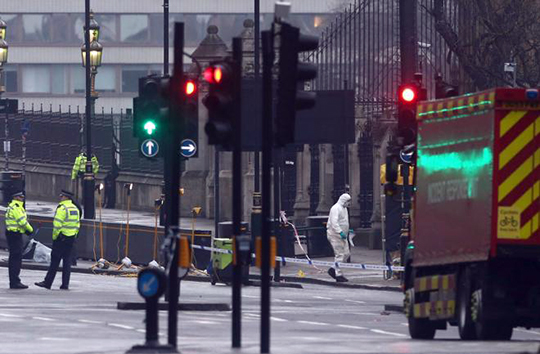
London, Mar 23: Eight people were arrested in raids across London and Birmingham today after a terror attack on the UK Parliament in the heart of Westminster killed four people, including the ISIS attacker who was inspired by "Islamist ideology" and known to British secret services.
uk

"We are not afraid...An act of terrorism tried to silence our democracy, but today we meet as normal," Prime Minister Theresa May told the packed House of Commons which reopened today with a minute's silence a day after the attack.

"What I can confirm is that the man was British born and that – some years ago – he was once investigated in relation to concerns about violent extremism. He was a peripheral figure," she told sombre-looking lawmakers.

Three people were killed and 40 injured when the attacker mowed down pedestrians on a bridge and stabbed to death a police officer outside parliament complex before being shot dead by Scotland Yard officers yesterday.

"It is still believed that this attacker acted alone, and the police have no reason to believe there are imminent further attacks on the public. His identity is known to the police and MI5, and when operational considerations allow, he will be publicly identified. Our working assumption is that the attacker was inspired by Islamist ideology," May said.

Meanwhile, the ISIS on its propaganda news agency 'Amaq' claimed responsibility, saying a "Soldier of the Caliphate" carried out the attack on the British Parliament.

"The operation was carried out in response to calls to target coalition countries," it said in a statement.

The Prime Minister confirmed that eight people have been arrested during raids across London and Birmingham following the attack on the Palace of Westminster in London, which houses Britain's Parliament and the iconic Big Ben.

In her message to the police, British Queen Elizabeth II said, "My thoughts, prayers and deepest sympathy are with all those who have been affected by yesterday's awful violence."

May said the threat level to the UK has been set at 'severe' – meaning an attack is highly likely – for some time. This is the second highest threat level. The highest level 'critical' means there is specific intelligence that an attack is imminent.

"As there is no such intelligence, the independent Joint Terrorism Analysis Centre has decided that the threat level will not change in the light of yesterday's attack," she said.

Giving details known about the attack, May said a single attacker drove his vehicle at speed into innocent pedestrians who were crossing Westminster Bridge, killing two people and injuring around 40 more, of which 29 were hospitalised.

The attacker then left the vehicle and approached a police officer at Carriage Gates of Parliament, attacking him with a large knife, before he was shot dead by an officer.

In addition to 12 Britons admitted to hospital, the injured include three French children, two Romanians, four South Koreans, one German, one Pole, one Irish, one Chinese, one Italian, one American and two Greeks.

"There was no prior intelligence of attacker's intent – or of the plot. Intensive investigations continue," May said.

She also paid tribute to the security services and the police officer who lost his life in the attack.

"Yesterday we saw the worst of humanity, but we will remember the best. We will remember the extraordinary efforts to save the life of Police Constable Keith Palmer. He was every inch a hero," she said.

Scotland Yard Acting Deputy Commissioner and Head of Counter Terrorism Mark Rowley said the investigation was at a critical stage and the identity of the attacker was not being released as the ongoing investigation tries to piece together the suspect's "motivations, his preparation and associates".

He urged the public to use their instincts and report anything suspicious, saying the Met Police will be working round the clock and all annual leave has been cancelled.

"We must not allow terrorists to create discord, distrust and fear. The police stand with all communities," Rowley said.

Overnight, West Midland Police officers stormed a second-floor flat in the city believed to be the residence of the knife-wielding attacker and led away people in handcuffs.

It has also emerged that the car used in the attack was reportedly hired from Solihull area of Birmingham.

The flag at New Scotland Yard premises in London is flying at half-mast following the attack, which claimed the life of one of their officers who was on guard at Parliament.

Mayor of London Sadiq Khan today invited all Londoners and visitors to the capital to a candlelit vigil in Trafalgar Square to show solidarity with the victims of theattack.

Comments

Add new comment

  • Coastaldigest.com reserves the right to delete or block any comments.
  • Coastaldigset.com is not responsible for its readers’ comments.
  • Comments that are abusive, incendiary or irrelevant are strictly prohibited.
  • Please use a genuine email ID and provide your name to avoid reject.
News Network
April 28,2020

Washington, Apr 28: After nearly three weeks in an intensive care unit in Los Angeles, doctors treating 41-year-old Broadway actor Nick Cordero for COVID-19 were forced to amputate his right leg.

The flow of blood had been impeded by a blood clot: yet another dangerous complication of the disease that has been bubbling up in frontline reports from China, Europe and the United States.

To be sure, so-called "thrombotic events" occur for a variety of reasons among intensive care patients, but the rates among COVID-19 patients are far higher than would be otherwise expected.

"I have had 40-year-olds in my ICU who have clots in their fingers that look like they'll lose the finger, but there's no other reason to lose the finger than the virus," Shari Brosnahan, a critical care doctor at NYU Langone said.

One of these patients is suffering from a lack of blood flow to both feet and both hands, and she predicts an amputation may be necessary, or the blood vessels may get so damaged that an extremity could drop off by itself.

Blood clots aren't just dangerous for our limbs, but can make their way to the lungs, heart or brain, where they may cause lethal pulmonary embolisms, heart attacks, and strokes.

A recent paper from the Netherlands in the journal Thrombosis Research found that 31 percent of 184 patients suffered thrombotic complications, a figure that the researchers called "remarkably high" -- even if extreme consequences like amputation are rare.

Behnood Bikdeli, a doctor at New York-Presbyterian Hospital, assembled an international consortium of experts to study the issue. Their findings were published in the Journal of The American College of Cardiology.

The experts found the risks were so great that COVID-19 patients "may need to receive blood thinners, preventively, prophylactically," even before imaging tests are ordered, said Bikdeli.

What exactly is causing it? The reasons aren't fully understood, but he offered several possible explanations.

People with severe forms of COVID-19 often have underlying medical conditions like heart or lung disease -- which are themselves linked to higher rates of clotting.

Next, being in intensive care makes a person likelier to develop a clot because they are staying still for so long. That's why for example people are encouraged to stretch and move around on long haul flights.

It's also now clear the COVID-19 illness is associated with an abnormal immune reaction called "cytokine storm" -- and some research has indicated this too is linked to higher rates of clotting.

There could also be something about the virus itself that is causing coagulation, which has some precedent in other viral illnesses.

A paper in the journal The Lancet last week showed that the virus can infect the inner cell layer of organs and of blood vessels, called the endothelium. This, in theory, could interfere with the clotting process.

According to Brosnahan, while thinners like Heparin are effective in some patients, they don't work for all patients because the clots are at times too small.

"There are too many microclots," she said. "We're not sure exactly where they are."

Autopsies have in fact shown some people's lungs filled with hundreds of microclots.

The arrival of a new mystery however helps solve a slightly older one.

Cecilia Mirant-Borde, an intensive care doctor at a military veterans hospital in Manhattan, told AFP that lungs filled with microclots helped explain why ventilators work poorly for patients with low blood oxygen.

Earlier in the pandemic doctors were treating these patients according to protocols developed for acute respiratory distress syndrome, sometimes known as "wet lung."

But in some cases, "it's not because the lungs are occupied with water" -- rather, it's that the microclotting is blocking circulation and blood is leaving the lungs with less oxygen than it should.

It has just been a little under five months since the virus emerged in Wuhan, China, and researchers are learning more about its impact every day.

"While we react surprised, we shouldn't be as surprised as we were. Viruses tend to do weird things," said Brosnahan.

While the dizzying array of complications may seem daunting, "it's possible there'll be one or a couple of unifying mechanisms that describe how this damage happens," she said.

"It's possible it's all the same thing, and that there'll be the same solution."

Comments

Add new comment

  • Coastaldigest.com reserves the right to delete or block any comments.
  • Coastaldigset.com is not responsible for its readers’ comments.
  • Comments that are abusive, incendiary or irrelevant are strictly prohibited.
  • Please use a genuine email ID and provide your name to avoid reject.
News Network
February 9,2020

Nakhon Ratchasima, Feb 9: The Thai soldier who killed at least 20 people and holed up in a mall overnight was shot dead Sunday morning by commandos, ending a near-17-hour ordeal which left dozens wounded and stunned the country.

It was unclear how many people remained trapped inside the Terminal 21 mall in Nakhon Ratchasima -- also known as Korat -- where the gunman held out through the night, armed with assault weapons stolen from his barracks.

Volleys of gunfire rang out as the siege ran into dawn, hours after Thai security services stormed the ground floor and freed scores of stunned, terrified shoppers from a bloody rampage that the gunman -- a junior army officer identified as Sergeant-Major Jakrapanth Thomma -- had relayed via Facebook posts.

"He was shot dead thirty minutes ago" (0200 GMT), chief of the Crime Suppression Division Jirabhob Bhuridej told AFP.

Commandos from elite Thai police units killed the gunman, a police spokesman added, after an operation involving hundreds of security personnel.

"The official death toll is 20 and wounded 42... nine are in surgery," Narinrat Pitchayakamin, a Korat doctor told reporters, revising down an initial death toll of 21.

But it was unclear if there were more victims inside the multi-level complex which was packed with Saturday shoppers when the gunman stormed in.

A fleet of ambulances left the front of the complex and forensic police poured into the grim crime scene, shortly before the gunman's death was confirmed.

The night was peppered with heavy exchanges of gunfire and sporadic evacuations.

A police officer who took part in a raid to flush out the gunman died, according to deputy prime minister Anutin Charnvirakul. "He had been hit and unfortunately, he couldn't make it," said Anutin.

Shocked evacuees recounted how an ordinary Saturday shopping day at the busy mall descended into horror as the gunman entered.

"It was like a dream... I'm grateful I survived," Sottiyanee Unchalee, 48, told AFP, explaining she hid in the toilet of a gym inside the mall as she heard the gunfire.

"I'm so sorry for those who died... (and) the people still trapped inside."

Stolen weapons

Jakrapanth relayed his shooting spree through Facebook posts which charted the attack from the army barracks in the city to the mall, where an unknown number of shoppers remained trapped.

A volunteer rescue worker recounted a bloody scene of horror after his team carried four corpses to the hospital.

"I've never seen anything like this," Peerapong Chatadee told AFP.

"I just feel so sad. He is a soldier, he should not have fired at unarmed people."

The bloodshed began Saturday afternoon when Jakrapanth shot three people -- among them at least one soldier -- at a senior officer's house and then at the nearby army barracks, before driving an army vehicle to the town centre.

There the gunman used weapons stolen from the military arsenal to unleash carnage in the town centre.

He "used a machine gun and shot innocent victims resulting in many injured and dead", said police spokesman Krissana Pattanacharoen.

Throughout the day, Jakrapanth posted images of himself and wrote several posts on his Facebook page as the attack unfolded.

In one Facebook video -- since deleted -- the assailant, wearing an army helmet, filmed from an open-top jeep, saying, "I'm tired... I can't pull my finger anymore" as he made a trigger symbol with his hand.

There were also photos of a man in a ski mask holding up a pistol.

A Facebook spokesperson said: "We have removed the gunman's accounts from our services and will work around the clock to remove any violating content related to this attack as soon as we become aware of it."

The city is home to one of the largest barracks in Thailand, a country where the military is enmeshed in politics and society.

The nation also has one of the highest rates of gun ownership in the world, and several shootings at courthouses last year renewed concern about gun violence.

Comments

Add new comment

  • Coastaldigest.com reserves the right to delete or block any comments.
  • Coastaldigset.com is not responsible for its readers’ comments.
  • Comments that are abusive, incendiary or irrelevant are strictly prohibited.
  • Please use a genuine email ID and provide your name to avoid reject.
News Network
April 18,2020

Washington, Apr 18: The United States on Friday passed 700,000 confirmed coronavirus cases, according to a tally maintained by Johns Hopkins University.

With the highest number of cases and deaths of any country in the world, the US had recorded 700,282 cases of COVID-19 and 36,773 deaths as of 8:30 pm (0030 GMT Friday), according to the Baltimore-based university.

That marked an increase of 3,856 deaths in the past 24 hours, but that figure likely includes "probable" virus-linked deaths, which had not previously been counted.

This week, New York City said it would add 3,778 "probable" virus deaths to its official count.

The US Centers for Disease Control and Prevention gave a toll Friday night of 33,049 dead, including 4,226 probable virus-linked deaths.

The United States has seen the highest death toll in the world in the coronavirus pandemic, ahead of Italy (22,745 deaths) although its population is just a fifth of that of the US.

Spain has recorded 19,478 deaths, followed by France with 18,681.

Trump announces $19 billion relief for farmers amid COVID-19 epidemic

President Donald Trump on Friday announced a $19 billion financial rescue package to help the agriculture industry weather the staggering economic downturn sparked by measures to defeat the coronavirus.

Trump told a press conference the government "will be implementing a $19 billion relief program for our great farmers and ranchers as they cope with the fallout of the global pandemic."

The program will include direct payments to farmers, ranchers and producers who Trump said have experienced "unprecedented losses during this pandemic."

Agriculture Secretary Sonny Perdue said US farmers have been hit hard by a sharp shift in demand, as schools and restaurants close and more Americans eat at home.

That has disrupted the food supply chain, forcing farmers in many places to destroy dairy output and plow under crops that no longer have buyers.

"Having to dump milk and plow under vegetables ready to market is not only financially distressing, but it's heartbreaking as well to those who produce them," Perdue said.

Perdue said some $3 billion of the money would go to buying produce and milk from such farmers, and redistribute it to community food banks.

Millions of Americans have recently turned to food pantries for meals and groceries after losing their jobs.

Comments

Add new comment

  • Coastaldigest.com reserves the right to delete or block any comments.
  • Coastaldigset.com is not responsible for its readers’ comments.
  • Comments that are abusive, incendiary or irrelevant are strictly prohibited.
  • Please use a genuine email ID and provide your name to avoid reject.