


ISIS claims British parliament attack; 8 arrested in UK raids

March 23, 2017

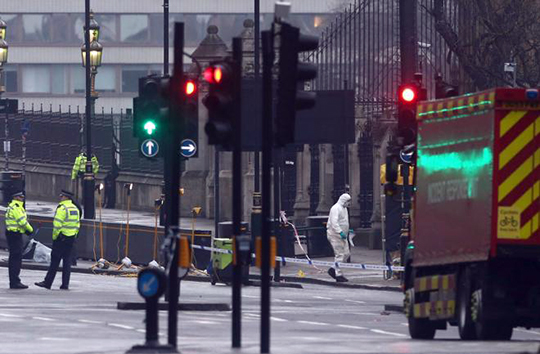
London, Mar 23: Eight people were arrested in raids across London and Birmingham today after a terror attack on the UK Parliament in the heart of Westminster killed four people, including the ISIS attacker who was inspired by "Islamist ideology" and known to British secret services.
uk

"We are not afraid...An act of terrorism tried to silence our democracy, but today we meet as normal," Prime Minister Theresa May told the packed House of Commons which reopened today with a minute's silence a day after the attack.

"What I can confirm is that the man was British born and that – some years ago – he was once investigated in relation to concerns about violent extremism. He was a peripheral figure," she told sombre-looking lawmakers.

Three people were killed and 40 injured when the attacker mowed down pedestrians on a bridge and stabbed to death a police officer outside parliament complex before being shot dead by Scotland Yard officers yesterday.

"It is still believed that this attacker acted alone, and the police have no reason to believe there are imminent further attacks on the public. His identity is known to the police and MI5, and when operational considerations allow, he will be publicly identified. Our working assumption is that the attacker was inspired by Islamist ideology," May said.

Meanwhile, the ISIS on its propaganda news agency 'Amaq' claimed responsibility, saying a "Soldier of the Caliphate" carried out the attack on the British Parliament.

"The operation was carried out in response to calls to target coalition countries," it said in a statement.

The Prime Minister confirmed that eight people have been arrested during raids across London and Birmingham following the attack on the Palace of Westminster in London, which houses Britain's Parliament and the iconic Big Ben.

In her message to the police, British Queen Elizabeth II said, "My thoughts, prayers and deepest sympathy are with all those who have been affected by yesterday's awful violence."

May said the threat level to the UK has been set at 'severe' – meaning an attack is highly likely – for some time. This is the second highest threat level. The highest level 'critical' means there is specific intelligence that an attack is imminent.

"As there is no such intelligence, the independent Joint Terrorism Analysis Centre has decided that the threat level will not change in the light of yesterday's attack," she said.

Giving details known about the attack, May said a single attacker drove his vehicle at speed into innocent pedestrians who were crossing Westminster Bridge, killing two people and injuring around 40 more, of which 29 were hospitalised.

The attacker then left the vehicle and approached a police officer at Carriage Gates of Parliament, attacking him with a large knife, before he was shot dead by an officer.

In addition to 12 Britons admitted to hospital, the injured include three French children, two Romanians, four South Koreans, one German, one Pole, one Irish, one Chinese, one Italian, one American and two Greeks.

"There was no prior intelligence of attacker's intent – or of the plot. Intensive investigations continue," May said.

She also paid tribute to the security services and the police officer who lost his life in the attack.

"Yesterday we saw the worst of humanity, but we will remember the best. We will remember the extraordinary efforts to save the life of Police Constable Keith Palmer. He was every inch a hero," she said.

Scotland Yard Acting Deputy Commissioner and Head of Counter Terrorism Mark Rowley said the investigation was at a critical stage and the identity of the attacker was not being released as the ongoing investigation tries to piece together the suspect's "motivations, his preparation and associates".

He urged the public to use their instincts and report anything suspicious, saying the Met Police will be working round the clock and all annual leave has been cancelled.

"We must not allow terrorists to create discord, distrust and fear. The police stand with all communities," Rowley said.

Overnight, West Midland Police officers stormed a second-floor flat in the city believed to be the residence of the knife-wielding attacker and led away people in handcuffs.

It has also emerged that the car used in the attack was reportedly hired from Solihull area of Birmingham.

The flag at New Scotland Yard premises in London is flying at half-mast following the attack, which claimed the life of one of their officers who was on guard at Parliament.

Mayor of London Sadiq Khan today invited all Londoners and visitors to the capital to a candlelit vigil in Trafalgar Square to show solidarity with the victims of theattack.

Comments

Add new comment

  • Coastaldigest.com reserves the right to delete or block any comments.
  • Coastaldigset.com is not responsible for its readers’ comments.
  • Comments that are abusive, incendiary or irrelevant are strictly prohibited.
  • Please use a genuine email ID and provide your name to avoid reject.
News Network
July 2,2020

Los Angeles, Jul 2: New daily coronavirus cases in the United States soared past 50,000 for the first time Wednesday, as the World Health Organization delivered a grave warning that the global pandemic is accelerating.

Restaurants, bars and beaches in the world's worst-hit nation closed from California to Florida, as states reeling from yet another surge in the deadly virus braced for Independence Day festivities.

Global infections have hit their highest level in the past week, WHO data showed, with chief Tedros Adhanom Ghebreyesus saying new cases topped "160,000 on every single day."

The grim milestone came as the European Union left the United States, Brazil and Russia off its final list of nations safe enough to allow residents to enter its borders.

With more than 52,000 new COVID-19 cases in the United States alone in the past 24 hours, according to a Johns Hopkins University tally, several US states imposed 14-day quarantines on visitors in the buildup to the long weekend's July 4 celebrations.

California suspended indoor dining at restaurants in Los Angeles and several counties, while New York scrapped plans to allow restaurants to seat customers inside from next week.

President Donald Trump reiterated his belief that the contagion will "at some point... sort of just disappear, I hope."

But the US leader who has yet to be seen in public wearing a face mask during the pandemic added he would have "no problem" doing so.

EU travel ban eased

The rollbacks came as the European Union reopened its borders to visitors from 15 countries.

The bloc hopes relaxing restrictions on countries from Algeria to Uruguay will breathe life into its tourism sector, choked by a ban on non-essential travel since mid-March.

Travelers from China, where the virus first emerged late last year, will be allowed to enter the EU only if Beijing reciprocates.

And Brazil -- which has suffered the most deaths globally for the last week, and is the second-worst affected country overall -- was excluded entirely.

It topped 60,000 total fatalities Wednesday, after suffering 1,000 deaths in just 24 hours.

However, with over 10 million known infections worldwide and more than 500,000 deaths, the pandemic is "not even close to being over", the WHO warned.

Data provided by the UN health agency for the seven days from June 25-July 1 showed the highest number of new daily cases ever recorded came on June 28, when over 189,500 new cases were registered worldwide.

'Dutch brothels reopen'

According to the United Nations, the coronavirus crisis could cost global tourism and related sectors from $1.2 to $3.3 trillion in lost revenue.

Greece, which has suffered fewer than 200 virus deaths, has seen its economy hit hard by lockdowns and travel restrictions -- all but ending its lucrative tourism season before it began.

Romanian Cojan Dragos was "the first tourist" in one Corfu hotel after driving there with his wife and daughter.

"We have the whole hotel just for us," he told news agency.

Separately, Spain and Portugal held a ceremony as they reopened their land border.

The Netherlands also confirmed the reopening Wednesday of another tourist draw -- its brothels and red-light districts.

"I'm totally booked," said sex worker Foxxy, adding that she had held a "little party" when she heard restrictions would be lifted.

Clusters spur new lockdowns

Russia did not make the EU's list of approved countries so its citizens will be absent from the bloc's tourist hot-spots.

The country, however, enjoyed a public holiday Wednesday as it voted in a referendum to approve constitutional changes allowing President Vladimir Putin to stay in power for another 16 years.

Putin was forced to postpone the vote in April as his government tackled an outbreak that has infected almost 650,000 people -- the third-highest in the world.

In other countries, clusters are still causing problems.

Parts of the Australian city of Melbourne suffered sharp rises in infections, spurring new stay-at-home measures.

The Palestinian Authority announced a five-day lockdown across the West Bank after a surge in confirmed cases.

And textile factories in the central British city of Leicester were suggested as the reason for a spike in infections that has prompted the reimposition of local restrictions.

Americas spike

In the United States, spikes across southern and western states are driving a surge in national infections.

Texas, which again smashed its daily COVID-19 record with over 8,000 new cases, joined Florida and California in closing some beaches for the upcoming holiday weekend.

Apple announced it would close another 30 US stores on Thursday, half of them in California.

A further 700 deaths nationwide took the US past 128,000 deaths in total.

The Pan American Health Organization warned that the death count in Latin America and the Caribbean could quadruple to more than 400,000 by October without stricter public health measures.

The US government announced this week it had bought 92 percent of all remdesivir production -- the first drug to be shown to be relatively effective in treating COVID-19.

Britain and Germany, however, said Wednesday they had sufficient stocks of the drug.

'Corona baby'

In Britain, some 1,500 acts from Ed Sheeran and Coldplay to Paul McCartney and The Rolling Stones urged the county's government to save the live music industry, which has been collapsing because of the coronavirus.

But while lockdown measures have been a disaster for many, some have welcomed the chance to spend more quality time with hard-working partners.

Comments

Add new comment

  • Coastaldigest.com reserves the right to delete or block any comments.
  • Coastaldigset.com is not responsible for its readers’ comments.
  • Comments that are abusive, incendiary or irrelevant are strictly prohibited.
  • Please use a genuine email ID and provide your name to avoid reject.
News Network
May 22,2020

Washington, May 22: The deadly coronavirus came from China and the US is not going to take it lightly, American President Donald Trump said on Thursday.

"It came from China. We are not happy about it. We just signed a trade deal, the ink wasn't dry and all of the sudden this floated in. We are not going to take it lightly,” Trump said participating in a Listening Session with African-American Leaders in Michigan.

Trump in the last several weeks has been very critical of China's inability to control the spread of the novel coronavirus within its territory. By Thursday more than 94,000 Americans have died due to the coronavirus and over 1.6 million have tested positive.

He has so far not given any indication of the steps that he is contemplating taking against China.

Meanwhile, pressure is building on his administration, mainly from the Republican lawmakers on this.

On Thursday, Senators Ted Cruz and Rick Scott, along Mike Braun, Marsha Blackburn, Joni Ernst, Martha McSally and Tom Cotton, introduced the COVID-19 Vaccine Protection Act to prevent the Chinese Communist Party from stealing or sabotaging American COVID-19 vaccine research.

The bill requires a thorough national security evaluation and clearance by the Department of Homeland Security, the Department of State, and the Federal Bureau of Investigation of all Chinese student visa holders taking part in activities related to COVID-19 vaccine research.

"The same Chinese Communist Party that covered up the coronavirus outbreak also routinely engages in state sponsored theft of intellectual property," Cruz said. "We cannot allow China to steal or interfere with American research and development of a vaccine,” he added.

"Communist China is responsible for the coronavirus pandemic, and their lies and misinformation cost American lives," Scott said.

"We cannot let Communist China off the hook for this, and we absolutely cannot allow Communist China to steal or sabotage any American research efforts related to the Coronavirus vaccine. The COVID-19 Vaccine Protection Act protects American efforts to create a vaccine as we work to end this pandemic," he added.

The COVID-19 Vaccine Protection Act, among others requires an enhanced vetting of nationals of the Chinese nationals in the US as nonimmigrants under F, J, or M student visas to determine if any student visa holders are a national security threat.

Once the review is complete, authorizes Department of Homeland Secretary, in consultation with other agencies, to continuously monitor all nonimmigrant student visa holders (F, M, J) who are Chinese nationals while in the US and are engaged in, or have access to, the research of any potential COVID-19 vaccine or COVID-19 related material.

Republican Whip and Ranking Member of the Select Subcommittee on the Coronavirus Crisis Steve Scalise alleged that China lied to the world on coronavirus.

"During a critical period in December and January, China withheld evidence of the virus: evidence that confirmed human to human transmission of the virus, evidence of the extent of the spread. China refused entry of American and other medical experts from around the world for weeks,” he said.

“And during this time, China hoarded medical supplies like masks, gowns, and other life-saving PPE. Chinese exports of surgical masks, gowns, and gloves were stifled by the Chinese Communist Party during this period. China knew the danger posed by the virus and while they hid the truth, they used the time to stock up on vital medical supplies,” Scalise said.

“While Chinese authorities limited domestic flights from Wuhan to other Chinese cities like Beijing and Shanghai, China's government urged international carriers to maintain their flight schedules — seeding the virus throughout the rest of the world,” he alleged.

Comments

Add new comment

  • Coastaldigest.com reserves the right to delete or block any comments.
  • Coastaldigset.com is not responsible for its readers’ comments.
  • Comments that are abusive, incendiary or irrelevant are strictly prohibited.
  • Please use a genuine email ID and provide your name to avoid reject.
News Network
February 9,2020

Wuhan, Feb 9: President Xi Jinping strode onstage before an adoring audience in the Great Hall of the People in Beijing less than three weeks ago, trumpeting his successes in steering China through a tumultuous year and promising "landmark" progress in 2020.

"Every single Chinese person, every member of the Chinese nation, should feel proud to live in this great era," he declared to applause on the day before the Lunar New Year holiday. "Our progress will not be halted by any storms and tempests."

Xi made no mention of a dangerous new coronavirus that had already taken tenacious hold in the country. As he spoke, the government was locking down Wuhan, a city of 11 million people, in a frantic attempt to stop the virus spreading from its epicenter.

The coronavirus epidemic, which has killed more than 800 people in China as of Sunday and sickened tens of thousands, comes as Xi has struggled with a host of other challenges: a slowing economy, huge protests in Hong Kong, an election in Taiwan that rebuffed Beijing and a protracted trade war with the United States.

Now Xi faces an accelerating health crisis that is also a political one: a profound test of the authoritarian system he has built around himself over the past seven years. As the Chinese government struggles to contain the virus amid rising public discontent with its performance, the changes that Xi has ushered in could make it difficult for him to escape blame.

"It’s a big shock to the legitimacy of the ruling party. I think it could be only second to the June 4 incident of 1989. It’s that big," said Rong Jian, a writer about politics in Beijing, referring to the armed crackdown on Tiananmen Square protesters that year.

"There’s no doubt about his control over power," he added, "but the manner of control and its consequences have hurt his legitimacy and reputation."

Xi himself has recognized what is at stake, calling the outbreak "a major test of China’s system and capacity for governance."

Yet as China’s battle with the coronavirus intensified, Xi put the country’s No. 2 leader, Li Keqiang, in charge of a leadership group handling the emergency, effectively turning him into the public face of the government’s response. It was Li Keqiang who traveled to Wuhan to visit doctors.

Xi, by contrast, receded from public view for several days. That was not without precedent, though it stood out in this crisis, after previous Chinese leaders had used times of disaster to try to show a more common touch. State television and newspapers almost always lead with fawning coverage of Xi’s every move.

That retreat from the spotlight, some analysts said, signaled an effort by Xi to insulate himself from a campaign that may falter and draw public ire. Yet Xi has consolidated power, sidelining or eliminating rivals, so there are few people left to blame when something goes wrong.

"Politically, I think he is discovering that having total dictatorial power has a downside, which is that when things go wrong or have a high risk of going wrong, then you also have to bear all the responsibility," said Victor Shih, an associate professor at the University of California San Diego who studies Chinese politics.

Much of the country’s population has been told to stay at home, factories remain closed, and airlines have cut service. Experts warn that the coronavirus could slam the economy if not swiftly contained.

The government is also having trouble controlling the narrative. Xi now faces unusually sharp public discontent that even China’s rigorous censorship apparatus has been unable to stifle entirely.

The death of an ophthalmologist in Wuhan, Dr. Li Wenliang, who was censured for warning his medical school classmates of the spread of a dangerous new disease in December, has unleashed a torrent of pent-up public grief and rage over the government’s handling of the crisis. Chinese academics have launched at least two petitions in the wake of Li’s death, each calling for freedom of speech.

State media still portray Xi as ultimately in control, and there’s no sign that he faces a serious challenge from within the party leadership. The crisis, though, has already tainted China’s image as an emerging superpower — efficient, stable and strong — that could eventually rival the United States.

How much the crisis might erode Xi’s political standing remains to be seen, but it could weaken his position in the long run as he prepares to take a likely third term as Communist Party general secretary in 2022.

In 2018, Xi won approval to remove the constitutional limits on his term as the country’s president, making his plan for another five-year term seem all but certain.

If Xi comes out of this crisis politically insecure, the consequences are unpredictable. He may become more open to compromise within the party elite. Or he may double down on the imperious ways that have made him China’s most powerful leader in generations.

"Xi’s grip on power is not light," said Jude Blanchette, the Freeman Chair in China Studies at the Center for Strategic and International Studies.

"While the ham-fisted response to this crisis undoubtedly adds a further blemish to Xi’s tenure in office," Blanchette added, "the logistics of organizing a leadership challenge against him remain formidable."

In recent days, despite a dearth of public appearances, state media have portrayed Xi as a tireless commander-in-chief. This week they began calling the government’s fight against the virus the "people’s war," a phrase used in the official readout of Xi’s telephone call with President Donald Trump on Friday.

There are increasing signs that the propaganda this time is proving less than persuasive.

The Lunar New Year reception in Beijing where Xi spoke became a source of popular anger, a symbol of a government slow to respond to the suffering in Wuhan. Xi and other leaders appear to have been caught off guard by the ferocity of the epidemic.

Senior officials would almost certainly have been informed of the emerging crisis by the time national health authorities told the World Health Organization on Dec. 31, but neither Xi nor other officials in Beijing informed the public.

Xi’s first acknowledgment of the epidemic came Jan. 20, when brief instructions were issued under his name. His first public appearance after the lockdown of Wuhan on Jan. 23 came two days later, when he presided over a meeting of the Communist Party’s top body, the Politburo Standing Committee, which was shown at length on Chinese television. "We’re sure to be able to win in this battle," he proclaimed.

Back then, the death toll was 106. As it rose, Xi allowed other officials to take on more visible roles. Xi’s only appearances have been meeting foreign visitors in the Great Hall of the People or presiding over Communist Party meetings.

On Jan. 28, Xi met with the executive director of the World Health Organization, Dr. Tedros Adhanom Ghebreyesus, and told Tedros that he "personally directed" the government’s response. Later reports in state media omitted the phrase, saying instead that Xi’s government was "collectively directing" the response.

Since nothing about how Xi is portrayed in state media happens by accident, the tweak suggested a deliberate effort to emphasize shared responsibility.

Xi did not appear on official broadcasts again for a week — until a highly scripted meeting Wednesday with the authoritarian leader of Cambodia, Hun Sen.

There is little evidence that Xi has given up power behind the scenes. Li Keqiang, the premier in formal charge of the leadership group for the crisis, and other officials have said that they take their orders from Xi. The group is filled with officials who work closely under Xi, and its directives emphasize his authority.

"The way the epidemic is being handled now from the top just doesn’t fit with the argument that there’s been a clear shift toward more collective, consultative leadership," said Holly Snape, a British Academy Fellow at the University of Glasgow who studies Chinese politics.

The scale of discontent and the potential challenges for Xi could be measured by repeated references online to the nuclear accident at Chernobyl. Many of them came under the guise of viewer reviews of the popular television miniseries of the same name, which is still available for streaming inside China.

"In any era, any country, it’s the same. Cover everything up," one reviewer wrote.

The Soviet Union of 1986, however, was a different country than China in 2020.

The Soviet state was foundering when Chernobyl happened, said Sergey Radchenko, a professor of international relations at Cardiff University in Wales who has written extensively on Soviet and Chinese politics.

"The Chinese authorities, by contrast, are demonstrating an ability to cope, a willingness to take unprecedented measures — logistical feats that may actually increase the regime’s legitimacy," he added.

Radchenko compared Xi’s actions to those of previous leaders in moments of crisis: Mao Zedong after the Cultural Revolution or Deng Xiaoping after the Tiananmen Square crackdown.

"He’s doing what Mao and Deng would have done in similar circumstances: stepping back into the shadows while remaining firmly in charge."

Comments

Add new comment

  • Coastaldigest.com reserves the right to delete or block any comments.
  • Coastaldigset.com is not responsible for its readers’ comments.
  • Comments that are abusive, incendiary or irrelevant are strictly prohibited.
  • Please use a genuine email ID and provide your name to avoid reject.