


ISIS claims British parliament attack; 8 arrested in UK raids

March 23, 2017

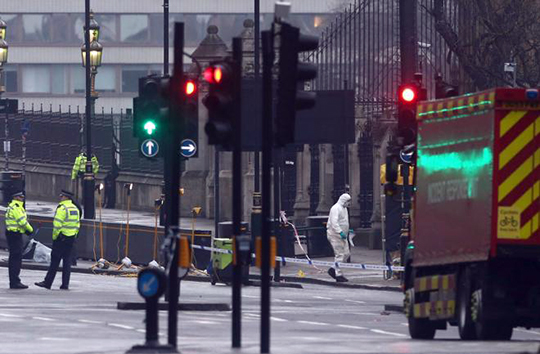
London, Mar 23: Eight people were arrested in raids across London and Birmingham today after a terror attack on the UK Parliament in the heart of Westminster killed four people, including the ISIS attacker who was inspired by "Islamist ideology" and known to British secret services.
uk

"We are not afraid...An act of terrorism tried to silence our democracy, but today we meet as normal," Prime Minister Theresa May told the packed House of Commons which reopened today with a minute's silence a day after the attack.

"What I can confirm is that the man was British born and that – some years ago – he was once investigated in relation to concerns about violent extremism. He was a peripheral figure," she told sombre-looking lawmakers.

Three people were killed and 40 injured when the attacker mowed down pedestrians on a bridge and stabbed to death a police officer outside parliament complex before being shot dead by Scotland Yard officers yesterday.

"It is still believed that this attacker acted alone, and the police have no reason to believe there are imminent further attacks on the public. His identity is known to the police and MI5, and when operational considerations allow, he will be publicly identified. Our working assumption is that the attacker was inspired by Islamist ideology," May said.

Meanwhile, the ISIS on its propaganda news agency 'Amaq' claimed responsibility, saying a "Soldier of the Caliphate" carried out the attack on the British Parliament.

"The operation was carried out in response to calls to target coalition countries," it said in a statement.

The Prime Minister confirmed that eight people have been arrested during raids across London and Birmingham following the attack on the Palace of Westminster in London, which houses Britain's Parliament and the iconic Big Ben.

In her message to the police, British Queen Elizabeth II said, "My thoughts, prayers and deepest sympathy are with all those who have been affected by yesterday's awful violence."

May said the threat level to the UK has been set at 'severe' – meaning an attack is highly likely – for some time. This is the second highest threat level. The highest level 'critical' means there is specific intelligence that an attack is imminent.

"As there is no such intelligence, the independent Joint Terrorism Analysis Centre has decided that the threat level will not change in the light of yesterday's attack," she said.

Giving details known about the attack, May said a single attacker drove his vehicle at speed into innocent pedestrians who were crossing Westminster Bridge, killing two people and injuring around 40 more, of which 29 were hospitalised.

The attacker then left the vehicle and approached a police officer at Carriage Gates of Parliament, attacking him with a large knife, before he was shot dead by an officer.

In addition to 12 Britons admitted to hospital, the injured include three French children, two Romanians, four South Koreans, one German, one Pole, one Irish, one Chinese, one Italian, one American and two Greeks.

"There was no prior intelligence of attacker's intent – or of the plot. Intensive investigations continue," May said.

She also paid tribute to the security services and the police officer who lost his life in the attack.

"Yesterday we saw the worst of humanity, but we will remember the best. We will remember the extraordinary efforts to save the life of Police Constable Keith Palmer. He was every inch a hero," she said.

Scotland Yard Acting Deputy Commissioner and Head of Counter Terrorism Mark Rowley said the investigation was at a critical stage and the identity of the attacker was not being released as the ongoing investigation tries to piece together the suspect's "motivations, his preparation and associates".

He urged the public to use their instincts and report anything suspicious, saying the Met Police will be working round the clock and all annual leave has been cancelled.

"We must not allow terrorists to create discord, distrust and fear. The police stand with all communities," Rowley said.

Overnight, West Midland Police officers stormed a second-floor flat in the city believed to be the residence of the knife-wielding attacker and led away people in handcuffs.

It has also emerged that the car used in the attack was reportedly hired from Solihull area of Birmingham.

The flag at New Scotland Yard premises in London is flying at half-mast following the attack, which claimed the life of one of their officers who was on guard at Parliament.

Mayor of London Sadiq Khan today invited all Londoners and visitors to the capital to a candlelit vigil in Trafalgar Square to show solidarity with the victims of theattack.

Comments

Add new comment

  • Coastaldigest.com reserves the right to delete or block any comments.
  • Coastaldigset.com is not responsible for its readers’ comments.
  • Comments that are abusive, incendiary or irrelevant are strictly prohibited.
  • Please use a genuine email ID and provide your name to avoid reject.
News Network
April 27,2020

Seoul/South Korea, Apr 27: North Korean leader Kim Jong Un is "alive and well", a top security adviser to the South's President Moon Jae-in said, downplaying rumours over Kim's health following his absence from a key anniversary.
"Our government position is firm," said Moon's special adviser on national security Moon Chung-in, in an interview with CNN on Sunday. "Kim Jong Un is alive and well."

The adviser said that Kim had been staying in Wonsan -- a resort town in the country's east -- since April 13, adding: "No suspicious movements have so far been detected."

Conjecture about Kim's health has grown since his conspicuous absence from the April 15 celebrations for the birthday of his grandfather Kim Il Sung, the North's founder -- the most important day in the country's political calendar.

Kim has not made a public appearance since presiding over a Workers' Party politburo meeting on April 11, and the following day state media reported him inspecting fighter jets at an air defence unit.

North Korean leader Kim Jong Un was not gravely ill, two South Korean government sources said on Tuesday, following reports he had undergone a cardiovascular procedure and was now in "grave danger."

His absence unleashed a series of unconfirmed media reports over his condition, which officials in Seoul previously poured cold water on.

"We have nothing to confirm and no special movement has been detected inside North Korea as of now," the South's presidential office said in a statement last week.

South Korea's unification minister Kim Yeon-chul reiterated Monday that remained the case, adding the "confident" conclusion was drawn from "a complex process of intelligence gathering and assessment".

'Grave danger'

Daily NK, an online media outlet run mostly by North Korean defectors, has reported Kim was undergoing treatment after a cardiovascular procedure earlier this month.

Citing an unidentified source inside the country, it said Kim, who is in his mid-30s, had needed urgent treatment due to heavy smoking, obesity and fatigue.

Soon afterwards, CNN reported that Washington was "monitoring intelligence" that Kim was in "grave danger" after undergoing surgery, quoting what it said was an anonymous US official.

US President Donald Trump on Thursday rejected reports that Kim was ailing but declined to state when he was last in touch with him.

On Monday, the official Rodong Sinmun newspaper reported that Kim had sent a message of thanks to workers on the giant Wonsan Kalma coastal tourism project.

It was the latest in a series of reports in recent days of statements issued or actions taken in Kim's name, although none has carried any pictures of him.

Satellite images reviewed by 38North, a US-based think tank, showed a train probably belonging to Kim at a station in Wonsan last week.

It cautioned that the train's presence did not "indicate anything about his health" but did "lend weight" to reports he was staying on the country's eastern coast.

Reporting from inside the isolated North is notoriously difficult, especially regarding anything to do with its leadership, which is among its most closely guarded secrets.

Previous absences from the public eye on Kim's part have prompted speculation about his health.

In 2014 he dropped out of sight for nearly six weeks before reappearing with a cane. Days later, the South's spy agency said he had undergone surgery to remove a cyst from his ankle.

Comments

Add new comment

  • Coastaldigest.com reserves the right to delete or block any comments.
  • Coastaldigset.com is not responsible for its readers’ comments.
  • Comments that are abusive, incendiary or irrelevant are strictly prohibited.
  • Please use a genuine email ID and provide your name to avoid reject.
News Network
February 26,2020

Feb 26: China’s massive travel restrictions, house-to-house checks, huge isolation wards and lockdowns of entire cities bought the world valuable time to prepare for the global spread of the new virus.

But with troubling outbreaks now emerging in Italy, South Korea and Iran, and U.S. health officials warning Tuesday it’s inevitable it will spread more widely in America, the question is: Did the world use that time wisely and is it ready for a potential pandemic?

“It’s not so much a question of if this will happen anymore, but rather more a question of exactly when this will happen — and how many people in this country will have severe illness,” said Dr. Nancy Messonnier of the U.S. Centers for Disease Control and Prevention.

Some countries are putting price caps on face masks to combat price gouging, while others are using loudspeakers on trucks to keep residents informed. In the United States and many other nations, public health officials are turning to guidelines written for pandemic flu and discussing the possibility of school closures, telecommuting and canceling events.

Countries could be doing even more: training hundreds of workers to trace the virus’ spread from person to person and planning to commandeer entire hospital wards or even entire hospitals, said Dr. Bruce Aylward, the World Health Organization’s envoy to China, briefing reporters Tuesday about lessons learned by the recently returned team of international scientists he led.

“Time is everything in this disease,” Aylward said. “Days make a difference with a disease like this.”

The U.S. National Institutes of Health’s infectious disease chief, Dr. Anthony Fauci, said the world is “teetering very, very close” to a pandemic. He credits China’s response for giving other nations some breathing room.

China locked down tens of millions of its citizens and other nations imposed travel restrictions, reducing the number of people who needed health checks or quarantines outside the Asian country.

It “gave us time to really brush off our pandemic preparedness plans and get ready for the kinds of things we have to do,” Fauci said. “And we’ve actually been quite successful because the travel-related cases, we’ve been able to identify, to isolate” and to track down those they came in contact with.

With no vaccine or medicine available yet, preparations are focused on what’s called “social distancing” — limiting opportunities for people to gather and spread the virus.

That played out in Italy this week. With cases climbing, authorities cut short the popular Venice Carnival and closed down Milan’s La Scala opera house. In Japan, Prime Minister Shinzo Abe called on companies to allow employees to work from home, while the Tokyo Marathon has been restricted to elite runners and other public events have been canceled.

Is the rest of the world ready?

In Africa, three-quarters of countries have a flu pandemic plan, but most are outdated, according to authors of a modeling study published last week in The Lancet medical journal. The slightly better news is that the African nations most connected to China by air travel — Egypt, Algeria and South Africa — also have the most prepared health systems on the continent.

Elsewhere, Thailand said it would establish special clinics to examine people with flu-like symptoms to detect infections early. Sri Lanka and Laos imposed price ceilings for face masks, while India restricted the export of personal protective equipment.

India’s health ministry has been framing step-by-step instructions to deal with sustained transmissions that will be circulated to the 250,000 village councils that are the most basic unit of the country’s sprawling administration.

Vietnam is using music videos on social media to reach the public. In Malaysia, loudspeakers on trucks blare information through the streets.

In Europe, portable pods set up at United Kingdom hospitals will be used to assess people suspected of infection while keeping them apart from others. France developed a quick test for the virus and has shared it with poorer nations. German authorities are stressing “sneezing etiquette” and Russia is screening people at airports, railway stations and those riding public transportation.

In the U.S., hospitals and emergency workers for years have practiced for a possible deadly, fast-spreading flu. Those drills helped the first hospitals to treat U.S. patients suffering from COVID-19, the disease caused by the virus.

Other hospitals are paying attention. The CDC has been talking to the American Hospital Association, which in turn communicates coronavirus news daily to its nearly 5,000 member hospitals. Hospitals are reviewing infection control measures, considering using telemedicine to keep potentially infectious patients from making unnecessary trips to the hospital and conserving dwindling supplies of masks and gloves.

What’s more, the CDC has held 17 different calls reaching more than 11,000 companies and organizations, including stadiums, universities, faith leaders, retailers and large corporations. U.S. health authorities are talking to city, county and state health departments about being ready to cancel mass gathering events, close schools and take other steps.

The CDC’s Messonnier said Tuesday she had contacted her children’s school district to ask about plans for using internet-based education should schools need to close temporarily, as some did in 2009 during an outbreak of H1N1 flu. She encouraged American parents to do the same, and to ask their employers whether they’ll be able to work from home.

“We want to make sure the American public is prepared,” Messonnier said.

How prepared are U.S. hospitals?

“It depends on caseload and location. I would suspect most hospitals are prepared to handle one to two cases, but if there is ongoing local transmission with many cases, most are likely not prepared just yet for a surge of patients and the ‘worried well,’” Dr. Jennifer Lighter, a pediatric infectious diseases specialist at NYU Langone in New York, said in an email.

In the U.S., a vaccine candidate is inching closer to first-step safety studies in people, as Moderna Inc. has delivered test doses to Fauci’s NIH institute. Some other companies say they have candidates that could begin testing in a few months. Still, even if those first safety studies show no red flags, specialists believe it would take at least a year to have something ready for widespread use. That’s longer than it took in 2009, during the H1N1 flu pandemic — because that time around, scientists only had to adjust regular flu vaccines, not start from scratch.

The head of the World Health Organization, Tedros Adhanom Ghebreyesus, said the U.N. health agency’s team in China found the fatality rate between 2% and 4% in the hard-hit city of Wuhan, the virus’ epicenter, and 0.7% elsewhere.

The world is “simply not ready,” said the WHO’s Aylward. “It can get ready very fast, but the big shift has to be in the mindset.”

Aylward advised other countries to do “really practical things” now to get ready.

Among them: Do you have hundreds of workers lined up and trained to trace the contacts of infected patients, or will you be training them after a cluster pops up?

Can you take over entire hospital wards, or even entire hospitals, to isolate patients?

Are hospitals buying ventilators and checking oxygen supplies?

Countries must improve testing capacity — and instructions so health workers know which travelers should be tested as the number of affected countries rises, said Johns Hopkins University emergency response specialist Lauren Sauer. She pointed to how Canada diagnosed the first traveler from Iran arriving there with COVID-19, before many other countries even considered adding Iran to the at-risk list.

If the disease does spread globally, everyone is likely to feel it, said Nancy Foster, a vice president of the American Hospital Association. Even those who aren’t ill may need to help friends and family in isolation or have their own health appointments delayed.

“There will be a lot of people affected even if they never become ill themselves,” she said.

Comments

Add new comment

  • Coastaldigest.com reserves the right to delete or block any comments.
  • Coastaldigset.com is not responsible for its readers’ comments.
  • Comments that are abusive, incendiary or irrelevant are strictly prohibited.
  • Please use a genuine email ID and provide your name to avoid reject.
News Network
February 12,2020

Saint Martin's Island, Feb 12: At least 15 women and children drowned and more than 50 others were missing after a boat overloaded with Rohingya refugees sank off southern Bangladesh as it tried to reach Malaysia Tuesday, officials said.

Some 138 people -- mainly women and children -- were packed on a trawler barely 13 metres (40 feet) long, trying to cross the Bay of Bengal, a coast guard spokesman told news agency.

"It sank because of overloading. The boat was meant to carry maximum 50 people. The boat was also loaded with some cargo," another coast guard spokesman, Hamidul Islam, added.

Nearly one million Rohingya live in squalid camps near Bangladesh's border with Myanmar, many fleeing the neighbouring country after a 2017 brutal military crackdown.

With few opportunities for jobs and education in the camps, thousands have tried to reach other countries like Malaysia and Thailand by attempting the hazardous 2,000-kilometre journey.

In the latest incident, 71 people have been rescued including 46 women. Among the dead, 11 were women and the rest children.

Anwara Begum said two of her sons, aged six and seven, drowned in the tragedy.

"We were four of us in the boat... Another child (son, aged 10) is very sick," the 40-year-old told news agency.

Fishermen tipped off the coast guard after they saw survivors swimming and crying for help in the sea.

The boat's keel hit undersea coral in shallow water off Saint Martin's Island, Bangladesh's southernmost territory, before it sank, survivors said.

"We swam in the sea before boats came and rescued us," said survivor Mohammad Hossain, 20.

Coast guard commander Sohel Rana said three survivors, including a Bangladeshi, were detained over human trafficking allegations.

An estimated 25,000 Rohingya left Bangladesh and Myanmar on boats in 2015 trying to get to Thailand, Malaysia and Indonesia. Hundreds drowned when overloaded boats sank.

Begum said her family paid a Bangladeshi trafficker $450 per head to be taken to Malaysia.

"We're first taken to a hill where we stayed for five days. Then they used three small trawlers to take us to a large trawler, which sank," she said.

Shakirul Islam, a migration expert whose group works with Rohingya to raise awareness against trafficking, said desperation in the camps was making refugees want to leave.

"It was a tragedy waiting to happen," he said.

"They just want to get out, and fall victim to traffickers who are very active in the camps."

Islam said in the past two months dozens of Rohingya reported approaches from traffickers to his OKUP migration rights group.

"Human smuggling and trafficking in the Bay of Bengal is particularly difficult to address as it requires concerted effort from multiple states," the Bangladesh head of UN agency the International Organization for Migration, Giorgi Gigauri, told news agency.

"The gaps in coordination are easily exploited by criminal networks."

Since last year, Bangladeshi authorities have picked up over 500 Rohingya from rickety fishing trawlers or coastal villages as they waited to board boats.

Trafficking often increases during the November-March period when the sea is safest for the small trawlers used by traffickers.

Bangladesh and Myanmar signed a repatriation deal to send back some Rohingya to their homeland, but none have agreed to return because of safety fears.

The charity Save the Children called on Myanmar to "take all necessary steps to ensure the Rohingya community can return to their homes in a safe and dignified manner".

"The tragic drowning of women and children... should be a wake-up call for us all," the group's Athena Rayburn said in a statement.

Comments

Add new comment

  • Coastaldigest.com reserves the right to delete or block any comments.
  • Coastaldigset.com is not responsible for its readers’ comments.
  • Comments that are abusive, incendiary or irrelevant are strictly prohibited.
  • Please use a genuine email ID and provide your name to avoid reject.