Israel bombs northern Gaza; 2 Palestinians killed, over 25 wounded

Agencies
December 9, 2017

At least two people have been killed in an Israeli air raid on the besieged Gaza Strip, according to the Palestinian health ministry.

Another 25 Palestinians, including a six-month-old baby, were also wounded in the attack carried out on Friday night.

Dr Ashraf al-Qidra, the spokesperson for the health ministry, told local media that the bodies of two Hamas fighters were recovered at dawn from training sites of the Qassam Brigades armed wing in the south of Gaza City.

The fighters were identified as Mahmoud al-Atal, 28 and Mohammed Safadi, 30.

Friday night's air raid by Israel followed the alleged launching of rockets from inside the Gaza Strip.

One was reportedly intercepted by Israel's US-built Iron Dome missile defence system over the southern Israeli city of Sderot, while the second did not reach Israeli territory.

A third rocket, allegedly fired from Gaza, exploded in Sderot, according to the Israeli daily Haaretz. No casualties were reported.

Palestinian political party Hamas tweeted that Israeli "jet planes target parts of north Gaza".

Israeli media said the targets were Hamas military installations.

The Israeli attack came amid massive protests in the occupied West Bank, occupied East Jerusalem and besieged Gaza over US President Donald Trump's recognition of Jerusalem as the capital of Israel.

Palestinians see East Jerusalem, which has been occupied by Israel since 1967, as the capital of their future state.

At least one Palestinian has been killed by Israeli fire in the protests and nearly 800 more have been injured.

Al Jazeera was unable to confirm if any group in Gaza had claimed responsibility for the rockets.

Speaking to Al Jazeera from Gaza on Wednesday, Hamas leader Ismail Haniya called Trump's move a "flagrant aggression".

"We call on stopping this decision fully because this will usher in the beginning of a time of terrible transformations, not just on the Palestinian level but on the region as a whole," Haniya said.

"This decision means the official announcement of the end of the peace process."

Comments

Add new comment

  • Coastaldigest.com reserves the right to delete or block any comments.
  • Coastaldigset.com is not responsible for its readers’ comments.
  • Comments that are abusive, incendiary or irrelevant are strictly prohibited.
  • Please use a genuine email ID and provide your name to avoid reject.
News Network
May 11,2020

Kabul, May 11: Four back-to-back roadside bombs exploded in a northern district of Afghanistan's capital Kabul on Monday, wounding four civilians including a child, police said. Kabul police spokesman Ferdaws Faramarz said a clearance team was at the site of the attacks.

Militants have carried out several roadside bombings and rocket attacks in Kabul and other parts of the country in recent weeks, but Monday's four consecutive explosions appeared to be the first coordinated effort for some months.

The Taliban has not carried out any large attacks in the city since they signed a landmark withdrawal deal with the US in February, meant to pave the way for peace in the country. No group has claimed the attacks. The explosions come as authorities are trying to impose a lockdown in the capital to curb the spread of coronavirus in the country.

Comments

Add new comment

  • Coastaldigest.com reserves the right to delete or block any comments.
  • Coastaldigset.com is not responsible for its readers’ comments.
  • Comments that are abusive, incendiary or irrelevant are strictly prohibited.
  • Please use a genuine email ID and provide your name to avoid reject.
coastaldigest.com web desk
August 1,2020

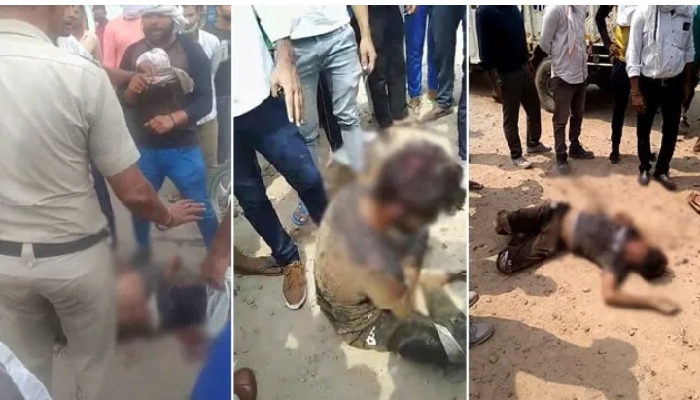
New Delhi, July 1: In a terrific incident with chilling echoes of the 2015 Dadri mob lynching, a Muslim man, who was carrying meat, was savagely attacked by a mob belonging to a saffron outfit in the presence of in BJP ruled Haryana on the eve of Eid al-Adha. 

The incident occurred at around 9 a.m. on Friday, July 31 at Badshahpur village in Haryana’s Gurgaon, when Lukman was transporting meat in a pic-kup truck. 

The attack was captured on mobile phones by onlookers and the video clips of the incident are now spreading on social media. 

A group of saffronite cow vigilantes chased the truck for about 8 km managed waylay it. Lukman, who was driving the truck was pulled out and brutally assaulted on the suspicion that he was transporting cow meat.

Just like Dadri, the police were faster at sending the meat to a lab for testing than catching any one of the suspects. One of the assailants - Pradeep Yadav- has been arrested. 

After being beating to an inch of his life, Lukman was bundled into the pick-up truck and taken back to Gurgaon's Badshahpur village where the goons started thrashing him again.

This is when the police stepped in and stopped them - only to find the assailants fearless enough to even take on them.

Lukman was taken to a hospital and the police filed a case against "unidentified individuals" even though the video of the incident recorded by witnesses shows the faces of the assailants.

The owner of the vehicles said that the meat was buffalo and he has been in the business for 50 years.

The police have so far refused to give a statement on record on the incident and explain their inaction as seen on video.

Comments

Add new comment

  • Coastaldigest.com reserves the right to delete or block any comments.
  • Coastaldigset.com is not responsible for its readers’ comments.
  • Comments that are abusive, incendiary or irrelevant are strictly prohibited.
  • Please use a genuine email ID and provide your name to avoid reject.
News Network
January 13,2020

Jan 13: For the first time in years, the government of India’s Prime Minister Narendra Modi is playing defense. Protests have sprung up across the country against an amendment to India’s laws — which came into effect on Friday — that makes it easier for members of some religions to become citizens of India. The government claims this is simply an attempt to protect religious minorities in the Muslim-majority countries that border India; but protesters see it as the first step toward a formal repudiation of India’s constitutionally guaranteed secularism — and one that must be resisted.

Modi was re-elected prime minister last year with an enhanced majority; his hold over the country’s politics is absolute. The formal opposition is weak, discredited and disorganized. Yet, somehow, the anti-Citizenship Act protests have taken hold. No political party is behind them; they are generally arranged by student unions, neighborhood associations and the like.

Yet this aspect of their character is precisely what will worry Modi and his right-hand man, Home Minister Amit Shah. They know how to mock and delegitimize opposition parties with ruthless efficiency. Yet creating a narrative that paints large, flag-waving crowds as traitors is not quite that easy.

For that is how these protests look: large groups of young people, many carrying witty signs and the national flag. They meet and read the preamble to India’s Constitution, into which the promise of secularism was written in the 1970’s.

They carry photographs of the Constitution’s drafter, the Columbia University-trained economist and lawyer B. R. Ambedkar. These are not the mobs the government wanted. They hoped for angry Muslims rampaging through the streets of India’s cities, whom they could point to and say: “See? We must protect you from them.” But, in spite of sometimes brutal repression, the protests have largely been nonviolent.

One, in Shaheen Bagh in a Muslim-dominated sector of New Delhi, began simply as a set of local women in a square, armed with hot tea and blankets against the chill Delhi winter. It has now become the focal point of a very different sort of resistance than what the government expected. Nothing could cure the delusions of India’s Hindu middle class, trained to see India’s Muslims as dangerous threats, as effectively as a group of otherwise clearly apolitical women sipping sweet tea and sharing their fears and food with anyone who will listen.

Modi was re-elected less than a year ago; what could have changed in India since then? Not much, I suspect, in most places that voted for him and his party — particularly the vast rural hinterland of northern India. But urban India was also possibly never quite as content as electoral results suggested. India’s growth dipped below 5% in recent quarters; demand has crashed, and uncertainty about the future is widespread. Worse, the government’s response to the protests was clearly ill-judged. University campuses were attacked, in one case by the police and later by masked men almost certainly connected to the ruling party.

Protesters were harassed and detained with little cause. The courts seemed uninterested. And, slowly, anger began to grow on social media — not just on Twitter, but also on Instagram, previously the preserve of pretty bowls of salad. Instagram is the one social medium over which Modi’s party does not have a stranglehold; and it is where these protests, with their photogenic signs and flags, have found a natural home. As a result, people across urban India who would never previously have gone to a demonstration or a political rally have been slowly politicized.

India is, in fact, becoming more like a normal democracy. “Normal,” that is, for the 2020’s. Liberal democracies across the world are politically divided, often between more liberal urban centers and coasts, and angrier, “left-behind” hinterlands. Modi’s political secret was that he was that rare populist who could unite both the hopeful cities and the resentful countryside. Yet this once magic formula seems to have become ineffective. Five of India’s six largest cities are not ruled by Modi’s Bharatiya Janata Party in any case — the financial hub of Mumbai changed hands recently. The BJP has set its sights on winning state elections in Delhi in a few weeks. Which way the capital’s voters will go is uncertain. But that itself is revealing — last year, Modi swept all seven parliamentary seats in Delhi.

In the end, the Citizenship Amendment Act is now law, the BJP might manage to win Delhi, and the protests might die down as the days get unmanageably hot and state repression increases. But urban India has put Modi on notice. His days of being India’s unifier are over: From now on, like all the other populists, he will have to keep one eye on the streets of his country’s cities.


Comments

Add new comment

  • Coastaldigest.com reserves the right to delete or block any comments.
  • Coastaldigset.com is not responsible for its readers’ comments.
  • Comments that are abusive, incendiary or irrelevant are strictly prohibited.
  • Please use a genuine email ID and provide your name to avoid reject.