


Israel continues Gaza offensive, kills over 90 including women, children

July 11, 2014

israel attack

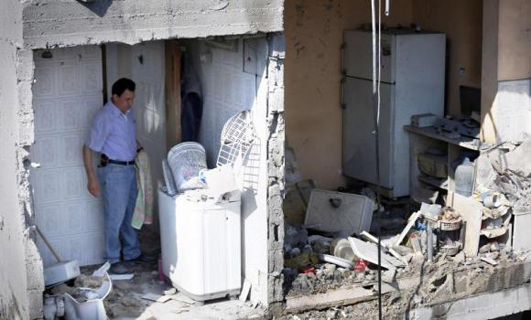
Gaza Strip, Jul 11: Israel has continued its major airstrikes on the besieged Gaza Strip for the third consecutive day, killing more than 90 Palestinians, including women and children.

On Thursday, Israel escalated its air campaign targeting hundreds of sites in the enclave.

At least three people, including a child, were killed in Israeli attacks in Gaza's northern cities of Beit Hanoun and Beit Lahiya.

Three others also lost their lives in Jebaliya after an Israeli strike hit their vehicle.

Earlier in the day, eight people were killed after Israeli jets bombed a building in the Gazan city of Khan Younis. Eight more people were also killed in an air strike on a beach cafe, where people were watching a football match between Argentina and the Netherlands.

Palestinian health officials say at least half of the casualties are civilians, including women and children.

Israel also mobilized 20,000 soldiers for a possible ground invasion of the Gaza Strip.

Meanwhile, Egyptian authorities temporarily opened the Rafah crossing to receive hundreds of injured Palestinians for medical treatment. The border had been closed since the ouster of Egyptian president, Mohammed Morsi, last year.

In retaliation, Hamas also fired more than 200 rockets from Gaza into Israeli towns and cities. Israeli media reports say that only some 60 of those rockets were intercepted by its US-funded Iron Dome missile system.

Sami Abu Zuhri, a Hamas spokesman, said that Tel Aviv is committing war crimes in the enclave, calling on the international community to take actions.

"We confirm that what is happening in Gaza are real war crimes that take place while the world is standing in silence,” he said.

“We as Palestinians confirm that we will use every means to protect our Palestinian people," he added.

Comments

Add new comment

  • Coastaldigest.com reserves the right to delete or block any comments.
  • Coastaldigset.com is not responsible for its readers’ comments.
  • Comments that are abusive, incendiary or irrelevant are strictly prohibited.
  • Please use a genuine email ID and provide your name to avoid reject.
News Network
July 3,2020

Jul 3: China under President Xi Jinping has stepped up its "aggressive" foreign policy toward India and "resisted" efforts to clarify the Line of Actual Control that prevented a lasting peace from being realised, according to a report released by a US Congress appointed commission.

The armies of India and China have been locked in a bitter standoff at multiple locations in eastern Ladakh for the last seven weeks, and the tension escalated after 20 Indian soldiers were killed in a violent clash in the Galwan Valley on June 15.

“Under General Secretary of the Chinese Communist Party (CCP) Xi Jinping, Beijing has stepped up its aggressive foreign policy toward New Delhi. Since 2013, China has engaged in five major altercations with India along the Line of Actual Control (LAC),” said a brief issued by US-China Economic and Security Review Commission.

"Beijing and New Delhi have signed a series of agreements and committed to confidence-building measures to stabilise their border, but China has resisted efforts to clarify the LAC, preventing a lasting peace from being realised,” said the report and was prepared at the request of the Commission to support its deliberations.

Authored by Will Green, a Policy Analyst on the Security and Foreign Affairs Team at the Commission, the report says that the Chinese government is particularly fearful of India’s growing relationship with the United States and its allies and partners.

“The latest border clash is part of a broader pattern in which Beijing seeks to warn New Delhi against aligning with Washington,” it said.

After Xi assumed power in 2012, there was a significant increase in clashes, despite the fact that he met Prime Minister Narendra Modi several times and Beijing and New Delhi have agreed to a series of confidence-building mechanisms designed to mitigate tensions.

Prior to 2013, the last major border clash was in 1987. The 1950s and 1960s were a particularly tense period, culminating in 1962 with a war that left thousands of soldiers dead on both sides, according to the records of China's People's Liberation Army, the report said.

“The 2020 skirmish is in line with Beijing’s increasingly assertive foreign policy. The clash came as Beijing was aggressively pressing its other expansive sovereignty claims in the Indo-Pacific region, such as over Taiwan and in the South and East China seas,” it said.

China is engaged in hotly contested territorial disputes in both the South China Sea and the East China Sea. Beijing has built up and militarised many of the islands and reefs it controls in the region. Both areas are stated to be rich in minerals, oil and other natural resources and are vital to global trade.

China claims almost all of the South China Sea. Vietnam, the Philippines, Malaysia, Brunei and Taiwan have counter claims over the area.

Several weeks before the clash in the Galwan Valley, Chinese Defence Minister Wei Fenghe called on Beijing to “use fighting to promote stability” as the country’s external security environment worsened, a potential indication of China’s intent to proactively initiate military tensions with its neighbours to project an image of strength, the report said.

Comments

Add new comment

  • Coastaldigest.com reserves the right to delete or block any comments.
  • Coastaldigset.com is not responsible for its readers’ comments.
  • Comments that are abusive, incendiary or irrelevant are strictly prohibited.
  • Please use a genuine email ID and provide your name to avoid reject.
News Network
February 22,2020

Washington, Feb 22: US President Donald Trump will raise the issue of religious freedom with Prime Minister Narendra Modi during his visit to India next week, the White House said on Friday, noting that the US has great respect for India's democratic traditions and institutions.

"President Trump will talk about our shared tradition of democracy and religious freedom both in his public remarks and then certainly in private. He will raise these issues, particularly the religious freedom issue, which is extremely important to this administration," a senior official told reporters in a conference call.

The official was responding to a question on whether the president was planning to speak to Modi on the Citizenship (Amendment) Act or the National Register of Citizens.

"We do have this shared commitment to upholding our universal values, the rule of law. We have great respect for India's democratic traditions and institutions, and we will continue to encourage India to uphold those traditions," the official said, requesting anonymity.

"And we are concerned with some of the issues that you have raised," the senior administration official said, in response to the question on CAA and NRC.

"I think the President will talk about these issues in his meetings with Prime Minister Modi and note that the world is looking to India to continue to uphold its democratic traditions, respect for religious minorities," the official said.

"Of course, it's in the Indian constitution -- religious freedom, respect for religious minorities, and equal treatment of all religions. So this is something that is important to the president and I'm sure it will come up," said the official.

Pointing out that India has a strong democratic foundation, the official said India is a country rich in religious, linguistic, and cultural diversity.

"In fact, it's the birthplace of four major world religions," the official noted.

Comments

Add new comment

  • Coastaldigest.com reserves the right to delete or block any comments.
  • Coastaldigset.com is not responsible for its readers’ comments.
  • Comments that are abusive, incendiary or irrelevant are strictly prohibited.
  • Please use a genuine email ID and provide your name to avoid reject.
Agencies
March 28,2020

Canadian researchers are developing a DNA vaccine for SARS-CoV-2, the coronavirus that causes COVID-19 and has currently infected nearly 5,00,000 people worldwide and crippled the global economy.

Entos Pharmaceuticals, a health-care biotechnology company headed by a University of Alberta researchers, develop new therapeutic compounds using the company's proprietary drug-delivery platform and has begun manufacturing vaccine candidates against the novel coronavirus.

"Given the urgency of the situation, we can have a lead candidate vaccine within two months. Once we have that it's a race to get it into clinical trials," said John Lewis, CEO of Entos and a Professor at the University of Alberta in Canada.

Lewis said in comparison to a traditional vaccine, DNA-based vaccines hold several advantages.

Nucleic acids are introduced directly into the patient's own cells, causing them to make pieces of the virus--tricking the immune system into mounting a response without the full virus actually being present, the researcher said.

According to the company, the approach is recognised as being easier to move into large-scale manufacturing, offers improved vaccine stability and works without needing an infectious agent.

In the current absence of a vaccine for COVID-19, several companies around the world are mounting efforts to begin similar work.

The first clinical trial using a DNA-based vaccine developed by Moderna Inc.in the US on March 13.

Their approach allows for antibodies to be made in the human trial volunteers against a specific protein on the surface of the coronavirus that lets the virus enter human cells.

The hope is that the antibodies will stop the interaction.

Though this approach is designed to be effective against COVID-19 specifically, Lewis said Entos is taking a different tack.

The company plans to use plasmid DNA to amplify the production of key coronavirus surface and structural proteins with each injection, with an eye to the bigger picture.

"Many of the structural proteins in the virus are pretty well conserved across all the coronaviruses, including SARS and MERS," said Lewis.

"We're hoping that if we express more of the structural proteins that are common to most coronaviruses, we can inhibit the current COVID-19, and also potentially protect against all coronaviruses both past and future," Lewis added.

To move the project forward quickly, the company is seeking financial support from both provincial and federal levels of government.

"We have the opportunity to save a lot of lives, and I think it's really upon us and governments to find solutions for that," Lewis said.

Comments

Add new comment

  • Coastaldigest.com reserves the right to delete or block any comments.
  • Coastaldigset.com is not responsible for its readers’ comments.
  • Comments that are abusive, incendiary or irrelevant are strictly prohibited.
  • Please use a genuine email ID and provide your name to avoid reject.