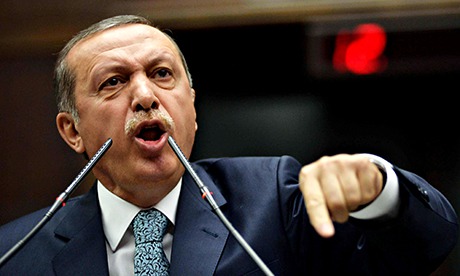
Israel more barbaric than Hitler, says Turkish Prime Minister

July 20, 2014

Ankara, Jul 20: Turkish Prime Minister Recep Tayyip Erdogan has accused Israel of "barbarism that surpasses Hitler" during its ground invasion of Gaza.Turkish-Prime-Minister

Erdogan accused Israel of using disproportionate force in Gaza and said the operation there has derailed efforts to normalize Turkish-Israeli ties. Those soured after Israel's 2010 raid on an aid ship which killed eight Turks and a Turkish-American.

Erdogan spoke in a campaign speech on Saturday in the Black Sea port city of Ordu. He is running for the presidency in elections next month.

He has been speaking out strongly against Israel during its offensive against Hamas militants in Gaza, which has killed more than 300 Palestinians.

Hundreds have also staged protests in recent days outside the Israeli diplomatic mission in Ankara and Istanbul.

Comments

Add new comment

  • Coastaldigest.com reserves the right to delete or block any comments.
  • Coastaldigset.com is not responsible for its readers’ comments.
  • Comments that are abusive, incendiary or irrelevant are strictly prohibited.
  • Please use a genuine email ID and provide your name to avoid reject.
Agencies
February 4,2020

As the deadly coronavirus has spread worldwide, it has carried with it xenophobia -- and Asian communities around the world are finding themselves subject to suspicion and fear.

When a patient on Australia's Gold Coast refused to shake the hand of her surgeon Rhea Liang, citing the virus that has killed hundreds, the medic's first response was shock.

But after tweeting about the incident and receiving a flood of responses, the respected doctor learned her experience was all too common.

There has been a spike in reports of anti-Chinese rhetoric directed at people of Asian origin, regardless of whether they have ever visited the centre of the epidemic or been in contact with the virus.

Chinese tourists have reportedly been spat at in the Italian city of Venice, a family in Turin was accused of carrying the disease, and mothers in Milan have used social media to call for children to be kept away from Chinese classmates.

In Canada, a white man was filmed telling a Chinese-Canadian woman "you dropped your coronavirus" in the parking lot of a local mall.

In Malaysia, a petition to "bar Chinese people from entering our beloved country" received almost 500,000 signatures in one week.

The incidents are part of what the Australasian College for Emergency Medicine has described as "misinformation" which it says is fuelling "racial profiling" where "deeply distressing assumptions are being made about 'Chinese' or 'Asian-looking' people." Disease has long been accompanied by suspicions of foreigners -- from Irish immigrants being targeted in the Typhoid Mary panic of 1900s America to Nepali peacekeepers being accused of bringing cholera to earthquake-struck Haiti in the last decade.

"It's a common phenomenon," said Rob Grenfell, director of health and biosecurity for Australia's science and research agency CSIRO.

"With outbreaks and epidemics along human history, we've always tried to vilify certain subsets of the population," he said, comparing the behaviour to 1300s plague-ridden medieval Europe, where foreigners and religious groups were often blamed.

"Sure it emerged in China," he said of the coronavirus, "but that's no reason to actually vilify Chinese people." In a commentary for the British Medical Journal, doctor Abraar Karan warned this behaviour could discourage people with symptoms from coming forward.

Claire Hooker, a health lecturer at the University of Sydney, said the responses from governments may have compounded prejudice.

The World Health Organisation has warned against "measures that unnecessarily interfere with international travel and trade", but this has not stopped scores of countries from introducing travel bans.

The tiny Pacific nation of Micronesia has banned its citizens from visiting mainland China altogether.

"Travel bans respond largely to people's fears," said Hooker, and while sometimes warranted, they often "have the effect of cementing an association between Chinese people and scary viruses".

Abbey Shi, a Shanghai-born student in Sydney, said the attitude shown by some of her peers has "become almost an attack on students who are Chinese".

While Australia's conservative government has banished its citizens returning from Wuhan -- the central Chinese city at the epicentre of the virus -- to a remote island for quarantine, thousands of students still stuck in China risk their studies being torpedoed.

"Right now it looks like they have to miss the semester's start and potentially the whole year, because of the way the courses are set up," Shi said.

According to Hooker, studies in Toronto on the impact of Severe Acute Respiratory Syndrome, or SARS -- another global coronavirus outbreak in 2002 -- showed the impact of xenophobic sentiment often lasted much longer than the public health scare.

"While there may be a cessation of direct forms of racism as news about the disease dies down, it takes quite a bit of time for economic recovery and people continue to feel unsafe," she said.

People may not rush back to Chinese businesses or restaurants, and may even heed some of the more outlandish viral social media disinformation -- such as one popular post imploring people to avoid eating noodles for their own safety.

"In one sense you might think the effects lasted from the last coronavirus to this one because the representation as China being a place where diseases come from has been persistent," Hooker said.


Comments

Add new comment

  • Coastaldigest.com reserves the right to delete or block any comments.
  • Coastaldigset.com is not responsible for its readers’ comments.
  • Comments that are abusive, incendiary or irrelevant are strictly prohibited.
  • Please use a genuine email ID and provide your name to avoid reject.
Agencies
May 25,2020

The Japan government on Monday decided to lift the state of emergency for COVID-19 in Tokyo and four other prefectures of the country, the only places where the measure implemented to curb the pandemic had remained in force.

The lifting of the alert was backed by the coronavirus advisory panel and will be formally approved by the government later day, the economic revitalization minister and head of the working group to coordinate Japan's fight against COVID-19, Yasutoshi Nishimura, said.

The Japanese authorities made the decision after taking into account the number of infections and the situation of the health system in Tokyo, the three neighbouring prefectures of Chiba, Kanagawa and Saitama and the northern Hokkaido, the only ones where the state of emergency declared more than a month ago to control the pandemic remained in effect, reports Efe news.

The health alert was initially declared in Tokyo and six other prefectures on April 17 and subsequently extended across the country.

It allowed local authorities to ban large-scale public events and close bars and restaurants at night, among other measures, while the government has launched a campaign to encourage teleworking and staying at home.

The government resorted to this measure for the first time in the country's recent history to contain the spread of the virus and is now withdrawing it after a sustained slowdown in infections throughout the archipelago, where around 16,600 confirmed COVID-19 cases and 839 deaths have been recorded, according to the latest data.

The group of experts advising the government appreciated the efforts made by citizens to comply with the recommendations to achieve the target of reducing interpersonal contact by 80 percent, top government spokesperson Yoshihide Suga said at a press conference on Monday.

The recommendation for citizens to avoid unnecessary trips outside and the request for non-essential businesses to close were not mandatory nor accompanied by fines or other penalties for non-compliance, unlike the stricter containment measures implemented in other countries.

The government plans to formally approve the lifting of the state of emergency on Monday after consulting with other political parties in parliament and another meeting with the advisory panel, following which Japanese Prime Minister Shinzo Abe will hold a press conference.

The government had already decided to lift the emergency in 39 prefectures on May 14 after they reported a marked decrease in the number of infections, leaving out the more populated regions such as Tokyo and Osaka.

To avoid new outbreaks of the virus, Abe has urged people to become accustomed to a "new lifestyle" that includes maintaining social distancing, the use of masks outside as well as a series of guidelines for the reopening of shops, restaurants and public facilities.

Comments

Add new comment

  • Coastaldigest.com reserves the right to delete or block any comments.
  • Coastaldigset.com is not responsible for its readers’ comments.
  • Comments that are abusive, incendiary or irrelevant are strictly prohibited.
  • Please use a genuine email ID and provide your name to avoid reject.
News Network
May 25,2020

Islamabad/Dhaka, May 25: The coronavirus pandemic and lockdowns coupled with travel restrictions and social distancing norms have muted the Eid celebrations in Pakistan and Bangladesh as worshippers in the two Muslim-majority countries marked the end of Ramzan in strictly-regulated prayer congregations.

A large number of people in the two countries were forced to stay indoors on the occasion of Eid al-Fitr, marking the end of the fasting month of Ramzan, due to the fears of contracting the novel coronavirus which has killed nearly 3.5 lakh people and infected over 5.4 million across the world.

In Pakistan, the government has issued strict instructions to observe social distancing while offering Eid prayers and asked people to avoid visiting relatives and hosting parties.

As the railways remained closed, many people could not travel to their hometowns for the most important festival.

Eid congregations were held at open places, mosques and Eidgahs in all major cities and towns while following strict standard operating procedures (SOPs) of social distancing and other precautionary measures. But in some areas, the people did not adhere to the SOPs and were seen thronging to their favourite shops to celebrate Eid.

Pakistan Prime Minister's Special Assistant on Health Zafar Mirza on Friday said the deadly infection would continue to multiply if precautions are not taken.

Earlier this month, the government announced the lifting of the countrywide lockdown imposed to curb the spread of the COVID-19 in phases, even as infections continued to rise in the country.

Pakistan's coronavirus cases on Monday reached 56,349 with 1,748 new patients while the death toll climbed to 1,167 after 34 people lost their lives in the last 24 hours.

The trajectory showed that the number was steadily going up with authorities fearing a rise in cases in the wake of the easing of lockdown before Eid.

But Prime Minister Imran Khan cited the economic havoc the virus restrictions had wreaked on citizens as the reason behind the decision to ease the restrictions.

He urged Pakistanis to forgo the traditional Eid festivity in view of the hundreds of fatalities caused by the coronavirus and the lives lost in Friday's plane crash in Karachi.

Ninety-seven people, including nine children, were killed and two passengers miraculously survived a fiery crash when a Pakistan International Airlines plane with 99 travellers on board plunged into a densely populated residential area near the Jinnah International Airport.

Most of the victims were travelling home to celebrate Eid.

In Bangladesh, millions of Muslims joined the strictly-regulated prayer congregations across the country.

Thousands of worshippers attended the prayer services at the Baitul Mukarram National Mosque in Dhaka while following the health and social distancing protocols to limit the spread of the coronavirus, bdnews24.com reported.

Despite the government directive for children and senior citizens not to participate in Eid prayers, many children and people aged over 60 attended the Eid prayers. Although social distancing rules were maintained to a large extent, people were seen flouting the norms, the report said.

As per the government order, no Eid congregation will be held in an open space, but people can perform the Eid prayers in mosques. However, everyone coming to the mosques for prayer must wear a mask, follow social distancing and other hygiene rules, said Islamic Foundation Secretary Kazi Nurul Islam.

On Sunday, Bangladesh reported 28 new fatalities, the highest single-day increase, bringing the death toll to 480.

The number of coronavirus cases in the country rose to 33,610 after 1,532 people tested positive on Sunday.

Comments

Add new comment

  • Coastaldigest.com reserves the right to delete or block any comments.
  • Coastaldigset.com is not responsible for its readers’ comments.
  • Comments that are abusive, incendiary or irrelevant are strictly prohibited.
  • Please use a genuine email ID and provide your name to avoid reject.