



Isro to Launch IIT-Bombay Students' Satellite 'Pratham' on Monday

September 25, 2016

Sep 25: Indian space agency Isro will shoot off the "Pratham" satellite designed and built by students of the IIT-Bombay among the eight satellites including its weather satellite on Monday, an official said in Mumbai.
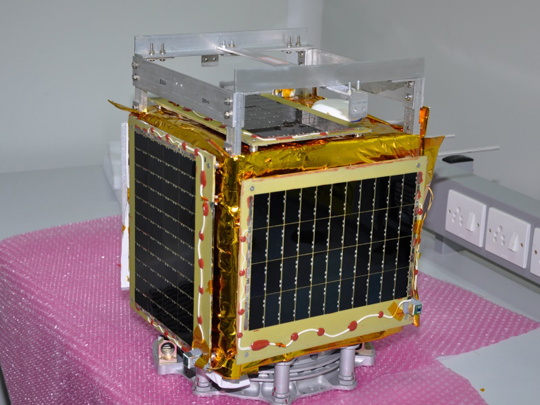
Pratham

Conceptualised in 2008 with the aim of making IIT-B a centre for space science and technology research, the satellite weighs just 10kg, is designed to fit within a cube of 30cm, and has a life span of around four months.

"The objective of Pratham is to empower the students involved with the skill set required to develop a statellite through various stages of design, analysis, fabrication and testing," said the official.

The project will also kickstart a collaboration between IIT-B and other Indian universities keen to contribute in the space sector and to share knowledge and facilties.

This has led to completion of ground-stations for tracking the satellite in several college, including the Atharva College of Engineering here.

The IIT-B has collaborated with some international universities like UCL, London and IPGP, Paris for the project.

Pratham will transmit data when it passes over India and any university with a small ground station can detect its signals and measure the total electron counts (TEC) above the ground station as part of the education process to spread awareness among the students.

The student-designed satellite's mission is four-fold: acquiring knowledge in the field of satellite and space technology, to fully design it by the students of IIT-B, launch it and measure TEC of uonosphere above India and Paris, and involve students from other universities in the satellite project, said the official.

Pratham's payload instrument comprises two monopole antennae transmitting at 145.98MHz and 437.45MHz.

Measuring 30.5cm by 33.4cm by 46.6 cm, it weighs 10.12kg, is made of aluminium alloy and other space-grade materials, and has an on board computer.

It has three monopoles, GPS, magnetometer, sun sensors, magnetorquers and is powered by Li-ion battery and four solar panels.

It will be positioned in a sun-synchronous orbit around 670 km away and will pass over India around 11.30am.

For the project, entirely funded by the IIT-B, the Isro has provided lot of technical help in terms of testing and guidance and the integration of the flight model of Pratham for which tests have been carried out in ISAC, Bangalore and SHAR, Sriharikota.

Each year in September, a rigorous selection test was conducted for all IIT-B students from which they were inducted into the Pratham team and formalized after ascertaining their satisfactory work.

The current strength of the team which has completed the project after more than eight years is around 30, the official said.

Comments

Add new comment

  • Coastaldigest.com reserves the right to delete or block any comments.
  • Coastaldigset.com is not responsible for its readers’ comments.
  • Comments that are abusive, incendiary or irrelevant are strictly prohibited.
  • Please use a genuine email ID and provide your name to avoid reject.
News Network
January 27,2020

Mumbai, Jan 27: The country's largest car maker Maruti Suzuki India (MSI) on Monday said it has increased prices of select models by up to Rs 10,000 with immediate effect to offset the impact of rising input costs.

The price change varies across models and ranges up to 4.7 per cent (ex-showroom Delhi) and are effective from January, 27 2020, MSI said in a statement.

The price of entry level model Alto range has gone up in the range of Rs 9,000-6,000, S-Presso between Rs 1,500 to 8,000, WagonR between Rs 1,500 and Rs 4,000.

The company has also increased the price of its multi purpose vehicle Ertiga between Rs 4,000-10,000, Baleno by Rs 3,000 to 8,000 and XL6 by up to Rs 5,000 (all prices ex-showroom Delhi).

Currently, the company sells a range of vehicles starting from entry-level small car Alto to premium multi purpose vehicle XL6 with price ranging from Rs 2.89 lakh to Rs 11.47 lakh (ex-showroom Delhi).

Comments

Add new comment

  • Coastaldigest.com reserves the right to delete or block any comments.
  • Coastaldigset.com is not responsible for its readers’ comments.
  • Comments that are abusive, incendiary or irrelevant are strictly prohibited.
  • Please use a genuine email ID and provide your name to avoid reject.
Agencies
May 15,2020

Kolkata, May 15: Veteran Bengali author Debesh Roy, who was conferred the Sahitya Akademi award for his novel 'Teesta Parer Brittanto', died at a private hospital in Kolkata on Thursday, his family members said.

Roy was 84 and he is survived by his son. His wife had died earlier.

He was admitted to the hospital near his residence at Baguihati, in the eastern fringes of the city, on Wednesday after having symptoms like sodium potasium imbalance, sugar problem and breathing problem, his family members said.

He suffered a massive cardiac arrest and died at 10.50 PM.

A regular contributor to a number of Bengali dailies, he was a staunch critic of the attacks on liberals by in the country in recent times and attended protest meetings despite his failing health.

He was born in Pabna in present-day Bangladesh on December 17, 1936. He had five decades of career as a writer.

Besides Teesta Parer Britanta', he will be remembered for books like Borisaler Jogen Mondal , Manush Khun Kore Keno and Samay Asamayer Brittanto . His first book was Jajati.

His last rites will be performed tomorrow.

Comments

Add new comment

  • Coastaldigest.com reserves the right to delete or block any comments.
  • Coastaldigset.com is not responsible for its readers’ comments.
  • Comments that are abusive, incendiary or irrelevant are strictly prohibited.
  • Please use a genuine email ID and provide your name to avoid reject.
Agencies
June 19,2020

Denser places, assumed by many to be more conducive to the spread of the coronavirus that causes COVID-19, are not linked to higher infection rates, say researchers.

The study, led by Johns Hopkins University, published in the Journal of the American Planning Association, also found that dense areas were associated with lower COVID-19 death rates.

"These findings suggest that urban planners should continue to practice and advocate for compact places rather than sprawling ones, due to the myriad well-established benefits of the former, including health benefits," says study lead author Shima Hamidi from Johns Hopkins Bloomberg School of Public Health in the US.

For their analysis, the researchers examined SARS-CoV-2 infection rates and COVID-19 death rates in 913 metropolitan counties in the US.

When other factors such as race and education were taken into account, the authors found that county density was not significantly associated with county infection rate.

The findings also showed that denser counties, as compared to more sprawling ones, tended to have lower death rates--possibly because they enjoyed a higher level of development including better health care systems.

On the other hand, the research found that higher coronavirus infection and COVID-19 mortality rates in counties are more related to the larger context of metropolitan size in which counties are located.

Large metropolitan areas with a higher number of counties tightly linked together through economic, social, and commuting relationships are the most vulnerable to the pandemic outbreaks.

According to the researchers, recent polls suggest that many US citizens now consider an exodus from big cities likely, possibly due to the belief that more density equals more infection risk.

Some government officials have posited that urban density is linked to the transmissibility of the virus.

"The fact that density is unrelated to confirmed virus infection rates and inversely related to confirmed COVID-19 death rates is important, unexpected, and profound," said Hamidi.

"It counters a narrative that, absent data and analysis, would challenge the foundation of modern cities and could lead to a population shift from urban centres to suburban and exurban areas," Hamidi added.

The analysis found that after controlling for factors such as metropolitan size, education, race, and age, doubling the activity density was associated with an 11.3 per cent lower death rate.

The authors said that this is possibly due to faster and more widespread adoption of social distancing practices and better quality of health care in areas of denser population.

The researchers concluded that a higher county population, a higher proportion of people age 60 and up, a lower proportion of college-educated people, and a higher proportion of African Americans were all associated with a greater infection rate and mortality rate.

Comments

Add new comment

  • Coastaldigest.com reserves the right to delete or block any comments.
  • Coastaldigset.com is not responsible for its readers’ comments.
  • Comments that are abusive, incendiary or irrelevant are strictly prohibited.
  • Please use a genuine email ID and provide your name to avoid reject.