



Istanbul nightclub attack kills 39 in New Year carnage

January 1, 2017

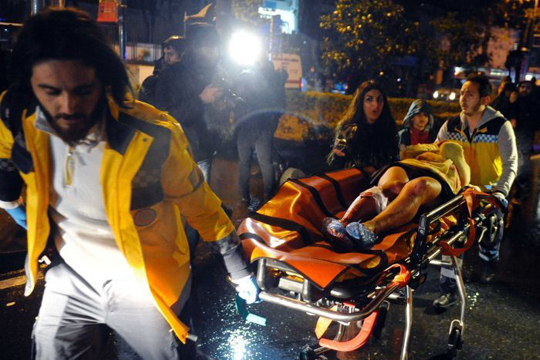
Istanbul, Jan 1: Thirty-nine people, including many foreigners, were killed when a gunman reportedly dressed as Santa Claus stormed an Istanbul nightclub as revellers were celebrating the New Year, the latest carnage to rock Turkey after a bloody 2016.
Istanbul

The assailant shot dead a policeman and a civilian at the entrance to the Reina club, one of the city's most exclusive nightspots, and then went on a shooting rampage inside, Turkish officials said.

Interior Minister Suleyman Soylu said the attacker escaped and was now the target of a major manhunt, expressing hope the suspect "would be captured soon".

Soylu said in televised comments that of 21 victims who have been identified so far, 16 are foreigners and five are Turks. Another 69 people are being treated in hospital.

"The attacker - in the most brutal and merciless way - targeted innocent people who had only come here to celebrate the New Year and have fun," Istanbul governor Vasip Sahin said at the scene on the shores of the Bosphorus.

Many revellers threw themselves into the water in panic and efforts were under way to rescue them, NTV television said.

Dogan news agency said there were two gunmen dressed in Santa Claus outfits, although this has yet to be confirmed.

Television pictures showed party-goers - including men in suits and women in cocktail dresses - emerging from the nightclub in a state of shock.

Sahin said the attack began at 1:15 am today (local time), just after hundreds of revellers had seen in 2017 at the club in the Ortakoy district on the European side of the city.

"What happened today is a terror attack," he said.

Dogan reported that some witnesses claimed the assailants were "speaking Arabic" while NTV said special force police officers were still searching the club.

There has been no claim of responsibility.

The attack evoked memories of the November 2015 carnage in Paris when Islamic State jihadists went on a gun and bombing rampage on nightspots in the French capital, killing 130 people including 90 at the Bataclan concert hall.

From Sydney to Paris, Rio to London, security had been boosted over fears that the New Year festivities could present a target for violent extremists.

In Istanbul, at least 17,000 police officers were deployed and some, as is customary in Turkey, dressed themselves as Santa Claus as cover, according to television reports.

"Just as we were settling down, by the door there was a lot of dust and smoke. Gunshots rang out. When those sounds were heard, many girls fainted," professional footballer Sefa Boydas told AFP.

"They say 35 to 40 died but it's probably more because when I was walking, people were walking on top of people."

Dogan said there were at least 700 revellers at the elite club, where getting past the bouncers who seek out only the best dressed is notoriously hard.

Turkey has been hit by a wave of attacks blamed on Kurdish militants and IS jihadists and 2016 saw more attacks than any other year in the history of the country.

On December 10, 44 people were killed in a double bombing in Istanbul after a football match hosted by top side Besiktas, an attack claimed by the Kurdistan Freedom Falcons (TAK) seen as a radical offshoot of the outlawed PKK rebel group.

In June, 47 people were killed in a triple suicide bombing and gun attack at Istanbul's Ataturk airport, with authorities blaming IS.

And in one of the most brazen strikes, an off-duty policeman assassinated Russia's ambassador to Turkey in an Ankara art gallery less than two weeks ago.

"No terror attack will destroy our unity, or eradicate our fraternity or weaken Turkey's effective fight against terror," Justice Minister Bekir Bozdag wrote on Twitter.

Mainly Muslin Turkey's religious affairs agency Diyanet condemned the attack, saying the fact it took place in a nightclub "was no different to it being in a market or place of worship".

Turkey is still reeling from a failed July coup blamed by the government on the US-based Islamic preacher Fethullah Gulen that has been followed by a relentless purge of his alleged supporters from state institutions.

"Tragic start to 2017 in Istanbul," NATO Secretary General Jens Stoltenberg wrote on Twitter.

The White House condemned the "savagery" of the attack, with National Security Council spokesman Ned Price saying that Washington reaffirmed its support for its NATO ally "in our shared determination to confront and defeat all forms of terrorism".

The US embassy warned citizens that extremist groups are continuing "aggressive efforts to conduct attacks in areas where US citizens and expatriates reside or frequent."

Turkish President Recep Tayyip Erdogan, who is in Istanbul for the New Year, had been informed of the attack, local media said.

The shooting spree came as the Turkish army wages a four-month incursion in Syria to oust IS jihadists and Kurdish militants from the border area, suffering increasing casualties.

As is customary after such attacks in Turkey, the authorities slapped a broadcast ban on images from the incident.

Comments

Naren kotian
 - 
Sunday, 1 Jan 2017

Israel actions are totally justified ...democracies must understand how to deal with jihadist menace ...religion of piece ....while shooting ...attacker shouting religious slogans. . time has come to mercilessly attack ...bomb them ...sympathy torsidre bennige chaaku haako jana...death to Islamic state ....rip innocents party goers.

Add new comment

  • Coastaldigest.com reserves the right to delete or block any comments.
  • Coastaldigset.com is not responsible for its readers’ comments.
  • Comments that are abusive, incendiary or irrelevant are strictly prohibited.
  • Please use a genuine email ID and provide your name to avoid reject.
News Network
April 15,2020

Seoul, Apr 15: Wearing masks and gloves, South Korean voters cast their ballots on Wednesday to elect 300 parliamentary lawmakers amid the coronavirus outbreak.

Voting kicked off at 6 am (local time) and was to run until 6 pm (local time) at 14,330 polling stations across the country, according to the National Election Commission (NEC). The number of eligible voters is 44 million, according to Yonhap news agency.

The once-in-four-years legislative election is widely seen as a referendum on President Moon Jae-in, whose five-year term will end in mid-2022, as well as a test of the country's fight against COVID-19 under the leadership of Moon, The Strait Times reported.

South Korea has received international praise for its massive testing capability and other innovative measures, such as drive-through testing and high-tech contact tracing.

Experts, therefore, expect the ruling Democratic Party (DP) to extend its lead in Parliament, given that the government's handling of the virus outbreak is viewed positively both at home and abroad, as per The Strait Times.

At least 10,564 people in the country have been infected by coronavirus, which has claimed 222 lives. About 2,800 patients are undergoing treatment.

The number of new cases has fallen from a high of 813 on February 29 to below 50 for six days in a row as an intensive social distancing campaign that started on March 21 remained in place.

Several surveys cited by the newspaper also showed that voters consider the pandemic as the biggest factor in their decision. A recent poll showed that 72.6 per cent of respondents rated the government's response to the outbreak as positive.

The NEC has said that public safety at polling stations will be a priority to prevent any possible spread of the virus.

All 14,330 polling stations and 251 counting stations will be disinfected on polling day, the NEC was quoted.

Voters will undergo temperature screening and those registering temperatures of 37.5 degrees Celsius or higher or display respiratory symptoms will have to exercise their franchise at a separate booth.

Tuesday was the last of 13 days of campaigning, which saw most candidates reducing their ground activities and face-to-face encounters with voters. Instead, the candidates boosted their online presence with videos and social media engagements in a bid to win votes, according to The Strait Times.

In addition, the government has also decided to temporarily lift quarantine rules to permit self-isolators to vote in the elections. Some 50,000 people in self-isolation who have no symptoms and expressed a willingness to vote will be allowed to cast ballots after the regular voting ends in the evening.

Comments

Add new comment

  • Coastaldigest.com reserves the right to delete or block any comments.
  • Coastaldigset.com is not responsible for its readers’ comments.
  • Comments that are abusive, incendiary or irrelevant are strictly prohibited.
  • Please use a genuine email ID and provide your name to avoid reject.
Agencies
July 1,2020

The ILO has warned that if another Covid-19 wave hits in the second half of 2020, there would be global working-hour loss of 11.9 percent - equivalent to the loss of 340 million full-time jobs.

According to the 5th edition of International Labour Organisation (ILO) Monitor: Covid-19 and the world of work, the recovery in the global labour market for the rest of the year will be uncertain and incomplete.

The report said that there was a 14 percent drop in global working hours during the second quarter of 2020, equivalent to the loss of 400 million full-time jobs.

The number of working hours lost across the world in the first half of 2020 was significantly worse than previously estimated. The highly uncertain recovery in the second half of the year will not be enough to go back to pre-pandemic levels even in the best scenario, the agency warned.

The baseline model – which assumes a rebound in economic activity in line with existing forecasts, the lifting of workplace restrictions and a recovery in consumption and investment – projects a decrease in working hours of 4.9 percent (equivalent to 140 million full-time jobs) compared to last quarter of 2019.

It says that in the pessimistic scenario, the situation in the second half of 2020 would remain almost as challenging as in the second quarter.

“Even if one assumes better-tailored policy responses – thanks to the lessons learned throughout the first half of the year – there would still be a global working-hour loss of 11.9 per cent at the end of 2020, or 340 million full-time jobs, relative to the fourth quarter of 2019,” it said.

The pessimistic scenario assumes a second pandemic wave and the return of restrictions that would significantly slow recovery. The optimistic scenario assumes that workers’ activities resume quickly, significantly boosting aggregate demand and job creation. With this exceptionally fast recovery, the global loss of working hours would fall to 1.2 per cent (34 million full-time jobs).

The agency said that under the three possible scenarios for recovery in the next six months, “none” sees the global job situation in better shape than it was before lockdown measures began.

“This is why we talk of an uncertain but incomplete recovery even in the best of scenarios for the second half of this year. So there is not going to be a simple or quick recovery,” ILO Director-General Guy Ryder said.

The new figures reflect the worsening situation in many regions over the past weeks, especially in developing economies. Regionally, working time losses for the second quarter were: Americas (18.3 percent), Europe and Central Asia (13.9 percent), Asia and the Pacific (13.5 percent), Arab States (13.2 percent), and Africa (12.1 percent).

The vast majority of the world’s workers (93 per cent) continue to live in countries with some sort of workplace closures, with the Americas experiencing the greatest restrictions.

During the first quarter of the year, an estimated 5.4 percent of global working hours (equivalent to 155 million full-time jobs) were lost relative to the fourth quarter of 2019. Working- hour losses for the second quarter of 2020 relative to the last quarter of 2019 are estimated to reach 14 per cent worldwide (equivalent to 400 million full-time jobs), with the largest reduction (18.3 per cent) occurring in the Americas.

The ILO Monitor also found that women workers have been disproportionately affected by the pandemic, creating a risk that some of the modest progress on gender equality made in recent decades will be lost, and that work-related gender inequality will be exacerbated.

The severe impact of Covid-19 on women workers relates to their over-representation in some of the economic sectors worst affected by the crisis, such as accommodation, food, sales and manufacturing.

Globally, almost 510 million or 40 percent of all employed women work in the four most affected sectors, compared to 36.6 percent of men, it said.

The report said that women also dominate in the domestic work and health and social care work sectors, where they are at greater risk of losing their income and of infection and transmission and are also less likely to have social protection.

The pre-pandemic unequal distribution of unpaid care work has also worsened during the crisis, exacerbated by the closure of schools and care services.

Even as countries have adopted policy measures with unprecedented speed and scope, the ILO Monitor highlights some key challenges ahead, including finding the right balance and sequencing of health, economic and social and policy interventions to produce optimal sustainable labour market outcomes; implementing and sustaining policy interventions at the necessary scale when resources are likely to be increasingly constrained and protecting and promoting the conditions of vulnerable, disadvantaged and hard-hit groups to make labour markets fairer and more equitable.

“The decisions we adopt now will echo in the years to come and beyond 2030. Although countries are at different stages of the pandemic and a lot has been done, we need to redouble our efforts if we want to come out of this crisis in a better shape than when it started,” Ryder said. 

Comments

Add new comment

  • Coastaldigest.com reserves the right to delete or block any comments.
  • Coastaldigset.com is not responsible for its readers’ comments.
  • Comments that are abusive, incendiary or irrelevant are strictly prohibited.
  • Please use a genuine email ID and provide your name to avoid reject.
News Network
June 19,2020

London, Jun 19: Malala Yousafzai, the youngest Nobel Peace Prize winner who once took a bullet for campaigning for girls' education in Pakistan, was over the moon on Friday after completing her degree in Philosophy, Politics and Economics at Britain's prestigious Oxford University.

Malala, 22, who attended Oxford's Lady Margaret Hall college, took to Twitter to share two pictures that show her celebrating the milestone with her family.

"Hard to express my joy and gratitude right now as I completed my Philosophy, Politics and Economics degree at Oxford," she said in the tweet, accompanied by two pictures - one showing her sitting with her family in front of a cake that says: 'Happy Graduation Malala', and the other in which she is covered with cake smiling for the camera.

In the tweet, the famed human rights activist also revealed her plans for the immediate future - Netflix, reading and sleeping.

"I don't know what's ahead. For now, it will be Netflix, reading and sleep," she wrote.

Malala was shot in the head by the Taliban militants in December 2012 for campaigning for female education in the Swat Valley in northeastern Pakistan.

Severely wounded, she was airlifted from one military hospital in Pakistan to another and later flown to the UK for treatment.

After the attack, the Taliban released a statement saying that they would target Malala again if she survived.

At the age of 17, Malala became the youngest recipient of the Nobel Peace Prize for her education advocacy in 2014 when she shared the coveted honour with India's social activist Kailash Satyarthi.

Unable to return to Pakistan after her recovery, she moved to Britain, setting up the Malala Fund and supporting local education advocacy groups with a focus on Pakistan, Nigeria, Jordan, Syria and Kenya.

The Taliban, who are against girls' education, have destroyed many schools in Pakistan.

Comments

Add new comment

  • Coastaldigest.com reserves the right to delete or block any comments.
  • Coastaldigset.com is not responsible for its readers’ comments.
  • Comments that are abusive, incendiary or irrelevant are strictly prohibited.
  • Please use a genuine email ID and provide your name to avoid reject.