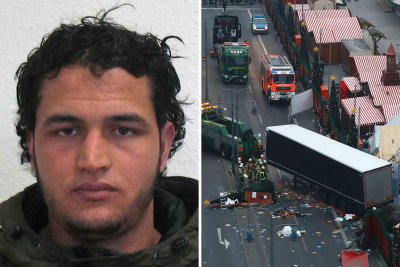
Italy confirms Berlin truck attack suspect shot dead in Milan

December 23, 2016

Berlin copy

Rome, Dec 23: The Tunisian man suspected of carrying out the deadly Berlin truck attack at the Christmas market was shot dead by police today in Milan, Italy's interior minister Marco Minniti said.

The minister told a press conference in Rome that Anis Amri had been fatally shot after firing at two police officers who had stopped his car for a routine identity check around 3:00 AM (0200 GMT).

Identity checks had established "without a shadow of doubt" that the dead man was Amri, the minister said.

He said Amri had coolly pulled the weapon from a backpack and began shooting. One of the officers was hit in the shoulder during the exchanges, the minister said. The officer was in hospital, awaiting surgery but not in any danger.

Italy had Amri's fingerprints on file as a result of him having been in prison in Sicily between 2011 and 2015. Thought to be around 24, he had been on the run since escaping after Monday's attack which left 12 people dead.

He had arrived in Italy from his native Tunisia during the Arab Spring in 2011. Shortly after his arrival he was sentenced to a prison term for starting a fire in a refugee centre. He was released in 2015 and made his way to Germany.

Media reports in Italy say he was on anti-terrorism police's radar as a potential Islamist radical during his time in prison but was not considered a high-priority subject for monitoring.

Comments

Add new comment

  • Coastaldigest.com reserves the right to delete or block any comments.
  • Coastaldigset.com is not responsible for its readers’ comments.
  • Comments that are abusive, incendiary or irrelevant are strictly prohibited.
  • Please use a genuine email ID and provide your name to avoid reject.
News Network
April 26,2020

Islamabad, Apr 26: Pakistan Prime Minister Imran Khan has been trumped by the country's powerful military yet again, this time over his government's inadequate steps and its poor response in curbing the coronavirus outbreak in the country, even as cases soared over 12,500.

In his address to the nation on March 22, Khan explained the reasons for not imposing a countrywide lockdown, asserting that millions would lose their jobs and affect families, who are below the poverty line, struggling to find enough food to eat. However, less than 24 hours later, Pakistan Army spokesperson Major General Babar Iftikhar announced the implementation of lockdown in the country having a population of over 200 million, contradicting the statements made by Imran Khan.

As lockdown was imposed, the military has deployed troops across Pakistan and is orchestrating the COVID-19 response through the National Core Committee, a body set up to coordinate policy between the national and provincial governments.

"The government left a big gap in its handling of the coronavirus. The army has tried to fill that gap, there was no choice," an unnamed retired general was quoted by Financial Times as saying.

The virus crisis in Pakistan has once again made things crystal clear about who is calling the shots -- the military, widely believed to bring Imran Khan to power in 2018.

The armymen have taken over the COVID-19 crisis as an opportunity to prove their competency in contrast to Imran Khan, who was mocked after urging youth to come forward and join Corona Relief Tigers Force, a volunteer body to wage "jihad" against the virus.

According to analysts, the military's seizure of the coronavirus response marks yet another policy failure for Imran Khan in the eyes of the generals, as per the Financial Times report.

The 67-year-old cricketer-turned-politician has repeatedly failed to gain international traction over the Kashmir issue and has struggled to convince the Financial Action Task Force (FATF) in getting his country removed from 'grey list' for terror funding.

In times of emergency, one has to take clear decisions and take them through. You can't dither. The whole world is advising strong lockdown. If the prime minister does not show that he is decisive, somebody else will," said Nafisa Shah, a Member of Parliament from the opposition Pakistan Peoples Party (PPP).

Even after the lockdown was imposed, Imran Khan continued to question the need for its implementation, raising eyebrows over the country's response in tackling the virus, as cases continue to rise. This comes even as such drastic measures are in place in many countries across the world, including neighbouring India.

According to The Dawn, the country has 12,657 confirmed cases of COVID-19, which includes 2,755 recoveries and 265 deaths. Punjab has the highest number of cases -- 5,326 --, followed by 4,232 in Sindh.

However, experts suggest that the actual numbers could be more given the low testing rates and inadequate supply of testing kits.

Doctors and nurses across the country have staged protests over the lack of personal protective equipment, as increasing numbers of health workers contract COVID-19.

"Because of the lack of resources, there is chaos among the doctors and healthcare workers. They know people are dying, they know the severity of the illness and they have to work without PPE," Shoaib Hasan Tarar, a doctor working in Rawalpindi, was quoted as saying.

As the coronavirus crisis continues to ravage Pakistan, the country's overwhelming health infrastructure has put a toll on its already floundering economy. The IMF said that the GDP will shrink 1.5 per cent in 2020. The cash-strapped nation is set to be the first major emerging economy to apply to a G-20 initiative to request debt repayment relief, according to Financial Times.

In early March, Pakistan saw a surge in coronavirus cases, when infected pilgrims and workers crossed the border from Qom, a religious city in Iran, which is a hotspot.

Pakistan's limited resources were exposed when quarantined pilgrims agitated against unhealthy conditions at Taftan camp on Pakistan-Iran border, where five people were living in a tent with no access to toilets.

While the lockdown is in place, authorities have been confronted by hardline clerics who have defied social distancing terms and downplayed the threat of the virus. During Friday prayers every week, worshippers violate the restrictions by gathering at various mosques.

Last week, Islamabad inked an agreement allowing mosques to stay open for Ramzan. It stipulated that people should follow 20 rules, including maintaining a six feet distance from each other.

"There is little consistency in terms of how the lockdown is being approached. Coronavirus has shown the disconnect between the national government, regional governments and the military. Imran Khan has been left behind as the cheerleader for keeping Pakistan's morale high. I think people are starting to ask, 'How long is he going to last?'", said Sajjan Gohel, South Asia expert and guest teacher at the London School of Economics.

Comments

Add new comment

  • Coastaldigest.com reserves the right to delete or block any comments.
  • Coastaldigset.com is not responsible for its readers’ comments.
  • Comments that are abusive, incendiary or irrelevant are strictly prohibited.
  • Please use a genuine email ID and provide your name to avoid reject.
News Network
February 26,2020

Feb 26: Looking out over the world’s largest cricket stadium, the seats jammed with more than 100,000 people, India’s prime minister heaped praise on his American visitor.

“The leadership of President Trump has served humanity,” Prime Minister Narendra Modi said Monday, highlighting Trump’s fight against terrorism and calling his 36-hour visit to India a watershed in India-U.S. relations.

The crowds cheered. Trump beamed.

“The ties between India and the U.S. are no longer just any other partnership,” Modi said. “It is a far greater and closer relationship.”

India, it seems, loves Donald Trump. It seemed obvious from the thousands who turned out to wave as his motorcade snaked through the city of Ahmedabad, and from the tens of thousands who filled the city’s new stadium. It seemed obvious from the hug that Modi gave Trump after he descended from Air Force One, and from the hundreds of billboards proclaiming Trump’s visit.

But it’s not so simple.

Because while Trump is genuinely popular in India, his clamorous and carefully choreographed welcome was also about Asian geopolitics, China’s growing power and a masterful Indian politician who gave his American visitor exactly what he wanted.

Modi “is doing this not necessarily because he loves Trump,” said Tanvi Madan, the director of the India Project at the Brookings Institution in Washington, D.C. “It’s very much about Trump as the leader of the U.S. and recognizing what it is that Trump himself likes.”

Trump likes crowds — big crowds — and the foot soldiers of India’s political parties have long known how to corral enough people to make any politician look popular. In a city like Ahmedabad, the capital of Modi’s home state of Gujarat and the center of his power base, it wouldn’t take much effort to fill a cavernous sports stadium. It was more surprising that a handful of seats remained empty, and that some in the stands had left even before Trump had finished his speech.

For India, good relations with the U.S. are deeply important: They signal that India is a serious global player, an issue that has long been important to New Delhi, and help cement an alliance that both nations see as a counterweight to China’s rise.

“For both countries, their biggest rival is China,” said John Echeverri-Gent, a professor at the University of Virginia whose research often focuses on India. “China is rapidly expanding its presence in the Indian Ocean, which India has long considered its backyard and its exclusive realm for security concerns.”

“It’s very clearly a major concern for both India and the United States,” he said.

Trump isn’t the first U.S. president that Modi has courted. In 2015, then-President Barack Obama was the first American chief guest at India’s Republic Day parade, a powerful symbolic gesture. Obama also got a Modi hug, and the media in both countries were soon writing about the two leaders’ “bromance.”

Trump is popular in India, even if some of that is simply because he’s the U.S. president. A 2019 Pew Research Center poll showed that 56% of Indians had confidence in Trump’s abilities in world affairs, one of only a handful of countries where he has that level of approval. But Obama was also popular: Before he left office, he had 58% approval in world affairs among Indians.

The Pew poll also indicated that Trump’s support was higher among supporters of Modi’s Hindu nationalist party.

That’s not surprising. Both men have fired up their nationalist bases with anti-Muslim rhetoric and government policies, from Trump’s travel bans to Modi’s crackdown in Kashmir, India’s only Muslim-majority state.

And Trump’s Indian support is far from universal. Protests against his trip roiled cities from New Delhi to Hyderabad to the far northeastern city of Gauhati, although those demonstrations were mostly overshadowed by protests over a new Indian citizenship law that Modi backs.

Modi, who is widely popular in India, has faced weeks of protests over the law, which provides fast track naturalization for some foreign-born religious minorities — but not Muslims. While Trump talked about ties with India on Tuesday, Hindus and Muslims fought in violent clashes that left at least 10 people dead over two days.

In some ways, Modi and Trump are powerful echoes of each other.

They have overlapping political styles. Both are populists who see themselves as brash, rule-breaking outsiders who disdain their countries’ traditional elites. Both are seen by their critics as having authoritarian leanings. Both surround themselves with officials who rarely question their decisions.

But are they friends?

Trump says yes. “Really, we feel very strongly about each other,” he said at a New Delhi press briefing.

But many observers aren’t so sure.

“The question is how much of this is real chemistry, as opposed to what I’d call planned chemistry” orchestrated for diplomatic reasons, said Madan. “It’s so hard to know if you’re not in the room.”

Certainly, Modi understands America’s importance to India. While the two countries continue to bicker about trade issues, the prime minister organized a welcome that impressed even India’s news media, which have watched countless choreographed mass political rallies.

“There is no other country for whose leader India would hold such an event, and for which an Indian prime minister would lavish such rhetoric,” the Hindustan Times said in an editorial.

“The spectacle and the sound were worth a thousand agreements.”

Comments

Add new comment

  • Coastaldigest.com reserves the right to delete or block any comments.
  • Coastaldigset.com is not responsible for its readers’ comments.
  • Comments that are abusive, incendiary or irrelevant are strictly prohibited.
  • Please use a genuine email ID and provide your name to avoid reject.
Agencies
May 23,2020

Washington, May 23: President Donald Trump has labeled churches and other houses of worship as “essential" and called on governors nationwide to let them reopen this weekend even though some areas remain under coronavirus lockdown.

The president threatened Friday to “override” governors who defy him, but it was unclear what authority he has to do so.

“Governors need to do the right thing and allow these very important essential places of faith to open right now — for this weekend," Trump said at a hastily arranged press conference at the White House. Asked what authority Trump might have to supersede governors, White House press secretary Kayleigh McEnany said she wouldn't answer a theoretical question.

Trump has been pushing for the country to reopen as he tries to reverse an economic free fall playing out months before he faces reelection. White evangelical Christians have been among the president's most loyal supporters, and the White House has been careful to attend to their concerns throughout the crisis.

Following Trump's announcement, the Centers for Disease Control and Prevention released new guidelines for communities of faith on how to safely reopen, including recommendations to limit the size of gatherings and consider holding services outdoors or in large, well-ventilated areas.

Public health agencies have generally advised people to avoid gatherings of more than 10 people and encouraged Americans to remain 6 feet (1.8 meters) away from others when possible. Some parts of the country remain under some version of remain-at-home orders.

In-person religious services have been vectors for transmission of the virus. A person who attended a Mother's Day service at a church in Northern California that defied the governor's closure orders later tested positive, exposing more than 180 churchgoers. And a choir practice at a church in Washington state was labeled by the CDC as an early “superspreading" event.

But Trump on Friday stressed the importance of churches in many communities and said he was “identifying houses of worship — churches, synagogues and mosques — as essential places that provide essential services.”

“Some governors have deemed liquor stores and abortion clinics as essential” but not churches, he said. “It's not right. So I'm correcting this injustice and calling houses of worship essential." “These are places that hold our society together and keep our people united,” he added.

Dr. Deborah Birx, coordinator of the White House coronavirus task force, said faith leaders should be in touch with local health departments and can take steps to mitigate risks, including making sure those who are at high risk of severe complications remain protected.

“There's a way for us to work together to have social distancing and safety for people so we decrease the amount of exposure that anyone would have to an asymptomatic," she said.

A person familiar with the White House's thinking who spoke on condition of anonymity to discuss internal deliberations said Trump had called the news conference, which had not been on his public schedule, because he wanted to be the face of church reopenings, knowing how well it would play with his political base.

Churches around the country have filed legal challenges opposing virus closures.

In Minnesota, after Democratic Gov. Tim Walz this week declined to lift restrictions on churches, Roman Catholic and some Lutheran leaders said they would defy his ban and resume worship services. They called the restrictions unconstitutional and unfair since restaurants, malls and bars were allowed limited reopening.

Some hailed the president's move, including Kelly Shackelford, president of the conservative First Liberty Institute.

“The discrimination that has been occurring against churches and houses of worship has been shocking," he said in a statement. "Americans are going to malls and restaurants. They need to be able to go to their houses of worship.” But Rabbi Jack Moline, president of Interfaith Alliance, said it was “completely irresponsible” for Trump to call for a mass reopening of houses of worship.

“Faith is essential and community is necessary; however, neither requires endangering the people who seek to participate in them,” he said.

“The virus does not discriminate between types of gatherings, and neither should the president." Rhode Island Gov. Gina Raimondo, a Democrat, made clear that churches and other houses of worship will not resume in-person services in her state until at least next weekend and said she was skeptical Trump had the authority to impose such a requirement.

“It's reckless to force them to reopen this weekend. They're not ready,” she said. “We've got a good plan. I'm going to stick with it.” New Hampshire Gov. Chris Sununu, a Republican, said he would review the federal guidance, while maintaining a decision rests with him.

"Obviously we'd love to get to the point where we can get those open, but we'll look at the guidance documents and try to make some decisions rather quickly, depending on what it might say,” he said. “It's the governor's decision, of course.”

The CDC more than a month ago sent the Trump administration documents the agency had drafted outlining specific steps various kinds of organizations, including houses of worship, could follow as they worked to reopen safely.

But the White House dragged its feet, concerned that the recommendations were too specific and could give the impression the administration was interfering in church operations.

The guidance posted Friday contains most of the same advice as the draft guidance. It calls for the use of face coverings and recommends keeping worshippers 6 feet from one another and cutting down on singing, which can spread aerosolized drops that carry the virus.

Comments

Add new comment

  • Coastaldigest.com reserves the right to delete or block any comments.
  • Coastaldigset.com is not responsible for its readers’ comments.
  • Comments that are abusive, incendiary or irrelevant are strictly prohibited.
  • Please use a genuine email ID and provide your name to avoid reject.