


Italy PM Matteo Renzi delays resignation until budget is passed

December 6, 2016

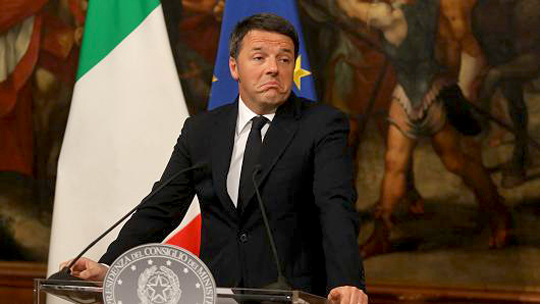
Rome, Dec 6: Italian Prime Minister Matteo Renzi formally resigned Monday after a crushing referendum defeat that has sent shockwaves around Europe — though his departure will be delayed by a final task, passing a budget.
Italy

Renzi handed his resignation to President Sergio Mattarella after Italians resoundingly rejected his constitutional reform proposals in Sunday's referendum, to the delight of the country's populist leaders, fresh after Brexit and Donald Trump's US victory.

The departure of the centre-left premier — who had staked his future on the outcome of the vote — plunges Italy into political uncertainty and casts a shadow over the future of the eurozone's third-largest economy.

In an apparent bid to ease investor fears, the presidency said in a statement that Mattarella had "asked the prime minister to postpone his resignation" until the 2017 budget has been passed, a move expected by the end of the week, according to Italian media.

The government has already won a vote of confidence on the budget in the lower house of parliament.

Renzi, who in 2014 became Italy's youngest-ever premier, was left with no option but to quit after his proposals to streamline parliament were rejected by voters by a decisive 59-41 percent margin.

The 41-year-old former mayor of Florence, who came to power promising radical reform, defended his record.

"1,000 difficult but wonderful days. Thanks to everyone. Viva l'Italia," he wrote on Facebook.

Italian media said he told his cabinet he had agreed to see the budget passed before his departure "out of a sense of responsibility".

Landmark moment?

Initial market reaction to Renzi's departure has been subdued.

The euro briefly sank to a 20-month low as investors fretted that political instability could scupper efforts to resolve debt-ridden Italy's long-running banking crisis, and over the possibility of an election that could see anti-EU parties challenge for power.

Italy's FTSE MIB stock index fell 2.0 percent at the opening but recovered to end the day only fractionally down. Italian bond yields rose slightly, having already edged up prior to Sunday's vote.

Traders were reassured in part by the result of Europe's other crucial vote this weekend, which saw Austria reject a far-right candidate for president.

But some analysts said the referendum could yet come to be seen as a landmark moment.

Holger Schmieding, at the Berenberg private bank, said the risk that Italy could choose to leave the euro, while still remote, had increased.

Capital Economics said: "Italy has taken the first step along a path that could lead it out of the eurozone."

An anti-establishment vote

The vote inevitably became something of a referendum on Renzi's personality and record after his pledge to stand down should he lose, and an opportunity for some to express wider frustrations.

Populists across Europe rejoiced at his downfall, with the founder of Italy's own anti-establishment Five Star movement Beppe Grillo calling for an election "within a week".

Giovanni Orsina, Professor of Politics at Rome's Luiss university, said four out of five voters had cast their vote politically rather than on the merits of the reform.

"The vote has broad similarities with the Brexit and Trump phenomena," he said. "The electorate voted against the establishment, against Brussels. They didn't get into the subtleties."

Poll data showed the No vote was strongest in areas with high unemployment, in the relatively poor south and amongst young voters, pointing to a correlation with levels of discontent.

Britain's eurosceptic Nigel Farage, who spearheaded the "Brexit" campaign, said the vote appeared to have been "more about the euro than constitutional change".

But former Bank of Italy economist Lorenzo Codgno insisted: "The outcome of the referendum is much more complex and nuanced than 'just another wave of protest across the globe'."

Padoan favourite for new PM

Most analysts see immediate elections as unlikely.

The most probable scenario is a caretaker administration dominated by Renzi's Democratic Party taking over before an election that has to take place by March 2018.

Finance Minister Pier Carlo Padoan was installed as the bookmakers favourite to succeed Renzi as prime minister, with Senate speaker Pietro Grasso, a veteran anti-mafia prosecutor, running in second place.

Renzi meanwhile may try to stay on as head of his party, which would leave him well-placed for a potential comeback to frontline politics at the next election. But he faces resistance to that scenario from the many enemies he has made while in office.

Comments

Add new comment

  • Coastaldigest.com reserves the right to delete or block any comments.
  • Coastaldigset.com is not responsible for its readers’ comments.
  • Comments that are abusive, incendiary or irrelevant are strictly prohibited.
  • Please use a genuine email ID and provide your name to avoid reject.
News Network
May 2,2020

Balochistan, May 1: Sajid Hussain, Editor-in-Chief of Balochistan Times, has been found dead in a Swedish town, the police have confirmed.

The Swedish police informed his family on Thursday night that they discovered his body from a river in Uppsala, The Times reported.
The Baloch journalist had been missing from the Swedish city since March 2 this year.

Sajid, 39, left Pakistan in 2012 and had been living as a refugee in Sweden since 2017. He wrote extensively on the suffering of the Balochis at the hands of the Pakistani military establishment.

His work often got him into trouble as the authorities did not like his reporting of Balochistan's forbidden stories, the reason he had to leave and live in exile.

The Baloch journalist was found dead two months after he went missing in Sweden.
Sajid left Pakistan because of security threats from Pakistan Army and its intelligence service ISI.

The spokesperson of the Baloch National Movement, Hammal Haider told news agency: "We are deeply saddened by the demise of prominent Baloch intellectual and writer Sajid Hussain."
"His death is indeed a loss of a great mind for the people of Balochistan. Due to his straightforwardness, he was loved among all journalistic, literary and political circles," added Haider.

"After this incident, we have serious concerns about our members and other Baloch refugees living in the West," he said.

Comments

Add new comment

  • Coastaldigest.com reserves the right to delete or block any comments.
  • Coastaldigset.com is not responsible for its readers’ comments.
  • Comments that are abusive, incendiary or irrelevant are strictly prohibited.
  • Please use a genuine email ID and provide your name to avoid reject.
News Network
February 17,2020

Feb 17: Chinese authorities on Monday reported a slight upturn in new virus cases and 105 more deaths for a total of 1,770 since the outbreak began two months ago.

The 2,048 new cases followed three days of declines but was up by just 39 cases from the previous day’s figure. Another 10,844 people have recovered from COVID-19, a disease caused by the new coronavirus, and have been discharged from hospitals, according to Monday’s figures.

The update followed the publication late Saturday in China’s official media of a recent speech by President Xi Jinping in which he indicated for the first time that he had led the response to the outbreak from early in the crisis. While the reports were an apparent attempt to demonstrate the Communist Party leadership acted decisively from the start, it also opened Xi up to criticism over why the public was not alerted sooner.

In his speech, Xi said he gave instructions on fighting the virus on Jan. 7 and ordered the shutdown of the most-affected cities that began on Jan. 23.

The disclosure of his speech indicates top leaders knew about the outbreak’s potential severity at least two weeks before such dangers were made known to the public. It was not until late January that officials said the virus can spread between humans and public alarm began to rise.

New cases in other countries are raising growing concerns about containment of the virus.

Taiwan on Sunday reported its first death from COVID-19, the fifth fatality outside of mainland China. Taiwan’s Central News Agency, citing health minister Chen Shih-chung, said the man who died was in his 60s and had not traveled overseas recently and had no known contact with virus patients.

Japanese Prime Minister Shinzo Abe convened an experts meeting to discuss containment measures in his country, where more than a dozen cases have emerged in the past few days without any obvious link to China.

“The situation surrounding this virus is changing by the minute,” Abe said.

Japanese Health Minister Katsunobu Kato said the country is “entering into a phase that is different from before,” requiring new steps to stop the spread of the virus.

Japan now has 413 confirmed cases, including 355 from a quarantined cruise ship, and one death from the virus. Its total is the highest number of cases among about two dozen countries outside of China where the illness has spread.

Hundreds of Americans from the cruise ship took charter flights home, as Japan announced another 70 infections had been confirmed on the Diamond Princess. Canada, Hong Kong and Italy were planning similar flights.

The 300 or so Americans flying on U.S.-government chartered aircraft back to the U.S. will face another 14-day quarantine at Travis Air Force Base in California and Lackland Air Force Base in Texas. The U.S. Embassy said the departure was offered because people on the ship were at a high risk of exposure to the virus. People with symptoms were banned from the flights.

About 255 Canadians and 330 Hong Kong residents are on board the ship or undergoing treatment in Japanese hospitals. There are also 35 Italians, of which 25 are crew members, including the captain.

In China’s Hubei province, where the outbreak began in December, all vehicle traffic will be banned in another containment measure. It expands a vehicle ban in the provincial capital, Wuhan, where public transportation, trains and planes have been halted for weeks.

Exceptions were being made for vehicles involved in epidemic prevention and transporting daily necessities.

Hubei has built new hospitals with thousands of patient beds and China has sent thousands of military medical personnel to staff the new facilities and help the overburdened health care system.

Last Thursday, Hubei changed how it recognized COVID-19 cases, accepting a doctor’s diagnosis rather than waiting for confirmed laboratory test results, in order to treat patients faster. The tally spiked by more than 15,000 cases under the new method.

Comments

Add new comment

  • Coastaldigest.com reserves the right to delete or block any comments.
  • Coastaldigset.com is not responsible for its readers’ comments.
  • Comments that are abusive, incendiary or irrelevant are strictly prohibited.
  • Please use a genuine email ID and provide your name to avoid reject.
News Network
May 25,2020

Beijing, May 25: China has reported 51 new coronavirus cases including 40 asymptomatic infections, majority of them in the contagion's first epicentre Wuhan, where over six million tests have been conducted in the last 10 days, health officials said on Monday.

The country's National Health Commission (NHC) said that 11 new imported cases were reported on Sunday.

While no new domestically-transmitted COVID-19 cases were reported in China on Sunday, 11 imported cases including 10 in the Inner Mongolia Autonomous Region and one in Sichuan province were reported, the NHC said in its daily report.

Out of the 40 new asymptomatic cases, 38 were reported in Wuhan, which is currently undergoing mass testing of its over 11.2 million people after a spike in the asymptomatic cases.

Currently, 396 people with asymptomatic symptoms are under medical observation in China, including 326 in Wuhan, according to the health authority.

Asymptomatic cases refer to the patients who have tested COVID-19 positive but develop no symptoms such as fever, cough or sore throat. However, they pose a risk of spreading the disease to others.

Wuhan, which earlier had over 50,000 cases between January and March, started a campaign on May 14 to expand the nucleic acid testing in order to better know the number of asymptomatic cases or people who show no clear symptoms despite carrying the virus.

According to the latest figures released by the Wuhan municipal health commission, the city conducted more than 6 million nucleic acid tests between May 14 and 23.

On Saturday, the city carried out nearly 1.15 million tests, state-run Xinhua news agency reported on Monday.

Nucleic acid testing is a molecular technique for screening blood donations to reduce the risk of transfusion transmitted infections.

As of Sunday, a total of 82,985 confirmed COVID-19 cases have been reported in China with 4,634 fatalities, the NHC added.

Comments

Add new comment

  • Coastaldigest.com reserves the right to delete or block any comments.
  • Coastaldigset.com is not responsible for its readers’ comments.
  • Comments that are abusive, incendiary or irrelevant are strictly prohibited.
  • Please use a genuine email ID and provide your name to avoid reject.