


Italy PM Matteo Renzi delays resignation until budget is passed

December 6, 2016

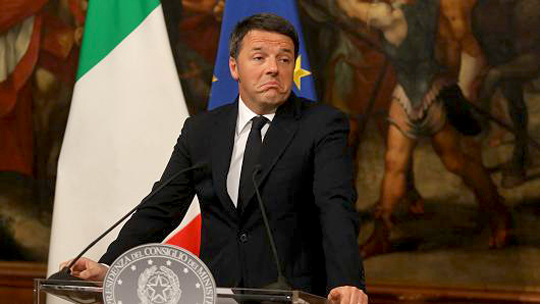
Rome, Dec 6: Italian Prime Minister Matteo Renzi formally resigned Monday after a crushing referendum defeat that has sent shockwaves around Europe — though his departure will be delayed by a final task, passing a budget.
Italy

Renzi handed his resignation to President Sergio Mattarella after Italians resoundingly rejected his constitutional reform proposals in Sunday's referendum, to the delight of the country's populist leaders, fresh after Brexit and Donald Trump's US victory.

The departure of the centre-left premier — who had staked his future on the outcome of the vote — plunges Italy into political uncertainty and casts a shadow over the future of the eurozone's third-largest economy.

In an apparent bid to ease investor fears, the presidency said in a statement that Mattarella had "asked the prime minister to postpone his resignation" until the 2017 budget has been passed, a move expected by the end of the week, according to Italian media.

The government has already won a vote of confidence on the budget in the lower house of parliament.

Renzi, who in 2014 became Italy's youngest-ever premier, was left with no option but to quit after his proposals to streamline parliament were rejected by voters by a decisive 59-41 percent margin.

The 41-year-old former mayor of Florence, who came to power promising radical reform, defended his record.

"1,000 difficult but wonderful days. Thanks to everyone. Viva l'Italia," he wrote on Facebook.

Italian media said he told his cabinet he had agreed to see the budget passed before his departure "out of a sense of responsibility".

Landmark moment?

Initial market reaction to Renzi's departure has been subdued.

The euro briefly sank to a 20-month low as investors fretted that political instability could scupper efforts to resolve debt-ridden Italy's long-running banking crisis, and over the possibility of an election that could see anti-EU parties challenge for power.

Italy's FTSE MIB stock index fell 2.0 percent at the opening but recovered to end the day only fractionally down. Italian bond yields rose slightly, having already edged up prior to Sunday's vote.

Traders were reassured in part by the result of Europe's other crucial vote this weekend, which saw Austria reject a far-right candidate for president.

But some analysts said the referendum could yet come to be seen as a landmark moment.

Holger Schmieding, at the Berenberg private bank, said the risk that Italy could choose to leave the euro, while still remote, had increased.

Capital Economics said: "Italy has taken the first step along a path that could lead it out of the eurozone."

An anti-establishment vote

The vote inevitably became something of a referendum on Renzi's personality and record after his pledge to stand down should he lose, and an opportunity for some to express wider frustrations.

Populists across Europe rejoiced at his downfall, with the founder of Italy's own anti-establishment Five Star movement Beppe Grillo calling for an election "within a week".

Giovanni Orsina, Professor of Politics at Rome's Luiss university, said four out of five voters had cast their vote politically rather than on the merits of the reform.

"The vote has broad similarities with the Brexit and Trump phenomena," he said. "The electorate voted against the establishment, against Brussels. They didn't get into the subtleties."

Poll data showed the No vote was strongest in areas with high unemployment, in the relatively poor south and amongst young voters, pointing to a correlation with levels of discontent.

Britain's eurosceptic Nigel Farage, who spearheaded the "Brexit" campaign, said the vote appeared to have been "more about the euro than constitutional change".

But former Bank of Italy economist Lorenzo Codgno insisted: "The outcome of the referendum is much more complex and nuanced than 'just another wave of protest across the globe'."

Padoan favourite for new PM

Most analysts see immediate elections as unlikely.

The most probable scenario is a caretaker administration dominated by Renzi's Democratic Party taking over before an election that has to take place by March 2018.

Finance Minister Pier Carlo Padoan was installed as the bookmakers favourite to succeed Renzi as prime minister, with Senate speaker Pietro Grasso, a veteran anti-mafia prosecutor, running in second place.

Renzi meanwhile may try to stay on as head of his party, which would leave him well-placed for a potential comeback to frontline politics at the next election. But he faces resistance to that scenario from the many enemies he has made while in office.

Comments

Add new comment

  • Coastaldigest.com reserves the right to delete or block any comments.
  • Coastaldigset.com is not responsible for its readers’ comments.
  • Comments that are abusive, incendiary or irrelevant are strictly prohibited.
  • Please use a genuine email ID and provide your name to avoid reject.
News Network
July 11,2020

Istanbul, Jul 11: Turkish President Recep Tayyip Erdogan announced Friday that the Hagia Sophia, one of the architectural wonders of the world, would be reopened for Muslim worship, sparking fury in the Christian community and neighbouring Greece.

His declaration came after a top Turkish court revoked the sixth-century Byzantine monument's status as a museum, clearing the way for it to be turned back into a mosque.

The UNESCO World Heritage site in historic Istanbul, a magnet for tourists worldwide, was first constructed as a cathedral in the Christian Byzantine Empire but was converted into a mosque after the Ottoman conquest of Constantinople in 1453.

The Council of State, Turkey's highest administrative court, unanimously cancelled a 1934 cabinet decision to turn it into a museum and said Hagia Sophia was registered as a mosque in its property deeds.

The landmark ruling could inflame tensions not just with the West and Turkey's historic foe Greece but also Russia, with which Erdogan has forged an increasingly close partnership in recent years.

'Millions of Christians not heard'

Greece swiftly branded the move by Muslim-majority Turkey an "open provocation to the civilised world".

"The nationalism displayed by Erdogan... takes his country back six centuries," Culture Minister Lina Mendoni said in a statement.

The Russian Orthodox Church was equally scathing.

"The concern of millions of Christians were not heard," Church spokesman Vladimir Legoida told Interfax news agency.

The decision "shows that all pleas regarding the need to handle the situation extremely delicately were ignored," he said.

UNESCO chief Audrey Azoulay said she "deeply regrets" the decision made without prior dialogue with the UN's cultural agency.

The move was also condemned by the US Commission on International Religious Freedom, which said it was an "unequivocal politicisation" of the monument.

Hagia Sophia, which stands opposite the impressive Sultanahmet Mosque -- often called the Blue Mosque, has been a museum since 1935 and open to believers of all faiths.

Transforming it from a mosque was a key reform under the new republic born out of the ashes of the Ottoman Empire.

Sharing a presidential decree which named Hagia Sophia as a "mosque", Erdogan announced its administration would be handed over to Turkey's religious affairs directorate known as Diyanet.

"May we be blessed," he commented. The decree was published on the official gazette.

Erdogan has in recent years placed great emphasis on the battles which resulted in the defeat of Byzantium by the Ottomans, with lavish celebrations held every year to mark the conquest.

Muslim clerics have occasionally recited prayers in the museum on key anniversaries or religious holidays.

"The decision is intended to score points with Erdogan's pious and nationalist constituents," said Anthony Skinner of the risk assessment firm Verisk Maplecroft.

"Hagia Sophia is arguably the most conspicuous symbol of Turkey's Ottoman past -- one which Erdogan is leveraging to strengthen his base while snubbing domestic and foreign rivals," he told AFP.

'Chains broken'

A few hundred Turks carrying Turkish flags gathered outside Hagia Sophia shouting "Chains broken, Hagia Sophia reopened".

Police heightened security measures around the building, according to AFP journalists.

"It's been a dream since we were kids," said Erdal Gencler, an Istanbul resident.

"(Hagia Sophia) finds its true purpose again. We are very excited, proud, and hopeful that there will be beautiful services here," he added.

Fatma, a woman with tearful eyes, said: "Of course I am crying. (Hagia Sophia) belongs to us."

Ahead of the court decision, Justice Minister Abdulhamit Gul shared a picture of Hagia Sophia on his official Twitter account, with a message: "Have a good Friday."

Finance Minister Berat Albayrak, Erdogan's son-in-law, tweeted that Hagia Sophia would be reopened to Muslim worship "sooner or later", referring to a quote from Turkish poet Necip Fazil Kisakurek.

The Council of State had on July 2 debated the case brought by a Turkish group -- the Association for the Protection of Historic Monuments and the Environment, which demanded Hagia Sophia be reopened for Muslim prayers.

Since 2005, there have been several attempts to change the building's status. In 2018, the Constitutional Court rejected one application.

Despite occasional protests outside the site by Islamic groups, Turkish authorities had until now kept the building as a museum.

Comments

Add new comment

  • Coastaldigest.com reserves the right to delete or block any comments.
  • Coastaldigset.com is not responsible for its readers’ comments.
  • Comments that are abusive, incendiary or irrelevant are strictly prohibited.
  • Please use a genuine email ID and provide your name to avoid reject.
Agencies
August 5,2020

Paris, Aug 5: French President Emmanuel Macron on Tuesday said France will deploy a civil security detachment and several tonnes of medical equipment to Lebanon, whose capital was hit by an explosion that left over 70 people dead and thousands injured.

"Emergency doctors will also reach Beirut as soon as possible to strengthen hospitals. France is already engaged," the French President said in a tweet.

US Secretary of State Mike Pompeo, also extended his deepest condolences to all those affected by the "massive explosion at the port of Beirut."

"We are closely monitoring and stand ready to assist the people of Lebanon as they recover from this tragedy. Our team in Beirut has reported to me the extensive damage to a city and a people that I hold dear, an additional challenge in a time of already deep crisis. 

We understand that the Government of Lebanon continues to investigate its cause and look forward to the outcome of those efforts," he said in a statement.

UK Prime Minister Boris Johnson said his country is ready to provide support in any way it can.

"The pictures and videos from Beirut tonight are shocking. All of my thoughts and prayers are with those caught up in this terrible incident. The UK is ready to provide support in any way we can, including to those British nationals affected," Johnson said.

Israeli people share the pain of their Lebanese neighbours after a devastating blast in the port of Beirut and reach out to offer their aid, Israeli President Reuven Rivlin said on Tuesday.

"We share the pain of the Lebanese people and sincerely reach out to offer our aid at this difficult time," Rivlin said on Twitter.

Over 70 people have been killed while thousands of others were wounded in the massive explosion on Tuesday in Beirut which shattered buildings and caused widespread damage.

Comments

Add new comment

  • Coastaldigest.com reserves the right to delete or block any comments.
  • Coastaldigset.com is not responsible for its readers’ comments.
  • Comments that are abusive, incendiary or irrelevant are strictly prohibited.
  • Please use a genuine email ID and provide your name to avoid reject.
News Network
April 12,2020

Apr 12: India and other South Asian countries are likely to record their worst growth performance in four decades this year due to the coronavirus outbreak, the World Bank said on Sunday.

The South Asian region, comprising eight countries, is likely to show economic growth of 1.8 per cent to 2.8 per cent this year, the World Bank said in its South Asia Economic Focus report, well down from the 6.3 per cent it projected six months ago.

India's economy, the region's biggest, is expected to grow 1.5 per cent to 2.8 per cent in the fiscal year that started on April 1. The World Bank has estimated it will grow 4.8 per cent to 5 per cent in the fiscal year that ended on March 31.

"The green shoots of a rebound that were observable at the end of 2019 have been overtaken by the negative impacts of the global crisis," the World Bank report said.

Other than India, the World Bank forecast that Sri Lanka, Nepal, Bhutan and Bangladesh will also see sharp falls in economic growth.

Three other countries - Pakistan, Afghanistan and the Maldives - are expected to fall into recession, the World Bank said in the report, which was based on country-level data available as of April 7.

Measures taken to counter the coronavirus have disrupted supply chains across South Asia, which has recorded more than 13,000 cases so far - still lower than many parts of the world.

India's lockdown of 1.3 billion people has also left millions out of work, disrupted big and small businesses and forced an exodus of migrant workers from the cities to their homes in villages.

In the event of prolonged and broad national lockdowns, the report warned of a worst-case scenario in which the entire region would experience an economic contraction this year.

To minimize short-term economic pain, the Bank called for countries in the region to announce more fiscal and monetary steps to support unemployed migrant workers, as well as debt relief for businesses and individuals.

India has so far unveiled a $23 billion economic plan to offer direct cash transfers to millions of poor people hit by its lockdown. In neighbouring Pakistan, the government has announced a $6 billion plan to support the economy.

"The priority for all South Asian governments is to contain the virus spread and protect their people, especially the poorest who face considerable worse health and economic outcomes," said senior World Bank official Hartwig Schafer.

Comments

Add new comment

  • Coastaldigest.com reserves the right to delete or block any comments.
  • Coastaldigset.com is not responsible for its readers’ comments.
  • Comments that are abusive, incendiary or irrelevant are strictly prohibited.
  • Please use a genuine email ID and provide your name to avoid reject.