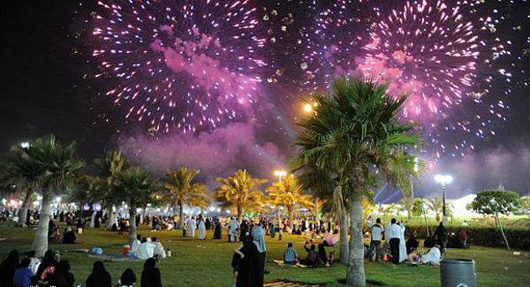
It’s official: Eid-ul-Fitr in Saudi Arabia, UAE, Kuwait, Qatar on Friday

July 16, 2015

Riyadh, Jul 16: A new moon has been sighted in Saudi Arabia, heralding the start of Eid Al-Fitr holiday in the region.

Muslims in Saudi Arabia, Kuwait, the UAE, Qatar, Bahrain and the UK will celebrate Eid al-Fitr on Friday, while Muslims in other nations such as Iraq, India and Bangladesh will observe the holiday on Saturday.

editulfitr

Even though the holy month of Ramadan had commenced in most of the Middle Eastern countries and south Indian state of Kerala and coastal Karnataka on June 18, the celebration of Eid in Kerala and coastal Karnataka will be held on Saturday due to

For Muslims, Eid al-Fitr celebration begins after the fasting month of Ramadan ends. During Ramadan, Muslims abstain from food, drinks and sexual intercourse from dawn to dusk, which is an exercise in self-restraint, intended to bring the faithful closer to God.

Eid al-Fitr starts when the new moon is spotted in the sky, making the Eid holiday different around the Muslim world.

Also Read: Shawwal moon not sighted in coastal Karnataka; Eid-ul-Fitr on Saturday

Comments

Add new comment

  • Coastaldigest.com reserves the right to delete or block any comments.
  • Coastaldigset.com is not responsible for its readers’ comments.
  • Comments that are abusive, incendiary or irrelevant are strictly prohibited.
  • Please use a genuine email ID and provide your name to avoid reject.
News Network
April 24,2020

Apr 24: Dubai's Supreme Committee of Crisis and Disaster Management has announced partial easing of restrictions on public movement in the emirate starting from Friday amid the COVID-19 outbreak.

The announcement is in line with the decisions of the Ministry of Health and Prevention and the National Emergency Crisis and Disaster Management Authority (NCEMA), a statement released late on Thursday said.

The move, which coincides with the start of the fasting month of Ramzan, will allow increased freedom of movement while ensuring the continuation of strict precautionary and preventive measures, the statement said.

The Committee has also outlined a new set of guidelines on movement and a list of exempted commercial activities and vital sectors, it added.

The decision to reduce restrictions on movement in Dubai follows a careful assessment of the current situation and analysis of reports from various authorities working to combat the pandemic, the committee said.

Underlining the emirate’s success in countering the spread of the virus, it said that stringent measures undertaken over the last three weeks have significantly helped to mitigate the crisis.

It further stressed that despite the partial easing of restrictions on movement, people will not be allowed to hold public or private gatherings and those who breach the guidelines will face legal action.

The need to ensure the safety and wellbeing of the community cannot be underestimated, the Committee stressed.

"Despite the difficult circumstances the world is facing today, the UAE has set an example for dealing with the crisis. This was also made possible through the commitment of all individuals and institutions both in the private and public sector,” the committee said in the statement.

“All measures undertaken by the country have been driven by the objective of safeguarding everyone’s safety and wellbeing,” it added.

Public transport (bus and metro), restaurants and cafes (except for buffet and shisha), retail sector (malls, high-street outlets and souqs), wholesale sector and maintenance shops will be allowed to operate under certain conditions, it said.

Shopping malls, markets and commercial outlets will be open daily from 12 pm to 10 pm. Restaurants and shops are allowed to operate at a maximum of 30 per cent capacity at shopping malls, it said.

Malls and retail outlets are not allowed to hold entertainment events to avoid congestion and crowding, it added.

Restaurants and cafés too have been allowed to operate but are not permitted to serve shisha and buffet. Dine-in customers are allowed but should occupy only a maximum of 30 per cent of the outlet’s capacity and only single-use cutlery can be used at restaurants and cafes, it said.

However, family entertainment facilities, cinemas, changing rooms and prayer rooms will not be allowed to operate. Hotels will be allowed to operate without opening pools, gyms, sauna and massage parlours.

A maximum of 30 per cent of the workforce of all organisations will be allowed to work from their offices while the rest will be required to work from home.

As part of the first phase of easing of restrictions, the stringent curbs on public movement will now be limited to the period between 10 pm to 6 am. During this period, the public will be allowed to leave their homes only for medical emergencies.

Individuals will be able to leave their homes between 6 am and 10 pm without a permit.

The public will be required to strictly follow precautionary measures which include maintaining physical distance from others as per guidelines and wearing a face mask. Those who do not wear a mask will be subject to a fine of AED 1,000.

Members of the public have also been allowed to exercise outside their homes provided they do not leave their area of residence. They can undertake activities such as walking, running or cycling for 1-2 hours each time. Only a maximum of three people can exercise at the same time.

Permission has also been granted to allow visit first and second degree relatives as long as gatherings are restricted to not more than five people. However, visiting high-risk individuals (individuals above 60 years and those with underlying medical conditions) should be avoided.


Comments

Add new comment

  • Coastaldigest.com reserves the right to delete or block any comments.
  • Coastaldigset.com is not responsible for its readers’ comments.
  • Comments that are abusive, incendiary or irrelevant are strictly prohibited.
  • Please use a genuine email ID and provide your name to avoid reject.
Agencies
February 27,2020

Riyadh, Feb 27: Saudi Arabia on Thursday halted travel to the holiest sites in Islam over fears about a new viral epidemic just months ahead of the annual hajj pilgrimage, a move coming as the Mideast has over 220 confirmed cases of the illness.

The extraordinary decision by Saudi Arabia stops foreigners from reaching the holy city of Mecca and the Kaaba, the cube-shaped structure the world's 1.8 billion Muslims pray toward five times a day. It also said travel was suspended to Prophet Muhammad's mosque in Medina.

The decision showed the worry about the outbreak potentially spreading into Saudi Arabia, whose oil-rich monarchy stakes its legitimacy on protecting Islam's holy sites. The epicenter in the Mideast's most-affected country, Iran, appears to be in the holy Shiite city of Qom, where a shrine there sees the faithful reach out to kiss and touch it in reverence.

"Saudi Arabia renews its support for all international measures to limit the spread of this virus, and urges its citizens to exercise caution before traveling to countries experiencing coronavirus outbreaks," the Saudi Foreign Ministry said in a statement announcing the decision.

"We ask God Almighty to spare all humanity from all harm." Disease outbreaks always have been a concern surrounding the hajj, required of all able-bodied Muslims once in their life, especially as pilgrims come from all over the world.

The earliest recorded outbreak came in 632 as pilgrims fought off malaria. A cholera outbreak in 1821, for instance, killed an estimated 20,000 pilgrims. Another cholera outbreak in 1865 killed 15,000 pilgrims and then spread worldwide.

More recently, Saudi Arabia faced a danger from a related coronavirus that caused Middle East respiratory syndrome, or MERS. The kingdom increased its public health measures in 2012 and 2013, though no outbreak occurred.

While millions attend the 10-day hajj, this year set for late July into early August, millions more come during the rest of the year to the holy sites in the kingdom.

"It is unprecedented, at least in recent times, but given the worldwide spread of the virus and the global nature of the umrah, it makes sense from a public health and safety point of view," said Kristian Ulrichsen, a research fellow at the James A Baker III Institute for Public Policy at Rice University. "Especially since the Iranian example illustrates how a religious crossroads can so quickly amplify the spread and reach of the virus." The virus that causes the illness named COVID-19 has infected more than 80,000 people globally, mainly in China. The hardest-hit nation in the Mideast is Iran, where Health Ministry spokesman Kianoush Jahanpour said 19 people have died among 139 confirmed cases.

Experts are concerned Iran may be underreporting cases and deaths, given the illness's rapid spread from Iran across the Persian Gulf. For example, Iran still has not confirmed any cases in Mashhad, even though a number of cases reported in Kuwait are linked to the Iranian city.

In Bahrain, which confirmed 33 cases as of Thursday morning, authorities halted all flights to Iraq and Lebanon. It separately extended a 48-hour ban overflights from Dubai and Sharjah in the United Arab Emirates, through which infected travellers reached the island kingdom off the coast of Saudi Arabia.

Iranian President Hassan Rouhani said there were no immediate plans to quarantine cities but acknowledged it may take "one, two or three weeks” to get control of the virus in Iran.

As Iran's 80 million people find themselves increasingly isolated in the region by the outbreak, the country's sanctions-battered economy saw its currency slump to its lowest level against the US dollar in a year on Wednesday.

Comments

Add new comment

  • Coastaldigest.com reserves the right to delete or block any comments.
  • Coastaldigset.com is not responsible for its readers’ comments.
  • Comments that are abusive, incendiary or irrelevant are strictly prohibited.
  • Please use a genuine email ID and provide your name to avoid reject.
Agencies
May 18,2020

Jeddah, May 18: Saudi Arabia’s Grand Mufti and head of the Council of Senior Scholars and the Department of Scientific Research and Ifta Sheikh Abdul Aziz Al Asheikh ruled that it is permissible to perform Eid Al-Fitr prayer at home under exceptional circumstances similar to the current pandemic situation. The prayer consists of two rakats with reciting more numbers of takbeer and without a sermon.

Speaking to Okaz/Saudi Gazette, he said that Zakat Al-Fitr could be distributed through charitable societies if they are reliable ones, with the condition that it should be distributed before the day of Eid. The Grand Mufti urged parents to bring joy and happiness to their children and their families by spending more on them.

Meanwhile, Sheikh Abdul Salam Abdullah Al-Sulaiman, member of the Council of Senior Scholars and the Standing Committee of Fatwa, said that Eid prayer could be performed individually or in congregation.

Speaking to Okaz/Saudi Gazette, he said that the worshiper will recite takbeer to start salat and then follow it with six more takbeer in the first rakat before reciting Fatiha loudly and then it is ideal to recite Surah Al-Qaf.

In the second rakat, there will be five takbeer after the takbeer at the start of the rakat before starting to recite Surah Fatiha and then Surah Al-Qamar, following the example of the Prophet (peace be upon him). It is also ideal to recite Surah Al-A’la and Al-Ghashiya instead of Al-Qaf and Al-Qamar in each rakat respectively.

Sheikh Al-Sulaiman also cited the example of Anas Bin Malik, a prominent companion of the Prophet (pbuh). When Anas (May Allah be pleased with him), was at his home in Zawiya, a place near Basra, he did not find any Eid congregation prayer and therefore he performed prayer along with his family members and his aide Abdullah Bin Abi Otba.

The scholar said that the time for Eid prayer begins after sunrise and the best time is after the sun rises by the height of one or two spears as agreed by most scholars. This means 15 or 30 minutes after sunrise and its time continues until the end of the time of the Duha prayer; that is before the Zuhr prayer begins.

The prayer is forbidden at the moment when the sun rises, and the majority of jurists, including the schools of thought of Shafi, Maliki, and Hanbali opposed prayer at sunrise and favored to perform the prayer only after the sun rises by the height of one or two spears in the sky.

Regarding the recitation of takbeer on the occasion of Eid Al-Fitr, Sheikh Al-Suleiman said that it should begin during the night of the Eid and continue until the beginning of the Eid prayer.

Comments

Add new comment

  • Coastaldigest.com reserves the right to delete or block any comments.
  • Coastaldigset.com is not responsible for its readers’ comments.
  • Comments that are abusive, incendiary or irrelevant are strictly prohibited.
  • Please use a genuine email ID and provide your name to avoid reject.