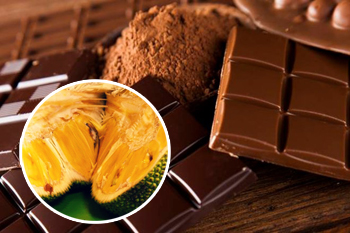
Jackfruit seeds could substitute cocoa beans to make chocolate

April 25, 2017

Apr 25: Jackfruit seeds produce chocolaty aromas and could be a potentially cheap, abundant substitute for making chocolates, say scientists in the light of the looming global cocoa bean shortage.

jackfruitResearchers from University of Sao Paulo in Brazil found that compounds found in jackfruit seeds produce many of the same aromas as processed cocoa beans and are a potentially cheap, abundant substitute for use in chocolate manufacturing.

Globally, farmers produce about 3.7 million tonnes of cocoa annually.

This yield is not expected to increase significantly in the next decade, but estimates suggest that worldwide demand for these beans will grow to 4.5 million tonnes by 2020 researchers said.

Scientists are investigating alternative sources that can mimic chocolates distinct aroma and flavour.

Researchers made 27 different roasted jackfruit seed flours by acidifying or fermenting the seeds prior to drying.

They roasted these flours for various times and temperatures using processes similar to those used to enhance the chocolaty flavor of cocoa beans.

Using gas chromatography-mass spectrometry, the team identified several compounds from the jackfruit flours that are associated with chocolate aromas.

The chocolate aroma of groups of four flours were ranked by a sensory panel and response surface methodology was used to identify optimum conditions.

They asked volunteers to smell the jack fruit seed flours and describe the aromas.

The team found that in contrast to the acidified flours, the fermented ones were described as having more positive attributes, such as caramel, hazelnut or fruity aromas, researchers said.

Researchers concluded that jackfruit seeds are capable of producing chocolate aromas and are a potential replacement for the aroma of cocoa powder or chocolate.

The study was published in the Journal of Agricultural and Food Chemistry.

Comments

Add new comment

  • Coastaldigest.com reserves the right to delete or block any comments.
  • Coastaldigset.com is not responsible for its readers’ comments.
  • Comments that are abusive, incendiary or irrelevant are strictly prohibited.
  • Please use a genuine email ID and provide your name to avoid reject.
Agencies
July 5,2020

The deadly coronavirus that entered India while there was still nip in the air has beaten rising mercury, humid conditions, unique Indian genome and has entered monsoon season with more potency as fresh cases are only breaking all records in the country.

India recorded a single-day spike of record 24,850 new coronavirus cases on Sunday, taking its total tally to 6.73 lakh corona-positive cases.

Top Indian microbiologists were hopeful in March that after the 21-day lockdown, as summer approaches, the rise in temperature would play an important role in preventing the drastic spread of COVID-19 virus in India.

Several virologists hinted that by June this year, the impact of COVID-19 would be less than what it appeared in March-April.

The claims have fallen flat as the virus is mutating fast, becoming more potent than ever.

According to experts, the novel coronavirus is a new virus whose seasonality and response to hot humid weather was never fully understood.

"The theory was based on the fact that high temperatures can kill the virus as in sterilisation techniques used in healthcare. But these are controlled environment conditions. There are many other factors besides temperature, humidity which influence the transmission rate among humans," Dr Anu Gupta, Head, Microbiologist and Infection Control, Fortis Escorts Heart Institute, told IANS.

There is no built-up immunity to COVID-19 in humans.

"Also, asymptomatic people might be passing it to many others unknowingly. New viruses tend not to follow the seasonal trend in their first year," Gupta emphasized.

Globally, as several countries are now experiencing hot weather, the World Health Organization (WHO) reported a record hike in the number of coronavirus cases, with the total rising by 2,12,326 in 24 hours in the highest single-day increase since COVID-19 broke out.

So far over 11 million people worldwide have tested positive for the disease which has led to over 5,25,000 deaths, according to data from Johns Hopkins University. The US remained the worst-hit country with over 28 lakh cases, followed by Brazil with 15.8 lakh.

According to Sandeep Nayar, Senior Consultant and HOD, Respiratory Medicine, Allergy & Sleep Disorders, BLK Super Speciality Hospital in New Delhi, whether temperature plays a role in COVID-19 infection is highly debated.

One school of thought said in the tropical regions of South Asia, the virus might not thrive longer.

"On the other hand, another school of thought has found that novel Coronavirus can survive in a hot and humid environment and tropical climate does not make a difference to the virus. According to them, this is what distinguishes the novel coronavirus from other common viruses, which usually wane in hot weather," stressed Nayar.

Not much has been studied in the past and no definite treatment or vaccine is available to date.

"Every day, new properties and manifestation of the disease come up. As of now, the only way to prevent this monster is by taking appropriate precautions. Hand hygiene, social distancing, cough etiquette and face masks definitely reduce spread of COVID-19 infection," Nayar told IANS.

Not just top Indian health experts, even Indian-American scientists had this theory in mind that sunshine and summer may ebb the spread of the coronavirus.

Ravi Godse, Director of Discharge Planning, UPMC Shadyside Pennsylvania in the US told IANS in April: "In the summer, the humidity can go up as well, meaning more water drops in the air. If the air is saturated with water and somebody sneezes virus droplets into such air, it is likely that the droplets will fall to the ground quicker, making them less infectious. So the short answer is yes, summer/sunshine could be bettera.

According to Dr Puneet Khanna, Head of Respiratory Medicine and Pulmonology, Manipal Hospital, Delhi, COVID-19 death rates are not too different in tropical countries but since the disease affected them late it was yet to show its peak in these areas.

"The virus can survive well in hot and humid countries and this is proven now," he stressed.

Comments

Add new comment

  • Coastaldigest.com reserves the right to delete or block any comments.
  • Coastaldigset.com is not responsible for its readers’ comments.
  • Comments that are abusive, incendiary or irrelevant are strictly prohibited.
  • Please use a genuine email ID and provide your name to avoid reject.
News Network
July 10,2020

Toronto, Jul 10: Pasteurising breast milk at 62.5 degrees Celsius for 30 minutes inactivates the SARS-CoV-2 virus that causes Covid-19, making it safe for consumption by babies, a study claims.

According to the research published in the Canadian Medical Association Journal, current advice for women with Covid-19 is to continue to breastfeed their own infants.

In Canada, it is standard care to provide pasteurised breast milk to very-low-birth-weight babies in hospital until their own mother's milk supply is adequate, the researchers said.

"In the event that a woman who is Covid-19-positive donates human milk that contains SARS-CoV-2, whether by transmission through the mammary gland or by contamination through respiratory droplets, skin, breast pumps and milk containers, this method of pasteurisation renders milk safe for consumption," said Sharon Unger, a professor at the University of Toronto in Canada.

The Holder method, a technique used to pasteurise milk in all Canadian milk banks at 62.5 degrees Celsius for 30 minutes, is effective at neutralising viruses such as HIV, hepatitis and others that are known to be transmitted through human milk, the researchers said.

In the latest study, the researchers spiked human breast milk with a viral load of SARS-CoV-2 and tested samples that either sat at room temperature for 30 minutes or were warmed to 62.5 degrees Celsius for 30 minutes.

They then measured for active virus, finding that the virus in the pasteurised milk was inactivated after heating.

More than 650 human breast milk banks around the world use the Holder method to ensure a safe supply of milk for vulnerable infants, the researchers said.

Comments

Add new comment

  • Coastaldigest.com reserves the right to delete or block any comments.
  • Coastaldigset.com is not responsible for its readers’ comments.
  • Comments that are abusive, incendiary or irrelevant are strictly prohibited.
  • Please use a genuine email ID and provide your name to avoid reject.
Agencies
July 8,2020

Scientists have designed a “catch and kill” air filter which they say can trap the novel coronavirus and neutralise it instantly, an invention that may reduce the spread of COVID-19 in closed spaces such as schools, hospitals and health care facilities, as well as public transit environments like airplanes.

According to the study, published in the journal Materials Today Physics, the device killed 99.8 per cent of the novel coronavirus, SARS-CoV-2, in a single pass through its filter. It said the device, made from commercially available nickel foam heated to 200 degrees Celsius, also killed 99.9 per cent of the spores of the deadly bacterium Bacillus anthracis which causes the anthrax disease.

“This filter could be useful in airports and in airplanes, in office buildings, schools, and cruise ships to stop the spread of COVID-19,” said Zhifeng Ren, a co-author of the study from the University of Houston (UH) in the US.

“Its ability to help control the spread of the virus could be very useful for society,” Ren added.

The researchers said they are also developing a desk-top model for the device which is capable of purifying the air in an office worker’s immediate surroundings. According to the scientists, since the virus can remain in the air for about three hours, a filter that could remove it quickly was a viable plan, and with businesses reopening across the world, they believe controlling the spread in air conditioned spaces was urgent.

The study noted that the novel coronavirus cannot survive temperatures above 70 degrees Celsius, so by making the filter temperature far hotter — about 200 degree Celsius, the researchers said they were able to kill the virus almost instantly.

Ren said the nickel foam met several key requirements. “It is porous, allowing the flow of air, and electrically conductive, which allowed it to be heated. It is also flexible,” the researchers noted in a statement.But they added that nickel foam also had low resistivity, making it difficult to raise the temperature high enough to quickly kill the virus.

The researchers said they solved this problem by folding the foam, connecting multiple compartments with electrical wires to increase the resistance high enough to raise the temperature as high as 250 degrees Celsius. By making the filter electrically heated, rather than heating it from an external source, they said the the amount of heat that escaped from the filter is minimised, allowing air conditioning to function with very low strain.

When the scientists built and tested a prototype for the relationship between voltage/current and temperature, they said it satisfies the requirements for conventional heating, ventilation, and air conditioning (HVAC) systems, and could kill the coronavirus.

“This novel biodefense indoor air protection technology offers the first-in-line prevention against environmentally mediated transmission of airborne SARS-CoV-2, and will be on the forefront of technologies available to combat the current pandemic and any future airborne biothreats in indoor environments,” said Faisal Cheema, another co-author of the study from UH.

The researchers have called for a phased roll-out of the device, “beginning with high-priority venues, where essential workers are at elevated risk of exposure.” They believe the novel device will both improve safety for frontline workers in essential industries and allow nonessential workers to return to public work spaces.

Comments

Add new comment

  • Coastaldigest.com reserves the right to delete or block any comments.
  • Coastaldigset.com is not responsible for its readers’ comments.
  • Comments that are abusive, incendiary or irrelevant are strictly prohibited.
  • Please use a genuine email ID and provide your name to avoid reject.