


January 2017 is third warmest month in 137 years

February 17, 2017

New York, Feb 17: Last month was the third warmest January in 137 years of modern record-keeping, according to a monthly analysis of global temperatures by Nasa scientists. Last month"s temperature was 0.20 degrees Celsius cooler than the warmest January in 2016. However, it was 0.92 degrees Celsius warmer than the mean January temperature from 1951-1980.temp
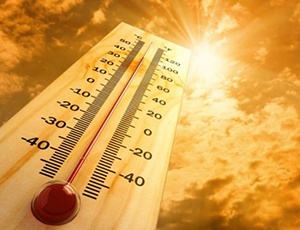
Two of the three top January temperature anomalies have been during the past two years. Year 2016 was the hottest on record, at 1.12 degrees Celsius warmer than the January mean temperature, followed by 2007 at 0.96 degrees Celsius warmer. January 2017 placed third. Scientists at Nasa"s Goddard Institute for Space Studies (GISS) in the US created a map of the January 2017 land-ocean temperature index (LOTI) anomaly.

It shows that most of North America and Siberia were much warmer than the 1951-1980 base period. Much of the rest of Asia was also relatively warm. The monthly analysis by the GISS team is assembled from publicly available data acquired by about 6,300 meteorological stations around the world, ship- and buoy-based instruments measuring sea surface temperature, and Antarctic research stations. The modern global temperature record begins around 1,880 because previous observations did not cover enough of the planet.

Comments

Add new comment

  • Coastaldigest.com reserves the right to delete or block any comments.
  • Coastaldigset.com is not responsible for its readers’ comments.
  • Comments that are abusive, incendiary or irrelevant are strictly prohibited.
  • Please use a genuine email ID and provide your name to avoid reject.
Agencies
June 9,2020

New Zealand's research institute in Antarctica is scaling back the number of projects planned for the upcoming season, in an effort to keep the continent free of coronavirus, it was reported on Tuesday.

The government agency, Antarctica New Zealand, told the BBC on Tuesday that it was dropping 23 of the 36 research projects.

Only long-term science monitoring, essential operational activity and planned maintenance will go ahead.

The upcoming research season runs from October to March.

"As COVID-19 sweeps the planet, only one continent remains untouched and (we) are focused on keeping it that way," Antarctica New Zealand told the BBC.

The organisation's chief executive Sarah Williamson said the travel limits and a strict managed isolation plan were the key factors for keeping Scott Base - New Zealand's research facility - virus free.

"Antarctica New Zealand is committed to maintaining and enhancing the quality of New Zealand's Antarctic scientific research. However, current circumstances dictate that our ability to support science is extremely limited this season" she said.

Earlier in April, Australia announced that it would scale back its activity in the 2020-21 summer season.

This included decreasing operational capacity and delaying work on some major projects.

Comments

Add new comment

  • Coastaldigest.com reserves the right to delete or block any comments.
  • Coastaldigset.com is not responsible for its readers’ comments.
  • Comments that are abusive, incendiary or irrelevant are strictly prohibited.
  • Please use a genuine email ID and provide your name to avoid reject.
Agencies
July 4,2020

The Mars Colour Camera (MCC) onboard ISRO's Mars Orbiter Mission has captured the image of Phobos, the closest and biggest moon of Mars.

The image was taken on July 1 when MOM was about 7,200 km from Mars and 4,200 km from Phobos.

"Spatial resolution of the image is 210 m.

This is a composite image generated from 6 MCC frames and has been color corrected," ISRO said in an update along with the image.

Phobos is largely believed to be made up of carbonaceous chondrites.

According to ISRO, "the violent phase that Phobos has encountered is seen in the large section gouged out from a past collision (Stickney crater) and bouncing ejecta."

"Stickney, the largest crater on Phobos along with the other craters (Shklovsky, Roche & Grildrig) are also seen in this image," it said.

The mission also known as Mangalyaan was initially meant to last six months, but subsequently ISRO had said it had enough fuel for it to last "many years."

The country had on September 24, 2014 successfully placed the Mars Orbiter Mission spacecraft in orbit around the red planet, in its very first attempt, thus breaking into an elite club.

ISRO had launched the spacecraft on its nine-month- long odyssey on a homegrown PSLV rocket from Sriharikota in Andhra Pradesh on November 5, 2013.

It had escaped the earth's gravitational field on December 1, 2013.

The Rs 450-crore MOM mission aims at studying the Martian surface and mineral composition as well as scan its atmosphere for methane (an indicator of life on Mars).

The Mars Orbiter has five scientific instruments - Lyman Alpha Photometer (LAP), Methane Sensor for Mars (MSM), Mars Exospheric Neutral Composition Analyser (MENCA), Mars Colour Camera (MCC) and Thermal Infrared Imaging Spectrometer

Comments

Add new comment

  • Coastaldigest.com reserves the right to delete or block any comments.
  • Coastaldigset.com is not responsible for its readers’ comments.
  • Comments that are abusive, incendiary or irrelevant are strictly prohibited.
  • Please use a genuine email ID and provide your name to avoid reject.
Agencies
February 23,2020

Google has indexed invite links to private WhatsApp group chats, meaning anyone can join various private chat groups (including several porn-sharing groups) with a simple search.

According to a report in Motherboard, invitations to WhatsApp group chats were being indexed by Google.

The team found private groups using specific Google searches and even joined a group intended for NGOs accredited by the UN and had access to all the participants and their phone numbers.

Journalist Jordan Wildon said on Twitter that he discovered that WhatsApp's "Invite to Group Link" feature lets Google index groups, making them available across the internet since the links are being shared outside of WhatsApp's secure private messaging service.

"Your WhatsApp groups may not be as secure as you think they are," Wildon tweeted on Friday, adding that using particular Google searches, people can discover links to the chats.

According to app reverse-engineer Jane Wong, Google has around 470,000 results for a simple search of "chat.whatsapp.com", part of the URL that makes up invites to WhatsApp groups.

WhatsApp spokesperson Alison Bonny said: "Like all content that is shared in searchable public channels, invite links that are posted publicly on the internet can be found by other WhatsApp users."

"The links that users wish to share privately with people they know and trust should not be posted on a publicly accessible website," Bonny told The Verge.

Danny Sullivan, Google's public search liaison, tweeted: "Search engines like Google & others list pages from the open web. That's what's happening here. It's no different than any case where a site allows URLs to be publicly listed. We do offer tools allowing sites to block content being listed in our results."

Comments

Add new comment

  • Coastaldigest.com reserves the right to delete or block any comments.
  • Coastaldigset.com is not responsible for its readers’ comments.
  • Comments that are abusive, incendiary or irrelevant are strictly prohibited.
  • Please use a genuine email ID and provide your name to avoid reject.