



Japan makes exception; signs historic nuclear deal with India

November 11, 2016

Tokyo, Nov 11: Making an exception, Japan today signed a historic civil nuclear cooperation deal with India, opening the door for collaboration between their industries in the field even as the countries signed nine other agreements in various areas to bolster bilateral ties.Japan-India
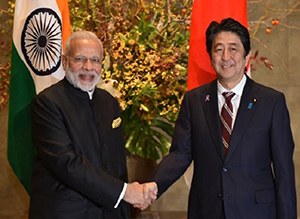
The agreements, including the one for cooperation in peaceful uses of nuclear energy, marks a historic step in their engagement to build a clean energy partnership, Prime Minister Narendra Modi said after wide-ranging talks with his Japanese counterpart Shinzo Abe.

The nuclear agreement comes after tough negotiations for over six years between the two countries and Abe said at the joint media interaction with Modi that he was delighted over the signing of agreement on peaceful use of nuclear energy.

"This agreement is a legal framework that India will act responsibly in peaceful uses of nuclear energy and also in Non-Proliferation regime even though India is not a participant or signatory of NPT," he said.

"It (the agreement) is in line with Japan's ambition to create a world without nuclear weapons," said Abe, whose country has traditionally adopted a tough stand on proliferation issues having been the only victim of atomic bombings during World War II.

He noted that India in September 2008 had made its intention of peaceful uses of nuclear energy and also announced moratorium on nuclear tests.

"Today's signing of the Agreement for Cooperation in Peaceful Uses of Nuclear Energy marks a historic step in our engagement to build a clean energy partnership," Modi said.

"Our cooperation in this field will help us combat the challenge of Climate Change. I also acknowledge the special significance that such an agreement has for Japan," he said and thanked Abe, Japanese government and Parliament for their support to this agreement.

Other nations who have signed civil nuclear deal with India include the US, Russia, South Korea, Mongolia, France, Namibia, Argentina, Canada, Kazakhstan and Australia.

In his remarks, Prime Minister Modi said as democracies, the two countries "support openness, transparency and the rule of law".

"We are also united in our resolve to combat the menace of terrorism, especially cross-border terrorism," he said.
Later, speaking at a Banquet hosted by Abe in his honour, Modi said there is also a lot that the two sides can do together as close partners, not just for the benefit of their societies, but also for the region and the whole world.

"Our capacities could also combine to respond to both, the opportunities and challenges that we jointly face in present times. And, together with the global community we can, and we must, combat the rising threats of radicalisation, extremism and terrorism," he said.

Abe pushed for universalization of the NPT, entry into force of Comprehensive Nuclear-Test-Ban Treaty (CTBT) and start of negotiations at the earliest on Fissile Material Cutoff Treaty (FMCT).

"The two Prime Ministers welcomed the signing of the Agreement between the Government of Japan and the Government of the Republic of India for Cooperation in the Peaceful Uses of Nuclear Energy which reflects a new level of mutual confidence and strategic partnership in the cause of clean energy, economic development and a peaceful and secure world," said a joint statement.

Modi said deeper economic engagement, growth of trade, manufacturing and investment ties, focus on clean energy, partnership to secure the citizens, and cooperation on infrastructure and skill development are among key priorities.

"India and its economy are pursuing many transformations. Our aim is to become a major centre for manufacturing, investments and for the 21st century knowledge industries.

"And, in this journey, we see Japan as a natural partner. We believe there is vast scope to combine our relative advantages, whether of capital, technology or human resources, to work for mutual benefit," he said in his joint interaction.

The Prime Minister said that the strategic partnership between the two countries also brings peace, stability and balance to the region. It is alive and responsive to emerging opportunities and challenges in Asia-Pacific, he said.

The successful Malabar naval exercise has underscored the convergence in the two sides' strategic interests in the broad expanse of the waters of the Indo-Pacific, Modi said.

On his part, Abe mentioned the high speed train corridor between Mumbai and Ahmedabad that is being built with the help of Japan, saying the project symbolizes a new dimension in the special relations.

Prime Minister Abe said the designing of the project will begin by the end of this year, construction will begin in 2018 and the high speed train will be in service from 2023.

He said Modi, who will travel by one such train to Kobe city tomorrow from here, will see for himself that it is the safest technology in the world.

The Japanese private sector also would be setting up an institute of manufacturing in India to train about 30,000 people in 10 years, particularly in rural areas, Abe said.

Abe said Japan will set up a tourism bureau in New Delhi to encourage people-to-people contacts. He said he wants to work with Modi in liberalizing the visa rules.

"India-Japan relations have the greatest potential in the world. Strong India is in the best interest of Japan and strong Japan is in the best interest of India," Abe said.

Noting that he had met Modi for the third time in one year, Abe praised him, saying he had a "global vision" and was a "decisive leader".

Comments

Add new comment

  • Coastaldigest.com reserves the right to delete or block any comments.
  • Coastaldigset.com is not responsible for its readers’ comments.
  • Comments that are abusive, incendiary or irrelevant are strictly prohibited.
  • Please use a genuine email ID and provide your name to avoid reject.
News Network
April 26,2020

Islamabad, Apr 26: Pakistan Prime Minister Imran Khan has been trumped by the country's powerful military yet again, this time over his government's inadequate steps and its poor response in curbing the coronavirus outbreak in the country, even as cases soared over 12,500.

In his address to the nation on March 22, Khan explained the reasons for not imposing a countrywide lockdown, asserting that millions would lose their jobs and affect families, who are below the poverty line, struggling to find enough food to eat. However, less than 24 hours later, Pakistan Army spokesperson Major General Babar Iftikhar announced the implementation of lockdown in the country having a population of over 200 million, contradicting the statements made by Imran Khan.

As lockdown was imposed, the military has deployed troops across Pakistan and is orchestrating the COVID-19 response through the National Core Committee, a body set up to coordinate policy between the national and provincial governments.

"The government left a big gap in its handling of the coronavirus. The army has tried to fill that gap, there was no choice," an unnamed retired general was quoted by Financial Times as saying.

The virus crisis in Pakistan has once again made things crystal clear about who is calling the shots -- the military, widely believed to bring Imran Khan to power in 2018.

The armymen have taken over the COVID-19 crisis as an opportunity to prove their competency in contrast to Imran Khan, who was mocked after urging youth to come forward and join Corona Relief Tigers Force, a volunteer body to wage "jihad" against the virus.

According to analysts, the military's seizure of the coronavirus response marks yet another policy failure for Imran Khan in the eyes of the generals, as per the Financial Times report.

The 67-year-old cricketer-turned-politician has repeatedly failed to gain international traction over the Kashmir issue and has struggled to convince the Financial Action Task Force (FATF) in getting his country removed from 'grey list' for terror funding.

In times of emergency, one has to take clear decisions and take them through. You can't dither. The whole world is advising strong lockdown. If the prime minister does not show that he is decisive, somebody else will," said Nafisa Shah, a Member of Parliament from the opposition Pakistan Peoples Party (PPP).

Even after the lockdown was imposed, Imran Khan continued to question the need for its implementation, raising eyebrows over the country's response in tackling the virus, as cases continue to rise. This comes even as such drastic measures are in place in many countries across the world, including neighbouring India.

According to The Dawn, the country has 12,657 confirmed cases of COVID-19, which includes 2,755 recoveries and 265 deaths. Punjab has the highest number of cases -- 5,326 --, followed by 4,232 in Sindh.

However, experts suggest that the actual numbers could be more given the low testing rates and inadequate supply of testing kits.

Doctors and nurses across the country have staged protests over the lack of personal protective equipment, as increasing numbers of health workers contract COVID-19.

"Because of the lack of resources, there is chaos among the doctors and healthcare workers. They know people are dying, they know the severity of the illness and they have to work without PPE," Shoaib Hasan Tarar, a doctor working in Rawalpindi, was quoted as saying.

As the coronavirus crisis continues to ravage Pakistan, the country's overwhelming health infrastructure has put a toll on its already floundering economy. The IMF said that the GDP will shrink 1.5 per cent in 2020. The cash-strapped nation is set to be the first major emerging economy to apply to a G-20 initiative to request debt repayment relief, according to Financial Times.

In early March, Pakistan saw a surge in coronavirus cases, when infected pilgrims and workers crossed the border from Qom, a religious city in Iran, which is a hotspot.

Pakistan's limited resources were exposed when quarantined pilgrims agitated against unhealthy conditions at Taftan camp on Pakistan-Iran border, where five people were living in a tent with no access to toilets.

While the lockdown is in place, authorities have been confronted by hardline clerics who have defied social distancing terms and downplayed the threat of the virus. During Friday prayers every week, worshippers violate the restrictions by gathering at various mosques.

Last week, Islamabad inked an agreement allowing mosques to stay open for Ramzan. It stipulated that people should follow 20 rules, including maintaining a six feet distance from each other.

"There is little consistency in terms of how the lockdown is being approached. Coronavirus has shown the disconnect between the national government, regional governments and the military. Imran Khan has been left behind as the cheerleader for keeping Pakistan's morale high. I think people are starting to ask, 'How long is he going to last?'", said Sajjan Gohel, South Asia expert and guest teacher at the London School of Economics.

Comments

Add new comment

  • Coastaldigest.com reserves the right to delete or block any comments.
  • Coastaldigset.com is not responsible for its readers’ comments.
  • Comments that are abusive, incendiary or irrelevant are strictly prohibited.
  • Please use a genuine email ID and provide your name to avoid reject.
Agencies
July 3,2020

The dollar's dominance will slowly melt away over the coming year on weakening global demand and a sombre U.S. economic outlook, according to a Reuters poll of currency forecasters whose views depend on there being no second coronavirus shock.

Despite fears a surge in new Covid-19 cases would delay economies reopening and stymie a tentative recovery, world stocks have rallied - with the S&P 500 finishing higher in June, marking its biggest quarterly percentage gain since the height of the technology boom in 1998.

Caught between bets in favour of riskier investments, weak U.S. economic prospects as well as an easing in the thirst for dollars after the Federal Reserve flooded markets with liquidity, the greenback fell nearly 1.0 per cent last month. It was its worst monthly performance since December.

While there was a dire prognosis from the top U.S. medical expert on the coronavirus' spread, the June 25-July 1 poll of over 70 analysts showed weak dollar projections as Fed Chair Jerome Powell on Monday reiterated the economic outlook for the world's largest economy was uncertain.

"The dollar rises in two instances: when you see risk off or when there is a situation where the U.S. is leading the global recovery, and we don't think that's going to be the case anytime soon," said Gavin Friend, senior FX strategist at NAB Group in London.

"The U.S. is playing fast and loose with the virus, and chronologically they're behind the rest of the world."

Currency speculators, who had built up trades against the dollar to the highest in two years during May, increased their out-of-favour dollar bets further last week, the latest positioning data showed.

About 80 per cent of analysts, 53 of 66, said the likely path for the dollar over the next six months was to trade around current levels, alternating between slight gains and losses in a range. That suggests the greenback may be at a crucial crossroad as more currency strategists have turned bearish.

But more than 90 per cent, or 63 of 68, said a second shock from the pandemic would push the dollar higher. Five said it would push the U.S. currency lower.

Much will also depend on debt servicing and repayments by Asian, European and other international borrowers in U.S. dollars.

While an early shortage of dollars in March from the pandemic's first shock pushed the Fed to open currency swap lines with major central banks, international funding strains have eased significantly since. In recent weeks, usage of the facility has reduced dramatically.

That trend is expected to continue over the next six months with major central banks' usage of swap lines to "stay around current levels", according to 32 of 46 analysts. While 13 predicted a sharp drop, only one respondent said use of them would "rise sharply".

The dollar index, which measures the greenback's strength against six other major currencies, has slipped over 5 per cent since touching a more than three-year high in March.

When asked which currencies would perform better against the dollar by end-December, a touch over half of 49 respondents said major developed market ones, with the remaining almost split between commodity-linked and emerging market currencies.

"The dollar is so overvalued, and has been overvalued for a long time, it's time now for it to come back down again, as we head towards the (U.S.) election," added NAB's Friend.

Over the last quarter, the euro has staged a 1.8 per cent comeback after falling by a similar margin during the first three months of the year. For the month of June, the euro was up 1.2 per cent against the dollar.

The single currency was now expected to gain about 2.5 per cent to trade at $1.15 in a year from around $1.12 on Wednesday, slightly stronger than $1.14 predicted last month. While those findings are similar to what analysts have been predicting for nearly two years, there was a clear shift in their outlook for the euro, with the range of forecasts showing higher highs and higher lows from last month.

"In comparison to even a month or two ago, the outlook in Europe has improved significantly," said Lee Hardman, currency strategist at MUFG.

"I think that makes the euro look relatively more attractive and cheap against the likes of the dollar. We're not arguing strongly for the euro to surge higher, we're just saying, after the weakness we have seen in recent years, there is the potential for that weakness to start to reverse."

Comments

Add new comment

  • Coastaldigest.com reserves the right to delete or block any comments.
  • Coastaldigset.com is not responsible for its readers’ comments.
  • Comments that are abusive, incendiary or irrelevant are strictly prohibited.
  • Please use a genuine email ID and provide your name to avoid reject.
News Network
July 11,2020

Istanbul, Jul 11: Turkish President Recep Tayyip Erdogan announced Friday that the Hagia Sophia, one of the architectural wonders of the world, would be reopened for Muslim worship, sparking fury in the Christian community and neighbouring Greece.

His declaration came after a top Turkish court revoked the sixth-century Byzantine monument's status as a museum, clearing the way for it to be turned back into a mosque.

The UNESCO World Heritage site in historic Istanbul, a magnet for tourists worldwide, was first constructed as a cathedral in the Christian Byzantine Empire but was converted into a mosque after the Ottoman conquest of Constantinople in 1453.

The Council of State, Turkey's highest administrative court, unanimously cancelled a 1934 cabinet decision to turn it into a museum and said Hagia Sophia was registered as a mosque in its property deeds.

The landmark ruling could inflame tensions not just with the West and Turkey's historic foe Greece but also Russia, with which Erdogan has forged an increasingly close partnership in recent years.

'Millions of Christians not heard'

Greece swiftly branded the move by Muslim-majority Turkey an "open provocation to the civilised world".

"The nationalism displayed by Erdogan... takes his country back six centuries," Culture Minister Lina Mendoni said in a statement.

The Russian Orthodox Church was equally scathing.

"The concern of millions of Christians were not heard," Church spokesman Vladimir Legoida told Interfax news agency.

The decision "shows that all pleas regarding the need to handle the situation extremely delicately were ignored," he said.

UNESCO chief Audrey Azoulay said she "deeply regrets" the decision made without prior dialogue with the UN's cultural agency.

The move was also condemned by the US Commission on International Religious Freedom, which said it was an "unequivocal politicisation" of the monument.

Hagia Sophia, which stands opposite the impressive Sultanahmet Mosque -- often called the Blue Mosque, has been a museum since 1935 and open to believers of all faiths.

Transforming it from a mosque was a key reform under the new republic born out of the ashes of the Ottoman Empire.

Sharing a presidential decree which named Hagia Sophia as a "mosque", Erdogan announced its administration would be handed over to Turkey's religious affairs directorate known as Diyanet.

"May we be blessed," he commented. The decree was published on the official gazette.

Erdogan has in recent years placed great emphasis on the battles which resulted in the defeat of Byzantium by the Ottomans, with lavish celebrations held every year to mark the conquest.

Muslim clerics have occasionally recited prayers in the museum on key anniversaries or religious holidays.

"The decision is intended to score points with Erdogan's pious and nationalist constituents," said Anthony Skinner of the risk assessment firm Verisk Maplecroft.

"Hagia Sophia is arguably the most conspicuous symbol of Turkey's Ottoman past -- one which Erdogan is leveraging to strengthen his base while snubbing domestic and foreign rivals," he told AFP.

'Chains broken'

A few hundred Turks carrying Turkish flags gathered outside Hagia Sophia shouting "Chains broken, Hagia Sophia reopened".

Police heightened security measures around the building, according to AFP journalists.

"It's been a dream since we were kids," said Erdal Gencler, an Istanbul resident.

"(Hagia Sophia) finds its true purpose again. We are very excited, proud, and hopeful that there will be beautiful services here," he added.

Fatma, a woman with tearful eyes, said: "Of course I am crying. (Hagia Sophia) belongs to us."

Ahead of the court decision, Justice Minister Abdulhamit Gul shared a picture of Hagia Sophia on his official Twitter account, with a message: "Have a good Friday."

Finance Minister Berat Albayrak, Erdogan's son-in-law, tweeted that Hagia Sophia would be reopened to Muslim worship "sooner or later", referring to a quote from Turkish poet Necip Fazil Kisakurek.

The Council of State had on July 2 debated the case brought by a Turkish group -- the Association for the Protection of Historic Monuments and the Environment, which demanded Hagia Sophia be reopened for Muslim prayers.

Since 2005, there have been several attempts to change the building's status. In 2018, the Constitutional Court rejected one application.

Despite occasional protests outside the site by Islamic groups, Turkish authorities had until now kept the building as a museum.

Comments

Add new comment

  • Coastaldigest.com reserves the right to delete or block any comments.
  • Coastaldigset.com is not responsible for its readers’ comments.
  • Comments that are abusive, incendiary or irrelevant are strictly prohibited.
  • Please use a genuine email ID and provide your name to avoid reject.