


Jasprit Bumrah irked by Jaipur Police for using his CT 17 no-ball image

Agencies
June 24, 2017

Jaipur, June 24: India fast bowler Jasprit Bumrah is not happy with Jaipur Police for using his no-ball image to create traffic awarneness. This has led to them apologising to the paceman, on the social media.bumrah 2
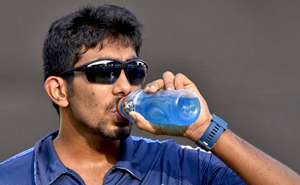
Bumrah bowled a no-ball in the ICC Champions Trophy 2017 final against Pakistan on Sunday (June 18). It proved to be costly as Fakhar Zaman was caught by Mahendra Singh Dhoni. Zaman was reprieved on 3 and he went on to score a century.

@traffic_jpr well done Jaipur traffic police this shows how much respect you get after giving your best for the country. pic.twitter.com/y0PU6v9uEc

— Jasprit bumrah (@Jaspritbumrah93) June 23, 2017

Pakistan defeated India by 180 runs to claim their maiden Champions Trophy title at London's The Oval stadium.

The picture of Bumrah overstepping the bowling crease was used as a billboard by Jaipur Traffic Police with the caption, "Don't cross the line. You know it can be costly." However, Bumrah did not like this.

He replied to them on Twitter, "@traffic_jpr well done Jaipur traffic police this shows how much respect you get after giving your best for the country."

Jaipur Police were forced to apologise to the 23-year-old Indian cricketer. They wrote, "Dear @jaspritbumrah93, our intent was not to hurt your sentiments or the sentiments of millions of cricket fans."

In another tweet, they said, ".@jaspritbumrah93, we only intended to create more awareness about traffic rules."

They called Bumrah a "youth icon", ".@jaspritbumrah93, you are a youth icon & an inspiration for all of us."

Bumrah wrote again stating he won't make fun of police's mistakes. "@traffic_jpr But don't worry I won't make fun of the mistakes which you guys make at your work .because I believe humans can make mistakes."

Before Jaipur Police, Bengaluru Traffic Police too had used the same photograph with the caption, "Crossing some lines can be devastating !!#RespectTheStopLine @

Comments

Add new comment

  • Coastaldigest.com reserves the right to delete or block any comments.
  • Coastaldigset.com is not responsible for its readers’ comments.
  • Comments that are abusive, incendiary or irrelevant are strictly prohibited.
  • Please use a genuine email ID and provide your name to avoid reject.
News Network
May 10,2020

New Delhi, May 10: Former Australia captain Ian Chappell has proposed radical changes in the LBW laws, stating that a batsman should be given out leg before as long as the ball is hitting the stumps irrespective of the spot of its landing and impact.

Chappell also said captains should agree on one way of working up the ball which will encourage swing bowling, even as the ICC is considering the use of artificial substances to shine the ball instead of sweat and saliva in post-COVID-19 scenario.

"The new lbw law should simply say: 'Any delivery that strikes the pad without first hitting the bat and, in the umpire's opinion, would go on to hit the stumps is out regardless of whether or not a shot is attempted'," he wrote in a column for ESPNcricinfo.

"Forget where the ball pitches and whether it strikes the pad outside the line or not; if it's going to hit the stumps, it's out."

The 76-year-old said the change in lbw law would attract expected criticism from the batsmen but it would make the game more fair.

"There will be screams of horror - particularly from pampered batsmen - but there are numerous positives this change would bring to the game. Most important is fairness.

"If a bowler is prepared to attack the stumps regularly, the batsman should only be able to protect his wicket with the bat. The pads are there to save the batsman from injury not dismissal.

"It would also force batsmen to seek an attacking method to combat a wristspinner pitching in the rough outside the right-hander's leg stump," said Chappell.

He cited Sachin Tendulkar's example on how he negotiated Shane Warne's round the wicket tactic during the 1997-98 Test series in India.

"Contrast Sachin Tendulkar's aggressive and successful approach to Shane Warne coming round the wicket in Chennai in 1997-98 with a batsman who kicks away deliveries pitching in the rough and turning in toward the stumps. Which would you rather watch?

"The current law encourages "pad play" to balls pitching outside leg while this change would force them to use their bat. The change would reward bowlers who attack the stumps and decrease the need for negative wide deliveries to a packed off-side field," he said.

Chappell said his proposed change to the lbw law would also cut down "frivolous" DRS challenges.

"This change to the lbw law would also simplify umpiring and result in fewer frivolous DRS challenges. Consequently, it would speed up a game that has slowed drastically in recent times.

"It would also make four-day Tests an even more viable proposition as mind-numbing huge first-innings totals would be virtually non-existent."

On the substitute of shining the ball without sweat and saliva, Chappell said international captains should find out a way of working up the ball.

"With ball-tampering always a hot topic, in the past I've suggested that administrators ask international captains to construct a list (i.e. the use of natural substances) detailing the things bowlers feel will help them to swing the ball.

"From this list, the administrators should deem one method to be legal with all others being punishable as illegal," the cricketer-turned-commentator added.

Comments

Add new comment

  • Coastaldigest.com reserves the right to delete or block any comments.
  • Coastaldigset.com is not responsible for its readers’ comments.
  • Comments that are abusive, incendiary or irrelevant are strictly prohibited.
  • Please use a genuine email ID and provide your name to avoid reject.
News Network
July 2,2020

Jul 2: Cricket Australia has decided to not use the Dukes ball from this summer's Sheffield Shield, having used it alongside Kookaburra for four seasons.

CA has confirmed that the Kookaburra ball will be used for the entire 2020-21 first-class season.

Australia has been using Dukes ball since the 2016-17 season in Shield matches with an aim to help its cricketers prepare for the hostile English conditions.

CA's Head of Cricket Operations, Peter Roach, said the decision to axe the Dukes was the right call. "The introduction of the Dukes ball has been a worthwhile exercise, particularly in the lead up to overseas Ashes series where the Dukes is used so well by our English opponents," Roach said.

"We have been happy with how the ball has performed when used in Australian conditions over the past four seasons. We do, however, feel that reverting to one ball for 2020-21 will provide the consistent examination of our players over a full season that CA and the states are presently seeking. The Kookaburra is the ball used for international cricket in Australia and many parts of the world and we see benefits this season of maximising our use of it," he added.

Roach said the ineffectiveness of spinners in first-class cricket in recent times played a role in CA's decision to do away with the Dukes. "We have noted that spin bowlers in the Sheffield Shield have been playing less of a role in recent seasons, most notably in games when the Dukes ball is in use. We need spinners bowling in first-class cricket and we need our batters facing spin. We hope that the change to one ball will have a positive benefit here," he said.

The CA official, however, didn't rule out the possibility of re-introducing it later.

"We see a definite opportunity to reintroduce the Dukes ball at some stage in the future."

Comments

Add new comment

  • Coastaldigest.com reserves the right to delete or block any comments.
  • Coastaldigset.com is not responsible for its readers’ comments.
  • Comments that are abusive, incendiary or irrelevant are strictly prohibited.
  • Please use a genuine email ID and provide your name to avoid reject.
News Network
March 5,2020

Mar 5: India reached a maiden women's Twenty20 World Cup final Thursday after their last four clash against England was washed out, sparking calls for the International Cricket Council to include reserve days in future events.

Harmanpreet Kaur's unbeaten side were due to face the 2009 champions at the Sydney Cricket Ground, but the rain began pouring early in the day with barely any let-up.

With a minimum 10 overs per side needed for a result and no break in the weather, the umpires called it off without a ball being bowled.

Normally, five overs per side are needed to constitute a Twenty20 match, but the rules are different for ICC tournaments.

Four-time champions Australia are scheduled to take on South Africa later in the second semi-final, with that match also under threat.

With no reserve day, the highest-ranked teams from the two groups move into the final if play is not possible

That would pit India against South Africa at the Melbourne Cricket Ground on Sunday, where organisers are hoping to attract 90,000 plus fans, denying Australia a chance to defend their crown.

A reserve day is allowed for the final and the lack of one for the semis has been criticised by some players, with England captain Heather Knight among those calling for change.

"If both semi-finals are lost it would be a sad time for the tournament," she told reporters ahead of the match. "It's obviously going to be a shame if it does happen and I'm sure there will be a lot of pressure on the ICC to change that."

Cricket Australia chief Kevin Roberts said he sought clarification from the ICC about adding a reserve day with the Sydney weather looking ominous, but the request was denied.

"We've asked the question and it's not part of the playing conditions and we respect that," he told Melbourne's SEN radio.

"It gives you cause to reflect and think about how you might improve things in the future, but going into a tournament with a given set of playing conditions and rules, I don't think it's time to tinker with the rules."

It is not the way India would have wanted to make the final, but they are deserving of being there having gone through the group phase as the only unbeaten team.

After opening their campaign by upsetting Australia, they beat Bangladesh, New Zealand and then Sri Lanka.

While the entire team played well, teenage batting prodigy Shafali Verma excelled, which saw her elevated to the top of the ICC T20 batting rankings this week aged just 16.

She is only the second Indian after Mithali Raj to reach number one, pushing New Zealand veteran Suzie Bates down to second.

Ranked four in the world, India had made three semi-finals before this year and lost every time, including against England at the last World Cup.

Comments

Add new comment

  • Coastaldigest.com reserves the right to delete or block any comments.
  • Coastaldigset.com is not responsible for its readers’ comments.
  • Comments that are abusive, incendiary or irrelevant are strictly prohibited.
  • Please use a genuine email ID and provide your name to avoid reject.