



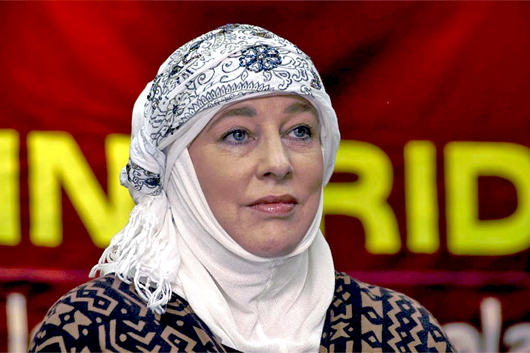
Je suis confused

[email protected] (Yvonne Ridley)
January 16, 2015

Je suis confused

Jan 16: Every single day since the horrific killings of the Charlie Hebdo staff, headlines around the world have been dominated by the fallout from the incident. In truth, though, each day has left me more confused about France's position on free speech, which we are all being led to believe can be used and abused without restriction.

Defending their position on attacking Prophet Muhammad, peace be upon him, white French intellectuals insist that they attack every single religion without fear or favour; and with impunity. It then emerged that Maurice Sinet, aged 80, who works under the pen name Sine, faces charges of "inciting racial hatred" over a column he wrote in Charlie Hebdo.

The piece ignited a debate among the Parisian intelligentsia and ended in the dismissal of the Left-wing cartoonist who has since been charged with anti-Semitism for suggesting that Jean Sarkozy, the son of the former French president, was converting to Judaism for financial reasons. With obvious hindsight, being sacked probably saved Sinet's life.

Meanwhile, as more than a million people rallied in Paris in support of the magazine, many holding placards with the Twitter hashtag #JeSuisCharlie, world leaders also joined hands and marched at their head; or so we were told. Some of the political big names who took part were British Prime Minister David Cameron, German Chancellor Angela Merkel, Spanish Prime Minister Mariano Rajoy, Malian President Ibrahim Boubacar Keïta, Palestinian leader Mahmoud Abbas and former French President Nicolas Sarkozy. It has emerged since, however, that most of them gathered in Boulevard Voltaire with the victims' families, and the road was then sealed off. The leaders' "protest march" was a photo opportunity in a well-guarded, near-empty street.

Israeli leader Benjamin Netanyahu was also there despite presiding a few months earlier over a war against the people of Gaza in which 17 journalists were killed by his soldiers; hardly an act by a state whose prime minister went to Paris to promote free speech. Marching near him was a representative of Saudi Arabia who kept silent about the plight of Raif Badawi; the imprisoned blogger had by then already received the first 50 of 1,000 lashes, part of his punishment for running a liberal website devoted to, erm, yes, you've guessed it, freedom of speech in the kingdom.

The day after the rally we heard that Netanyahu was demanding an apology from the London-based Sunday Times for a cartoon by Gerald Scarfe which was published in the Murdoch-owned newspaper. It depicted the Zionist leader as a bricklayer cementing Palestinians into a wall using blood red cement; Scarfe's work is brutal, bloody and brilliant when it comes to satire, and it has appeared in the paper every week since 1967.

Accusations that the cartoon was anti-Semitic are nonsense. It didn't mock Judaism, target Jews or depict the object of its attack with any religious symbolism at all. Nevertheless, the drawing exposed just how sensitive Israel and Netanyahu are when it comes to satire and free speech.

Rupert Murdoch called the cartoon "offensive and grotesque" and then apologised for the caricature. The media mogul made his apology days after sending out an unrelated tweet attacking the world's 1.8 billion Muslims and inferring that we are all somehow to blame for the horrific killings at Charlie Hebdo and the kosher supermarket which was also attacked a couple of days later.

Back in London, just hours after marching alongside Netanyahu in Paris in the name of liberté and a good photo opportunity, David Cameron was helping to revive the Snooper's Charter. It seems that the prime minister will only support free speech when it can be accessed and reviewed by the state security services.

While all of this was going on, back in France anti-Semitic comedian Dieudonne M'Bala M'Bala was arrested after he appeared to compare himself with one of the armed gunmen who murdered four people at the Jewish supermarket in Paris. After mocking the media superlatives scattered about liberally to describe the #JeSuisCharlie march, the comedian declared, "As for me, I feel I am Charlie Coulibaly." He was referring to Amedy Coulibaly, the man who took hostages and killed people in the supermarket before being killed himself by police officers. The French police say that M'Bala could face charges of making an "apology for terrorism" and state prosecutors opened a formal investigation on Monday night into remarks he made on his Facebook page. What he said was, in my opinion, in poor taste and showed a distinct lack of judgement; which just about sums up my feelings about the cartoons in the latest issue of Charlie Hebdo.

The circulation of the "satirical" magazine is this week set to soar to around five million copies in a number of languages, including English and Arabic. It is being funded by donations from other media organisations, including Britain's Guardian Newspaper Group, and the French government. This would be unthinkable for the British Private Eye, which is merciless in lampooning the government and any public figures which enter its crosshairs.

As for free speech in America, some confuse that with pure invention, like daft Steven Emerson. The so-called terrorism expert on the right-wing Fox News channel claimed that Birmingham, Britain's second largest city, is "a totally Muslim" city "where non-Muslims just simply don't go". The discussion, on the back of the Paris killings, was about supposed no-go zones in Europe where Muslims are apparently in complete control. More apologies followed.

While the Parisian deaths are indeed a tragedy, no one mentions the former French colony of Syria where dozens of innocent civilians are killed every hour at the hands of the brutal Bashar Al-Assad regime. Not to be outdone – and to cap it all - Assad joined in with some crocodile tears of his own along with a few double standards and a liberal dose of hypocrisy when he extended his sympathy to the people of France. "We are against the killing of innocent people anywhere in the world," he said without a hint of irony. "At the same time, we want to remind people in the West that we have been talking about such consequences since the beginning of the Syrian crisis."

More than 200,000 people have been killed since a rebellion against the Assad family's four-decade rule began in March 2011, triggering a brutal crackdown that is tearing the country apart. Bashar Al-Assad made his statement in an interview with Czech publication Literarni Noviny. Some might call his interview the ultimate in satirical journalism.

After all of this, the issue of freedom of speech is, I'm afraid, still as clear as mud. Je suis definitely confused.

Comments

Add new comment

  • Coastaldigest.com reserves the right to delete or block any comments.
  • Coastaldigset.com is not responsible for its readers’ comments.
  • Comments that are abusive, incendiary or irrelevant are strictly prohibited.
  • Please use a genuine email ID and provide your name to avoid reject.
News Network
May 7,2020

Toronto, May 7: Scientists have uncovered how bats can carry the MERS coronavirus without getting sick, shedding light on what triggers coronaviruses, including the one behind the COVID-19 pandemic, to jump to humans.

According to the study, published in the journal Scientific Reports, coronaviruses like the Middle East respiratory syndrome (MERS) virus, and the COVID19-causing SARS-CoV-2 virus, are thought to have originated in bats.

While these viruses can cause serious, and often fatal disease in people, bats seem unharmed, the researchers, including those from the University of Saskatchewan (USask) in Canada, said.

"The bats don't get rid of the virus and yet don't get sick. We wanted to understand why the MERS virus doesn't shut down the bat immune responses as it does in humans," said USask microbiologist Vikram Misra.

In the study, the scientists demonstrated that cells from an insect-eating brown bat can be persistently infected with MERS coronavirus for months, due to important adaptations from both the bat and the virus working together.

"Instead of killing bat cells as the virus does with human cells, the MERS coronavirus enters a long-term relationship with the host, maintained by the bat's unique 'super' immune system," said Misra, one of the study's co-authors.

"SARS-CoV-2 is thought to operate in the same way," he added.

Stresses on bats, such as wet markets, other diseases, and habitat loss, may have a role in coronavirus spilling over to other species, the study noted.

"When a bat experiences stress to their immune system, it disrupts this immune system-virus balance and allows the virus to multiply," Misra said.

The scientists, involved in the study, had earlier developed a potential treatment for MERS-CoV, and are currently working towards a vaccine against COVID-19.

While camels are the known intermediate hosts of MERS-CoV, they said bats are suspected to be the ancestral host.

There is no vaccine for either SARS-CoV-2 or MERS, the researchers noted.

Follow latest updates on the COVID-19 pandemic here

"We see that the MERS coronavirus can very quickly adapt itself to a particular niche, and although we do not completely understand what is going on, this demonstrates how coronaviruses are able to jump from species to species so effortlessly," said USask scientist Darryl Falzarano, who co-led the study.

According to Misra, coronaviruses rapidly adapt to the species they infect, but little is known on the molecular interactions of these viruses with their natural bat hosts.

An earlier study had shown that bat coronaviruses can persist in their natural bat host for at least four months of hibernation.

When exposed to the MERS virus, the researchers said, bat cells adapt, not by producing inflammation-causing proteins that are hallmarks of getting sick, but instead by maintaining a natural antiviral response.

On the contrary, they said this function shuts down in other species, including humans.

The MERS virus, the researchers said, also adapts to the bat host cells by very rapidly mutating one specific gene.

These adaptations, according to the study, result in the virus remaining long-term in the bat, but being rendered harmless until something like a disease, or other stressors, upsets this balance.

In future experiments, the scientists hope to understand how the bat-borne MERS virus adapts to infection and replication in human cells.

"This information may be critical for predicting the next bat virus that will cause a pandemic," Misra said.

Comments

Add new comment

  • Coastaldigest.com reserves the right to delete or block any comments.
  • Coastaldigset.com is not responsible for its readers’ comments.
  • Comments that are abusive, incendiary or irrelevant are strictly prohibited.
  • Please use a genuine email ID and provide your name to avoid reject.
News Network
April 17,2020

Paris, Apr 17: Even as virologists zero in on the virus that causes COVID-19, a very basic question remains unanswered: do those who recover from the disease have immunity?

There is no clear answer to this question, experts say, even if many have assumed that contracting the potentially deadly disease confers immunity, at least for a while.

"Being immunised means that you have developed an immune response against a virus such that you can repulse it," explained Eric Vivier, a professor of immunology in the public hospital system in Marseilles.

"Our immune systems remember, which normally prevents you from being infected by the same virus later on."

For some viral diseases such a measles, overcoming the sickness confers immunity for life.

But for RNA-based viruses such as Sars-Cov-2 -- the scientific name for the bug that causes the COVID-19 disease -- it takes about three weeks to build up a sufficient quantity of antibodies, and even then they may provide protection for only a few months, Vivier told AFP.

At least that is the theory. In reality, the new coronavirus has thrown up one surprise after another, to the point where virologists and epidemiologists are sure of very little.

"We do not have the answers to that -- it's an unknown," Michael Ryan, executive director of the World Health Organization's Emergencies Programme said in a press conference this week when asked how long a recovered COVID-19 patient would have immunity.

"We would expect that to be a reasonable period of protection, but it is very difficult to say with a new virus -- we can only extrapolate from other coronaviruses, and even that data is quite limited."

For SARS, which killed about 800 people across the world in 2002 and 2003, recovered patients remained protected "for about three years, on average," Francois Balloux director of the Genetics Institute at University College London, said.

"One can certainly get reinfected, but after how much time? We'll only know retroactively."

A recent study from China that has not gone through peer review reported on rhesus monkeys that recovered from Sars-Cov-2 and did not get reinfected when exposed once again to the virus.

"But that doesn't really reveal anything," said Pasteur Institute researcher Frederic Tangy, noting that the experiment unfolded over only a month.

Indeed,several cases from South Korea -- one of the first countries hit by the new coronavirus -- found that patients who recovered from COVID-19 later tested positive for the virus.

But there are several ways to explain that outcome, scientists cautioned.

While it is not impossible that these individuals became infected a second time, there is little evidence this is what happened.

More likely, said Balloux, is that the virus never completely disappeared in the first place and remains -- dormant and asymptomatic -- as a "chronic infection", like herpes.

As tests for live virus and antibodies have not yet been perfected, it is also possible that these patients at some point tested "false negative" when in fact they had not rid themselves of the pathogen.

"That suggests that people remain infected for a long time -- several weeks," Balloux added. "That is not ideal."

Another pre-publication study that looked at 175 recovered patients in Shanghai showed different concentrations of protective antibodies 10 to 15 days after the onset of symptoms.

"But whether that antibody response actually means immunity is a separate question," commented Maria Van Kerhove, Technical Lead of the WHO Emergencies Programme.

"That's something we really need to better understand -- what does that antibody response look like in terms of immunity."

Indeed, a host of questions remain.

"We are at the stage of asking whether someone who has overcome COVID-19 is really that protected," said Jean-Francois Delfraissy, president of France's official science advisory board.

For Tangy, an even grimmer reality cannot be excluded.

"It is possible that the antibodies that someone develops against the virus could actually increase the risk of the disease becoming worse," he said, noting that the most serious symptoms come later, after the patient had formed antibodies.

For the moment, it is also unclear whose antibodies are more potent in beating back the disease: someone who nearly died, or someone with only light symptoms or even no symptoms at all. And does age make a difference?

Faced with all these uncertainties, some experts have doubts about the wisdom of persuing a "herd immunity" strategy such that the virus -- unable to find new victims -- peters out by itself when a majority of the population is immune.

"The only real solution for now is a vaccine," Archie Clements, a professor at Curtin University in Perth Australia, told AFP.

At the same time, laboratories are developing a slew of antibody tests to see what proportion of the population in different countries and regions have been contaminated.

Such an approach has been favoured in Britain and Finland, while in Germany some experts have floated the idea of an "immunity passport" that would allow people to go back to work.

"It's too premature at this point," said Saad Omer, a professor of infectious diseases at the Yale School of Medicine.

"We should be able to get clearer data very quickly -- in a couple of months -- when there will be reliable antibody tests with sensitivity and specificity."

One concern is "false positives" caused by the tests detecting antibodies unrelated to COVID-19.

The idea of immunity passports or certificates also raises ethical questions, researchers say.

"People who absolutely need to work -- to feed their families, for example -- could try to get infected," Balloux.

Comments

Add new comment

  • Coastaldigest.com reserves the right to delete or block any comments.
  • Coastaldigset.com is not responsible for its readers’ comments.
  • Comments that are abusive, incendiary or irrelevant are strictly prohibited.
  • Please use a genuine email ID and provide your name to avoid reject.
Agencies
June 18,2020

New Delhi, Jun 18: Vodafone Idea on Thursday told the Supreme Court that it has incurred Rs 1 lakh crore losses as it insisted it is not in a position to furnish bank guarantees.

A bench comprising Justices Arun Mishra, S. Abdul Nazeer, and M.R. Shah, taking up the adjusted gross revenue (AGR) matter through video conferencing, directed the telecom companies to submit their financial documents and books for the last 10 years.

Asking Vodafone if it was a foreign company, the bench said that how can the company say it would not furnish any bank guarantee.

"What if you fly away overnight in future without paying anything?" it asked.

Senior advocate Mukul Rohatgi, representing Vodafone Idea, denied his client is a completely foreign firm and cited before the bench its tie-ups and investments.

Vodafone owes over Rs 58,000 crore as AGR dues and so far, has paid close to Rs 7,000 crore.

Rohatgi contended before the court that the telecom company is in a tough situation, and cannot furnish any fresh bank guarantee, as profits have eluded the company in past many quarters. He submitted before the bench that Rs 15,000 crore bank guarantees are lying with the government, and his client's losses are over Rs 1 lakh crore.

"I cannot offer any more surety," he informed the bench.

Justice Mishra noted that this is public money and these dues should be recovered. "Do not tell us that you will pay if you were to make profits... the money must come," he noted.

Justice Shah observed that the telecom industry is the only industry which earned during the Covid-19 pandemic. "After all, this money will be used for public welfare", he said.

Rohatgi argued that his client would have to fold up if orders were issued to clear dues tomorrow. "11,000 employees will have to go without notice, as we cannot pay them," he added.

Senior advocate Abhishek Manu Singhvi, appearing for Bharti Airtel, contended before the court that out of Rs 21,000 crore AGR dues, the company has already deposited a sum of Rs 18,000 crore.

He argued that his client has given a bank guarantee, in excess of demand, to DoT, and supported the proposal for phased repayment of remaining AGR dues. He insisted that the company needs to sit down with the government and calculate the dues. Airtel owes Rs 25,976 crore after paying Rs 18,000 crore, as per the government.

Senior advocate Arvind Datar, representing Tata Telecom, informed the bench that his client has paid Rs 6,504 crore in AGR dues so far, and furnishing a bank guarantee may adversely impact investments in the sector.

The total AGR dues are close to Rs 1.5 lakh crore.

The top court will now take up the matter in the third week of July.

Comments

Add new comment

  • Coastaldigest.com reserves the right to delete or block any comments.
  • Coastaldigset.com is not responsible for its readers’ comments.
  • Comments that are abusive, incendiary or irrelevant are strictly prohibited.
  • Please use a genuine email ID and provide your name to avoid reject.