



Jeddah airport ranked the ‘worst in facilities’

October 17, 2016

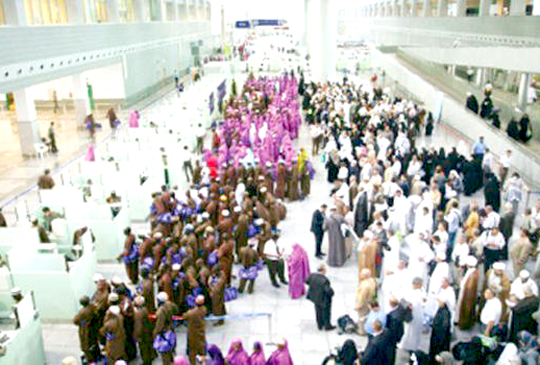
Jeddah, Oct 17: King Abdul Aziz International Airport in Jeddah (KAAI) topped the list of the worst airports in the world for 2016, says the website “The Guide to Sleeping in Airports,” which evaluates the overall airport experience based on the views of passengers.
airport

The website recently announced the list for the worst 10 airports around the world. Every year, the website conducts a survey of the services offered for passengers who spend extended periods within the airports’ premises, and the comfort and sleeping accommodations provided for them.

The Jeddah airport jumped to the No. 1 spot on “Worst Airports in the World” list. All aspects of the terminals need serious improvement. “Though JED continually promises that ‘next year’ travelers will see a new terminal, clean toilets and more amenities, a semblance of organization has yet to appear. Instead, when the passengers arrive at Jeddah’s Haj Terminal, they walk into a terminal where cleanliness is but a mythical concept,” according to the website.

The website said, the place is said to be staffed by a team of immigration officers described as “careless,” “arrogant” and “rude,” and amenity-wise, the terminal is devoid of restaurants, shopping and entertainment.

The General Authority of Civil Aviation (GACA) said Jeddah airport’s southern terminal was originally designed to receive 6 million passengers, while now it receives 17 million passengers. Therefore, it is necessary to build anew airport in Jeddah.

Media and Public Relation Department at GACA Abdullah Al-Kharif said that the website of “The Guide to Sleeping in Airports” was a personal blog of sleeping experiments in airports, and then it was transformed to a website of evaluating airports in the world. The website’s classification is not based on specific standards to evaluate airports.

Speaking to Arab News, Al-Kharif said that a delegation of experts will visit international airports in upcoming weeks to evaluate these airports. Al-Kharif, however, said feedback is important to improve services at Saudi airports.

The evaluation focuses on specific factors concerning the airport experience such as hygiene issues and cleanliness, the services and facilities provided, customer service, comfort, sleeping areas and restaurants, dining options and cleanliness in toilets.

Juba International Airport in South Sudan came second on the list of the worst airports, followed by Port Harcourt International Airport, Nigeria and Tashkent International Airport in Uzbekistan.

Comments

Naren kotian
 - 
Tuesday, 18 Oct 2016

Darvesi country ...darvesi people ....avara raja kumara ...2030 ge full change maadi bidthananthe.....these wahabis are fit for nothing ........they think they are devara maklu ....papa illinda chumma sigathe ummah concept moolka ankondu hogorige toilet and bathroom kelsasa kodthare ...I heard many ummah gang even do mala horo paddathi in Saudi

irshad
 - 
Monday, 17 Oct 2016

i experienced this on my trip to Umrah in 2014 ....still they were using windows XP.....and they made me wait more than 1 hour in standing while i was holding my kid ....and no one to take care .........police men (Emigration staff ) were talking to each other and having Fun themselves....

Add new comment

  • Coastaldigest.com reserves the right to delete or block any comments.
  • Coastaldigset.com is not responsible for its readers’ comments.
  • Comments that are abusive, incendiary or irrelevant are strictly prohibited.
  • Please use a genuine email ID and provide your name to avoid reject.
News Network
March 21,2020

Mar 21: Qatari authorities arrested 10 nationals for breaking home quarantine rules as Doha tightens regulations amid the coronavirus outbreak, local daily The Peninsula Qatar reported on Saturday.

The Ministry of Public Health released a statement naming the detainees and said that the violators were currently being referred to prosecution.

The tiny country, where expatriates comprise the majority of the population, on Thursday reported eight more infections to take its tally to 470, the highest number among the six Gulf Arab states that have reported a total of more than 1,300 coronavirus cases.

Government spokeswoman Lulwa Rashed Al-Khater told a news conference the new cases included two Qataris who had been in Europe, with the rest migrant workers.

Qatari authorities on Tuesday announced the closure of several square kilometers of the industrial area in Doha, the capital, which also contains labor camps and other housing units.

Comments

Add new comment

  • Coastaldigest.com reserves the right to delete or block any comments.
  • Coastaldigset.com is not responsible for its readers’ comments.
  • Comments that are abusive, incendiary or irrelevant are strictly prohibited.
  • Please use a genuine email ID and provide your name to avoid reject.
Agencies
April 27,2020

Riyad, Apr 27: The Saudi-led Arab Coalition supporting Yemen’s UN-recognized government on Monday urged all parties to end any escalation of hostilities and return to the status that existed before the Southern Transitional Council (STC) declared self-rule.

In a statement carried by the Saudi Press Agency (SPA), the coalition emphasized “the need to cancel any step that violates the Riyadh agreement and work to accelerate its implementation.” 

On Sunday, the United Arab Emirates-backed STC scrapped a peace deal with the internationally recognized government of President Abed Rabbo Mansour Hadi.

Accusing the government of corruption and mismanagement, the separatists said they would “self-govern” the key southern port city of Aden and other southern provinces.

Yemen’s Foreign Minister Mohammed Al-Hadhrami described the move as a “resumption of its (STC’s) armed insurgency and rejection and complete withdrawal from the Riyadh agreement.” 

Authorities in Yemen’s southern provinces of Hadramawt, Abyan, Shabwa, Al-Mahra and the remote island of Socotra also rejected the separatist group’s claim to self-rule.

The government said local and security authorities in the five provinces dismissed the move as a “clear and definite coup.” 

Some of the provinces issued their own statements condemning it.

The coalition appealed to all parties to “give priority to the interests of the Yemeni people over any other interests”. 

It also urged the parties involved not to lose their focus on working to achieve the goal of restoring the state, ending the Houthi “coup” and “countering terrorist organizations”.

“The Coalition has and will continue to undertake practical and systematic steps to implement the Riyadh Agreement between the parties to unite Yemeni ranks, restore state institutions and combat the scourge of terrorism,” the statement said. “The responsibility rests with the signatories to the Agreement to undertake national steps toward implementing its provisions, which were signed and agreed upon with a time matrix for implementation.”

The STC has been part of the coalition-backed forces fighting the Iran-backed Houthi militia, which seized control of the Yemeni capital Sanaa and other provinces in 2014.

The Houthi “coup” has led to the formation of the Saudi-led coalition, which had since driven away the Houthis from the south and other provinces. President Hadi’s government has made Aden as its temporary seat.

Comments

Add new comment

  • Coastaldigest.com reserves the right to delete or block any comments.
  • Coastaldigset.com is not responsible for its readers’ comments.
  • Comments that are abusive, incendiary or irrelevant are strictly prohibited.
  • Please use a genuine email ID and provide your name to avoid reject.
News Network
April 5,2020

Beirut, Apr 5: The novel coronavirus has put global trade on hold, placed half of the world population in confinement and has the potential to topple governments and reshape diplomatic relations.

The United Nations has appealed for ceasefires in all the major conflicts rocking the planet, with its chief Antonio Guterres on Friday warning "the worst is yet to come". But it remains unclear what the pandemic's impact will be on the multiple wars roiling the Middle East.

Here is an overview of the impact so far on the conflicts in Syria, Yemen, Libya and Iraq:

The COVID-19 outbreak turned into a pandemic just as a ceasefire reached by the two main foreign power brokers in Syria's nine-year-old war -- Russia and Turkey -- was taking effect.

The three million people living in the ceasefire zone, in the country's northwestern region of Idlib, had little hope the deal would hold.

Yet fears the coronavirus could spread like wildfire across the devastated country appear to have given the truce an extended lease of life.

According to the Syrian Observatory for Human Rights, the month of March saw the lowest civilian death toll since the conflict started in 2011, with 103 deaths.

The ability of the multiple administrations in Syria -- the Damascus government, the autonomous Kurdish administration in the northeast and the jihadist-led alliance that runs Idlib -- to manage the coronavirus threat is key to their credibility.

"This epidemic is a way for Damascus to show that the Syrian state is efficient and all territories should be returned under its governance," analyst Fabrice Balanche said.

However the pandemic and the global mobilisation it requires could precipitate the departure of US-led troops from Syria and neighbouring Iraq.

This in turn could create a vacuum in which the Islamic State jihadist group, still reeling from the demise of its "caliphate" a year ago, could seek to step up its attacks.

The Yemeni government and the Huthi rebels initially responded positively to the UN appeal for a ceasefire, as did neighbouring Saudi Arabia, which leads a military coalition in support of the government.

That rare glimmer of hope in the five-year-old conflict was short-lived however and last week Saudi air defences intercepted ballistic missiles over Riyadh and a border city fired by the Iran-backed rebels.

The Saudi-led coalition retaliated by striking Huthi targets in the rebel-held capital Sanaa on Monday.

Talks have repeatedly faltered but the UN envoy Martin Griffiths is holding daily consultations in a bid to clinch a nationwide ceasefire.

More flare-ups in Yemen could compound a humanitarian crisis often described as the worst in the world and invite a coronavirus outbreak of catastrophic proportions.

In a country where the health infrastructure has collapsed, where water is a rare commodity and where 24 million people require humanitarian assistance, the population fears being wiped out if a ceasefire doesn't allow for adequate aid.

"People will end up dying on the streets, bodies will be rotting in the open," said Mohammed Omar, a taxi driver in the Red Sea port city of Hodeida.

Much like Yemen, the main protagonists in the Libyan conflict initially welcomed the UN ceasefire call but swiftly resumed hostilities.

Fierce fighting has rocked the south of the capital Tripoli in recent days, suggesting the risk of a major coronavirus outbreak is not enough to make guns fall silent.

Turkey has recently played a key role in the conflict, throwing its weight behind the UN-recognised Government of National Accord.

Fabrice Balanche predicted that accelerated Western disengagement from Middle East conflicts could limit Turkish support to the GNA.

That could eventually favour forces loyal to eastern-based strongman Khalifa Haftar, who launched an assault on Tripoli one year ago and has the backing of Russia, Egypt and the United Arab Emirates.

Western countries have been hit hardest by the pandemic, which could prompt them to divert both military resources and peace-brokering capacity from foreign conflicts.

A report by the International Crisis Group said European officials had reported that efforts to secure a ceasefire in Libya were no longer receiving high-level attention due to the pandemic.

Iraq is no longer gripped by fully-fledged conflict but it remains vulnerable to an IS resurgence in some regions and its two main foreign backers are at each other's throats.

Iran and the United States are two of the countries most affected by the coronavirus but there has been no sign of any let-up in their battle for influence that has largely played out on Iraqi soil.

With most non-US troops in the coalition now gone and some bases evacuated, American personnel are now regrouped in a handful of locations in Iraq.

Washington has deployed Patriot air defence missiles, prompting fears of a fresh escalation with Tehran, whose proxies it blames for a spate of rocket attacks on bases housing US troops.

Comments

Add new comment

  • Coastaldigest.com reserves the right to delete or block any comments.
  • Coastaldigset.com is not responsible for its readers’ comments.
  • Comments that are abusive, incendiary or irrelevant are strictly prohibited.
  • Please use a genuine email ID and provide your name to avoid reject.