


Jeddah’s bridges, tunnels ease traffic congestion

January 21, 2015

Jeddah, Jan 21: Jeddah will have a smoother traffic flow thanks to the bridges and tunnels projects the mayoralty is implementing with coordination with Jeddah traffic administration, said Zaid Al-Hamzi, spokesman for the Jeddah traffic police.
Jeddah Bridges

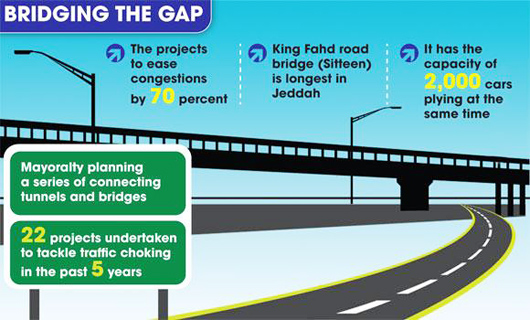
Al-Hamzi said the new projects will facilitate traffic movement and ease congestions by 70 percent.

These remarks came after the inauguration of the King Fahd (Sitteen) Road bridge across Heraa Street (White Horse Square) and Prince Sultan Bin Salman Street. The 2.5-km long and 56 meter wide bridge has a capacity of carrying 2,000 cars at the same time. With three lanes on each way of traffic, it gives the area a 100 percent flexibility and release traffic for Heraa and Prince Sultan Bin Salman streets.

Jeddah Mayor Hani Abu Ras on Sunday opened traffic on the bridge that is considered the longest in Jeddah.

Abu Ras said the mayoralty is keen on easing the traffic jams in Jeddah by implementing a series of connecting tunnels and bridges to release the traffic in the main roads and intersections, “The Jeddah mayoralty has carried out 22 projects for easing traffic congestions in the past five years, including constructing 18 bridges and 10 tunnels,” he added saying that these projects have decreased the commuting time in Jeddah.

The project is the sixth project to be implemented on the Sitteen Street (north-south) as Jeddah celebrated opening the industrial institute intersection bridge, Quraish street intersection bridge, Al-Tahlia intersection, King Abdullah road tunnel, and Gharnata street bridge.

Abu Ras said that citizens and visitors of Jeddah will celebrate the opening of a bridge at the intersection between Madinah Road and Haleema Al-Saadia Street in the upcoming month. He pointed out the King Fahd intersection bridge with Al-Rawda Street (the Bicycle Square). The bridge is a 583-meter-long,13.5-meter-wide and has three lanes for each traffic side.

The mayor added the final designs are being put to King Fahd Road tunnel at the intersection with Al-Falak and Sari streets, adding that the project will be rendered soon. The project is part of releasing traffic congestion project at the King Fahd Road (Sitteen), especially that this important road links between King Abdulaziz International Airport and Jeddah Islamic Port.

Abu Ras said work is under way for seven bridges and tunnels projects, including King Abdulaziz intersection tunnel with Palestine and Al-Hamra streets, King Fahd Road (The bicycle) intersection with Al-Rawda, Prince Majed intersection with Bani Malik road-bridge, Madinah Road and Haleema Al-Saadia intersection bridge, Prince Majed intersection tunnel and bridge with old Makkah Road, Al-Mahjar intersection bridge with Zenel and Television streets, Al-Mahjar intersection bridge with King Faisal Road (The southern Corniche).

Comments

Add new comment

  • Coastaldigest.com reserves the right to delete or block any comments.
  • Coastaldigset.com is not responsible for its readers’ comments.
  • Comments that are abusive, incendiary or irrelevant are strictly prohibited.
  • Please use a genuine email ID and provide your name to avoid reject.
Agencies
April 27,2020

Riyadh, Apr 27: A Saudi Arabia-led coalition said on Monday that all parties need to return to the status that existed before the Southern Transitional Council (STC) in Yemen declared an emergency in Aden, according to a statement published by Spa.

The Coalition to Restore Legitimacy in Yemen, led by Saudi Arabia and the UAE, stresses the need to restore conditions to their previous state following the announcement of a state of emergency by the Southern Transitional Council and the consequential development of affairs in the interim capital (Aden) and some Southern governorates in the Republic of Yemen.

The Coalition urges for an immediate end to any steps contrary to the Riyadh Agreement, and work rapidly toward its implementation, citing the wide support for the agreement by the international community and the United Nations.

The Coalition has and will continue to undertake practical and systematic steps to implement the Riyadh Agreement between the parties to unite Yemeni ranks, restore state institutions and combat the scourge of terrorism. The responsibility rests with the signatories to the Agreement to undertake national steps toward implementing its provisions, which were signed and agreed upon with a time matrix for implementation. The Coalition demands an end to any escalation and calls for return to the Agreement by the participating parties, stressing the immediate need for implementation without delay, and the need to prioritise the Yemeni peoples' interests above all else, as well as working to achieve the stated goals of restoring the state, ending the coup and combatting terrorist organizations.

The Coalition reaffirms its ongoing support to the legitimate Yemeni government, and its support for implementing the Riyadh Agreement, which entails forming a competent government that operate from the interim capital Aden to tackle economic and developmental challenges, in light of natural disasters such as floods, fears of the coronavirus (Covid-19) pandemic outbreak, and work to provide services to the brotherly people of Yemen.

Comments

Add new comment

  • Coastaldigest.com reserves the right to delete or block any comments.
  • Coastaldigset.com is not responsible for its readers’ comments.
  • Comments that are abusive, incendiary or irrelevant are strictly prohibited.
  • Please use a genuine email ID and provide your name to avoid reject.
News Network
January 12,2020

Tehran, Jan 12: Iranian police dispersed students chanting “radical” slogans during a Saturday gathering in Tehran to honour the 176 people killed when an Ukrainian airliner was mistakenly shot down, Fars news agency reported.

News agency correspondents said hundreds of students gathered early in the evening at Amir Kabir University, in downtown Tehran, to pay respects to those killed in the air disaster. The tribute later turned into an angry demonstration.

The students chanted slogans denouncing "liars" and demanded the resignation and prosecution of those responsible for downing the plane and allegedly covering up the accidental action.

Iran said Saturday that the Ukraine International Airlines Boeing 737 was “unintentionally” shot down on Wednesday shortly after taking off from Tehran's main airport. All 176 people on board died, mostly Iranians and Canadians, many of whom were students.

Fars, which is close to conservatives, said the protesting students chanted “destructive” and “radical” slogans. The news agency said some of the students tore down posters of Qasem Soleimani, the Iranian general killed on January 3 in a US drone strike on Baghdad.

Fars published pictures of demonstrators gathered around a ring of candles during the tribute and a picture of a torn poster bearing the image of a smiling Soleimani. It said that police "dispersed" them as they left the university and blocked streets, causing a traffic jam.

In an extremely unusual move, state television mentioned the protest, reporting that the students shouted "anti-regime" slogans.

A video purportedly of the protest circulated online showing police firing tear gas at protesters and a man getting up after apparently being hit in the leg by a projectile. It was not possible to verify the location of the video, or when it was filmed.

Iran's acknowledgement on Saturday that the plane had been shot down in error came after officials had for days categorically denied Western claims that it had been struck by a missile. The aerospace commander of Iran's Revolutionary Guards accepted full responsibility.

But Brigadier General Amirali Hajizadeh said the missile operator acted independently, shooting down the Boeing 737 after mistaking it for a "cruise missile".

Comments

Add new comment

  • Coastaldigest.com reserves the right to delete or block any comments.
  • Coastaldigset.com is not responsible for its readers’ comments.
  • Comments that are abusive, incendiary or irrelevant are strictly prohibited.
  • Please use a genuine email ID and provide your name to avoid reject.
News Network
May 11,2020

May 11: Saudi Arabia will triple its value-added tax rate and suspend a cost of living allowance for state workers, it said on Monday, seeking to shield finances hit by low oil prices and a slump in demand for its lifeline export worsened by the new coronavirus.

Historic oil output cuts agreed by Riyadh and other major producers have given only limited support to prices after they sank on oversupply caused by a war for petroleum market share between the kingdom and its fellow oil titan Russia.

Saudi Arabia, the world's largest oil exporter, is also being hit hard by measures to fight the new coronavirus, which are likely to curb the pace and scale of economic reforms launched by Crown Prince Mohammed bin Salman.

"The cost of living allowance will be suspended as of June 1, and the value added tax will be increased to 15% from 5% as of July 1," Finance Minister Mohammed al-Jadaan said in a statement reported by the state news agency. "These measures are painful but necessary to maintain financial and economic stability over the medium to long term...and to overcome the unprecedented coronavirus crisis with the least damage possible."

The austerity measures come after the kingdom posted a $9 billion budget deficit in the first quarter.

The minister said non-oil revenues were affected by the suspension and decline in economic activity, while spending had risen due to unplanned strains on the healthcare sector and the initiatives taken to support the economy.

"All these challenges have cut state revenues, pressured public finances to a level that is hard to deal with going forward without affecting the overall economy in the medium to long term, which requires more spending cuts and measures to support non-oil revenues stability," he added.

The government has cancelled and put on hold some operating and capital expenditures for some government agencies, and cut allocations for some reform initiatives and projects worth a total 100 billion riyals ($26.6 billion), the statement said.

Central bank foreign reserves fell in March at their fastest rate in at least 20 years and to their lowest since 2011, while oil revenues in the first three months of the year fell 24% from a year earlier to $34 billion, pulling total revenues down 22%.

"The reforms are positive from a fiscal side as greater adjustment is essential. However, the tripling of VAT is unlikely to help that much in 2020 revenue wise with the expected fall in consumption," said Monica Malik, chief economist at Abu Dhabi Commercial Bank.

She said she kept unchanged her deficit forecast of 16.3% of GDP for this year, which already factors in a greater than previously announced spending cut.

About 1.5 million Saudis are employed in the government sector, according to official figures released in December.

In 2018, Saudi Arabia's King Salman ordered a monthly payment of 1,000 riyals ($267) to every state employee to compensate them for the rising living costs after the government hiked domestic gas prices and introduced value-added tax.

DIFFICULT TIMES

A committee has been formed to study all financial benefits paid to public sector employees and contractors, and will submit recommendations within 30 days, the statement said.

In late 2015, when oil prices fell from record highs, the kingdom slashed lavish bonuses, overtime payments and other benefits once considered routine perks in the public sector.

In a country without elections and with political legitimacy resting partly on distribution of oil revenue, the ability of citizens to adapt to such reforms is crucial for stability.

"Tripling the VAT will test the limits of the balance between revenues and consumption as the economy dives into a deep recession. The move will impact consumption and could also lower the expected revenues," said John Sfakianakis, a Gulf expert at the University of Cambridge.

"These are pro-austerity and pro-revenue moves rather than pro-growth ones," he said.

Hasnain Malik, head of equity strategy at Tellimer, said the VAT rise could bring about $24-$26.5 billion in additional non-oil fiscal revenue. The rise would hit consumer spending further but was a needed step towards fiscal sustainability, he said.

Comments

Add new comment

  • Coastaldigest.com reserves the right to delete or block any comments.
  • Coastaldigset.com is not responsible for its readers’ comments.
  • Comments that are abusive, incendiary or irrelevant are strictly prohibited.
  • Please use a genuine email ID and provide your name to avoid reject.