



Jobless Saudis demand higher Nitaqat quotas

December 6, 2013

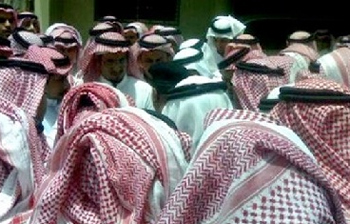
Nitaqat_quotas_copyJeddah, Dec 6: Jobless young Saudis have called on the Ministry of Labor to increase Nitaqat quotas at private firms and fill positions left vacant by departing illegal workers to solve the country's unemployment problem.

This comes as Minister of Labor Adel Fakeih recently announced that 250,000 Saudis have found jobs because of the rectification process.

A survey conducted by Arab News showed that many Saudis want the quotas increased, with some seeing positive signs that companies are employing more citizens.

“I've observed a noticeable rise in the number of companies looking for Saudi workers since the Labor Ministry introduced the Nitaqat program and the rectification campaign currently being implemented in collaboration with the Ministry of Interior,” Abdullah Al-Qadi, a citizen, told Arab News.

“We expect the ministry to raise the Saudization quotas in industries such as construction and contracting where very few Saudis are working even though there are huge projects under way. The contracting companies can appoint Saudis in administrative posts,” Al-Qadi said.

Another Saudi, Yusuf Sadiq, urged private companies to cooperate with the ministry by not appointing more expatriates. “Such patriotic acts will be more profitable for employers and the country. It will reduce the unemployment rate considerably,” he said.

He urged the government to provide more training and rehabilitation programs for young Saudis.

Nasser Al-Saedi, a citizen, said large companies were not helping to reduce the unemployment rate despite the government offering them massive contracts with huge concessions and incentives.

He said a tax should be imposed on expatriates for using the country's subsidized petrol and commodities. “It is logical to impose a levy on the subsidized services enjoyed by expatriate workers,” he said.

Asim Al-Masari said that expatriates have had easy access to the country's top jobs, creating the incorrect perception that Saudis are not qualified to take up these positions. He also urged the government to provide more training for Saudis because this would benefit companies and the country.

According to the Nitaqat program, the agriculture sector should have 27 percent Saudi staff, and banks 90 percent Saudis, especially if the company employs more than 3,000 workers. Crude oil production and the gas sector should have a Saudization rate of 85 percent.

Downstream industries with more than 3,000 workers should appoint 35 percent Saudis, the telecommunications sector 75 percent, the petrochemical sector 80 percent, printing and publishing 65 percent, information technology 45 percent and schools for boys 40 percent.

Comments

Add new comment

  • Coastaldigest.com reserves the right to delete or block any comments.
  • Coastaldigset.com is not responsible for its readers’ comments.
  • Comments that are abusive, incendiary or irrelevant are strictly prohibited.
  • Please use a genuine email ID and provide your name to avoid reject.
News Network
March 21,2020

Mar 21: Qatari authorities arrested 10 nationals for breaking home quarantine rules as Doha tightens regulations amid the coronavirus outbreak, local daily The Peninsula Qatar reported on Saturday.

The Ministry of Public Health released a statement naming the detainees and said that the violators were currently being referred to prosecution.

The tiny country, where expatriates comprise the majority of the population, on Thursday reported eight more infections to take its tally to 470, the highest number among the six Gulf Arab states that have reported a total of more than 1,300 coronavirus cases.

Government spokeswoman Lulwa Rashed Al-Khater told a news conference the new cases included two Qataris who had been in Europe, with the rest migrant workers.

Qatari authorities on Tuesday announced the closure of several square kilometers of the industrial area in Doha, the capital, which also contains labor camps and other housing units.

Comments

Add new comment

  • Coastaldigest.com reserves the right to delete or block any comments.
  • Coastaldigset.com is not responsible for its readers’ comments.
  • Comments that are abusive, incendiary or irrelevant are strictly prohibited.
  • Please use a genuine email ID and provide your name to avoid reject.
coastaldigest.com web desk
July 6,2020

Dubai, July 6: In an attempt to make a comeback in the tourism sector amidst managing covid-19 crisis, Dubai is all set to welcome holiday-makers from foreign countries from July 7.

It said those entering would have to present certificates to show they had recently tested negative for the coronavirus or would undergo tests on arrival at Dubai airports.

Reassuring tourists of several comprehensive measures to prevent the transmission of the pandemic, Dubai Tourism urged global travellers to make the city that boasts world class health and safety standards "a must-visit destination."

Dubai Tourism hosted a virtual forum for stakeholders and partners to share its industry outlook ahead of the city's reopening to international tourists.

The forum, which was attended by nearly 2,000 key executives from the aviation, travel and hospitality sectors and across tourism touch-points, provided a first-hand insight into current and post-pandemic strategies that will help accelerate tourism momentum and position Dubai as a safe global destination.

Helal Saeed Almarri, director general, Dubai Tourism, said that the city has put in place a robust strategy to manage the pandemic with the key priority being to safeguard the health and well-being of citizens, residents and guests.

Dubai, which saw a 5.1 per cent in tourist traffic to 16.73 million in 2019, remains top of mind for travellers and ranks high in global Internet search rankings for tourist destinations.

Dubai Tourism has launched marketing activities designed to convey positive messages about travel in today's environment, Dubai's preparedness, high standards of quality and safety, unique experiences that await visitors and also address traveller concerns across every touch-point in their journey.

The forum highlighted the preventive measures taken so far against Covid-19 that have further elevated the UAE's standing as one of the world's safest countries. The UAE is globally ranked No.3 in testing per million of population. It was also ranked No.3 in an international survey that assessed satisfaction with governments' response to the pandemic.

Over 350 influencers were also deployed to take the Dubai story in 14 different languages to a global audience spanning 18 markets, which yielded over 21 million engagements across multiple social media platforms.

Comments

Add new comment

  • Coastaldigest.com reserves the right to delete or block any comments.
  • Coastaldigset.com is not responsible for its readers’ comments.
  • Comments that are abusive, incendiary or irrelevant are strictly prohibited.
  • Please use a genuine email ID and provide your name to avoid reject.
News Network
May 7,2020

Dubai, May 7: Saudi Arabia will emerge as the victor of the oil price war that sent global crude markets into a spin last month, according to two experts in the energy industry.

Jason Bordoff, professor and founding director of the Center for Global Energy policy at New York’s Columbia University, said: “While 2020 will be remembered as a year of carnage for oil nations, at least one will most likely emerge from the pandemic stronger, both economically and geopolitically: Saudi Arabia.”

Writing in the American publication Foreign Policy, Bordoff said that the Kingdom’s finances can weather the storm from lower oil prices as a result of the drastically reduced demand for oil in economies under pandemic lockdowns, and that it will end up with higher oil revenues and a bigger share of the global market once it stabilizes.

Bordoff’s view was reinforced by Sir Mark Moody-Stuart, former chairman of Royal Dutch Shell and one of the longest-standing directors of Saudi Aramco. In an interview with the Gulf Intelligence energy consultancy, he said that low-cost oil producers such as Saudi Arabia would emerge from the pandemic with increased market share.

“Oil is the only commodity where the lowest-cost producers have contained their production and allowed high-cost producers to benefit. When demand recovers this year or next, we will emerge from it with the lowest-cost producers having increased their market share,” Moody-Stuart said.

Bordfoff said that it would take years for the high-cost American shale industry to recover to pre-pandemic levels of output. “Depending on how long oil demand remains depressed, US oil production is projected to decline from its pre-coronavirus peak of around 13 million barrels per day.

“Shale's heady growth in recent years (with production growing by about 1 million to 1.5 million barrels per day each year) also reflected irrational exuberance in financial markets. Many US companies struggling with uneconomical production only managed to stay afloat with infusions of cheap debt. One quarter of US shale oil production may have been uneconomic even before prices crashed,” he said.

Moody-Stuart said that recent statements about cuts to the Saudi Arabian budget as a result of falling oil revenues were “an important step to wean the population of the Kingdom off an entitlement feeling. It means that everybody is joining in it.”

The former Shell boss said that other big oil companies would follow Shell’s recent decision to cut its dividend for the first time in more than 70 years. But he added that Aramco would stick by its commitment to pay $75 billion of dividends this year.

“When a company looks at its forecasts it looks ahead for one year, so for this year it (the dividend) is fine,” he said.

Bordoff added that Saudi Arabia’s action in cutting oil production in response to the pandemic would improve its global position.

“Saudi Arabia has improved its standing in Washington. Following intense pressure from the White House and powerful senators, the Kingdom’s willingness to oblige by cutting production will reverse some of the damage done when it was blamed for the oil crash after it surged production in March,” he said.

“Only a few weeks ago, the outlook for Saudi Arabia seemed bleak. But looking out a few years, it’s difficult to see the Kingdom in anything other than a strengthened position,” Bordoff said.

Comments

Add new comment

  • Coastaldigest.com reserves the right to delete or block any comments.
  • Coastaldigset.com is not responsible for its readers’ comments.
  • Comments that are abusive, incendiary or irrelevant are strictly prohibited.
  • Please use a genuine email ID and provide your name to avoid reject.