John Glenn, first American to orbit Earth, dies at 95

December 9, 2016

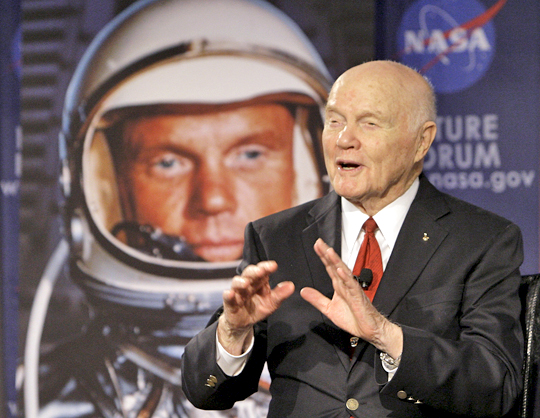
Dec 9: John Glenn, who became one of the 20th century's greatest explorers as the first American to orbit Earth and later as the world's oldest astronaut, and also had a long career as a US senator, died in Ohio on Thursday at age 95.
JohnGlenn

Glenn, the last surviving member of the original seven American "Right Stuff" Mercury astronauts, died at the James Cancer Hospital at Ohio State University in Columbus, said Hank Wilson, a spokesman at the university's John Glenn College of Public Affairs, which Glenn helped found.

Glenn was credited with reviving US pride after the Soviet Union's early domination of manned space exploration. His three laps around the world in the Friendship 7 capsule on Feb. 20, 1962, forged a powerful link between the former fighter pilot and the Kennedy-era quest to explore outer space as a "New Frontier."

President Barack Obama, who in 2012 awarded Glenn the nation's highest civilian honor, the Presidential Medal of Freedom, said: "With John's passing, our nation has lost an icon."

"When John Glenn blasted off from Cape Canaveral atop an Atlas rocket in 1962, he lifted the hopes of a nation," Obama said in a statement. "And when his Friendship 7 spacecraft splashed down a few hours later, the first American to orbit the Earth reminded us that with courage and a spirit of discovery there's no limit to the heights we can reach together."

President-elect Donald Trump said on Twitter the United States had lost "a great pioneer of air and space in John Glenn. He was a hero and inspired generations of future explorers."

As the third of seven astronauts in NASA's solo-flight Mercury program to venture into space, Glenn became more of a media fixture than the others and was known for his composure and willingness to promote the program.

Glenn's astronaut career, as well as his record as a fighter pilot in World War Two and the Korean War, helped propel him to the US Senate in 1974, where he represented his home state of Ohio for 24 years as a moderate Democrat.

His star was dimmed somewhat by a Senate investigation of several senators on whether special favors were done for a major campaign contributor. He was cleared of wrongdoing.

Glenn's entry into history came in early 1962 when fellow astronaut Scott Carpenter bade him "Godspeed, John Glenn" just before the Ohio native was rocketed into space for a record-breaking trip that would last just under five hours.

'View is tremendous'

"Zero-G (gravity) and I feel fine," was Glenn's succinct assessment of weightlessness several minutes into his mission. "Oh, and that view is tremendous."

After splashdown and recovery in the Atlantic, Glenn was treated as a hero, addressing a joint session of Congress and feted in a New York ticker-tape parade.

Glenn had been hospitalized since Nov. 25. He "died peacefully," according to a statement from his family and Ohio State University. "He left this earth for the third time as a happy and fulfilled person," the statement said.

"Glenn's extraordinary courage, intellect, patriotism and humanity were the hallmarks of a life of greatness. His missions have helped make possible everything our space program has since achieved and the human missions to an asteroid and Mars that we are striving toward now," NASA Administrator Charles Bolden said.

Glenn's experiences as a pioneer astronaut were chronicled in the book and movie "The Right Stuff," along with the other Mercury pilots. The book's author, Tom Wolfe, called Glenn "the last true national hero America has ever had."

"I don't think of myself that way," Glenn told the New York Times in 2012 to mark the 50th anniversary of his flight. "I get up each day and have the same problems others have at my age. As far as trying to analyze all the attention I received, I will leave that to others."

Glenn's historic flight made him a favorite of President John F. Kennedy and his brother Robert, who encouraged him to launch a political career that finally took off after a period as a businessman made him a millionaire.

Hero status

Even before his Mercury flight, Glenn qualified for hero status, earning six Distinguished Flying Crosses and flying more than 150 missions in World War Two and the Korean War.

After Korea, Glenn became a test pilot, setting a transcontinental speed record from Los Angeles to New York in 1957.

The determination and single-mindedness that marked Glenn's military and space career did not save him from misjudgments and defeat in politics. He lost his first bid for the Senate from Ohio in 1970, after abandoning a race in 1964 because of a head injury suffered in a fall.

He was elected in 1974 and was briefly considered as a running mate for Democratic presidential candidate Jimmy Carter in 1980. But a ponderous address at the Democratic National Convention - people walked out - caused Carter to remark that Glenn was "the most boring man I ever met."

Glenn sought the Democratic presidential nomination himself in 1984 but was quickly eliminated by eventual nominee Walter Mondale, Carter's vice president. His failure was all the more stinging because he had been touted as an early front-runner.

In the Senate, Glenn was respected as a thoughtful moderate with expertise in defense and foreign policy. His luster was dulled, however, by a Senate investigation of the "Keating Five" - five senators suspected of doing favors for campaign contributor Charles Keating Jr. The panel eventually found Glenn did nothing improper or illegal.

Back to space

He took a leading role in seeking to prevent the spread of nuclear weapons, especially to Pakistan. He was the author of a law that forced the United States to impose sanctions on India and Pakistan in 1998 after both countries conducted nuclear tests.

He also was a staunch advocate of a strong military and took a keen interest in strategic issues. He retired from the Senate in 1999.

Thirty-six years after his maiden space voyage, Glenn became America's first geriatric astronaut on Oct. 29, 1998. He was 77 when he blasted off as a mission specialist aboard the shuttle Discovery. He saw it as a blow to the stereotyping of the elderly.

"Maybe prior to this flight, we were looked at as old geezers who ought to get out of the way," Glenn said after his nine-day shuttle mission. "Just because you're up in years some doesn't mean you don't have hopes and dreams and aspirations just as much as younger people do."

John Herschel Glenn Jr. was born on July 18, 1921, in Cambridge, Ohio.

In his latter years, he was an adjunct professor at the John Glenn College of Public Affairs.

He had a knee replacement operation in 2011 and heart surgery in 2014.

Glenn is survived by his wife of 73 years, his childhood sweetheart, Annie Castor. They had two children, David and Lyn.

Comments

Add new comment

  • Coastaldigest.com reserves the right to delete or block any comments.
  • Coastaldigset.com is not responsible for its readers’ comments.
  • Comments that are abusive, incendiary or irrelevant are strictly prohibited.
  • Please use a genuine email ID and provide your name to avoid reject.
News Network
March 5,2020

Washington, Feb 5: Experts warned a US government panel last night that India's Muslims face risks of expulsion and persecution under the country’s new Citizenship Amendment Act (CAA) which has triggered major protests.

The hearing held inside Congress was called by the US Commission on International Freedom, which has been denounced by the Indian government as biased.

Ashutosh Varshney, a prominent scholar of sectarian violence in India, told the panel that the law championed by prime minister Narendra Modi's government amounted to a move to narrow the democracy's historically inclusive and secular definition of citizenship.

"The threat is serious, and the implications quite horrendous," said Varshney, a professor at Brown University.

"Something deeply injurious to the Muslim minority can happen once their citizenship rights are taken away," he said.

Varshney warned that the law could ultimately lead to expulsion or detention -- but, even if not, contributes to marginalization.

"It creates an enabling atmosphere for violence once you say that a particular community is not fully Indian or its Indianness in grave doubt," he said.

India's parliament in December passed a law that fast-tracks citizenship for persecuted non-Muslim minorities from neighboring countries.

Responding to criticism at the time from the US commission, which advises but does not set policy, India's External Affairs Ministry said the law does not strip anyone's citizenship and "should be welcomed, not criticized, by those who are genuinely committed to religious freedom."

Fears are particularly acute in Assam, where a citizens' register finalized last year left 1.9 million people, many of them Muslims, facing possible statelessness.

Aman Wadud, a human rights lawyer from Assam who traveled to Washington for the hearing, said that many Indians lacked birth certificates or other documentation to prove citizenship and were only seeking "a dignified life."

The hearing did not exclusively focus on India, with commissioners and witnesses voicing grave concern over Myanmar's refusal to grant citizenship to the Rohingya, the mostly Muslim minority that has faced widespread violence.

Gayle Manchin, the vice chair of the commission, also voiced concern over Bahrain's stripping of citizenship from activists of the Shiite majority as well as a new digital ID system in Kenya that she said risks excluding minorities.

More than 40 people were killed last week in New Delhi in sectarian violence sparked by the citizenship law.

India on Tuesday lodged another protest after the UN human rights chief, Michele Bachelet, sought to join a lawsuit in India that challenges the citizenship law's constitutionality.

Comments

Add new comment

  • Coastaldigest.com reserves the right to delete or block any comments.
  • Coastaldigset.com is not responsible for its readers’ comments.
  • Comments that are abusive, incendiary or irrelevant are strictly prohibited.
  • Please use a genuine email ID and provide your name to avoid reject.
News Network
March 29,2020

Washington, Mar 29: The number of known coronavirus US cases soared well past 115,000, with more than 1,900 dead, as President Donald Trump said on Saturday he was considering imposing a quarantine on the hard hit New York region.

American healthcare workers in the trenches of the pandemic are appealing for more protective gear and equipment to treat a surge in patients that is already pushing hospitals to their limits in virus hot spots such as New York City, New Orleans and Detroit.

Trump told reporters he could order a quarantine on three states, New York, New Jersey and Connecticut, which between them have recorded at least 64,000 infections and 895 deaths.

He also appeared to soften his previous comments calling for the US economy to be swiftly reopened. Asked whether he thought the United States would restart by Easter Sunday, April 12, Trump replied, "We'll see, what happens."

New York Governor Andrew Cuomo said he had no details on any possible quarantine order for his state, telling a briefing: "I don't even know what that means. I don't know how that would be legally enforceable, and from a medical point of view I don't know what you would be accomplishing."

He said New York was postponing its presidential primary election to June 23, from April 28.

As the crisis deepened, nurses at Jacobi Medical Center in New York's borough of the Bronx protested outside the hospital on Saturday, saying supervisors asked them to reuse personal protective equipment, including masks. Some held signs with slogans including "Protect our lives so we can save yours."

"The masks are supposed to be one-time use," one nurse said, according to videos posted online. "Now, all of a sudden the CDC (Centers for Disease Control and Prevention) is saying that it's fine for us to reuse them. These choices are being made not based on science. They're being made based on need."

One resident at New York Presbyterian Hospital said they were issued with just one mask.

"This is your mask forever. You can bring it home with you. Here's how you can clean your mask," said the resident, who asked not to be named because he was not authorized to speak to the media. "It's not the people who are making these decisions that go into the patients' rooms."

Doctors are also especially concerned about a shortage of ventilators, machines that help patients breathe and are widely needed for those suffering from COVID-19, the pneumonia-like respiratory ailment caused by the highly contagious novel coronavirus.

Hospitals have also sounded the alarm about scarcities of drugs, oxygen tanks and trained staff.

By Saturday afternoon, the US number of cases stood at 115,842 with at least 1,929 deaths, according to a Reuters tally. The United States has had the most recorded cases of any country since its count of infections eclipsed those of China and Italy on Thursday.

BLACK MARKET
As shortages of key medical supplies abounded, desperate physicians and nurses were forced to take matters into their own hands.

New York-area doctors say they have had to recycle some protective gear, or even resort to bootleg suppliers.

Dr. Alexander Salerno of Salerno Medical Associates in northern New Jersey described going through a "broker" to pay $17,000 for masks and other protective equipment that should have cost about $2,500, and picking them up at an abandoned warehouse.

"You don't get any names. You get just phone numbers to text," Salerno said. "And so you agree to a term. You wire the money to a bank account. They give you a time and an address to come to."

Nurses at Mount Sinai Hospital in New York said they were locking away or hiding N95 respirator masks, surgical masks and other supplies that are prone to pilfering if left unattended.

"Masks disappear," nurse Diana Torres said. "We hide it all in drawers in front of the nurses' station."

One nurse at Westchester Medical Center, in the suburbs of the city, said colleagues have begun absconding with scarce supplies without asking, prompting better-stocked teams to lock masks, gloves and gowns in drawers and closets.

An emergency room doctor in Michigan, an emerging epicenter of the pandemic, said he was wearing one paper face mask for an entire shift due to a shortage and that hospitals in the Detroit area would soon run out of ventilators.

"We have hospital systems here in the Detroit area in Michigan who are getting to the end of their supply of ventilators and have to start telling families that they can't save their loved ones because they don't have enough equipment," the physician, Dr. Rob Davidson, said in a video posted on Twitter.

Sophia Thomas, a nurse practitioner at DePaul Community Health Center in New Orleans, where Mardi Gras celebrations late last month fueled an outbreak in Louisiana's largest city, said the numbers of coronavirus patients "have been staggering."

In the nation's second-largest city, Los Angeles Mayor Eric Garcetti said spiking cases were putting Southern California on track to match New York City's infection figures in the next week.

Comments

Add new comment

  • Coastaldigest.com reserves the right to delete or block any comments.
  • Coastaldigset.com is not responsible for its readers’ comments.
  • Comments that are abusive, incendiary or irrelevant are strictly prohibited.
  • Please use a genuine email ID and provide your name to avoid reject.
News Network
July 27,2020

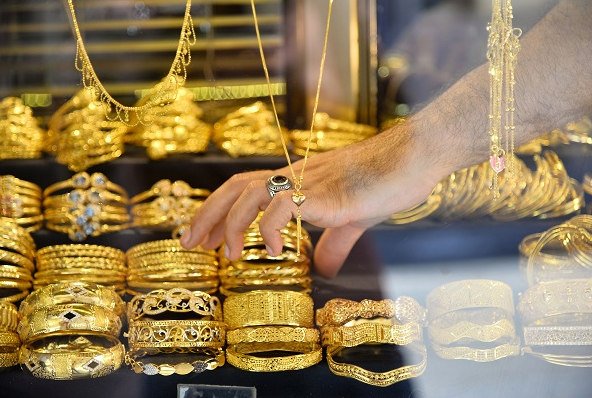
Tokyo, Jul 27: Gold hit an all-time high on Monday as tit-for-tat consulate closures in China and the United States rattled investors, boosting the allure of safe-haven assets, although sentiment was mixed with tech gains supporting some Asian stocks.

MSCI's ex-Japan Asia-Pacific index rose 1.3 percent as Taiwan's TSMC, Asia's third-largest company by market capitalisation, rose almost 10 percent.

The chipmaker's gains boosted other tech stocks in the region and came after rival Intel signalled it may give up manufacturing its own components due to delays in new 7-nanometer chip technology.

Also soothing sentiment, Chinese shares eked out gains after big falls late last week, with CSI300 index rising 0.5 percent.

S&P500 futures were last up 0.4 percent in choppy trade while Japan's Nikkei fell 0.5 percent, resuming trade after a long weekend and catching up with falls in global shares late last week.

Global shares had lost steam last week after Washington ordered China's consulate in Houston to close, prompting Beijing to react in kind by closing the US consulate in Chengdu.

US Secretary of State Mike Pompeo took fresh aim at China last week, saying Washington and its allies must use "more creative and assertive ways" to press the Chinese Communist Party to change its ways.

"US President (Donald) Trump used to say China's President Xi Jinping is a great leader. But now Pompeo's wording is becoming so aggressive that markets are starting to worry about further escalation," said Norihiro Fujito, chief investment strategist at Mitsubishi Securities.

Gold rose 1.0 percent to a record high of $1,920.9 per ounce, surpassing a peak touched in September 2011, as Sino-US tensions boosted the allure of safe-haven assets, especially those not tied to any specific country.

The yellow metal is also helped by aggressive monetary easing adopted by many central banks around the world since the pandemic plunged the global economy into a recession.

Some investors fret such an unprecedented level of money-printing could eventually lead to inflation.

MORE STIMULUS

Hopes of a quick US economic recovery are fading as coronavirus infections showed few signs of slowing.

That means the economy could capitulate without fresh support from the government, with some of earlier steps such as enhanced jobless benefits due to expire this month.

Investors hope US Congress will agree on a deal before its summer recess but there are some sticking points including the size of the stimulus and enhanced unemployment benefits.

US Treasury Secretary Steve Mnuchin said the package will contain extended unemployment benefits with 70 percent "wage replacement".

Democrats, who control the House of Representatives, want enhanced benefits of $600 per week to be extended and look to much bigger stimulus compared with the Republicans' $1 trillion plan.

Investors are looking to corporate earnings from around the world for hints on the pace of recovery in the global economy.

"It looks like rising coronavirus cases are starting to slow down recovery in many countries," said Masahiro Ichikawa, senior strategist at Sumitomo Mitsui DS Asset Management.

Concerns about the US economic outlook started to weigh on the dollar, reversing its inverse correlation with the economic well-being over the past few months.

The dollar index dropped 0.3 percent to its lowest level in nearly two years.

The euro gained 0.3 percent to $1.1693, hitting a 22-month high of $1.16590 as sentiment on the common currency improved after European leaders reached a deal on a recovery fund in a major step towards more fiscal co-operation.

Against the yen, the dollar slipped 0.5 percent to 105.605 yen, a four-month low while the British pound hit a 4 1/2-month high of $1.2832.

Oil prices dipped on worries about the worsening Sino-US relations.

Brent futures fell 0.46 percent to $43.14 per barrel while US crude futures lost 0.44 percent to $41.11.

Comments

Add new comment

  • Coastaldigest.com reserves the right to delete or block any comments.
  • Coastaldigset.com is not responsible for its readers’ comments.
  • Comments that are abusive, incendiary or irrelevant are strictly prohibited.
  • Please use a genuine email ID and provide your name to avoid reject.