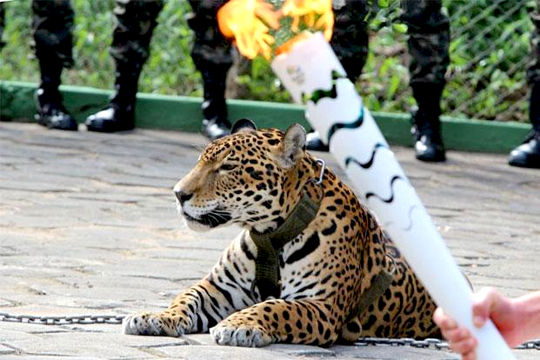
Juma the jaguar becomes a tragic casualty of the Olympics

June 22, 2016

Jun 22: On Monday, less than a month after a gorilla was killed in the Cincinnati zoo because a child had slipped into its enclosure, an Amazonian jaguar was killed after the Olympic torch-bearing ceremony in Brazil.

jaguar

While news reports are surfacing now, there has been no media stir, or social media ire like there was with the Cincinnati zoo incident. The 17-year-old female jaguar Juma was raised in a military-run zoo in Manaus and was part of the ceremonial Olympic torch-bearing procession.

The jaguar, which is the symbol of the Amazon, derives its name from the Native American yaguar, meaninghe who kills with one leap'. Juma, along with another jaguar, were chained and exhibited throughout the ceremony. The jaguar become restless when she was forced to pose for multiple-angle shots with a man holding the torch, managing to unshackle herself.

Once free, Juma was shot with four tranquilizer darts but despite that, she attacked a soldier. To save him and the rest of the rescue team, she was killed with a single gunshot.

“Wild animals held captive and forced to do things that are frightening, sometimes painful, and always unnatural are ticking time bombs,” says Brittany Peet, director of captive animal law enforcement at People for the Ethical Treatment of Animals (PETA).

As per the Amazonas state government environmental authority, Juma's participation in the event was illegal, Reuters reported. “No request was made to authorize the participation of the jaguarJuma' in the event of the Olympic torch.”

The jaguar is a near-extinct species. Only 15,000 of them are left on earth.

“We made a mistake in permitting the Olympic torch, a symbol of peace and unity, to be exhibited alongside a chained wild animal. This image goes against our beliefs and our values,” the Olympic committee's statement post the incident read.

It is little consolation for yet another meaningless and brutal killing.

Comments

Add new comment

  • Coastaldigest.com reserves the right to delete or block any comments.
  • Coastaldigset.com is not responsible for its readers’ comments.
  • Comments that are abusive, incendiary or irrelevant are strictly prohibited.
  • Please use a genuine email ID and provide your name to avoid reject.
Agencies
January 4,2020

Washington D.C: One of the greatest spectacles of modern art is still thriving in the Australian outback as confirmed by satellite imagery of NASA. The Marree Man is a massive geoglyph depicting an aboriginal hunter, that spans over 2.6 miles in the Southern Australian region.

Discovered by a pilot in 1998, its origin still remains a mystery even to this date.

The Marree Man was given a new lease of life in 2016 when a group of people from the neighboring town of Marree plowed its lines to avert its fading due to erosion.

After NASA shared the image of the art-work that was taken in June, the efforts of the good samaritans turned out to be a total success, reported CNN Travel.

The restoration team believes that the refurbished Marree Man would last longer than its original version.

According to NASA, "They [the team] created wind grooves, designed to trap water and encourage the growth of vegetation. They hope that eventually, the man will turn green."

In a previous article, CNN reported that an entrepreneur by the name of Dick Smith took upon himself to unravel the geoglyph's mystery in 2016. His team combed through all the available evidence but couldn't find anything conclusive.

In 2018 he even offered a 5,000 Australian dollar reward for anyone who knows the identity of its creator.

Nobody turned up with an answer but it was speculated that unknown artist lives in Alice Springs or even might be an American.

Comments

Add new comment

  • Coastaldigest.com reserves the right to delete or block any comments.
  • Coastaldigset.com is not responsible for its readers’ comments.
  • Comments that are abusive, incendiary or irrelevant are strictly prohibited.
  • Please use a genuine email ID and provide your name to avoid reject.
Agencies
May 31,2020

Cape Canaveral, May 31: SpaceX, the private rocket company of billionaire entrepreneur Elon Musk, launched two Americans into orbit from Florida on Saturday in a landmark mission marking the first spaceflight of NASA astronauts from U.S. soil in nine years.

A SpaceX Falcon 9 rocket lifted off from the Kennedy Space Center at 3:22 p.m. EDT (19:22 GMT), launching Doug Hurley and Bob Behnken on a 19-hour ride aboard the company’s newly designed Crew Dragon capsule bound for the International Space Station.

Just before liftoff, Hurley said, “SpaceX, we’re go for launch. Let’s light this candle,” paraphrasing the famous comment uttered on the launch pad in 1961 by Alan Shepard, the first American flown into space.

Minutes after launch, the first-stage booster rocket of the Falcon 9 separated from the upper second-stage rocket and flew itself back to Earth to descend safely onto a landing platform floating in the Atlantic.

High above the Earth, the Crew Dragon jettisoned moments later from the second-stage rocket, sending the capsule on its way to the space station.

The exhilarating spectacle of the rocket soaring flawlessly into the heavens came as a welcome triumph for a nation gripped by racially-charged civil unrest as well as ongoing fear and economic upheaval from the coronavirus pandemic.

The Falcon 9 took off from the same launch pad used by NASA’s final space shuttle flight, piloted by Hurley, in 2011. Since then, NASA astronauts have had to hitch rides into orbit aboard Russia’s Soyuz spacecraft.

“It’s incredible, the power, the technology,” said U.S. President Donald Trump, who was at Kennedy Space Center at Cape Canaveral in Florida for the launch. “That was a beautiful sight to see.”

The mission’s first launch attempt on Wednesday was called off with less than 17 minutes remaining on the countdown clock. Weather again threatened Saturday’s launch, but cleared in time to proceed with the mission.

SPACEFLIGHT MILESTONES

NASA chief Jim Bridenstine has said resuming launches of American astronauts on American-made rockets from U.S. soil is the space agency’s top priority.

“I’m breathing a sigh of relief, but I will also tell you I’m not gonna celebrate until Bob and Doug are home safely.” Bridenstine said.

For Musk, the launch represents another milestone for the reusable rockets his company pioneered to make spaceflight less costly and more frequent. And it marks the first time commercially developed space vehicles - owned and operated by a private entity rather than NASA - have carried Americans into orbit.

The last time NASA launched astronauts into space aboard a brand new vehicle was 40 years ago at the start of the space shuttle program.

Musk, the South African-born high-tech entrepreneur who made his fortune in Silicon Valley, is also chief executive of electric carmaker and battery manufacturer Tesla Inc. He founded Hawthorne, California-based SpaceX, formally known as Space Exploration Technologies, in 2002.

Hurley, 53, and Behnken, 49, NASA employees under contract to fly with SpaceX, are expected to remain at the space station for several weeks, assisting a short-handed crew aboard the orbital laboratory.

Boeing Co, producing its own launch system in competition with SpaceX, is expected to fly its CST-100 Starliner vehicle with astronauts aboard for the first time next year. NASA has awarded nearly $8 billion combined to SpaceX and Boeing for development of their rival rockets.

Trump also hailed the launch as a major advance toward the goal of eventually sending humans to Mars.

He was joined at the viewing by Musk, as well as Vice President Mike Pence, Commerce Secretary Wilbur Ross, Education Secretary Betsy DeVos, Florida congressman Matt Gaetz and Senator Rick Scott.

Earlier on Saturday, the crew bid goodbye to their families. Prior to climbing into a specially designed Tesla automobile for the ride to the launch site, Behnken told his young son, “Be good for mom. Make her life easy.”

During the drive, Behnken and Hurley passed former astronaut Garrett Reisman who held a sign saying, “Take me with you.”


Comments

Add new comment

  • Coastaldigest.com reserves the right to delete or block any comments.
  • Coastaldigset.com is not responsible for its readers’ comments.
  • Comments that are abusive, incendiary or irrelevant are strictly prohibited.
  • Please use a genuine email ID and provide your name to avoid reject.
News Network
February 21,2020

London, Feb 21: Scientists have discovered a new species of land snail, and have named it Craspedotropis Greta Thunberg in honour of the Swedish activist Greta Thunberg for her efforts to raise awareness about climate change.

According to the study, published in the Biodiversity Data Journal, the newly discovered species belongs to the so-called caenogastropods -- a group of land snails known to be sensitive to drought, temperature extremes, and forest degradation.

The scientists, including evolutionary ecologist Menno Schilthuizen from Naturalis Biodiversity Center in the Netherlands, said the snails were found very close to the research field station at Kuala Belalong Field Studies Centre in Brunei.

They added that the snails were discovered at the foot of a steep hill-slope, next to a river bank, foraging at night on the green leaves of understorey plants.

The effort aided by amateur scientist J.P. Lim, who found the first individual of the snail said, "Naming this snail after Greta Thunberg is our way of acknowledging that her generation will be responsible for fixing problems that they did not create."

"And it's a promise that people from all generations will join her to help," Lim said.

The researchers said they approached Thunberg who said that she would be "delighted" to have this species named after her.

The study work including, fieldwork, morphological study, and classification of identified specimen was carried out in a field centre with basic equipment and no internet access, the scientists said.

According to the study, the work was done by untrained ‘citizen scientists’ guided by experts, on a 10-day taxon expedition.

"While we are aware that this way of working has its limitations in terms of the quality of the output (for example, we were unable to perform dissections or to do extensive literature searches), the benefits include rapid species discovery and on-site processing of materials," the researchers wrote in the study.

Comments

Add new comment

  • Coastaldigest.com reserves the right to delete or block any comments.
  • Coastaldigset.com is not responsible for its readers’ comments.
  • Comments that are abusive, incendiary or irrelevant are strictly prohibited.
  • Please use a genuine email ID and provide your name to avoid reject.