Kandhamal: Long Wait for Justice

[email protected] (Ram Puniyani)
August 25, 2016

Today, nearly a decade later when we are remember with pain the horrific violence of Kandhmal in 2008, many issues related to the state of affairs of communal violence, state of minorities, the state of justice delivery system come to one’s mind.kandhamal
The incident

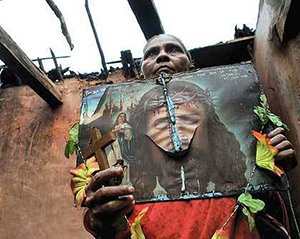
Just to recall, Orissa witnessed unprecedented violence against the Christian minority in August 2008. On August 23, 2008, Swami Laxmananand along with his four followers was killed, probably by a group of Maoists. Immediately, anti-Christian violence began on a big scale. The way it began it seemed as if preparations for it were well afoot. It was systematic and widespread. It sounded as if preparation was already there just the pretext was being awaited.

Christians in India

Christians are a tiny minority in India. Contrary to the perception that British brought Christianity to India, it is one of the oldest religions of India. Its spread has been slow. Not much was heard against this minority till the decade of 1990s, when suddenly it started being asserted that Christian missionaries are converting. Anti-Christian violence has been occurring more in the remote-interior places and is accompanied by another phenomenon, that of Ghar Vapasi (return home), which is the conversions of Adivasis into the fold of Hinduism, by Vishwa Hindu Parishad-Vanavasi Kalyan Ashram.

It is from 1996, that this phenomenon of conversion-anti Christian violence has captured the attention of all of us. Suddenly, as if from nowhere has descended the ‘threat of conversion to Christianity’ by force or fraud. Simultaneously, attacks on priests and nuns increased in distant interior places. It has been a peculiar phenomenon that while these attacks in remote places were being undertaken, the Christian institutions in cities – schools, colleges and hospitals – were hard pressed to cope with the demands on their services related to education and health. The selective targeting of Christian missionaries in distant places was a matter of serious attention, concern and introspection.

Social Common Sense

As the ‘social common sense’ started accepting, ‘yes, they are converting’, ‘they have been converting’, a sort of silent approval of layers of society and state officials did accompany these attacks on the missionaries. One was used to hearing about attacks on Muslim minorities so far. How come a new minority came to be perceived as the ‘source of trouble’ and hence started being targeted?

Anti Christian violence did begin with isolated incidents like the attack on the Catholic Health Centre of India near Latur (1996), burning of Bibles and attacks on the Christian congregations. But most shocking was the burning alive of Pastor Graham Steward Stains (1999, January) along with his two sons, Philip and Timothy, aged 9 and 7 years, who were sleeping in a jeep after a village festival. Gradually the pattern of these attacks started emerging. In the remote places where Vanvasi Kalyan Ashrams (Society for Welfare of Forest Dwellers), an outfit of RSS, have been active and doing the propaganda work along with starting of Ekal schools and have been Hinduising Adivasis, the incidents were more pronounced and intense.

Anti Christian Violence: Characteristics

The violence against Christian missionaries has by now become a matter of routine. Unlike the anti Muslim pogroms-violence, it has been scattered and generally low key, occurring at sporadic intervals. Barring few dastardly acts like Pastor Stains’ burning and Rani Maria’s being hacked to death the incidents were medium in intensity and did not take the shape of carnage or pogrom against the community till the one in Orissa (December 2007 and later August 2008). The occurrence of these incidents was mostly in places that are having rampant poverty and illiteracy. The apathy in highlighting these core issues, deprivations, by a section of media was appalling. At the same time, by word of mouth the propaganda against Christian Missionaries was intensified.

The message has been spread that Christian missionaries working in remote places are soft targets and one can get away without much reprisals. Also the anti-Christian mobilization of Adivasi youth through cultural manipulation was the groundwork on which the anti-Christian violence could sustain. In the atmosphere created by the activities of RSS progeny, local communal groups have felt emboldened to pick up any small issue and to make a violent incident out of it. Its’ frightening effect on the victims is tremendous. It also begins to polarize the local communities into Christian and non-Christian camps amongst whom the seeds of tension are sown.

Cultural: Agenda

The physical violence has been accompanied by cultural manipulation in these areas. The silent work to Hinduise Adivasis through religio-cultural mechanisms has been stepped up from last three decades. People like Swami Aseemanand (Dangs), Swami Laxmanand (Kandhmal, Orissa), followers of Asaram Bapu (Jhabua, MP) began their work in popularizing Hindu gods and Goddesses in the region. The choice of Gods/Goddesses from the vast pantheon of Hindu religion was a clever one. Here Shabri (Symbol of poverty and deprivation) was the main goddess, the idol for Adivasis. Temples in her names were started and regular Kumbhs (mass religious congregation of Hindus) were organized in her name. Kumbhs have been a tradition in Hinduism on fixed interval of time on the banks of Holy rivers; Ganges in particular. Modifying that tradition, these Kumbhs were organized in Adivasis areas. Here the work of conversion to Hinduism, the spread of ‘Hate against’ foreigners’, particularly Christians, was spread. In addition an atmosphere of terror was created against those who do not toe the line of Vanavasi Kalyan Ashram.

Similarly the God Hanuman, the foremost devotee of Lord Ram was also made popular, by spreading his lockets and through different stories around him, in the Ekal Schools and Sarswati Shishu Mandirs. It created an atmosphere of divide in the Adivasi areas; Adivasis turned Hindus, the Hindu dalits and upper caste versus the Christians. It is this atmosphere of divisiveness, which has been at the root of the violence in these areas.

Political Agenda

This has been a part of the different activities undertaken by RSS combine to promote the agenda of Hindu nation. While RSS has floated many a organizations to communalize different sections of society, BJP, VHP, Bajrang Dal, etc. it has also unleashed a set of cultural activities, set of educational institutions along with infiltration in media, bureaucracy, police and military. They are gradually imposing the idea of Hindu nation and accompanying culture and ideas. The culmination of this has been the violence against minorities, polarization of communities along religious lines and ghettoization of minorities. While all this is going on the violence against minorities’ is the most visible part of this phenomenon.

The role of state agencies has been no different in these incidents than what it has been in the anti Muslim violence. In most cases, the administration has looked the other way when communal goons were on the rampage. The administration most often provided enough leeway for them to wreck havoc, indulge in intimidation, violence and to get away with that. The Adivasi areas, which were so far peaceful, started witnessing communal tensions. The area of violence in Adivasi regions is synonymous with the map of spread of Vanvasi Kalyan Ashrams and Vishwa Hindu Parishads in an indirect way.

RSS had been floating different organizations for different sections of society; Vanvasi Kalyan Ashram, to Hinduise Adivasis was founded in 1952 and the Vishwa Hindu Parishad founded in 1964 was to play an important role in the anti Christian tirade in times to come. Another RSS progeny which, directly supported violence against Christians, Bajrang Dal, was founded by RSS in 1984. After the intimidation and browbeating of Muslim minorities, especially after the post Babri demolition Mumbai riots, they stepped up their social dominance and needed another community to target their trishuls for further expansion of their social and electoral base, and that was done by the bogey of forced conversions and accompanying anti Christian violence, which started coming to the fore from 1996 onwards. The targeting of minorities has played an important role in polarizing the communities, in consolidation of the majoritarian politics in various ways.

The burning of Pastor Stains, in that sense was a turning point for Human rights groups, who so far were trying to grapple and respond to the anti Muslim violence. With this many concerned groups took up the investigations of the violence against Christians in the right earnest. As such, the first major cover up had to be undertaken by the BJP led NDA Government itself, in the aftermath of Stains murder. Initially, as a fire fighting measure, the functionaries of the NDA government tried to give a clean chit to the RSS combine. After the murder, the then home minister Lal Krishna Advani stated that he knows Bajrang Dal very well and this act could not have been done by that organization. To put a veil on the episode, the three cabinet ministers, George Fernandez, Murli Manohar Joshi and Navin Patnaik rushed to the site and proclaimed that the murder of Pastor is an international conspiracy to destabilize the BJP Government. This way they tried to bypass the real issue, i.e. involvement of Dara Singh, an activist of Bajrang Dal.

Struggle for Justice: People’s Tribunals

The case of Orissa was specifically investigated by India Peoples Tribunal, led by Justice K.K.Usha (retired) of Kerala High court in 2006. This tribunal forewarns about the shape of things to come. This tribunal assessed the spread of communal organizations in Orissa, which has been accompanied by a series of small and large events and some riots…such violations are utilized to generate the threat and reality of greater violence, and build and infrastructure of fear and intimidation. It further noted that minorities are being grossly ill treated; there is gross inaction of the state Government to take action. The report also describes in considerable detail how the cadre of majoritarian communal organizations are indoctrinated in hatred and violence against other communities it holds to be inherently inferior. If such communalization is undertaken in Orissa, it is indicative of the future of the nation… the signs are truly ominous for India's democratic future.

It is in this backdrop that when the Kandhamal carnage took place, the offense of RSS affiliates, the lapses and partisan behaviour of state machinery, the lack of rehabilitation and deliverance of justice came as a big jolt to the victims and became the matter of concern for human rights groups. The lack of proper investigation and other actions on the part of state were the key for getting justice for the victims. While many a sincere, scattered efforts to help the afflicted were undertaken by different groups. These efforts were effective but inadequate in their reach. The tribunal organized for Orissa violence under Justice A. P.Shah (Retd) brought out the truth of the carnage. The hope was that the victims will be suitably rehabiliatated and get justice.

This tribunal observed, (excerpts)
“The appalling feature of the Kandhamal violence, where rescue and relief work by non-profit, charitable and humanitarian organizations was prohibited through a government notification, indicates the impunity with which the state government acted, and its scant respect for rule of law and human rights of the victim-survivors of the violence.”...

“The dismal conditions in the government-run relief camps are clearly indicative of the indifference of the state government to the plight of victim-survivors.”...”The testimonies of victim-survivors as well as the reports presented to the Tribunal indicate that victim-survivors were forcibly sent back to their villages, or abandoned near their villages, with total disregard to their safety.”...“Peace-building Initiatives: The fact that many victim-survivors are unable to return to their villages due to threats and intimidation by perpetrators, and many of those who have returned continue to live in constant fear and security, lead us to conclude that the state government’s peace initiatives have been a dismal failure and nothing more than an eyewash.”

It also made lot of recommendations about relief, rehaibilation, compensation and justice. This excerpt is very telling “Implementation of State’s Duty Towards Peace-building, Voluntary Return and Reintegration: The State should recognize the Internally Displaced Persons’ right to return to their homes and create all possible enabling conditions to facilitate such safe return in accordance with the above standards. The state ought to discharge its duty of creating a conducive, safe and peaceful environment that can sustain return or re-integration of victim-survivors through access to public services, legal and personal documentation, and to livelihoods and income-generating opportunities without any form of discrimination.”

As usual the recommendations of the tribunal remain in the limbo. The heartening feature of struggle for justice in Kandhamal is the dogged determination of the victims and human rights activists to get the justice. This is also the time to understand that justice is a long term goal also which requires a programmatic alliance between the struggling sections of society, be it dalits, Adivasis, women, workers or struggling sections of society. In the light of growing intolerance in society, in the light of the growing stifling of the democracy society the need to build social alliances to preserve democracy and human rights is all the more crucial at this juncture.

Comments

Add new comment

  • Coastaldigest.com reserves the right to delete or block any comments.
  • Coastaldigset.com is not responsible for its readers’ comments.
  • Comments that are abusive, incendiary or irrelevant are strictly prohibited.
  • Please use a genuine email ID and provide your name to avoid reject.
Ram Puniyani
January 14,2020

In the beginning of January 2020 two very disturbing events were reported from Pakistan. One was the attack on Nankana Sahib, the holy shrine where Sant Guru Nanak was born. While one report said that the place has been desecrated, the other stated that it was a fight between two Muslim groups. Prime Minister of Pakistan Imran Khan condemned the incident and the main accused Imran Chisti was arrested. The matter related to abduction and conversion of a Sikh girl Jagjit Kaur, daughter of Pathi (One who reads Holy Guru Granth Sahib in Gurudwara) of the Gurudwara. In another incident one Sikh youth Ravinder Singh, who was out on shopping for his marriage, was shot dead in Peshawar.

While these condemnable attacks took place on the Sikh minority in Pakistan, BJP was quick enough to jump to state that it is events like this which justify the Citizenship Amendment Act (CAA). Incidentally CAA is the Act which is discriminatory and relates to citizenship with Religion, which is not as per the norms of Indian constitution. There are constant debates and propaganda that population of Hindus has come down drastically in Pakistan and Bangla Desh. Amit Shah, the Home minister stated that in Pakistan the population of Hindus has come down from 23% at the time of partition to 3.7% at present. And in Bangla Desh it has come down from 22% to present 8%.

While not denying the fact that the religious minorities are getting a rough deal in both these countries, the figures which are presented are totally off the mark. These figures don’t take into consideration the painful migrations, which took place at the time of partition and formation of Bangla Desh later. Pakistan census figures tell a different tale. Their first census was held in 1951. As per this census the overall percentage of Non Muslim in Pakistan (East and West together) was 14.2%, of this in West Pakistan (Now Pakistan) it was 3.44 and in Eat Pakistan it was 23.2. In the census held in Pakistan 1998 it became 3.72%. As far as Bangla Desh is concerned the share of Non Muslims has gone down from 23.2 (1951) to 9.6% in 2011.

The largest minority of Pakistan is Ahmadis, (https://minorityrights.org/country/pakistan/) who are close to 4 Million and are not recognised as Muslims in Pakistan. In Bangla Desh the major migrations of Hindus from Bangla Desh took place in the backdrop of Pakistan army’s atrocities in the then East Pakistan.

As far as UN data on refugees in India it went up by 17% between 2016-2019 and largest numbers were from Tibet and Sri Lanka.  (https://www.un.org/en/development/desa/population/migration/publication…)

The state of minorities is in a way the index of strength of democracy. Most South Asian Countries have not been able to sustain democratic values properly. In Pakistan, the Republic began with Jinnah’s classic speech where secularism was to be central credo of Pakistan. This 11th August speech was in a way what the state policy should be, as per which people of all faiths are free to practice their religion. Soon enough the logic of ‘Two Nation theory” and formation of Pakistan, a separate state for Muslim took over. Army stepped in and dictatorship was to reign there intermittently. Democratic elements were suppressed and the worst came when Zia Ul Haq Islamized the state in collusion with Maulanas. The army was already a strong presence in Pakistan. The popular formulation for Pakistan was that it is ruled by three A’s, Army, America and Allah (Mullah).

Bangla Desh had a different trajectory. Its very formation was a nail in the coffin of ‘two nation theory’; that religion can be the basis of a state. Bangla Desh did begin as a secular republic but communal forces and secular forces kept struggling for their dominance and in 1988 it also became Islamic republic. At another level Myanmar, in the grip of military dictatorship, with democratic elements trying to retain their presence is also seeing a hard battle. Democracy or not, the army and Sanghas (Buddhist Sang has) are strong, in Myanmar as well. The most visible result is persecution of Rohingya Muslims.

Similar phenomenon is dominating in Sri Lanka also where Budhhist Sanghas and army have strong say in the political affairs, irrespective of which Government is ruling. Muslim and Christian minorities are a big victim there, while Tamils (Hindus, Christians etc.) suffered the biggest damage as ethnic and religious minorities. India had the best prospect of democracy, pluralism and secularism flourishing here. The secular constitution, the outcome of India’s freedom struggle, the leadership of Gandhi and Nehru did ensure the rooting of democracy and secularism in a strong way.

India so far had best democratic credentials amongst all the south Asian countries. Despite that though the population of minorities rose mainly due to poverty and illiteracy, their overall marginalisation was order of the day, it went on worsening with the rise of communal forces, with communal forces resorting to identity issues, and indulging in propaganda against minorities.

While other South Asian countries should had followed India to focus more on infrastructure and political culture of liberalism, today India is following the footsteps of Pakistan. The retrograde march of India is most visible in the issues which have dominated the political space during last few years. Issues like Ram Temple, Ghar Wapasi, Love Jihad, Beef-Cow are now finding their peak in CAA.

India’s reversal towards a polity with religion’s identity dominating the political scene was nicely presented by the late Pakistani poetess Fahmida Riaz in her poem, Tum bhi Hum Jaise Nikle (You also turned out to be like us). While trying to resist communal forces has been an arduous task, it is becoming more difficult by the day. This phenomenon has been variously called, Fundamentalism, Communalism or religious nationalism among others. Surely it has nothing to do with the religion as practiced by the great Saint and Sufi traditions of India; it resorts mainly to political mobilization by using religion as a tool.

Comments

Ashi
 - 
Tuesday, 14 Jan 2020

If Malaysia implement similar NRC/CAA, India and China are the loser.

Add new comment

  • Coastaldigest.com reserves the right to delete or block any comments.
  • Coastaldigset.com is not responsible for its readers’ comments.
  • Comments that are abusive, incendiary or irrelevant are strictly prohibited.
  • Please use a genuine email ID and provide your name to avoid reject.
Ram Puniyani
February 4,2020

As democracy is seeping in slowly all over the world, there is an organization which is monitoring the degree of democracy in the individual countries, The Economist Intelligence Unit. As such in each country there are diverse factors which on one hand work to deepen it, while others weaken it. Overall there is a march from theoretical democracy to substantive one. The substantive democracy will herald not just the formal equality, freedom and community feeling in the country but will be founded on the substantive quality of these values. In India while the introduction of modern education, transport, communication laid the backdrop of beginning of the process, the direction towards deepening of the process begins with Mahatma Gandhi when he led the non-cooperation movement in 1920, in which average people participated. The movement of freedom for India went on to become the ‘greatest ever mass movement’ in the World.

The approval and standards for democracy were enshrined in Indian Constitution, which begins ‘We the people of India’, and was adopted on 26th January 1950. With this Constitution and the policies adopted by Nehru the process of democratization started seeping further, the dreaded Emergency in 1975, which was lifted later restored democratic freedoms in some degree. This process of democratisation is facing an opposition since the decade of 1990s after the launch of Ram Temple agitation, and has seen the further erosion with BJP led Government coming to power in 2014. The state has been proactively attacking civil liberties, pluralism and participative political culture with democracy becoming flawed in a serious way. And this is what got reflected in the slipping of India by ten places, to 51st, in 2019. On the index of democracy India slipped down from the score of 7.23 to 6.90. The impact of sectarian BJP politics is writ on the state of the nation, country.

Ironically this lowering of score has come at a time when the popular protests, the deepening of democracy has been given a boost and is picking up with the Shaheen Bagh protests. The protest which began in Shaheen Bagh, Delhi in the backdrop of this Government getting the Citizenship amendment Bill getting converted into an act and mercilessly attacking the students of Jamia Milia Islamia, Aligarh Muslim University along with high handed approach in Jamia Nagar and neighbouring areas.  From 15th December 2019, the laudable protest is on.

It is interesting to note that the lead in this protest has been taken by the Muslim women, from the Burqa-Hijab clad to ‘not looking Muslim’ women and was joined by students and youth from all the communities, and later by the people from all the communities. Interestingly this time around this Muslim women initiated protest has contrast from all the protests which earlier had begun by Muslims. The protests opposing Shah Bano Judgment, the protests opposing entry of women in Haji Ali, the protests opposing the Government move to abolish triple Talaq. So far the maulanas from top were initiating the protests, with beard and skull cap dominating the marches and protests. The protests were by and large for protecting Sharia, Islam and were restricted to Muslim community participating.

This time around while Narendra Modi pronounced that ‘protesters can be identified by their clothes’, those who can be identified by their external appearance are greatly outnumbered by all those identified or not identified by their appearance.

The protests are not to save Islam or any other religion but to protect Indian Constitution. The slogans are structured around ‘Defence of democracy and Indian Constitution’. The theme slogans are not Allahu Akbar’ or Nara-E-Tadbeer’ but around preamble of Indian Constitution. The lead songs have come to be Faiz Ahmad Faiz’s ‘Hum Dekhenge’, a protest against Zia Ul Haq’s attempts to crush democracy in the name of religion. Another leading protest song is from Varun Grover, ‘Tanashah Aayenge…Hum Kagaz nahin Dikhayenge’, a call to civil disobedience against the CAA-NRC exercise and characterising the dictatorial nature of the current ruling regime.

While BJP was telling us that primary problem of Muslim women is Triple talaq, the Muslim women led movements has articulated that primary problem is the very threat to Muslim community. All other communities, cutting across religious lines, those below poverty line, those landless and shelter less people also see that if the citizenship of Muslims can be threatened because of lack of some papers, they will be not far behind in the victimization process being unleashed by this Government.

While CAA-NRC has acted as the precipitating factor, the policies of Modi regime, starting from failure to fulfil the tall promises of bringing back black money, the cruel impact of demonetisation, the rising process of commodities, the rising unemployment, the divisive policies of the ruling dispensation are the base on which these protest movements are standing. The spread of the protest movement, spontaneous but having similar message is remarkable. Shaheen Bagh is no more just a physical space; it’s a symbol of resistance against the divisive policies, against the policies which are increasing the sufferings of poor workers, the farmers and the average sections of society.

What is clear is that as identity issues, emotive issues like Ram Temple, Cow Beef, Love Jihad and Ghar Wapasi aimed to divide the society, Shaheen Bagh is uniting the society like never before. The democratisation process which faced erosion is getting a boost through people coming together around the Preamble of Indian Constitution, singing of Jan Gan Man, waving of tricolour and upholding the national icons like Gandhi, Bhagat Singh, Ambedkar and Maulana Azad. One can feel the sentiments which built India; one can see the courage of people to protect what India’s freedom movement and Indian Constitution gave them.

Surely the communal forces are spreading canards and falsehood against the protests. As such these protests which is a solid foundation of our democracy. The spontaneity of the movement is a strength which needs to be channelized to uphold Indian Constitution and democratic ethos of our beloved country.

Comments

Add new comment

  • Coastaldigest.com reserves the right to delete or block any comments.
  • Coastaldigset.com is not responsible for its readers’ comments.
  • Comments that are abusive, incendiary or irrelevant are strictly prohibited.
  • Please use a genuine email ID and provide your name to avoid reject.
Ram Puniyani
June 29,2020

In Minneapolis, US an African American, George Floyd lost his life as the white policeman, Derek Chauvin, caught hold of him and put his knee on his neck. This is a technique developed by Israel police. For nine long minutes the knee of the while policeman was on the neck of George, who kept shouting, I can’t breathe.

Following this gruesome murder America erupted with protests, ‘Black lives matter’. The protestors were not just African Americans but also a large section of whites. Within US one police Chief apologized for the act of this. In a touching gesture of apology the police force came on its knees. This had reverberations in different parts of the World.

The act was the outcome of the remnants of the racial hatred against blacks by the whites. It is the hatred and the perceptions which are the roots of such acts of violence. What was also touching that the state of democracy in US is so deep that even the police apologized, the nation, whites and blacks, stood up as a sensitive collective against this violence.

US is not the only country where the brutal acts of violence torment the marginalized sections of society. In India there is a list of dalits, minorities and adivasis who are regularly subjected to such acts. But the reaction is very different. We have witnessed the case of Tabrez Ansari, who was tied to the pole by the mob and beaten ruthlessly. When he was taken to police station, police took enough time to take him to hospital and Tabrez died.

Mohsin Sheikh, a Pune techie was murdered by Hindu Rashtra Sena mob, the day Modi came to power in 2014. Afrazul was killed by Shambhulal Regar, videotaped the act released on social media. Regar believed that Muslims are indulging in love Jihad, so deserve such a fate. Mohammad Akhlaq is one among many names who were mob lynched on the issue of beef cow. The list can fill pages after pages.

Recently a young dalit boy was shot dead for the crime of entering a temple. In Una four dalits were stripped above waste and beaten mercilessly. Commenting on this act the Union Minister Ramvilas Paswan commented that it is a minor incident. Again the list of atrocities against dalits is long enough. The question is what Paswan is saying is the typical response to such gruesome murders and tortures. In US loss of one black life, created the democratic and humane response. In India there is a general silence in response to these atrocities. Some times after a good lapse of time, the Prime Minister will utter, ‘Mother Bharati has lost a son’. Most of the time victim is blamed. Some social groups raise their voice in some fora but by and large the deafening silence from the country is the norm.

India is regarded as the largest democracy. Democracy is the rule of law, and the ground on which the injustices are opposed. In America though the present President is insensitive person, but its institutions and processes of democratic articulations are strong. The institutions have deepened their roots and though prejudices may be guiding the actions of some of the officers like the killer of George, there are also police officers who can tell their President to shut up if he has nothing meaningful to say on the issue. The prejudices against Blacks may be prevalent and deep in character, still there are large average sections of society, who on the principles of ‘Black lives matter’. There are large sections of vocal population who can protest the violation of basic norms of democracy and humanism.

In India by contrast there are multiple reasons as to why the lives of Tabrez Ansari, Mohammad Akhlaq, Una dalit victims and their likes don’t matter. Though we claim that we are a democracy, insensitivity to injustices is on the rise. The strong propaganda against the people from margins has become so vicious during last few decades that any violence against them has become sort of a new normal. The large populace, though disturbed by such brutalities, is also fed the strong dose of biases against the victims. The communal forces have a great command over effective section of media and large section of social media, which generates Hate against these disadvantaged groups, thereby the response is muted, if at all.

As such also the process of deepening of our democracy has been weak. Democracy is a dynamic process; it’s not a fixed entity. Decades ago workers and dalits could protest for their rights. Now even if peasants make strong protests, dominant media presents it as blocking of traffic! How the roots of democracy are eroded and are visible in the form where the criticism of the ruling dispensation is labelled as anti National..

Our institutions have been eroded over a period of time, and these institutions coming to the rescue of the marginalized sections have been now become unthinkable. The outreach of communal, divisive ideology, the ideology which looks down on minorities, dalits and Adivasis has risen by leaps and bounds.

The democracy in India is gradually being turned in to a hollow shell, the rule of law being converted in to rule of an ideology, which does not have faith in Indian Constitution, which looks down upon pluralism and diversity of this country, which is more concerned for the privileges of the upper caste, rich and affluent. The crux of the matter is the weak nature of democracy, which was on way to become strong, but from decades of 1980s, as emotive issues took over, the strength of democracy started dwindling, and that’s when the murders of the types of George Floyd, become passé. One does complement the deeper roots of American democracy and its ability to protect the democratic institutions, which is not the case in India, where protests of the type, which were witnessed after George Floyd’s murder may be unthinkable, at least in the present times. 

Comments

Add new comment

  • Coastaldigest.com reserves the right to delete or block any comments.
  • Coastaldigset.com is not responsible for its readers’ comments.
  • Comments that are abusive, incendiary or irrelevant are strictly prohibited.
  • Please use a genuine email ID and provide your name to avoid reject.