Karnataka polls: JD(S) endorses CM’s demand for ballot papers, but BJP wants EVMs

coastaldigest.com news network
December 16, 2017

The Janata Dal (Secular) has seconded Chief Minister Siddaramaiah’s demand for holding the 2018 Karnataka Assembly polls using ballot papers amidst fears of saffronisation of Electronic Voting Machines.

In last two years many cases of EVM tempering have come to light across the country. In recently held Uttar Pradesh local body polls too several complaints had surfaced about EVMs voting only for BJP. Besides, many political parties have accused BJP of indulgencing in EVM hacking and converting votes of other parties in BJP votes.

JD(S) leaders H D Deve Gowda and H D Kumaraswamy on Friday said that the JD(S) too had on previous occasions demanded that the elections be held using ballot paper. Gowda said that he had written to the Election Commission twice in this regard, in the past.

"There were several apprehensions about EVMs in previous elections, including the Uttar Pradesh polls held earlier this year. The JD(S) has been categorical in this demand," he said.

Raising suspicions over EVMs, Kumaraswamy said that developed nations like the USA were continuing to use ballot papers. The Election Commission should bring back the system in the state, he added.

But, BJP wants EVM in Karnataka

On the other hand the Karnataka state unit of BJP stated that opposing the use of EVMs was equivalent to conceding the defeat even before the announcement of the electoral battle.

In a statement in Bengaluru, BJP’s state spokesperson and former Law minister S Suresh Kumar said that the demand for reintroduction of ballot papers is a proof that the Congress leaders are paranoid about the "impending doom" in the 2018 polls.

"Their worst fear has come true by the outcome of the exit polls which have predicted impressive victory for the BJP in both Gujarat and Himachal Pradesh", Suresh Kumar stated. The Congress party's opposition to EVMs is not only illogical but also amateurish, Kumar stated.

Also Read: Siddaramaiah demands use of ballot papers for state Assembly polls

Comments

wellwisher
 - 
Saturday, 16 Dec 2017

Yes this is what all we peace loving patriot INDIANS wants. Without pointing or supporting any political party's 

in INDIA we want respect and value for our voting power franchise. At Karnataka all should stand togther and make  demand if require  mass protest. It will be best foundation for good admiisrtation. Here we not require any politicians TV anchors clarification debate or any one to campare with any other states  pole result,


In INDIA election should conducted always by ballot system .


Jai Hind! Jai Karnataka

Add new comment

  • Coastaldigest.com reserves the right to delete or block any comments.
  • Coastaldigset.com is not responsible for its readers’ comments.
  • Comments that are abusive, incendiary or irrelevant are strictly prohibited.
  • Please use a genuine email ID and provide your name to avoid reject.
News Network
August 2,2020

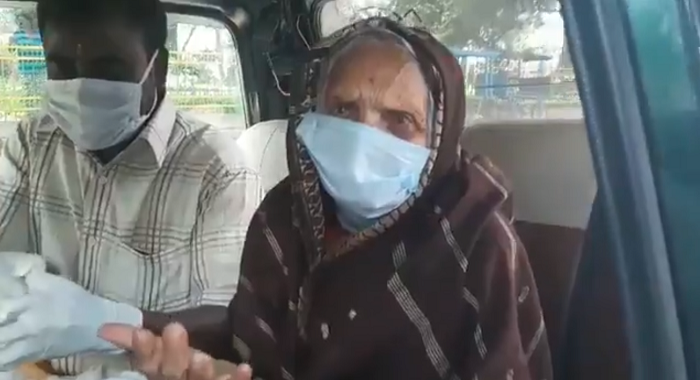
Chitradurga,  Aug 2: Said to be 110-years-old, a grand old woman Siddamma was discharged on Saturday from a COVID Hospital in Chitradurga after recovering from the novel coronavirus.

According to Dr Basavaraj, District Surgeon, Chitradurga, the woman had tested positive for the disease on July 27.

After her recovery, the frail woman dressed in a sari was seen being wheeled out from the hospital.

As many as 5,172 new COVID-19 cases and 98 deaths were reported in Karnataka on Saturday, taking the state's count of coronavirus cases to 1,29,287.

The active cases in the state now stand at 73,219 while 53,648 people have been discharged.

"5,172 new COVID-19 cases and 98 deaths reported in Karnataka in the last 24 hours, taking total cases to 1,29,287 including 53,648 discharges and 2,412 deaths. 

The number of active cases stands at 73,219," said State Health Department.

So far, a total of 2,412 people have succumbed to the virus in the State.

Comments

Add new comment

  • Coastaldigest.com reserves the right to delete or block any comments.
  • Coastaldigset.com is not responsible for its readers’ comments.
  • Comments that are abusive, incendiary or irrelevant are strictly prohibited.
  • Please use a genuine email ID and provide your name to avoid reject.
KT
April 12,2020

Apr 12: The board and management of troubled NMC Healthcare should be held accountable for the financial irregularities, said Abdulaziz Al Ghurair, chairman of the UAE Banks Federation.

"Banks have dealt with the exposure professionally and they lent to a company which was listed on FTSE-100 index with world-class regulator and the world's largest audit firm doing their audit. Even if they present their balance sheet today, people will still lend to them. This is a world-class fraud and the management and board members should be held accountable. We should have a different track to handle this company. It is not a normal track that we can go," Al Ghurair said during a virtual press conference on Sunday.

It is estimated that the more than 80 local, regional and international banks have exposure to healthcare firm. The UAE bourses had asked all the listed companies in the UAE to announce their exposure. The UAE banks last week announced nearly Dh10 billion exposure to NMC Healthcare, which is owned by the billionaire BR Shetty.

Abu Dhabi Commercial Bank has the highest exposure to NMC at Dh3 billion. Dubai Islamic Bank and its subsidiary Noor Bank announced Dh2 billion exposure while Emirates NBD and its Shariah-compliant unit Emirates Islamic Bank revealed Dh747.34 million exposure. Ajman Bank has Dh151.8 million while Al Salam Bank pegged its exposure at Dh161.5 million. All these lenders revealed their exposure for the first time on Sunday.

Abu Dhabi Islamic Bank said it had extended Dh1.07 billion in financing to NMC Healthcare, and an additional Dh113.67 million exposure to Islamic bonds issued by NMC.National Bank of Fujairah pegged its exposure to NMC at Dh289.1 million, while Sharjah-based United Arab Bank said its exposure was Dh135.3 million.

NMC recently revised its debt position to $6.6 billion, well above earlier estimates.

London's High Court last week placed hospital operator NMC Health into administration, on the application of Abu Dhabi Commercial Bank.

"I know leading bank in UAE have already legal guardian of the company so now management cannot hide anything. The new team will manage and discover what happened," said Al Ghurair.

Comments

Add new comment

  • Coastaldigest.com reserves the right to delete or block any comments.
  • Coastaldigset.com is not responsible for its readers’ comments.
  • Comments that are abusive, incendiary or irrelevant are strictly prohibited.
  • Please use a genuine email ID and provide your name to avoid reject.
Ram Puniyani
January 14,2020

In the beginning of January 2020 two very disturbing events were reported from Pakistan. One was the attack on Nankana Sahib, the holy shrine where Sant Guru Nanak was born. While one report said that the place has been desecrated, the other stated that it was a fight between two Muslim groups. Prime Minister of Pakistan Imran Khan condemned the incident and the main accused Imran Chisti was arrested. The matter related to abduction and conversion of a Sikh girl Jagjit Kaur, daughter of Pathi (One who reads Holy Guru Granth Sahib in Gurudwara) of the Gurudwara. In another incident one Sikh youth Ravinder Singh, who was out on shopping for his marriage, was shot dead in Peshawar.

While these condemnable attacks took place on the Sikh minority in Pakistan, BJP was quick enough to jump to state that it is events like this which justify the Citizenship Amendment Act (CAA). Incidentally CAA is the Act which is discriminatory and relates to citizenship with Religion, which is not as per the norms of Indian constitution. There are constant debates and propaganda that population of Hindus has come down drastically in Pakistan and Bangla Desh. Amit Shah, the Home minister stated that in Pakistan the population of Hindus has come down from 23% at the time of partition to 3.7% at present. And in Bangla Desh it has come down from 22% to present 8%.

While not denying the fact that the religious minorities are getting a rough deal in both these countries, the figures which are presented are totally off the mark. These figures don’t take into consideration the painful migrations, which took place at the time of partition and formation of Bangla Desh later. Pakistan census figures tell a different tale. Their first census was held in 1951. As per this census the overall percentage of Non Muslim in Pakistan (East and West together) was 14.2%, of this in West Pakistan (Now Pakistan) it was 3.44 and in Eat Pakistan it was 23.2. In the census held in Pakistan 1998 it became 3.72%. As far as Bangla Desh is concerned the share of Non Muslims has gone down from 23.2 (1951) to 9.6% in 2011.

The largest minority of Pakistan is Ahmadis, (https://minorityrights.org/country/pakistan/) who are close to 4 Million and are not recognised as Muslims in Pakistan. In Bangla Desh the major migrations of Hindus from Bangla Desh took place in the backdrop of Pakistan army’s atrocities in the then East Pakistan.

As far as UN data on refugees in India it went up by 17% between 2016-2019 and largest numbers were from Tibet and Sri Lanka.  (https://www.un.org/en/development/desa/population/migration/publication…)

The state of minorities is in a way the index of strength of democracy. Most South Asian Countries have not been able to sustain democratic values properly. In Pakistan, the Republic began with Jinnah’s classic speech where secularism was to be central credo of Pakistan. This 11th August speech was in a way what the state policy should be, as per which people of all faiths are free to practice their religion. Soon enough the logic of ‘Two Nation theory” and formation of Pakistan, a separate state for Muslim took over. Army stepped in and dictatorship was to reign there intermittently. Democratic elements were suppressed and the worst came when Zia Ul Haq Islamized the state in collusion with Maulanas. The army was already a strong presence in Pakistan. The popular formulation for Pakistan was that it is ruled by three A’s, Army, America and Allah (Mullah).

Bangla Desh had a different trajectory. Its very formation was a nail in the coffin of ‘two nation theory’; that religion can be the basis of a state. Bangla Desh did begin as a secular republic but communal forces and secular forces kept struggling for their dominance and in 1988 it also became Islamic republic. At another level Myanmar, in the grip of military dictatorship, with democratic elements trying to retain their presence is also seeing a hard battle. Democracy or not, the army and Sanghas (Buddhist Sang has) are strong, in Myanmar as well. The most visible result is persecution of Rohingya Muslims.

Similar phenomenon is dominating in Sri Lanka also where Budhhist Sanghas and army have strong say in the political affairs, irrespective of which Government is ruling. Muslim and Christian minorities are a big victim there, while Tamils (Hindus, Christians etc.) suffered the biggest damage as ethnic and religious minorities. India had the best prospect of democracy, pluralism and secularism flourishing here. The secular constitution, the outcome of India’s freedom struggle, the leadership of Gandhi and Nehru did ensure the rooting of democracy and secularism in a strong way.

India so far had best democratic credentials amongst all the south Asian countries. Despite that though the population of minorities rose mainly due to poverty and illiteracy, their overall marginalisation was order of the day, it went on worsening with the rise of communal forces, with communal forces resorting to identity issues, and indulging in propaganda against minorities.

While other South Asian countries should had followed India to focus more on infrastructure and political culture of liberalism, today India is following the footsteps of Pakistan. The retrograde march of India is most visible in the issues which have dominated the political space during last few years. Issues like Ram Temple, Ghar Wapasi, Love Jihad, Beef-Cow are now finding their peak in CAA.

India’s reversal towards a polity with religion’s identity dominating the political scene was nicely presented by the late Pakistani poetess Fahmida Riaz in her poem, Tum bhi Hum Jaise Nikle (You also turned out to be like us). While trying to resist communal forces has been an arduous task, it is becoming more difficult by the day. This phenomenon has been variously called, Fundamentalism, Communalism or religious nationalism among others. Surely it has nothing to do with the religion as practiced by the great Saint and Sufi traditions of India; it resorts mainly to political mobilization by using religion as a tool.


Comments

Ashi
 - 
Tuesday, 14 Jan 2020

If Malaysia implement similar NRC/CAA, India and China are the loser.

Add new comment

  • Coastaldigest.com reserves the right to delete or block any comments.
  • Coastaldigset.com is not responsible for its readers’ comments.
  • Comments that are abusive, incendiary or irrelevant are strictly prohibited.
  • Please use a genuine email ID and provide your name to avoid reject.