



Katju objects to Justice Dave's statement on Gita

August 3, 2014

New Delhi, Aug 3: Press Council of India Chairman Markandey Katju on Sunday objected to a Supreme Court judge's statement that Gita and Mahabharat should be taught in schools, saying this is against India's secular feature and Constitution and will do it "great harm".
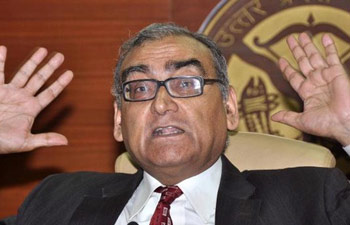
Markandey KatjuSupreme Court judge Justice A R Dave had yesterday said Indians should revert to their ancient traditions and texts such as Mahabharat and Bhagavad Gita and they should be introduced to children at an early age.

"Somebody who is very secular will not agree. Had I been the dictator of India, I would have introduced Gita and Mahabharata in class one. That is the way you learn how to live life. I am sorry if somebody says I am secular or I am not secular. But if there is something good, we have to get it from anywhere," he had said in Ahmedabad.

Katju, a former Supreme Court judge, said, "I totally disagree with Justice Dave's statement that Gita and Mahabharat should be made compulsory in schools.

"In a country of such diversity as ours, nothing of this kind should be compelled or imposed, as that is against our nation's secular feature and Constitution," he said in a statement.

He said Muslims and Christians may not want their children to be taught these books and questioned if their children yet be forced to read them.

"Some people say that Gita only teaches morality and has nothing to do with religion. But Muslims may say that only the Quran teaches morality, Christians may say that only the Bible teaches morality, Sikhs may say that only the Guru Granth Saheb teaches morality, Parsis may say only the Zend Avesta teaches morality, etc," he said.

In his opinion, he said, such compulsion or imposition will do great harm to the unity of the country.

Comments

Add new comment

  • Coastaldigest.com reserves the right to delete or block any comments.
  • Coastaldigset.com is not responsible for its readers’ comments.
  • Comments that are abusive, incendiary or irrelevant are strictly prohibited.
  • Please use a genuine email ID and provide your name to avoid reject.
News Network
March 4,2020

New Delhi, Mar 4: The government on Wednesday permitted NRIs to own up to 100 per cent stake in disinvestment-bound Air India.

The decision comes at a time when the government is looking to sell 100 per cent stake sale in the national carrier.

Union minister Prakash Javadekar said the Cabinet has approved allowing Non-Residents Indians (NRIs) to hold up to 100 per cent stake in Air India.

Allowing 100 per cent investment by Non-Resident Indians (NRIs) in the carrier would also not be in violation of SOEC norms. NRI investments would be treated as domestic investments.

Under the Substantial Ownership and Effective Control (SOEC) framework, which is followed in the airline industry globally, a carrier that flies overseas from a particular country should be substantially owned by that country's government or its nationals.

Currently, NRIs can acquire only 49 per cent in Air India. Foreign Direct Investment (FDI) in the airline is also 49 per cent through the government approval route.

As per the existing norms, 100 per cent FDI is permitted in scheduled domestic carriers, subject to certain conditions, including that it would not be applicable for overseas airlines.

In the case of scheduled airlines, 49 per cent FDI is permitted through automatic approval route and any such investment beyond that level requires government nod.

On January 27, the government came out witha Preliminary Information Memorandum (PIM) for Air India disinvestment. It has proposed selling 100 per cent stake in Air India along with budget airline Air India Express and the national carrier's 50 per cent stake in AISATS, an equal joint venture with Singapore Airlines.

Under the latest disinvestment plan, the successful bidder would have to take over only debt worth Rs 23,286.5 crore while the liabilities would be decided depending on current assets at the time of closing of the transaction.

This is the second attempt by the government in as many years to divest Air India, which has been in the red for long.

Comments

Add new comment

  • Coastaldigest.com reserves the right to delete or block any comments.
  • Coastaldigset.com is not responsible for its readers’ comments.
  • Comments that are abusive, incendiary or irrelevant are strictly prohibited.
  • Please use a genuine email ID and provide your name to avoid reject.
News Network
May 6,2020

New Delhi, May 6: Taking a cue from states, the Centre announced one of the steepest hikes in duties on petrol and diesel in the recent past, by raising it by Rs 10 and Rs 13 per litre, respectively, in a notification issued late on Tuesday.

Retail prices, however, will see no change as the price hike will be absorbed by oil marketing companies against the fall in crude prices.

Road and infrastructure cess was hiked by Rs 8 for petrol and diesel and the special additional excise duty (SAED) was hiked by Rs 2 per litre and Rs 5 per litre, respectively. While the road cess will only go into the Centre’s coffers, the hike on account of SAED will be passed on to states via devolution at 42 per cent. Hence, the states will get only Rs 0.84 per litre in case of petrol and Rs 2.1 in case of diesel.

The decision comes after several states increased the value added tax (VAT) on petrol and diesel making use of the lower price regime. The Delhi government on Tuesday increased VAT on petrol and diesel to 30 per cent each, from 27 and 16.75, respectively. As a result, the price of petrol in Delhi increased by Rs 1.67 to Rs 71.26 a litre and diesel by Rs 7.10 to Rs 69.29 in Delhi on Tuesday.

Amid falling international crude oil prices, the Centre introduced an enabling provision in March to raise excise duty on petrol and diesel by Rs 8 per litre in the Finance Act. The government had on March 14 raised excise duty on petrol and diesel by? 3 per litre each, which was to help raise an additional ?39,000 crore in revenue annually.

This duty hike included Rs 2 a litre increase in SAED and Rs 1 in road and infrastructure cess. It raised SAED to Rs 10 for petrol and Rs 4 for diesel. The limit has now been increased to Rs 18 a litre in case of petrol and Rs 12 in case of diesel by way of amendment of the Eighth Schedule of the Finance Act.

Economists said the move would impact retail inflation by over half a percentage point at least. “With lower consumption, there was loss of revenue for Centre and states, who earn Rs 6 trillion annually or Rs 50,000 crore monthly from fuel. Amid lockdown in April, the collection must have come down to just Rs 5,000 crore, and this will hold for May.

This means that Centre and states have lost 20 per cent of annual revenue from fuel. Hence, they have hiked duties to recover losses,” said Madan Sabnavis, chief economist, CARE Ratings. He added that the hike will impact inflation by at least 0.6-0.7 percentage points.

According to industry experts, an estimate of the additional government revenue cannot be made as the consumption of petrol and diesel has dropped to 40 per cent of what it was before the lockdown. The duty hike comes following a drop in international crude oil prices in April, owing to lower consumption figures globally. At 11.50 pm on Tuesday, Brent was priced at $30.67 a barrel, while West Texas Intermediate (WTI) crude was seen at $24.36 a barrel. On Monday, the Indian basket of crude oil was priced at $23.38 a barrel, after touching a 15-year low last month.

Comments

Add new comment

  • Coastaldigest.com reserves the right to delete or block any comments.
  • Coastaldigset.com is not responsible for its readers’ comments.
  • Comments that are abusive, incendiary or irrelevant are strictly prohibited.
  • Please use a genuine email ID and provide your name to avoid reject.
Agencies
July 30,2020

Kochi, Jul 30: The Kerala High Court on Thursday refused to grant the extension for the stay of a 74-year-old US citizen, Johnny Paul Pierce, who had earlier said that he felt safer to remain in India than in the United States amid the COVID-19 pandemic.

The single-judge bench of Justice CS Dias, which considered the writ petition, observed that the grant or extension of visa to foreign nationals fall exclusively within the domain of the Government of India (GoI) and that judicial review in such matters is minimal.

The power of the GoI to expel foreigners is absolute and unlimited, the bench said.

"In view of the categoric declaration of law by the Supreme Court, the plea of the petitioner to permit him to stay back in India cannot be accepted, as it falls within the purview of the guidelines and the discretion of the Government of India," the order said.

"The petitioner cannot be heard that the guidelines/policies/regulations formulated by the Government of India, that an American national though has been granted a visa having validity of five years has to leave India within 180 days, is irrational or unreasonable," it added.

The High Court, which was hearing a plea to permit the US citizen to stay in India for a further period of six months, said that the petitioner does not have a case that there is an infraction of Article 21 of the Constitution of India.

"The petitioner was well aware of the visa conditions when he arrived in India, and it is too late in the day for him to raise a grievance on the visa conditions," the bench said noting that the petitioner's love for India was heartening.

The High Court also directed the Foreigners Registration Officer to consider the petitioner's representation within a period of two weeks in accordance with the applicable guidelines and policies.

Comments

Add new comment

  • Coastaldigest.com reserves the right to delete or block any comments.
  • Coastaldigset.com is not responsible for its readers’ comments.
  • Comments that are abusive, incendiary or irrelevant are strictly prohibited.
  • Please use a genuine email ID and provide your name to avoid reject.