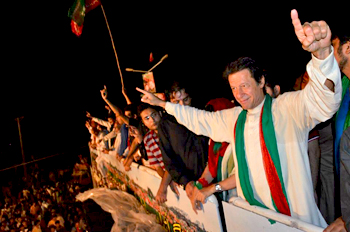
Khan, Qadri march to Parliament inside Islamabad's 'Red Zone'

August 20, 2014

Khan Red ZoneIslamabad, Aug 20: Pakistan opposition leader Imran Khan and cleric Tahirul Qadri tonight marched with thousands of their supporters towards the Parliament, entering the heavily fortified 'Red Zone', the capital's diplomatic and political enclave, even as minor clashes took place between anti-government protesters and security personnel.

"Promise me, if something were to happen to me, you will take revenge from Nawaz Sharif," Khan said while addressing his supporters before starting his march towards the Red Zone that houses important government buildings including the Parliament House, Prime Minister House, President House, the Supreme Court besides embassies of various countries.

Unfazed by army deployment, the Pakistan Tehreek-i-Insaf chief and Qadri marched towards the Parliament demanding Prime Minister Nawaz Sharif's resignation, putting the PML-N-led government on the backfoot.

Khan said that he has given Prime Minister Sharif till tomorrow evening to resign."If Nawaz Sharif does not resign then we will enter into the PM House," said the PTI chief.

Police baton-charged Qadri's Pakistan Awami Tehreek (PAT) protesters as they neared the Parliament.

Anti-government protesters entered the Red Zone, even as clashes took place between them and the police. After the initial minor skirmishes, police slowly retreated as part of policy to avoid violence.

The protesters had reached the Constitution Avenue as the government decided to withdraw security forces.

"PM just told me he has ordered the police not to use any kind of force against the protesters as women & children are in the front rows," Sharif's daughter Maryam Nawaz Sharif tweeted.

Inter-Services Public Relations spokesperson Asim Bajwa tweeted: "Bldgs in red Zone r symbol of State & being protected by Army, therefore sanctity of these national symbols must be respected."

"Situation requires patience, wisdom & sagacity from all stakeholders to resolve prevailing impasse through meaningful dialogue in larger national and public interest," he said.

Pakistan Army has also taken charge of the Interior Ministry's control room, Dawn News reported.

The protesters of Khan and Qadri started separately but later were moving towards the Parliament together. Thousands of anti-government protesters planned to stage a sit-in in an open ground in front of the building.

Information minister Pervaiz Rashid told Geo TV that the marchers have violated written commitment that they will not enter the Red Zone.

"They have women and children with them. So the government has decided to show maximum restraint. They want dead bodies but we will not give them the opportunity despite provocations," he said.

Comments

Add new comment

  • Coastaldigest.com reserves the right to delete or block any comments.
  • Coastaldigset.com is not responsible for its readers’ comments.
  • Comments that are abusive, incendiary or irrelevant are strictly prohibited.
  • Please use a genuine email ID and provide your name to avoid reject.
Agencies
June 7,2020

Boston, Jun 7: Dozens of scientists doing research funded by Mark Zuckerberg say Facebook should not be letting President Donald Trump use of the social media platform to spread both misinformation and incendiary statements.

The researchers, including 60 professors at leading US research institutions, wrote a letter to the Facebook CEO on Saturday asking that he consider stricter policies on misinformation and incendiary language that harms people," especially during the current turmoil over racial injustice.

The letter calls the spread of deliberate misinformation and divisive language the researchers' goal of using technology to prevent and eradicate disease, improving childhood education and reform the criminal justice system.

The researchers' mission "is antithetical to some of the stances that Facebook has been taking, so we're encouraging them to be more on the side of truth and on the right side of history as we've said in the letter, said Debora Marks of Harvard Medical School, one of three professors who organized the letter.

The other organisers are Martin Kampmann of the University of California-San Francisco and Jason Shepherd of the University of Utah.

All have grants from a Chan Zuckerberg Initiative program working to prevent, cure and treat neurodegenerative disorders including Alzheimer's and Parkinson's disease. The initiative is run by Zuckerberg and his wife, Priscilla Chan.

They said the letter had more than 160 signatories. Shepherd said about 10% are employees of Chan Zuckerberg foundations.

The letter objects specifically to Zuckerberg's decision not to at least flag as a violation of Facebook's community standards Trump's post that stated when the looting starts, the shooting starts after unrest in Minneapolis over the videotaped killing of George Floyd, a black man, by a white police officer.

The letter's authors called the post a clear statement of inciting violence.

Twitter had both flagged and demoted a Trump tweet using the same language.

The Associated Press emailed the Chan Zuckerberg Initiative press office for comment. It did not immediately respond.

Some Facebook employees have publicly objected to Zuckerberg's refusal to take down or label misleading or incendiary posts by Trump or other politicians. But Zuckerberg who controls a majority of voting shares in the company has so far refused.

On Friday, Zuckerberg said in a post that he would review potential options for handling violating or partially-violating content aside from the binary leave-it-up or take-it-down decisions I know many of you think we should have labeled the President's posts in some way last week, he wrote.

"Our current policy is that if content is actually inciting violence, then the right mitigation is to take that content down not let people continue seeing it behind a flag. There is no exception to this policy for politicians or newsworthiness.

Comments

Add new comment

  • Coastaldigest.com reserves the right to delete or block any comments.
  • Coastaldigset.com is not responsible for its readers’ comments.
  • Comments that are abusive, incendiary or irrelevant are strictly prohibited.
  • Please use a genuine email ID and provide your name to avoid reject.
News Network
April 2,2020

United Nations, Apr 2: The global economy could shrink by up to one per cent in 2020 due to the coronavirus pandemic, a reversal from the previous forecast of 2.5 per cent growth, the UN has said, warning that it may contract even further if restrictions on the economic activities are extended without adequate fiscal responses.

The analysis by the UN Department of Economic and Social Affairs (DESA) said the COVID-19 pandemic is disrupting global supply chains and international trade. With nearly 100 countries closing national borders during the past month, the movement of people and tourism flows have come to a screeching halt.

"Millions of workers in these countries are facing the bleak prospect of losing their jobs. Governments are considering and rolling out large stimulus packages to avert a sharp downturn of their economies which could potentially plunge the global economy into a deep recession. In the worst-case scenario, the world economy could contract by 0.9 per cent in 2020," the DESA said, adding that the world economy had contracted by 1.7 per cent during the global financial crisis in 2009.

It added that the contraction could be even higher if governments fail to provide income support and help boost consumer spending.

The analysis noted that before the outbreak of the COVID-19, world output was expected to expand at a modest pace of 2.5 per cent in 2020, as reported in the World Economic Situation and Prospects 2020.

Taking into account rapidly changing economic conditions, the UN DESA's World Economic Forecasting Model has estimated best and worst-case scenarios for global growth in 2020.

In the best-case scenario with moderate declines in private consumption, investment and exports and offsetting increases in government spending in the G-7 countries and China global growth would fall to 1.2 per cent in 2020.

"In the worst-case scenario, the global output would contract by 0.9 per cent instead of growing by 2.5 per cent in 2020," it said, adding that the scenario is based on demand-side shocks of different magnitudes to China, Japan, South Korea, the US and the EU, as well as an oil price decline of 50 per cent against our baseline of USD 61 per barrel.

The severity of the economic impact will largely depend on two factors - the duration of restrictions on the movement of people and economic activities in major economies; and the actual size and efficacy of fiscal responses to the crisis.

A well-designed fiscal stimulus package, prioritising health spending to contain the spread of the virus and providing income support to households most affected by the pandemic would help to minimise the likelihood of a deep economic recession, it said.

According to the forecast, lockdowns in Europe and North America are hitting the service sector hard, particularly industries that involve physical interactions such as retail trade, leisure and hospitality, recreation and transportation services. Collectively, such industries account for more than a quarter of all jobs in these economies.

The DESA said as businesses lose revenue, unemployment is likely to increase sharply, transforming a supply-side shock to a wider demand-side shock for the economy.

Against this backdrop, the UN-DESA is joining a chorus of voices across the UN system calling for well-designed fiscal stimulus packages which prioritize health spending and support households most affected by the pandemic.

Urgent and bold policy measures are needed, not only to contain the pandemic and save lives, but also to protect the most vulnerable in our societies from economic ruin and to sustain economic growth and financial stability, Under-Secretary-General for Economic and Social Affairs Liu Zhenmin said.

The analysis also warns that the adverse effects of prolonged economic restrictions in developed economies will soon spill over to developing countries via trade and investment channels.

A sharp decline in consumer spending in the European Union and the United States will reduce imports of consumer goods from developing countries.

Developing countries, particularly those dependent on tourism and commodity exports, face heightened economic risks. Global manufacturing production could contract significantly, and the plummeting number of travellers is likely to hurt the tourism sector in small island developing States, which employs millions of low-skilled workers, it said.

Meanwhile, the decline in commodity-related revenues and a reversal of capital flows are increasing the likelihood of debt distress for many nations. Governments may be forced to curtail public expenditure at a time when they need to ramp up spending to contain the pandemic and support consumption and investment.

UN Chief Economist and Assistant Secretary-General for Economic Development Elliot Harris said the collective goal must be a resilient recovery which puts the planet back on a sustainable track. We must not lose sight how it is affecting the most vulnerable population and what that means for sustainable development, he said.

The alarms raised by UN-DESA echo another report, released on March 31, in which UN experts issued a broad appeal for a large-scale, coordinated, comprehensive multilateral response amounting to at least 10 per cent of global gross domestic product (GDP).

According to estimates by the Johns Hopkins University, confirmed coronavirus cases across the world now stand at over 932,600 and over 42,000 deaths.


Comments

Add new comment

  • Coastaldigest.com reserves the right to delete or block any comments.
  • Coastaldigset.com is not responsible for its readers’ comments.
  • Comments that are abusive, incendiary or irrelevant are strictly prohibited.
  • Please use a genuine email ID and provide your name to avoid reject.
Agencies
January 11,2020

New York, Jan 11: The United Nations Security Council (UNSC) on Friday renewed a six-year-long cross-border humanitarian aid deliveries mechanism into Syria.

According to Sputnik, the Security Council voted in favour of a resolution on Friday that allows cross border deliveries to be conducted via Turkey, preserving two checkpoints and excluding the Al-Yarubiyah border crossing with Iraq and the Al-Ramtha crossing with Jordan, until July 10, 2020.

Russia proposed to amend the adopted resolution by replacing a part of the draft which stipulates that humanitarian assistance into Syria should be delivered based on the principles of humanity, neutrality, impartiality and independence by the phrase that such aid should be provided "in accordance with the guiding principles of humanitarian emergency assistance, as contained in UNGA resolution 46/182."

The agreement was reached after Belgium and Germany decided to amend the original version of their joint resolution, which proposed keeping three points for cross-border deliveries into the Arab republic.

In December last year, the United Nations had said that over 235,000 people fled the Idlib region in the last two weeks after Russia and Syria launched airstrikes in a bid to take over the last major opposition bastion.

Russia backed Syria government launched a fresh assault to capture the province.

Syrian Bashar al-Assad regime, backed by Iran, has reportedly promised to take back the rebel-controlled area and broke a ceasefire that was announced in August.

They have since December 19 seized dozens of towns and villages from armed fighters amid clashes that have killed hundreds on both sides.

Comments

Add new comment

  • Coastaldigest.com reserves the right to delete or block any comments.
  • Coastaldigset.com is not responsible for its readers’ comments.
  • Comments that are abusive, incendiary or irrelevant are strictly prohibited.
  • Please use a genuine email ID and provide your name to avoid reject.