


King to open 6 mega projects today

November 25, 2016

Dammam, Nov 25: Custodian of the Two Holy Mosques King Salman has paid tribute to the warm hospitality of people in the Eastern Province.
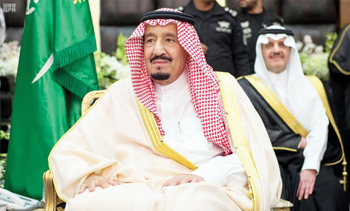
kingAddressing a reception held in his honor in Dammam on Thursday evening, King Salman said: “I deeply thank the people of this region, among (whom) I will always be pleased to find myself, for their unbound hospitality.”

He said the Kingdom’s Vision 2030 plan reflected the strength and the might of the Saudi economy. “(It is) a vision that will provide the Kingdom (with) wider and more comprehensive prospects,” he said, according to SPA.

“Our approach is steadfast and rock-solid; it is seeking a comprehensive, balanced and integrated development in various parts of the Kingdom,” the king added, promising to “make opportunities available to all and to realize legitimate aspirations, within the framework of the state’s rules and norms.”

King Salman is in Dammam to open six mega projects developed by the energy giant Saudi Aramco, which are expected to be launched on Friday.

At the reception, King Salman was accompanied by Madinah Gov. Prince Faisal bin Salman. The king was received by Crown Prince Mohammed bin Naif and Eastern Province Gov. Prince Saud bin Naif.

Prince Saud bin Naif welcomed the king, expressing pleasure at the royal visit.

“Words fail to express the sentiments harbored by the well-wishing citizenry of the region on this exceptional occasion of having the king among us,” the governor said, assuring the king that the entire nation will work hard to implement the Kingdom’s Vision 2030.

One of the projects to be launched on Friday is the King Abdulaziz Center for World Culture (iThra), which is a platform to encourage creativity, innovation and communication between different cultures, promote Saudi Arabia’s efforts in building a knowledge-based economy and deal with modern technologies of new generations.

The center seeks to enhance investment in members of the community to encourage learning and exploration, as well as find economic opportunities by developing a generation of thinkers, innovators and creators in the Kingdom. The center also seeks to provide unlimited economic opportunities as a result of such innovation and creation.

The king will also inaugurate the Khurais oil field, which is one of the last giant oil fields to be discovered in the world. The oil field has obtained a high global ranking in terms of size, and is located near the world’s largest oil field, Ghawar.

Among the other large projects to be launched and expanded is the project to increase crude oil production at the Manifa oil field, one of the largest crude oil production projects in the world.

King Salman will also inaugurate the Wasit gas plant project, north of Jubail Industrial City, which is set to help meet Saudi Arabia’s energy needs. The project comes as part of Vision 2030, which stipulates as part of its economic plan the importance of doubling gas production levels and establishing a natural network to expand distribution activities.

The king will also inaugurate the expansion project of the Shaybah crude oil field, which is one of the largest projects of its kind, in both the Middle East and wider world.

Comments

Add new comment

  • Coastaldigest.com reserves the right to delete or block any comments.
  • Coastaldigset.com is not responsible for its readers’ comments.
  • Comments that are abusive, incendiary or irrelevant are strictly prohibited.
  • Please use a genuine email ID and provide your name to avoid reject.
News Network
July 1,2020

Riyadh, Jul 1: Saudis braced Wednesday for a tripling in value added tax, another unpopular austerity measure after the twin shocks of coronavirus and an oil price slump triggered the kingdom's worst economic decline in decades.

Retailers in the country reported a sharp uptick in sales this week of everything from gold and electronics to cars and building materials, as shoppers sought to stock up before VAT is raised to 15 percent.

The hike could stir public resentment as it weighs on household incomes, pushing up inflation and depressing consumer spending as the kingdom emerges from a three-month coronavirus lockdown.

"Cuts, cuts, cuts everywhere," a Saudi teacher in Riyadh told AFP, bemoaning vanishing subsidies as salaries remain stagnant.

"Air conditioner, television, electronic items," he said, rattling off a list of items he bought last week ahead of the VAT hike.

"I can't afford these things from Wednesday."

With its vast oil wealth funding the Arab world's biggest economy, the kingdom had for decades been able to fund massive spending with no taxes at all.

It only introduced VAT in 2018, as part of a push to reduce its dependence on crude revenues.

Then, seeking to shore up state finances battered by sliding oil prices and the coronavirus crisis, it announced in May that it would triple VAT and halt a cost-of-living monthly allowance to citizens.

The austerity push underscores how Saudi Arabia's once-lavish spending is becoming a thing of the past, with the erosion of the welfare system leaving a mostly young population to cope with reduced incomes and a lifestyle downgrade.

That could pile strain on a decades-old social contract whereby citizens were given generous subsidies and handouts in exchange for loyalty to the absolute monarchy.

The rising cost of living may prompt many to ask why state funds are being lavished on multi-billion-dollar projects and overseas assets, including the proposed purchase of English football club Newcastle United.

Shopping malls in the kingdom have drawn large crowds in recent days as retailers offered "pre-VAT sales" and discounts before the hike kicks in.

A gold shop in Riyadh told AFP it saw a 70 percent jump in sales in recent weeks, while a car dealership saw them tick up by 15 percent.

Once the new rate is in place, businesses are predicting depressed sales of everything from cars to cosmetics and home appliances.

Capital Economics forecast inflation will jump up to six percent year-on-year in July, from 1.1 percent in May, as a result.

"The government ended the country's lockdown (in June) and there are signs that economic activity has started to recover," Capital Economics said in a report.

"Nonetheless, we expect the recovery to be slow-going as fiscal austerity measures bite."

The kingdom also risks losing its edge against other Gulf states, including its principal ally the United Arab Emirates, which introduced VAT at the same time but has so far refrained from raising it beyond five percent.

"Saudi Arabia is taking massive risks with contractionary fiscal policies," said Tarek Fadlallah, chief executive officer of the Middle East unit of Nomura Asset Management.

But the kingdom has few choices as oil revenue declines.

Its finances have taken another blow as authorities massively scaled back this year's hajj pilgrimage, from 2.5 million pilgrims last year to around a thousand already inside the country, and suspended the lesser umrah because of coronavirus.

Together the rites rake in some $12 billion annually.

The International Monetary Fund warned the kingdom's GDP will shrink by 6.8 percent this year -- its worst performance since the 1980s oil glut.

The austerity drive would boost state coffers by 100 billion riyals ($26.6 billion), according to state media.

But the measures are unlikely to plug the kingdom's huge budget deficit.

The Saudi Jadwa Investment group forecasts the shortfall will rise to a record $112 billion this year.

Comments

Add new comment

  • Coastaldigest.com reserves the right to delete or block any comments.
  • Coastaldigset.com is not responsible for its readers’ comments.
  • Comments that are abusive, incendiary or irrelevant are strictly prohibited.
  • Please use a genuine email ID and provide your name to avoid reject.
News Network
March 21,2020

Mar 21: Qatari authorities arrested 10 nationals for breaking home quarantine rules as Doha tightens regulations amid the coronavirus outbreak, local daily The Peninsula Qatar reported on Saturday.

The Ministry of Public Health released a statement naming the detainees and said that the violators were currently being referred to prosecution.

The tiny country, where expatriates comprise the majority of the population, on Thursday reported eight more infections to take its tally to 470, the highest number among the six Gulf Arab states that have reported a total of more than 1,300 coronavirus cases.

Government spokeswoman Lulwa Rashed Al-Khater told a news conference the new cases included two Qataris who had been in Europe, with the rest migrant workers.

Qatari authorities on Tuesday announced the closure of several square kilometers of the industrial area in Doha, the capital, which also contains labor camps and other housing units.

Comments

Add new comment

  • Coastaldigest.com reserves the right to delete or block any comments.
  • Coastaldigset.com is not responsible for its readers’ comments.
  • Comments that are abusive, incendiary or irrelevant are strictly prohibited.
  • Please use a genuine email ID and provide your name to avoid reject.
News Network
July 6,2020

Dubai, July 6: Even as the world’s one of the most sought after tourist destinations is gearing up to welcome foreign tourists from July 7, the authorities have taken necessary measures to prevent the spread of covid-19.

If the foreign tourists want to avoid self-isolation after landing in Dubai International Airport, they have to fetch covid-negative certificates from their home country. The certificate ought to have been issued up to 96 hours prior to the travel.

Those without a cvid-negative certificate, however, will need to undergo a PCR test on arrival at the Dubai airports and self-isolate until they receive their negative results.

"If passengers opt to take the PCR test on arrival in Dubai, they must self-isolate until test results are received. If the test result is negative, passengers can leave the hotel and enjoy the trip as normal. However, if the test result is positive, passengers are asked to follow the advice of the Dubai Health Authority and self-isolate," Emirates said in a statement.

Budget carrier flydubai said if a passenger tests positive for Covid-19, he/she would need to observe a 14-day quarantine. The airline also advised passengers to comply with all the precautionary Covid-19 measures in place in Dubai "including wearing a mask, observing social distancing and washing your hands regularly".

Tourists with Covid-19 symptoms

* If a traveller is suspected to have Covid-19 symptoms, Dubai Airports has the right to re-test to ensure the tourist is free of the virus

*It is mandatory for Covid-positive tourists to isolate themselves at an institutional facility provided by the government for 14 days at their own expense.

Other requirements

*Travel insurance: Tourists must have a travel insurance with Covid-19 cover or declare that they would bear the costs for treatment and isolation if required. "Bring an insurance certificate stating Covid-19 coverage to present at check-in," Emirates said.

*Visa: Referring to visa requirements, Emirates said: "Depending on your nationality you can get a visa on arrival, or you can apply for your visit visa from Dubai Immigration before you travel."

*Health Declaration Form: Tourists need to complete the form that states they are free from Covid-19 symptoms. This must be done before embarking.

*Tracing app: Tourists must download the Covid-19 DXB app and register details. "This is critically important since it facilitates easy coordination and communication with the health authorities if tourists experience Covid-19 symptoms," Dubai authorities had said earlier.

Comments

Add new comment

  • Coastaldigest.com reserves the right to delete or block any comments.
  • Coastaldigset.com is not responsible for its readers’ comments.
  • Comments that are abusive, incendiary or irrelevant are strictly prohibited.
  • Please use a genuine email ID and provide your name to avoid reject.