


King to open 6 mega projects today

November 25, 2016

Dammam, Nov 25: Custodian of the Two Holy Mosques King Salman has paid tribute to the warm hospitality of people in the Eastern Province.
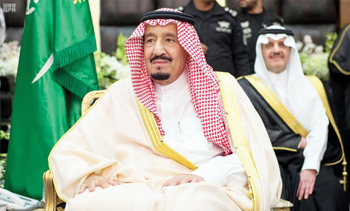
kingAddressing a reception held in his honor in Dammam on Thursday evening, King Salman said: “I deeply thank the people of this region, among (whom) I will always be pleased to find myself, for their unbound hospitality.”

He said the Kingdom’s Vision 2030 plan reflected the strength and the might of the Saudi economy. “(It is) a vision that will provide the Kingdom (with) wider and more comprehensive prospects,” he said, according to SPA.

“Our approach is steadfast and rock-solid; it is seeking a comprehensive, balanced and integrated development in various parts of the Kingdom,” the king added, promising to “make opportunities available to all and to realize legitimate aspirations, within the framework of the state’s rules and norms.”

King Salman is in Dammam to open six mega projects developed by the energy giant Saudi Aramco, which are expected to be launched on Friday.

At the reception, King Salman was accompanied by Madinah Gov. Prince Faisal bin Salman. The king was received by Crown Prince Mohammed bin Naif and Eastern Province Gov. Prince Saud bin Naif.

Prince Saud bin Naif welcomed the king, expressing pleasure at the royal visit.

“Words fail to express the sentiments harbored by the well-wishing citizenry of the region on this exceptional occasion of having the king among us,” the governor said, assuring the king that the entire nation will work hard to implement the Kingdom’s Vision 2030.

One of the projects to be launched on Friday is the King Abdulaziz Center for World Culture (iThra), which is a platform to encourage creativity, innovation and communication between different cultures, promote Saudi Arabia’s efforts in building a knowledge-based economy and deal with modern technologies of new generations.

The center seeks to enhance investment in members of the community to encourage learning and exploration, as well as find economic opportunities by developing a generation of thinkers, innovators and creators in the Kingdom. The center also seeks to provide unlimited economic opportunities as a result of such innovation and creation.

The king will also inaugurate the Khurais oil field, which is one of the last giant oil fields to be discovered in the world. The oil field has obtained a high global ranking in terms of size, and is located near the world’s largest oil field, Ghawar.

Among the other large projects to be launched and expanded is the project to increase crude oil production at the Manifa oil field, one of the largest crude oil production projects in the world.

King Salman will also inaugurate the Wasit gas plant project, north of Jubail Industrial City, which is set to help meet Saudi Arabia’s energy needs. The project comes as part of Vision 2030, which stipulates as part of its economic plan the importance of doubling gas production levels and establishing a natural network to expand distribution activities.

The king will also inaugurate the expansion project of the Shaybah crude oil field, which is one of the largest projects of its kind, in both the Middle East and wider world.

Comments

Add new comment

  • Coastaldigest.com reserves the right to delete or block any comments.
  • Coastaldigset.com is not responsible for its readers’ comments.
  • Comments that are abusive, incendiary or irrelevant are strictly prohibited.
  • Please use a genuine email ID and provide your name to avoid reject.
News Network
May 7,2020

Dubai, May 7: The holy month of Ramadan is expected to be a 30-day month this year, said Ibrahim Al Jarwan, member of the Arab Union for Astronomy and Space Sciences.

According to Arabic daily Emarat Al Youm, he said that Sunday, May 24, will mark the end of the holy month of Ramadan and the beginning of Shawwal.

Additionally, he said that the crescent of Shawwal will occur on Friday, May 22, at 9.39pm, after sunset, and will be visible on Sunday, May 24, the beginning of Shawal, which makes Ramadan a 30-day month this year.

He added that the next Ramadan is expected to start on April 13, 2021, and the one after that on April 2, 2022.

Comments

Add new comment

  • Coastaldigest.com reserves the right to delete or block any comments.
  • Coastaldigset.com is not responsible for its readers’ comments.
  • Comments that are abusive, incendiary or irrelevant are strictly prohibited.
  • Please use a genuine email ID and provide your name to avoid reject.
News Network
May 11,2020

May 11: Saudi Arabia will triple its value-added tax rate and suspend a cost of living allowance for state workers, it said on Monday, seeking to shield finances hit by low oil prices and a slump in demand for its lifeline export worsened by the new coronavirus.

Historic oil output cuts agreed by Riyadh and other major producers have given only limited support to prices after they sank on oversupply caused by a war for petroleum market share between the kingdom and its fellow oil titan Russia.

Saudi Arabia, the world's largest oil exporter, is also being hit hard by measures to fight the new coronavirus, which are likely to curb the pace and scale of economic reforms launched by Crown Prince Mohammed bin Salman.

"The cost of living allowance will be suspended as of June 1, and the value added tax will be increased to 15% from 5% as of July 1," Finance Minister Mohammed al-Jadaan said in a statement reported by the state news agency. "These measures are painful but necessary to maintain financial and economic stability over the medium to long term...and to overcome the unprecedented coronavirus crisis with the least damage possible."

The austerity measures come after the kingdom posted a $9 billion budget deficit in the first quarter.

The minister said non-oil revenues were affected by the suspension and decline in economic activity, while spending had risen due to unplanned strains on the healthcare sector and the initiatives taken to support the economy.

"All these challenges have cut state revenues, pressured public finances to a level that is hard to deal with going forward without affecting the overall economy in the medium to long term, which requires more spending cuts and measures to support non-oil revenues stability," he added.

The government has cancelled and put on hold some operating and capital expenditures for some government agencies, and cut allocations for some reform initiatives and projects worth a total 100 billion riyals ($26.6 billion), the statement said.

Central bank foreign reserves fell in March at their fastest rate in at least 20 years and to their lowest since 2011, while oil revenues in the first three months of the year fell 24% from a year earlier to $34 billion, pulling total revenues down 22%.

"The reforms are positive from a fiscal side as greater adjustment is essential. However, the tripling of VAT is unlikely to help that much in 2020 revenue wise with the expected fall in consumption," said Monica Malik, chief economist at Abu Dhabi Commercial Bank.

She said she kept unchanged her deficit forecast of 16.3% of GDP for this year, which already factors in a greater than previously announced spending cut.

About 1.5 million Saudis are employed in the government sector, according to official figures released in December.

In 2018, Saudi Arabia's King Salman ordered a monthly payment of 1,000 riyals ($267) to every state employee to compensate them for the rising living costs after the government hiked domestic gas prices and introduced value-added tax.

DIFFICULT TIMES

A committee has been formed to study all financial benefits paid to public sector employees and contractors, and will submit recommendations within 30 days, the statement said.

In late 2015, when oil prices fell from record highs, the kingdom slashed lavish bonuses, overtime payments and other benefits once considered routine perks in the public sector.

In a country without elections and with political legitimacy resting partly on distribution of oil revenue, the ability of citizens to adapt to such reforms is crucial for stability.

"Tripling the VAT will test the limits of the balance between revenues and consumption as the economy dives into a deep recession. The move will impact consumption and could also lower the expected revenues," said John Sfakianakis, a Gulf expert at the University of Cambridge.

"These are pro-austerity and pro-revenue moves rather than pro-growth ones," he said.

Hasnain Malik, head of equity strategy at Tellimer, said the VAT rise could bring about $24-$26.5 billion in additional non-oil fiscal revenue. The rise would hit consumer spending further but was a needed step towards fiscal sustainability, he said.

Comments

Add new comment

  • Coastaldigest.com reserves the right to delete or block any comments.
  • Coastaldigset.com is not responsible for its readers’ comments.
  • Comments that are abusive, incendiary or irrelevant are strictly prohibited.
  • Please use a genuine email ID and provide your name to avoid reject.
Saudi Gazette
June 2,2020

Abu Dhabi, Jun 2: The United Arab Emirates on Monday recorded 635 new coronavirus cases, taking the total number of infections in the country to 35,192, the UAE’s Ministry of Health and Prevention said in a statement carried by state news agency WAM.

The new cases were detected after the health authorities conducted 30,147 additional COVID-19 tests citizens and residents.

The ministry also announced that 406 more patients have fully recovered after receiving the necessary medical care, raising the total number of recoveries in the country to 18,338.

The announcement was made during the regular media briefing held in Abu Dhabi, wherein Dr. Amna Al Dahak Al Shamsi, official spokesperson for the UAE government, provided an update on coronavirus-related developments and measures taken to mitigate its impact.

During the briefing, Dr. Al Shamsi also announced the death of two patients from COVID-19, taking the total number of deaths in the country to 266.

"The number of COVID-19 cases still receiving treatment now stands at 16,588 from different nationalities," she added, noting that more than 650,000 COVID-19 tests have been conducted over the past two weeks.

"Since the onset of the crisis, the UAE has focused on select segments of society, primarily the elderly and patients with chronic diseases, in order to ensure they survive the crisis," she added.

"We believe it is particularly morally important to support and stand by them, provide them with their daily needs, and keep them from harm’s way," she added.

Dr. Al Shamsi asserted that all precautionary measures announced, including the updated fines and penalties, will be enforced against violators, including citizens and residents.

"The law does not differentiate between citizens and residents. We are living in one homeland, which is for all of us," she continued.

"Your safety and health are a priority. We must comply with all precautionary measures. Though restrictions have been relaxed, caution must continue to be exercised."

Dr. Al Shamsi also warned, "Recklessness may undermine the efforts made by our frontline defenders. It is the responsibility of every individual to support protective efforts to ensure the safety of all."

Comments

Add new comment

  • Coastaldigest.com reserves the right to delete or block any comments.
  • Coastaldigset.com is not responsible for its readers’ comments.
  • Comments that are abusive, incendiary or irrelevant are strictly prohibited.
  • Please use a genuine email ID and provide your name to avoid reject.