


King Salman inaugurates mega projects in Ras Al-Khair, Jubail

November 30, 2016

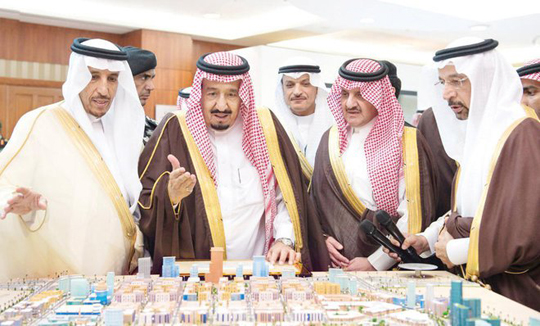
Ras Al-Khair/Jubail, Nov 30: Custodian of the Two Holy Mosques King Salman inaugurated Tuesday a group of basic infrastructure and development projects in Jubail and Ras Al-Khair industrial cities on the Gulf coast.
arab

The inauguration ceremonies were attended by Eastern Province Gov. Prince Saud bin Naif and a number of princes, ministers, government officials, private sector officials, and other dignitaries.

The king inaugurated the Sadara Chemical Company (Sadara) and the Saudi Aramco Total Refining and Petrochemical Co. (SATORP) in Jubail. The two projects are among the largest facilities in the refining and petrochemicals industries that support the objectives of Saudi Vision 2030.

The Vision aims to create new industries that will help provide new job opportunities for Saudis, as well as attract foreign investment to the Kingdom. Sadara and SATORP are aligned with these objectives and are the result of successful partnerships between Saudi Aramco and two global companies — the Dow Chemical Company and Total — which are leaders in their respective areas of business.

Minister of Energy, Industry and Mineral Resources Khalid Al-Falih, who is also chairman of Saudi Aramco, said: “Sadara and SATORP represent a bold undertaking for Saudi Aramco and its respective partners, Dow Chemical and Total. It is a major driver in achieving our goals of greater integration and value addition. They represent the concrete realization of our distinct yet complementary corporate visions — it is one way in which Saudi Aramco is helping to deliver on its abiding commitment to the Kingdom.”

The Sadara project is the largest integrated chemicals complex in the world to be built in one phase. It is a joint venture between Saudi Aramco and The Dow Chemical Company in Jubail Industrial City. The first phase commenced operations in 2015, and the remaining operating units are scheduled for completion by the end of 2016. The production capacity is more than 3 million tons of various plastics and chemical products annually.

The king also laid the cornerstone of the King Salman International Complex for Maritime Industries & Services, near Jubail, which was named in his honor during the groundbreaking ceremony. The complex is a commercial maritime project that complements the growth of the Saudi energy industry and helps to meet the development, localization and diversification objectives outlined by Saudi Vision 2030.

The development of the complex will start with a maritime yard as an anchor project to be completed in 2021. It will be managed and maintained by Saudi Aramco’s proposed joint venture with The National Shipping Company of Saudi Arabia (Bahri), Hyundai Heavy Industries Co, and Lamprell PLC. The facility will offer quality, efficiency and economies of scale, and when completed it will offer vessel and rig build, maintenance, repair and overhaul services. The project will comply with all of the Saudi government’s environmental and sustainability requirements.

At Ras Al-Khair, Al-Falih gave a speech in which he expressed his pleasure at the king's presence on the occasion of the inauguration of the development projects. The projects, he said, would put Ras Al-Khair on the map as a key contributor to an integrated and productive economy as one of the Kingdom's developmental successes and a source of pride.

“Like your father, King Abdulaziz (may he rest in peace), who was the Kingdom’s founder, and who had the vision and insight to launch the Saudi oil industry immediately after the country's unification, you today are inaugurating a comprehensive group of projects for the mineral resources sector in Ras Al-Khair Industrial City, and in turn making it a launch pad to move toward broader development, growth and prosperity for the Kingdom and its people,” said the minister.

“What we celebrate today is a true embodiment of the keenness to diversify sources of income in the national economy and open the doors for strategic industries to operate and flourish,” he added.

“For this, we are committed, under your guidance, to ensure these projects are founded on the same solid foundations that have contributed to the success of previous strategic initiatives, namely: Conscious investment and diligent planning for the country’s resources and wealth; commitment to the highest levels and international standards of planning and implementation; keenness to establish strategic partnerships with relevant international institutions; cautious increase of local content in these projects; serious and consistent investment in national human resources through training, rehabilitation and employment generation.”

“The government has sought to support the development of the mineral resources sector as per new and exceptional competitive outputs, and with large investments exceeding SR130 billion allocated to developing the establishment of basic infrastructure, including trains, water and power plants, ports, networks of gas and sulfur, phosphate and aluminum factories linked to mines founded by Maaden, the Saudi Arabian Mining Company. Maaden today is classified among the 10 largest mining companies in the world, only 9 years after it was founded,” he said.

The minister also thanked all involved parties for the notable success, saying, “I take this opportunity to extend my thanks to all our partners, particularly the Saudi Railway company for its outstanding efforts regarding the North South Railway Line Project, which has a length of 3,000 km. It can help Maaden Phosphate and Maaden Aluminum deliver phosphate and bauxite ore from mines in the north and center of the Kingdom to manufacturing areas in the cities of Ras Al-Khair.”

The development and mining infrastructure projects in Ras Al-Khair include the railway project, the mining train, the Ras Al-Khair water desalination and power plant, Ras Al-Khair port, Maaden phosphate mine in Jalamid in the Northern Border Region, Al-Ba’itha bauxite mine in Qassim, Maaden phosphate complex in Ras Al-Khair, and Maaden Aluminum complex also at Ras Al-Khair.

They also include basic infrastructure projects carried out by the Royal Commission for Jubail and Yanbu, which is the management and operation body in Ras Al-Khair.

Comments

Add new comment

  • Coastaldigest.com reserves the right to delete or block any comments.
  • Coastaldigset.com is not responsible for its readers’ comments.
  • Comments that are abusive, incendiary or irrelevant are strictly prohibited.
  • Please use a genuine email ID and provide your name to avoid reject.
News Network
May 4,2020

Dubai, May 4: An Indian salesman in the UAE has won a whopping 10 million dirhams at an Abu Dhabi draw, a media report said.

Dileep Kumar Ellikkottil Parameswaran, from Kerala’s Thrissur, works with an auto spare parts company in Ajman and earns 5,000 dirhams (USD 1,361) a month, Gulf News reported on Sunday.

Parameswaran, who won the 10 million dirhams (USD 2.7 million) prize at the Big Ticket draw in Abu Dhabi, will spend a big part of the money to repay a loan of 700,000 dirhams (USD 190,574 ), according to the report.

He said that a good part of the prize money will be spent on the education of his two children.

Parameswaran, who has been a resident of the UAE for 17 years, lives in Ajman along with his family.

Big Ticket is the largest and longest-running monthly raffle draw for cash prizes and dream luxury cars in Abu Dhabi.

A live monthly draw is organized at the Abu Dhabi International Airport on 3rd of each month.

Tickets are sold for 500 dirhams (USD 136).

Comments

Add new comment

  • Coastaldigest.com reserves the right to delete or block any comments.
  • Coastaldigset.com is not responsible for its readers’ comments.
  • Comments that are abusive, incendiary or irrelevant are strictly prohibited.
  • Please use a genuine email ID and provide your name to avoid reject.
News Network
May 11,2020

May 11: Saudi Arabia will triple its value-added tax rate and suspend a cost of living allowance for state workers, it said on Monday, seeking to shield finances hit by low oil prices and a slump in demand for its lifeline export worsened by the new coronavirus.

Historic oil output cuts agreed by Riyadh and other major producers have given only limited support to prices after they sank on oversupply caused by a war for petroleum market share between the kingdom and its fellow oil titan Russia.

Saudi Arabia, the world's largest oil exporter, is also being hit hard by measures to fight the new coronavirus, which are likely to curb the pace and scale of economic reforms launched by Crown Prince Mohammed bin Salman.

"The cost of living allowance will be suspended as of June 1, and the value added tax will be increased to 15% from 5% as of July 1," Finance Minister Mohammed al-Jadaan said in a statement reported by the state news agency. "These measures are painful but necessary to maintain financial and economic stability over the medium to long term...and to overcome the unprecedented coronavirus crisis with the least damage possible."

The austerity measures come after the kingdom posted a $9 billion budget deficit in the first quarter.

The minister said non-oil revenues were affected by the suspension and decline in economic activity, while spending had risen due to unplanned strains on the healthcare sector and the initiatives taken to support the economy.

"All these challenges have cut state revenues, pressured public finances to a level that is hard to deal with going forward without affecting the overall economy in the medium to long term, which requires more spending cuts and measures to support non-oil revenues stability," he added.

The government has cancelled and put on hold some operating and capital expenditures for some government agencies, and cut allocations for some reform initiatives and projects worth a total 100 billion riyals ($26.6 billion), the statement said.

Central bank foreign reserves fell in March at their fastest rate in at least 20 years and to their lowest since 2011, while oil revenues in the first three months of the year fell 24% from a year earlier to $34 billion, pulling total revenues down 22%.

"The reforms are positive from a fiscal side as greater adjustment is essential. However, the tripling of VAT is unlikely to help that much in 2020 revenue wise with the expected fall in consumption," said Monica Malik, chief economist at Abu Dhabi Commercial Bank.

She said she kept unchanged her deficit forecast of 16.3% of GDP for this year, which already factors in a greater than previously announced spending cut.

About 1.5 million Saudis are employed in the government sector, according to official figures released in December.

In 2018, Saudi Arabia's King Salman ordered a monthly payment of 1,000 riyals ($267) to every state employee to compensate them for the rising living costs after the government hiked domestic gas prices and introduced value-added tax.

DIFFICULT TIMES

A committee has been formed to study all financial benefits paid to public sector employees and contractors, and will submit recommendations within 30 days, the statement said.

In late 2015, when oil prices fell from record highs, the kingdom slashed lavish bonuses, overtime payments and other benefits once considered routine perks in the public sector.

In a country without elections and with political legitimacy resting partly on distribution of oil revenue, the ability of citizens to adapt to such reforms is crucial for stability.

"Tripling the VAT will test the limits of the balance between revenues and consumption as the economy dives into a deep recession. The move will impact consumption and could also lower the expected revenues," said John Sfakianakis, a Gulf expert at the University of Cambridge.

"These are pro-austerity and pro-revenue moves rather than pro-growth ones," he said.

Hasnain Malik, head of equity strategy at Tellimer, said the VAT rise could bring about $24-$26.5 billion in additional non-oil fiscal revenue. The rise would hit consumer spending further but was a needed step towards fiscal sustainability, he said.

Comments

Add new comment

  • Coastaldigest.com reserves the right to delete or block any comments.
  • Coastaldigset.com is not responsible for its readers’ comments.
  • Comments that are abusive, incendiary or irrelevant are strictly prohibited.
  • Please use a genuine email ID and provide your name to avoid reject.
Agencies
July 5,2020

Iraq’s deputy parliament speaker Hassan Karim al-Kaabi on Saturday described the move as provocative and in violation of international law.

Kaabi also called on the Iraqi government to take swift measures to halt such actions.

The Embassy’s move to fire in a residential area in the heart of Baghdad is an unacceptable act and another challenge for the Arab country, adding to the mass of its provocations and illegal actions in Iraq, he noted.

According to Iraqi media, the US tested a patriot missile system inside Baghdad’s heavily fortified Green Zone.

Anti-US sentiments have been running high in Iraq since Washington assassinated top Iranian commander Qassem Soleimani and the second-in-command of the Iraqi popular mobilization units, Abu Mahdi al-Muhandis, in January.

Following the attack, Iraqi lawmakers unanimously approved a bill on January 5, demanding the withdrawal of all foreign troops.

Baghdad and Washington are currently in talks over the withdrawal of American troops. Iraqi resistance groups have vowed to take up arms against US forces if Washington fails to comply with the parliamentary order.

Comments

Add new comment

  • Coastaldigest.com reserves the right to delete or block any comments.
  • Coastaldigset.com is not responsible for its readers’ comments.
  • Comments that are abusive, incendiary or irrelevant are strictly prohibited.
  • Please use a genuine email ID and provide your name to avoid reject.