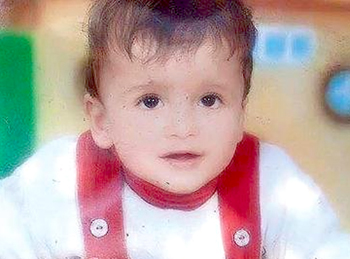
KSA raps barbaric killing of toddler

August 2, 2015

Riyadh, Aug 2: Saudi Arabia has denounced the horrendous terror attack by Israeli settlers in the West Bank village of Duma in Palestine that killed a toddler.

toddlerReports said that Israeli settlers threw a Molotov cocktail into a West Bank home, killing the 18-month-old boy Ali Saad Dawabsheh. His four-year-old brother and parents, who were wounded in the attack, were battling for lives in hospital.

Foreign Minister Adel Al-Jubeir described the assault as a “barbaric” and “brutal.”

He said: “The heinous crime has been committed without a shred of ethics, conscience or humanity.”

Al-Jubeir said that he held Israeli occupation authorities responsible and accountable for criminal acts against innocent civilians in Palestine.

He called upon the international community to fulfil its responsibilities for finding a two-state solution for the oppressed Palestinian.

Offering the sincere condolences on behalf of the Kingdom to the victim’s family, the government and the people of Palestine, the minister expressed wishes for a speedy recovery of the injured.

The child’s father, Saad, was being treated for third-degree burns at the Soroka hospital in southern Israel, where a spokeswoman described his condition as critical.

Mother Riham and brother Ahmed were being treated at Tel Hashomer hospital near Tel Aviv, where a spokeswoman described their condition as life-threatening.

Comments

Add new comment

  • Coastaldigest.com reserves the right to delete or block any comments.
  • Coastaldigset.com is not responsible for its readers’ comments.
  • Comments that are abusive, incendiary or irrelevant are strictly prohibited.
  • Please use a genuine email ID and provide your name to avoid reject.
coastaldigest.com news network
June 16,2020

Dubai, Jun 16: In a humanitarian gesture, a UAE-based Pakistani businessman has come forward to offer free interim accommodation options to covid lockdown hit expatriates. 

The men benefitted from Ali Rao's housing initiative include Indians, Pakistanis and Africans. 

Inspired by the ongoing efforts taken by the UAE leadership to take care of all UAE residents, Ali Rao, CEO of Rao Holdings LLC in Dubai is offering free shared accommodation to unemployed male bachelors and workers, especially expatriates who do not have a place to stay.

Ali Rao currently has a capacity of 100 accommodation options that he wishes to offer to those who cannot afford house rent. 

"We have already placed 25 such men in these housing options spread across Al Quoz, Jebel Ali and Muhaisnah areas of Dubai," Ali Rao told local media. He works in collaboration with major charities in Dubai, who refer the cases to Rao.

"One of our companies - the property management division - deals with industrial housing accommodation. We decided to put this space to good use when I came across media articles that highlighted the plight of these homeless men," he said. 

Rao has already sheltered 25 homeless workers in the Al Quoz area. "We have received applications for 35 more, however, many of these men are due to return to their home countries, so we are awaiting confirmation from the charities," he explained. He has provided them with free Wi-Fi, bedding, blankets, bedsheets, and pillows.

"In one unit, we provide them with food and the other unit, social workers and the associated charities deliver food," he added. The housing is exclusively for men and not for women and families. "Many are seeking jobs, so they needed Wi-Fi. I went to the camps today and set up a Wi-Fi connection. Someone wanted to eat eggs, so we got him some eggs and rice. These are simple things most of us take for granted, but to many people this is vital," he added.

Since most of the residents are looking to return to their home countries, Rao is also in the process of providing them with air tickets.

"If the need arises, we will add more units," he explained. Rao said, "The ongoing pandemic has hit everyone hard, especially those with no security to fall back on. The economic and income disparities have only increased in this time, with those dependent on daily wages being rendered homeless in massive numbers across the globe."

He added, "I felt heartbroken and if I would stand by and watch, I would feel very small as a human being, I won't be able to stand in front of the creator I thought to myself. These are some very difficult times for all of us."

A beneficiary of the programme said, "I am very happy with this initiative as living outside in the summer is very difficult. It's very hot. I want to thank God and this company for providing me with a roof over my head."

Comments

Add new comment

  • Coastaldigest.com reserves the right to delete or block any comments.
  • Coastaldigset.com is not responsible for its readers’ comments.
  • Comments that are abusive, incendiary or irrelevant are strictly prohibited.
  • Please use a genuine email ID and provide your name to avoid reject.
News Network
June 12,2020

Beirut, Jun 12: Angry Lebanese protesters blocked roads across the country with burning tyres, debris and their vehicles, incensed over the local currency's depreciation by more than 25 percent in just two days.

The demonstrations from northern Akkar and Tripoli to central Zouk, the eastern Bekaa Valley, Beirut and southern Tyre and Nabatieh on Thursday were some of the most widespread in months of upheaval over a calamitous economic and financial crisis.

Protesters set ablaze a branch of the Central Bank, vandalised several private banks and clashed with security forces in several areas. At least 41 people were injured in Tripoli alone, according to the Lebanese Red Cross.

"I'm really pissed off, that's all. If politicians think they can burn our hearts like this the fire is going to reach them too," unemployed computer engineer Ali Qassem, 26, told Al Jazeera after pouring fuel onto smouldering tyres on a main Beirut thoroughfare.

Tens of thousands of Lebanese have lost jobs in the past six months and hundreds of businesses have shuttered as a dollar shortage led the Lebanese pound to slide from 1,500 to $1 last summer - where it was pegged for 23 years - to roughly 4,000 for each US dollar last month.

But the slide turned into a freefall between Wednesday and Thursday when the pound plummeted to roughly 5,000 to $1 on black markets, which have become a main source of hard currency. There was widespread speculation the rate hit 6,000 or even 7,000 pounds to the dollar, though most markets stopped trading.

Protesters began amassing on streets across the country before sunset and increased into the thousands across the country as the night fell.

Prime Minister Hassan Diab cancelled all meetings scheduled for Friday to hold an emergency cabinet session at 9:30am and another at 3pm at the presidential palace to be headed by President Michel Aoun.

The pound's collapse is the perhaps the biggest challenge yet for Diab's young cabinet, which gained confidence in February after former prime minister Saad Hariri's government was toppled by an unprecedented October uprising that had the country's economic crisis at its core.

Economy Minister Raoul Nehme told Al Jazeera that there was "disinformation" being circulated about the exchange rate on social media and said he was investigating possible currency manipulation.

"I don't understand how the exchange rate increased by so much in two days," he said.

Many protesters have pitted blame on Central Bank governor Riad Salameh, nominally in charge of  keeping the currency stable. But they have also called on the government to resign.

"If people want reform between dawn and dusk, that's not going to work, and if someone thinks they can do a better job then please come forward," Nehme said.

"But what we can't have is a power vacuum - then the exchange rate won't be 5000, it'll be a catastrophe."

'Everyone paying the price'

When protesters set a large fire in Beirut's Riad al-Solh Square, which lies at the foot of a grand Ottoman-era building that serves as the seat of government, firefighters did not intervene to extinguish it.

It later became clear why: Civil Defence told local news channel LBCI they had run out of diesel to fuel their firetrucks.

Basic imports such as fuel have been hit hard by the currency crisis, making already-weak state services increasingly feeble.

A half-dozen or so police officers with Lebanon's Internal Security Forces observed the scene unfolding in front of them in the square.

"Why do you destroy shops and things and attack us security forces - do you think we're happy? Go and f****** break that wall or go to the politicians' houses," one police officer told Al Jazeera, referring to a large concrete barrier separating protesters from the seat of government.

"In the end we are with you and we want the country to change. Don't you dare think we're happy. My salary is now worth $130," the officer said.

The currency's spectacular fall seems to have pushed many Lebanese to put common interests above their differences.

Large convoys of men on motorbikes from Shia-majority areas of southern Beirut joined the demonstrations on Thursday, though they have clashed with protesters many times before - including at a protest on Saturday.

Some chanted sectarian insults, leading to brief clashes in areas that were formerly front lines during the country's devastating 15-year civil war.

Instead, the motorbike-riding demonstrators on Thursday chanted: "Shia, Sunni, F*ck sectarianism."

"We are Shia, and Sunnis and Christian are our brothers," Hisham Houri, 39, told Al Jazeera, perched on a moped with his fiancee behind him just a few metres from a pile of burning tyres.

The blaze sent thick black smoke into the sky towards an iconic blue-domed mosque and church in downtown Beirut.

"Politicians play on these sectarian issues and sometimes succeed, but in the end, they'll fail because all the people have been hurt," he said. "The dollar isn't just worth 6,000 for Shias or for Sunnis, everyone is paying that price."


Comments

Add new comment

  • Coastaldigest.com reserves the right to delete or block any comments.
  • Coastaldigset.com is not responsible for its readers’ comments.
  • Comments that are abusive, incendiary or irrelevant are strictly prohibited.
  • Please use a genuine email ID and provide your name to avoid reject.
News Network
June 26,2020

Dubai, Jun 26: As summers in Dubai bloom in its full glory, the most savoured summer fruit - Mongo - is getting the most special treatment in the city as it gets delivered to customers via an emperor like ride of a Lamborghini.

As per a video report by Gulf News, the Pakistan Supermarket in Dubai is delivering the king of fruits to the doorsteps of its customers in a green coloured Lamborghini to match the level of its supremacy among fruits.

"The king should travel like a king," says the managing director of the store, Mohammad Jehanzeb who delivers the pulpy fruit by himself and also takes the customers on a short ride in the luxury car.

In order to avail the offer rolled out on the Facebook page of the famous supermarket, customers are required to make a minimum order of Dh100, reports the Gulf News.

"The idea is to put a smile on people's faces and make them feel special," says Jehanzeb who has put a smile on the face of dozens of Dubai residents amidst the throes of a pandemic with his 'Mangoes in Lamborghini' campaign.

The delicacy this year has gone viral with videos of delighted mango lovers taking a joy ride in the supercar doing rounds over the internet.

"The joy ride was essentially meant for kids who have been sequestered at homes because of the coronavirus but adults are equally thrilled at the prospect of getting behind the wheels of my Lamborghini Huracan. I am happy to oblige them too," says Jehanzeb.

"Each order takes about an hour. We do about 7-8 home deliveries a day but are hoping to ramp up the numbers to 12," he adds.

Arshad Khan who hails from the Indian city of nawabs - Lucknow- ordered the 'nawabi' varieties - Sindhri and Anwar Ratol - and said that his children were exhilarated after hearing the roar of the Lamborghini outside their Falcon City villa.

"For someone who hails from Lucknow -- the land of the famous dussheri and landga mangoes -- I was a bit skeptical about the taste of Pakistani mangoes. I ordered them for the sheer experience of seeing them come to my place in a luxury supercar," Gulf News quoted Khan as saying.

"It was quite exhilarating and I must confess that the mangoes were as delicious as the ones back home," he added.

Mango fruit has been a delicacy in the 16th-century Hindustan sub-continent. It holds a fascinating narrative in Babur Nama which is an autobiography of the Mughal emperor Zahiruddin Muhammad Babur.

Comments

Add new comment

  • Coastaldigest.com reserves the right to delete or block any comments.
  • Coastaldigset.com is not responsible for its readers’ comments.
  • Comments that are abusive, incendiary or irrelevant are strictly prohibited.
  • Please use a genuine email ID and provide your name to avoid reject.