




At least 120 dead, 270 injured in Nigeria mosque suicide attack

November 29, 2014

Nigeria mosque2

Kano/Nigeria, Nov 29: At least 120 people were killed and 270 others wounded on Friday when two suicide bombers blew themselves up and gunmen opened fire during weekly prayers at the mosque of one of Nigeria's top Islamic leaders.

The attack at the Grand Mosque in Kano, the biggest city in the mainly Muslim north of the country, came just as Friday prayers had started. The mosque is attached to the palace of the Emir of Kano Muhammad Sanusi II, Nigeria's second most senior Muslim cleric, who last week urged civilians to take up arms against Boko Haram.

The blasts came after a bomb attack was foiled against a mosque in the northeastern city of Maiduguri earlier on Friday, five days after two female suicide bombers killed over 45 people in the city.

National police spokesperson Emmanuel Ojukwu said that the bombers blew themselves up in quick succession then "gunmen opened fire on those who were trying to escape".

Ojukwu said he did not know whether the suicide bombers were male or female, after a spate of attacks by women in recent months, and did not give an exact figure on the number of gunmen.

But he said an angry mob killed four of the shooters in the chaotic aftermath. Witnesses in the city said they were set on fire.

Influential figure

An AFP reporter at the Murtala Mohammed Specialist Hospital morgue counted 92 bodies, most of them men and boys with blast injuries and severe burns.

As night fell, hundreds of people were desperately trying to use the lights on their mobile phones to identify loved ones.

But a senior rescue official said later that there were at least 120 dead and 270 wounded. Emergency workers were still trying to visit all hospitals, he added.

The Emir of Kano last week told worshippers at the same mosque that northerners should take up arms against Boko Haram, which has been fighting for a hardline Islamic state since 2009.

He also cast doubt on Nigerian troops' ability to protect civilians and end the insurgency, in rare public comments by a cleric on political and military affairs.

The emir, who is currently thought to be out of the country, is a hugely influential figure in Nigeria, which is home to more than 80 million Muslims, most of whom live in the north.

Officially the emir is the country's number two cleric, behind the Sultan of Sokoto, and any attack could inflame tensions in Nigeria's second city, which is an ancient seat of Islamic learning.

Sanusi was named emir earlier this year and is a prominent figure in his own right, having previously served as the governor of the Central Bank of Nigeria.

During his time in charge of the CBN, he spoke out against massive government fraud and was suspended from his post in February just as his term of office was drawing to a close.

Previous attacks

Boko Haram has repeatedly attacked Kano. On November 14, a suicide bomb attack at a petrol station killed six people, including three police.

The Islamists have a record of attacking prominent clerics. In July 2012 a suicide bomber killed five people leaving Friday prayers at the home of the Shehu of Borno in Maiduguri.

The Shehu is Nigeria's number three Islamic leader.

Boko Haram threatened Sanusi's predecessor and the Sultan of Sokoto for allegedly betraying the faith by submitting to the authority of the secular government in Abuja.

In early 2013, the convoy of Sanusi's predecessor was also attacked.

Andrew Noakes, co-ordinator of the Nigeria Security Network of security analysts, said the attack fit a pattern of violence targeting religious and traditional leaders seen as "allies" of the state.

He said it was possible that the group carried out the attack as a direct response to Sanusi's comments last week, although it may have been planned beforehand.

"Whatever the case, the group has sent a message to northern leaders that crossing them will have consequences," Noakes said in an email exchange.

Boko Haram attacks in recent months have ranged from the far northeast of Nigeria, across the wider north and northwest, using hit-and-run tactics, suicide bombings and car bombs.

The authorities in Cameroon, Chad and Niger have all expressed concern about Boko Haram's ability to conduct cross-border strikes, particularly as the dry season approaches.
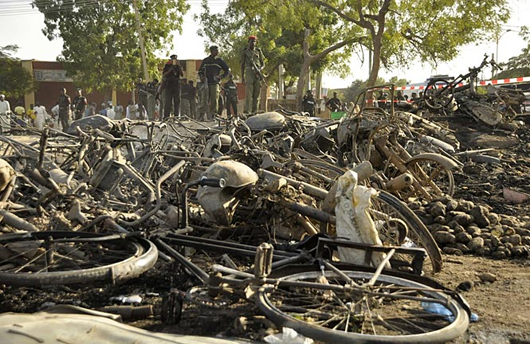

Nigeria mosque

Comments

Add new comment

  • Coastaldigest.com reserves the right to delete or block any comments.
  • Coastaldigset.com is not responsible for its readers’ comments.
  • Comments that are abusive, incendiary or irrelevant are strictly prohibited.
  • Please use a genuine email ID and provide your name to avoid reject.
Agencies
May 4,2020

Washington, May 4: Anxious for an economic recovery, President Donald Trump fielded Americans' questions about decisions by some states to allow nonessential businesses to reopen while other states are on virtual lockdown due to the coronavirus.

After more than a month of being cooped up at the White House, Trump returned from a weekend at the Camp David presidential retreat in Maryland and participated in a “virtual” town hall, hosted Sunday night by Fox News Channel, from inside the Lincoln Memorial.

He pushed for an economic reopening, one his advisers believe will be essential for his reelection chances this November.

“We have to get it back open safely but as quickly as possible," Trump said.

The president acknowledged fear on both sides of the issue, some Americans worried about getting sick while others are concerned about losing jobs.

Though the administration's handling of the pandemic, particularly its ability to conduct widespread testing, has come under fierce scrutiny, the president defended the response and said the nation was ready to begin reopening.

“I'll tell you one thing. We did the right thing and I really believe we saved a million and a half lives,” the president said.

But he also broke with the assessment of his senior adviser and son-in-law, Jared Kushner, saying it was “too soon to say" if the federal government was overseeing a “success story."

Trump's impatience also flashed. While noting that states would go at their own pace in returning to normal, with ones harder hit by the coronavirus going slower, he said that “some states frankly I think aren't going fast enough" and singled out Virginia, which has a Democratic governor and legislature.

And he urged the nation's schools and universities to return to classes this fall.

But many public health experts believe that cannot be done safely until a vaccine is developed.

Trump declared Sunday that he believed one could be available by year's end although his own pandemic task force has predicated it could be another 18 months.

Federal guidelines that encouraged people to stay at home and practice social distancing expired late last week.

Debate continued over moves by governors to start reopening state economies that tanked after shopping malls, salons and other nonessential businesses were ordered closed in attempt to slow a virus that has killed more than 66,000 Americans, according to a tally of reported deaths by Johns Hopkins University.

The U.S. economy has suffered, shrinking at a 4.8 per cent annual rate from January through March, the government estimated last week. It was the sharpest quarterly drop since the 2008 financial crisis.

Roughly 30.3 million people have filed for unemployment aid in the six weeks since the outbreak forced employers to shut down and slash their workforces. It was the worst string of layoffs on record.

Larry Kudlow, Trump's top economic adviser, on Sunday predicted a “spectacular 2021” — with “the right set of policies” — on top of a rebound from July through December of this year.

He said on CNN's "State of the Union" that the administration would "pause” to review the effectiveness of trillions in economic relief spending before making any decision on whether additional aid is needed.

House Speaker Nancy Pelosi, D-Calif., said Thursday that state and local governments are seeking up to USD 1 trillion for coronavirus costs, The Senate planned to reopen Monday, despite the Washington area's continued status as a virus hot spot and with the region still under stay-at-home orders.

The House remains shuttered. The pandemic is forcing big changes at the tradition-bound Supreme Court: The justices will hear arguments, beginning Monday, by telephone for the first time since Alexander Graham Bell patented his invention in 1876.

Congressional Republicans are resisting calls by Democrats for emergency spending for states and local governments whose revenue streams all but dried up in recent weeks.

The GOP is counting on the country's reopening and the rebound promised by Trump as their best hope to forestall another big round of virus aid.

The leaders of California and Michigan are among governors under public pressure over lockdowns still in effect while states such as Florida, Georgia and Ohio are reopening.

Michigan Governor Gretchen Whitmer, a Democrat, said Sunday that the armed protesters who demonstrated inside her state's Capitol “depicted some of the worst racism” and “awful parts” of US history by showing up with Confederate flags, nooses and swastikas.

Trump had tweeted “LIBERATE” and named Michigan and other states in mid-April. In a new tweet Friday, he urged Whitmer to “make a deal” with the protesters. “These are very good people, but they are angry.

They want their lives back again, safely!” Trump said.

Despite the opposition of Michigan's Republican-controlled Legislature, Whitmer has extended a state of emergency declaration and directed most businesses statewide to remain closed.

Some people participating in other public protests across the US have not kept their distance from one another and have rallied without masks, not heeding public health recommendations.

Deborah Birx, coordinator of the White House coronavirus task force, called that behavior “devastatingly worrisome.”

She said people will feel guilty for the rest of their lives if they end up infected and unwittingly spread the virus to vulnerable family members.

“We need to protect each other at the same time we're voice our discontent,” she told CNN's “State of the Union.”

An overwhelming majority of Americans support stay-at-home orders and other efforts to slow the virus' spread, according to a recent survey from The Associated Press-NORC Center for Public Affairs Research.

Asked about states that are reopening before they meet benchmarks laid out in federal guidelines she helped write, Birx said the guidelines “are a pretty firm policy of what we think is important from a public health standpoint.”

She added that she and others have made it clear that people must continue practising social distancing, “scrupulous” hand washing and other measures to protect themselves and others.

Fox News Channel said it asked viewers to submit questions about reopening the country on the network's Twitter, Facebook and Instagram accounts for a chance to appear on the rare broadcast from the Lincoln Memorial. Trump spoke from the memorial's steps last July Fourth.

Comments

Add new comment

  • Coastaldigest.com reserves the right to delete or block any comments.
  • Coastaldigset.com is not responsible for its readers’ comments.
  • Comments that are abusive, incendiary or irrelevant are strictly prohibited.
  • Please use a genuine email ID and provide your name to avoid reject.
News Network
March 4,2020

Beijing/Zurich, Mar 4: China has approved the use of Swiss drugmaker Roche's anti-inflammation drug Actemra for patients who develop severe complications from the coronavirus as it urgently hunts for new ways to combat the deadly infection that is spreading worldwide.

China is hoping that some older drugs could stop severe cytokine release syndrome (CRS), or cytokine storms, an overreaction of the immune system which is considered a major factor behind catastrophic organ failure and death in some coronavirus patients.

Actemra, a biologic drug approved in 2010 in the United States for rheumatoid arthritis (RA), inhibits high Interleukin 6 (IL-6) protein levels that drive some inflammatory diseases.

China's National Health Commission said in treatment guidelines published online on Wednesday that Actemra can now be used to treat coronavirus patients with serious lung damage and high IL-6 levels.

Separately, researchers in the country are testing Actemra, known generically as tocilizumab, in a clinical trial expected to include 188 coronavirus patients and running until May 10.

Roche, which donated 14 million yuan ($2.02 million) worth of Actemra during February, said the trial was initiated independently by a third party with the aim of exploring the efficacy and safety of the drug in coronavirus patients with CRS.

It added that there was currently no published clinical trial data on the drug's safety or efficacy against the virus.

More than 3,000 people have died and 93,000 have been infected by the novel coronavirus thought to have originated in Wuhan, China, before spreading to around 90 countries including the United States, Italy, Switzerland, France and Germany.

The Swiss company, for which China is its No. 2 market behind the United States, also makes diagnostic gear to detect the coronavirus.

Since Actemra's approval a decade ago, it has become a go-to drug against other inflammatory conditions, including cytokine storms in cancer patients receiving cell therapies from Novartis and Gilead Sciences.

In 2012 it helped save the life of a young U.S. girl, the first child to be treated for leukaemia with Novatis' Kymriah, from a post-treatment rush of IL-6.

Priced at between $20-30,000 annually for RA according to SSR Health, Roche's medicine is also used for rare juvenile arthritis and giant cell arteritis, or inflammation of the blood vessels.

Comments

Add new comment

  • Coastaldigest.com reserves the right to delete or block any comments.
  • Coastaldigset.com is not responsible for its readers’ comments.
  • Comments that are abusive, incendiary or irrelevant are strictly prohibited.
  • Please use a genuine email ID and provide your name to avoid reject.
News Network
July 23,2020

Minneapolis, Jul 23: The former Minneapolis police officer charged with murder in the death of George Floyd was charged Wednesday with multiple felony counts of tax evasion.

Derek Chauvin and his wife, Kellie May Chauvin, were each charged in Washington County with six counts of filing false or fraudulent tax returns for the tax years 2014 through 2019 and three counts of failing to file tax returns for 2016, 2017 and 2018.

Floyd, a Black man who was handcuffed, died May 25 after Chauvin, who is white, pressed his knee against Floyd's neck for nearly eight minutes as Floyd pleaded for air.

Chauvin is charged with second-degree murder, third-degree murder and manslaughter. He and three other officers who were at the scene were fired.

Chauvin is in custody on the charges in the Floyd case. Kellie Chauvin, who filed for divorce after Floyd's death, is not in custody.

Online court records didn't list attorneys for either in the tax evasion case, and calls to Kellie Chauvin did not go through.

Washington County Attorney Pete Orput said the investigation into the Chauvins was started in June by the Minnesota Department of Revenue and Oakdale Police Department.

Authorities allege in the criminal complaints that the Chauvins failed to file income tax returns and pay state income taxes, and that they underreported and underpaid taxes on income they earned from various jobs each year.

The complaints allege that they also failed to pay proper sales tax on a $100,000 BMW purchased in Minnesota in 2018.

Prosecutors say the Chauvins bought the car in Minnetonka but registered it in Florida, where they paid lower sales taxes.

Comments

Add new comment

  • Coastaldigest.com reserves the right to delete or block any comments.
  • Coastaldigset.com is not responsible for its readers’ comments.
  • Comments that are abusive, incendiary or irrelevant are strictly prohibited.
  • Please use a genuine email ID and provide your name to avoid reject.