


At least 86 dead in attack on Ankara peace rally

October 10, 2015

Ankara, Oct 10: At least 86 people were killed today when two explosions ripped through groups of leftist and pro- Kurdish activists gathering for an anti-government peace rally in the Turkish capital Ankara.Ankara blast
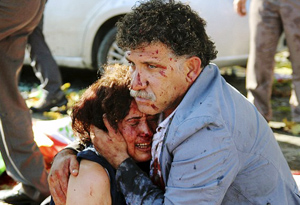
The attack, near Ankara's main train station, was the deadliest in the city's history and has ratcheted up tensions ahead of Turkey's November 1 snap elections, which were already riding high amid the government's offensive on Kurdish militants.

Bodies of the slain activists were seen strewn across the ground after the blasts, with the banners they had been holding lying next to them for the "Work, Peace and Democracy" rally.

Sixty-two people died at the scene of the blasts and 24 more then succumbed to their wounds in hospital, Health Minister Mehmet Muezzinoglu told reporters in Ankara. He said another 186 people had been injured in the attack.

Turkey's President Recep Tayyip Erdogan denounced the "heinous attack", saying it was aimed at "our unity and our country's peace." A Turkish government official told AFP that the authorities "suspect that there is a terrorist connection," without giving further details. Reports said they were investigating if a suicide bomber was involved.

There were scenes of chaos after the blasts, as ambulances raced to get to the wounded and police cordoned off the area around the train station. "We heard one huge blast and then one smaller explosion and then there was a great movement and panic. Then we saw corpses around the station," said Ahmet Onen, 52.

"A demonstration that was to promote peace has turned into a massacre, I don't understand this," he said, sobbing. Turkish police fired in the air to disperse demonstrators angered by the deaths of their fellow activists from the scene, an AFP correspondent reported.

Amateur footage broadcast by NTV television showed smiling activists holding hands and dancing and then suddenly falling to the ground as a huge explosion went off behind them.

Initial reports spoke of a single explosion but Turkish media said later there had been two separate blasts in short sequence. Reports said that hundreds of people in Ankara had rushed to hospital to donate blood for the victims.

With international concern growing over instability in the key NATO member, EU foreign policy chief Federica Mogherini urged Turkey to "stand united against terrorists."

French President Francois Hollande condemned the "odious terrorist attack" while Russian President Vladimir Putin passed his condolences to Erdogan. Turkish Prime Minister Ahmet Davutoglu was hosting a meeting of top officials, including powerful spy chief Hakan Fidan, in the early afternoon to discuss the attack.

The pro-Kurdish Peoples' Democratic Party (HDP) was to have been one of several groups that was to have taken part in the pro-peace protest. "We are faced with a huge massacre. A barbaric attack has been committed," said the HDP's leader Selahattin Demirtas.

He blamed a "mafia state" and a "state mentality which acts like a serial killer" for the attack. The attack comes with Turkey on edge ahead of November 1 polls and a wave of unrest over the past few months.

An attack in the predominantly Kurdish town of Suruc on July 20 targeting pro-HDP activists and blamed on Islamic State (IS) jihadists killed 32 people and wounded a hundred others.

The militant Kurdistan Workers' Party (PKK) accused Ankara of collaborating with IS and resumed attacks on the Turkish security forces after observing a two-year ceasefire.

Over 140 members of the security forces have since been killed while Ankara claims to have killed over 1,700 Kurdish militants in weeks of bombardments of PKK targets in southeast Turkey and northern Iraq. With conspicuous timing, the PKK Saturday announced it would suspend all attacks -- except in self defence -- ahead of the polls.

"Heeding calls from Turkey and abroad, our movement has decided on a state of inactivity by our guerillas, unless our people and our guerilla forces are attacked," Kurdistan Communities Union (KCK), an umbrella movement that includes the PKK, said in a statement.

The HDP performed strongly in the last election on June 7, winning 80 seats in parliament to deprive Erdogan's ruling Justice and Development Party (AKP) of an outright majority for the first time since it came to power in 2002.

The AKP then failed to form a coalition in months of talks, prompting Erdogan -- who had been hoping for a large majority to push through reforms to boost his powers -- to call another election on November 1. The office of Davutoglu said that he had cancelled election campaigning for the next three days.

Comments

Add new comment

  • Coastaldigest.com reserves the right to delete or block any comments.
  • Coastaldigset.com is not responsible for its readers’ comments.
  • Comments that are abusive, incendiary or irrelevant are strictly prohibited.
  • Please use a genuine email ID and provide your name to avoid reject.
News Network
February 22,2020

Washington, Feb 22: US President Donald Trump will raise the issue of religious freedom with Prime Minister Narendra Modi during his visit to India next week, the White House said on Friday, noting that the US has great respect for India's democratic traditions and institutions.

"President Trump will talk about our shared tradition of democracy and religious freedom both in his public remarks and then certainly in private. He will raise these issues, particularly the religious freedom issue, which is extremely important to this administration," a senior official told reporters in a conference call.

The official was responding to a question on whether the president was planning to speak to Modi on the Citizenship (Amendment) Act or the National Register of Citizens.

"We do have this shared commitment to upholding our universal values, the rule of law. We have great respect for India's democratic traditions and institutions, and we will continue to encourage India to uphold those traditions," the official said, requesting anonymity.

"And we are concerned with some of the issues that you have raised," the senior administration official said, in response to the question on CAA and NRC.

"I think the President will talk about these issues in his meetings with Prime Minister Modi and note that the world is looking to India to continue to uphold its democratic traditions, respect for religious minorities," the official said.

"Of course, it's in the Indian constitution -- religious freedom, respect for religious minorities, and equal treatment of all religions. So this is something that is important to the president and I'm sure it will come up," said the official.

Pointing out that India has a strong democratic foundation, the official said India is a country rich in religious, linguistic, and cultural diversity.

"In fact, it's the birthplace of four major world religions," the official noted.

Comments

Add new comment

  • Coastaldigest.com reserves the right to delete or block any comments.
  • Coastaldigset.com is not responsible for its readers’ comments.
  • Comments that are abusive, incendiary or irrelevant are strictly prohibited.
  • Please use a genuine email ID and provide your name to avoid reject.
News Network
April 2,2020

United Nations, Apr 2: The global economy could shrink by up to one per cent in 2020 due to the coronavirus pandemic, a reversal from the previous forecast of 2.5 per cent growth, the UN has said, warning that it may contract even further if restrictions on the economic activities are extended without adequate fiscal responses.

The analysis by the UN Department of Economic and Social Affairs (DESA) said the COVID-19 pandemic is disrupting global supply chains and international trade. With nearly 100 countries closing national borders during the past month, the movement of people and tourism flows have come to a screeching halt.

"Millions of workers in these countries are facing the bleak prospect of losing their jobs. Governments are considering and rolling out large stimulus packages to avert a sharp downturn of their economies which could potentially plunge the global economy into a deep recession. In the worst-case scenario, the world economy could contract by 0.9 per cent in 2020," the DESA said, adding that the world economy had contracted by 1.7 per cent during the global financial crisis in 2009.

It added that the contraction could be even higher if governments fail to provide income support and help boost consumer spending.

The analysis noted that before the outbreak of the COVID-19, world output was expected to expand at a modest pace of 2.5 per cent in 2020, as reported in the World Economic Situation and Prospects 2020.

Taking into account rapidly changing economic conditions, the UN DESA's World Economic Forecasting Model has estimated best and worst-case scenarios for global growth in 2020.

In the best-case scenario with moderate declines in private consumption, investment and exports and offsetting increases in government spending in the G-7 countries and China global growth would fall to 1.2 per cent in 2020.

"In the worst-case scenario, the global output would contract by 0.9 per cent instead of growing by 2.5 per cent in 2020," it said, adding that the scenario is based on demand-side shocks of different magnitudes to China, Japan, South Korea, the US and the EU, as well as an oil price decline of 50 per cent against our baseline of USD 61 per barrel.

The severity of the economic impact will largely depend on two factors - the duration of restrictions on the movement of people and economic activities in major economies; and the actual size and efficacy of fiscal responses to the crisis.

A well-designed fiscal stimulus package, prioritising health spending to contain the spread of the virus and providing income support to households most affected by the pandemic would help to minimise the likelihood of a deep economic recession, it said.

According to the forecast, lockdowns in Europe and North America are hitting the service sector hard, particularly industries that involve physical interactions such as retail trade, leisure and hospitality, recreation and transportation services. Collectively, such industries account for more than a quarter of all jobs in these economies.

The DESA said as businesses lose revenue, unemployment is likely to increase sharply, transforming a supply-side shock to a wider demand-side shock for the economy.

Against this backdrop, the UN-DESA is joining a chorus of voices across the UN system calling for well-designed fiscal stimulus packages which prioritize health spending and support households most affected by the pandemic.

Urgent and bold policy measures are needed, not only to contain the pandemic and save lives, but also to protect the most vulnerable in our societies from economic ruin and to sustain economic growth and financial stability, Under-Secretary-General for Economic and Social Affairs Liu Zhenmin said.

The analysis also warns that the adverse effects of prolonged economic restrictions in developed economies will soon spill over to developing countries via trade and investment channels.

A sharp decline in consumer spending in the European Union and the United States will reduce imports of consumer goods from developing countries.

Developing countries, particularly those dependent on tourism and commodity exports, face heightened economic risks. Global manufacturing production could contract significantly, and the plummeting number of travellers is likely to hurt the tourism sector in small island developing States, which employs millions of low-skilled workers, it said.

Meanwhile, the decline in commodity-related revenues and a reversal of capital flows are increasing the likelihood of debt distress for many nations. Governments may be forced to curtail public expenditure at a time when they need to ramp up spending to contain the pandemic and support consumption and investment.

UN Chief Economist and Assistant Secretary-General for Economic Development Elliot Harris said the collective goal must be a resilient recovery which puts the planet back on a sustainable track. We must not lose sight how it is affecting the most vulnerable population and what that means for sustainable development, he said.

The alarms raised by UN-DESA echo another report, released on March 31, in which UN experts issued a broad appeal for a large-scale, coordinated, comprehensive multilateral response amounting to at least 10 per cent of global gross domestic product (GDP).

According to estimates by the Johns Hopkins University, confirmed coronavirus cases across the world now stand at over 932,600 and over 42,000 deaths.

Comments

Add new comment

  • Coastaldigest.com reserves the right to delete or block any comments.
  • Coastaldigset.com is not responsible for its readers’ comments.
  • Comments that are abusive, incendiary or irrelevant are strictly prohibited.
  • Please use a genuine email ID and provide your name to avoid reject.
News Network
May 11,2020

Kabul, May 11: Four back-to-back roadside bombs exploded in a northern district of Afghanistan's capital Kabul on Monday, wounding four civilians including a child, police said. Kabul police spokesman Ferdaws Faramarz said a clearance team was at the site of the attacks.

Militants have carried out several roadside bombings and rocket attacks in Kabul and other parts of the country in recent weeks, but Monday's four consecutive explosions appeared to be the first coordinated effort for some months.

The Taliban has not carried out any large attacks in the city since they signed a landmark withdrawal deal with the US in February, meant to pave the way for peace in the country. No group has claimed the attacks. The explosions come as authorities are trying to impose a lockdown in the capital to curb the spread of coronavirus in the country.

Comments

Add new comment

  • Coastaldigest.com reserves the right to delete or block any comments.
  • Coastaldigset.com is not responsible for its readers’ comments.
  • Comments that are abusive, incendiary or irrelevant are strictly prohibited.
  • Please use a genuine email ID and provide your name to avoid reject.