


At least 86 dead in attack on Ankara peace rally

October 10, 2015

Ankara, Oct 10: At least 86 people were killed today when two explosions ripped through groups of leftist and pro- Kurdish activists gathering for an anti-government peace rally in the Turkish capital Ankara.Ankara blast
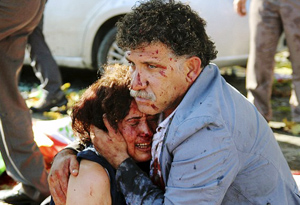
The attack, near Ankara's main train station, was the deadliest in the city's history and has ratcheted up tensions ahead of Turkey's November 1 snap elections, which were already riding high amid the government's offensive on Kurdish militants.

Bodies of the slain activists were seen strewn across the ground after the blasts, with the banners they had been holding lying next to them for the "Work, Peace and Democracy" rally.

Sixty-two people died at the scene of the blasts and 24 more then succumbed to their wounds in hospital, Health Minister Mehmet Muezzinoglu told reporters in Ankara. He said another 186 people had been injured in the attack.

Turkey's President Recep Tayyip Erdogan denounced the "heinous attack", saying it was aimed at "our unity and our country's peace." A Turkish government official told AFP that the authorities "suspect that there is a terrorist connection," without giving further details. Reports said they were investigating if a suicide bomber was involved.

There were scenes of chaos after the blasts, as ambulances raced to get to the wounded and police cordoned off the area around the train station. "We heard one huge blast and then one smaller explosion and then there was a great movement and panic. Then we saw corpses around the station," said Ahmet Onen, 52.

"A demonstration that was to promote peace has turned into a massacre, I don't understand this," he said, sobbing. Turkish police fired in the air to disperse demonstrators angered by the deaths of their fellow activists from the scene, an AFP correspondent reported.

Amateur footage broadcast by NTV television showed smiling activists holding hands and dancing and then suddenly falling to the ground as a huge explosion went off behind them.

Initial reports spoke of a single explosion but Turkish media said later there had been two separate blasts in short sequence. Reports said that hundreds of people in Ankara had rushed to hospital to donate blood for the victims.

With international concern growing over instability in the key NATO member, EU foreign policy chief Federica Mogherini urged Turkey to "stand united against terrorists."

French President Francois Hollande condemned the "odious terrorist attack" while Russian President Vladimir Putin passed his condolences to Erdogan. Turkish Prime Minister Ahmet Davutoglu was hosting a meeting of top officials, including powerful spy chief Hakan Fidan, in the early afternoon to discuss the attack.

The pro-Kurdish Peoples' Democratic Party (HDP) was to have been one of several groups that was to have taken part in the pro-peace protest. "We are faced with a huge massacre. A barbaric attack has been committed," said the HDP's leader Selahattin Demirtas.

He blamed a "mafia state" and a "state mentality which acts like a serial killer" for the attack. The attack comes with Turkey on edge ahead of November 1 polls and a wave of unrest over the past few months.

An attack in the predominantly Kurdish town of Suruc on July 20 targeting pro-HDP activists and blamed on Islamic State (IS) jihadists killed 32 people and wounded a hundred others.

The militant Kurdistan Workers' Party (PKK) accused Ankara of collaborating with IS and resumed attacks on the Turkish security forces after observing a two-year ceasefire.

Over 140 members of the security forces have since been killed while Ankara claims to have killed over 1,700 Kurdish militants in weeks of bombardments of PKK targets in southeast Turkey and northern Iraq. With conspicuous timing, the PKK Saturday announced it would suspend all attacks -- except in self defence -- ahead of the polls.

"Heeding calls from Turkey and abroad, our movement has decided on a state of inactivity by our guerillas, unless our people and our guerilla forces are attacked," Kurdistan Communities Union (KCK), an umbrella movement that includes the PKK, said in a statement.

The HDP performed strongly in the last election on June 7, winning 80 seats in parliament to deprive Erdogan's ruling Justice and Development Party (AKP) of an outright majority for the first time since it came to power in 2002.

The AKP then failed to form a coalition in months of talks, prompting Erdogan -- who had been hoping for a large majority to push through reforms to boost his powers -- to call another election on November 1. The office of Davutoglu said that he had cancelled election campaigning for the next three days.

Comments

Add new comment

  • Coastaldigest.com reserves the right to delete or block any comments.
  • Coastaldigset.com is not responsible for its readers’ comments.
  • Comments that are abusive, incendiary or irrelevant are strictly prohibited.
  • Please use a genuine email ID and provide your name to avoid reject.
News Network
June 19,2020

London, Jun 19: Malala Yousafzai, the youngest Nobel Peace Prize winner who once took a bullet for campaigning for girls' education in Pakistan, was over the moon on Friday after completing her degree in Philosophy, Politics and Economics at Britain's prestigious Oxford University.

Malala, 22, who attended Oxford's Lady Margaret Hall college, took to Twitter to share two pictures that show her celebrating the milestone with her family.

"Hard to express my joy and gratitude right now as I completed my Philosophy, Politics and Economics degree at Oxford," she said in the tweet, accompanied by two pictures - one showing her sitting with her family in front of a cake that says: 'Happy Graduation Malala', and the other in which she is covered with cake smiling for the camera.

In the tweet, the famed human rights activist also revealed her plans for the immediate future - Netflix, reading and sleeping.

"I don't know what's ahead. For now, it will be Netflix, reading and sleep," she wrote.

Malala was shot in the head by the Taliban militants in December 2012 for campaigning for female education in the Swat Valley in northeastern Pakistan.

Severely wounded, she was airlifted from one military hospital in Pakistan to another and later flown to the UK for treatment.

After the attack, the Taliban released a statement saying that they would target Malala again if she survived.

At the age of 17, Malala became the youngest recipient of the Nobel Peace Prize for her education advocacy in 2014 when she shared the coveted honour with India's social activist Kailash Satyarthi.

Unable to return to Pakistan after her recovery, she moved to Britain, setting up the Malala Fund and supporting local education advocacy groups with a focus on Pakistan, Nigeria, Jordan, Syria and Kenya.

The Taliban, who are against girls' education, have destroyed many schools in Pakistan.

Comments

Add new comment

  • Coastaldigest.com reserves the right to delete or block any comments.
  • Coastaldigset.com is not responsible for its readers’ comments.
  • Comments that are abusive, incendiary or irrelevant are strictly prohibited.
  • Please use a genuine email ID and provide your name to avoid reject.
News Network
May 9,2020

London, May 9: Air India's first evacuation flight from London will be taking off for Mumbai today.

The screening of passengers is underway.

"Air India's first evacuation flight from London taking off for Mumbai today at 1200. Flight is 100% booked! Shubh Yatra. Please stay in touch. GoI working to send more evacuation flights!" High Commission of India, London said in a tweet.

On Monday, India announced had that it will begin phased repatriation of its citizens stranded abroad from May 7.

The government said that Air India will operate 64 flights in the first week from May 7 to May 13 to bring back around 15,000 Indian nationals.

On day three of the 'Vande Bharat Mission', flights carrying Indians from the Gulf countries, the United Kingdom, Bangladesh and Malaysia will arrive in India.

Comments

Add new comment

  • Coastaldigest.com reserves the right to delete or block any comments.
  • Coastaldigset.com is not responsible for its readers’ comments.
  • Comments that are abusive, incendiary or irrelevant are strictly prohibited.
  • Please use a genuine email ID and provide your name to avoid reject.
Agencies
February 4,2020

As the deadly coronavirus has spread worldwide, it has carried with it xenophobia -- and Asian communities around the world are finding themselves subject to suspicion and fear.

When a patient on Australia's Gold Coast refused to shake the hand of her surgeon Rhea Liang, citing the virus that has killed hundreds, the medic's first response was shock.

But after tweeting about the incident and receiving a flood of responses, the respected doctor learned her experience was all too common.

There has been a spike in reports of anti-Chinese rhetoric directed at people of Asian origin, regardless of whether they have ever visited the centre of the epidemic or been in contact with the virus.

Chinese tourists have reportedly been spat at in the Italian city of Venice, a family in Turin was accused of carrying the disease, and mothers in Milan have used social media to call for children to be kept away from Chinese classmates.

In Canada, a white man was filmed telling a Chinese-Canadian woman "you dropped your coronavirus" in the parking lot of a local mall.

In Malaysia, a petition to "bar Chinese people from entering our beloved country" received almost 500,000 signatures in one week.

The incidents are part of what the Australasian College for Emergency Medicine has described as "misinformation" which it says is fuelling "racial profiling" where "deeply distressing assumptions are being made about 'Chinese' or 'Asian-looking' people." Disease has long been accompanied by suspicions of foreigners -- from Irish immigrants being targeted in the Typhoid Mary panic of 1900s America to Nepali peacekeepers being accused of bringing cholera to earthquake-struck Haiti in the last decade.

"It's a common phenomenon," said Rob Grenfell, director of health and biosecurity for Australia's science and research agency CSIRO.

"With outbreaks and epidemics along human history, we've always tried to vilify certain subsets of the population," he said, comparing the behaviour to 1300s plague-ridden medieval Europe, where foreigners and religious groups were often blamed.

"Sure it emerged in China," he said of the coronavirus, "but that's no reason to actually vilify Chinese people." In a commentary for the British Medical Journal, doctor Abraar Karan warned this behaviour could discourage people with symptoms from coming forward.

Claire Hooker, a health lecturer at the University of Sydney, said the responses from governments may have compounded prejudice.

The World Health Organisation has warned against "measures that unnecessarily interfere with international travel and trade", but this has not stopped scores of countries from introducing travel bans.

The tiny Pacific nation of Micronesia has banned its citizens from visiting mainland China altogether.

"Travel bans respond largely to people's fears," said Hooker, and while sometimes warranted, they often "have the effect of cementing an association between Chinese people and scary viruses".

Abbey Shi, a Shanghai-born student in Sydney, said the attitude shown by some of her peers has "become almost an attack on students who are Chinese".

While Australia's conservative government has banished its citizens returning from Wuhan -- the central Chinese city at the epicentre of the virus -- to a remote island for quarantine, thousands of students still stuck in China risk their studies being torpedoed.

"Right now it looks like they have to miss the semester's start and potentially the whole year, because of the way the courses are set up," Shi said.

According to Hooker, studies in Toronto on the impact of Severe Acute Respiratory Syndrome, or SARS -- another global coronavirus outbreak in 2002 -- showed the impact of xenophobic sentiment often lasted much longer than the public health scare.

"While there may be a cessation of direct forms of racism as news about the disease dies down, it takes quite a bit of time for economic recovery and people continue to feel unsafe," she said.

People may not rush back to Chinese businesses or restaurants, and may even heed some of the more outlandish viral social media disinformation -- such as one popular post imploring people to avoid eating noodles for their own safety.

"In one sense you might think the effects lasted from the last coronavirus to this one because the representation as China being a place where diseases come from has been persistent," Hooker said.

Comments

Add new comment

  • Coastaldigest.com reserves the right to delete or block any comments.
  • Coastaldigset.com is not responsible for its readers’ comments.
  • Comments that are abusive, incendiary or irrelevant are strictly prohibited.
  • Please use a genuine email ID and provide your name to avoid reject.