


Lee Beard reveals what Vijender unlearnt to be WBO champ

July 18, 2016

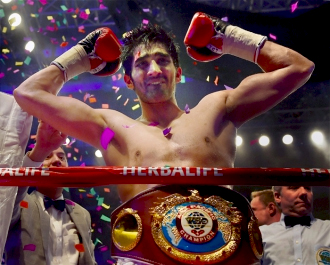
New Delhi, Jul 18: Vijender Singh has had to unlearn a few tactics from his amateur days in his unbeaten journey to the WBO Asia Pacific title, reveals the Indian boxing star's renowned British trainer Lee Beard who "makes it hard for him in the gym to make him more spiteful and angry in the ring".
LeeSpeaking to agency, Beard, who has worked with the likes of Floyd Mayweather Sr besides being the assistant trainer to former world champion Ricky Hatton, detailed Vijender's rise to the WBO title that was won amid frenzied fans here on Saturday.

"All his amateur experience has been a huge help for him because he has won on some very big occasions –- Olympics, World Championships. By the time he turned pro, he had already learnt to deal with pressure. He was smart and skillful even before he came to me. I have only added to his game, made him think differently," Beard said.

"I have tried to make him punch harder and harder and use his jab more. His footwork used to slow him down because as an amateur he used to run around in the ring. The main thing he has unlearnt is the footwork from amateur days with regards to running around the ring. It's no good for a 10-round bout," he added.

Beard, who fondly calls Vijender just V, said another aspect of the Indian's game he has tried to improve is his defence.

"He is more fluent now, there is bit more rhythm. His defence is also so much better now. Now when you see him in the ring, it is not easy to connect to him because he is walking, turning, his defensive jab has improved a lot. His all-round understanding, his patience and control over the fight has improved.

"He can't be reached that easily. I have educated him about energy because in Olympics it is just three rounds so the pace is very fast. But in pro, you have to slow it down a bit.

"When I spoke about energy with him I said 'V, there is a glass of water here, when you drink it the level goes down, imagine that is your energy. So if you are in the fight, and every time you throw a punch, it is like you are drinking and the level will go down. So you have got to be careful that you don't empty it before the final bell'," explained the Manchester-based coach.

Beard said he could see a world champion in Vijender the day he met him first in Manchester last year.

"When I first saw him, it took just 15 minutes for me to gauge that he will win a world title. I looked into his eyes and I saw a fire. Whatever he seems to focus on, he gets it. Of all the fighters I have trained, he is one of the best when it comes to learning, he is an extremely quick learner," he said.

Vijender, who holds the distinction of being India's first Olympic and World Championships medallist, won his first six pro bouts via knockouts before being stretched to a 10-round win in the WBO title clash against former WBC European champion Kerry Hope.

Beard said that Vijender had to battle a few niggles in the run up to the fight. "It was just hard for him with the injuries, this is psychological. He was stressed...He was not scared of the opponent it was more about the occasion, about fighting in India and how India would respond to it. The opponent was nothing, the attention was the factor," Beard said.

"What Vijender did was huge, because he performed despite all that he went through in training. I pushed him really hard. He was doing 10-12 rounds every day with three different quality opponents, who were trying to destroy him. They were not doing him any favours, they were pushing him," he said.

"On Saturday, he needed to stay in the middle, he needed to take his time. Vijender got tired in the fight. They were both tired. But Vijender is a very smart man, he is a thinking fighter. He doesn't rush things all the time. He was more in control of the pace of the fight."

On his personal equation with the reticent Haryana-lad, Beard said he has been bowled over by Vijender's humility. "I have got 5-6 guys in my gym, one of them is an 18-year-old boy called Jason. I like the way Vijender is with him. Jason is a very very quiet boy but Vijender always talks very good with him.

"When you have got a three-time Olympian in the gym, you worry about their ego but it is not like that with Vijender and Jason is an example of that. Jason is irrelevant to Vijender but he shows affection for him which I really like. I have a very good bond with him. The communication with him is very good. I know how to calm him down," he said.

"Our equation now is such that when V walks in, I can look at him and tell him whether he is feeling strong or not. I can understand when something is not right." Asked about his India experience so far, Beard said he was amazed to see such a huge turnout for Vijender's fight even though most fans in the arena simply had no clue about the sport.

"Most people I spoke with on Saturday didn't even understand what was going on. They were going crazy about every punch Vijender was throwing. I was talking to a few fans when the undercard was on and I was asking them, who do you think will win? They simply said 'we don't know, we are here for Vijender', I was amazed. They love the man but they didn't know what was happening," Beard chuckled.

Comments

Add new comment

  • Coastaldigest.com reserves the right to delete or block any comments.
  • Coastaldigset.com is not responsible for its readers’ comments.
  • Comments that are abusive, incendiary or irrelevant are strictly prohibited.
  • Please use a genuine email ID and provide your name to avoid reject.
News Network
May 13,2020

May 13: With the Olympics postponed due to the coronavirus, top Japanese fencer Ryo Miyake has swapped his metal mask and foil for a bike and backpack as a Tokyo UberEats deliveryman.

The 29-year-old, who won silver in the team foil at the 2012 London Olympics and was itching to compete in a home Games, says the job keeps him in shape physically and mentally -- and brings in much-needed cash.

"I started this for two reasons -- to save money for travelling (to future competitions) and to keep myself in physical shape," he told AFP.

"I see how much I am earning on the phone, but the number is not just money for me. It's a score to keep me going."

Japanese media have depicted Miyake as a poor amateur struggling to make ends meet but he himself asked for his three corporate sponsorships to be put on hold -- even if that means living off savings.

Like most of the world's top athletes, he is in limbo as the virus forces competitions to be cancelled and plays havoc with training schedules.

"I don't know when I can resume training or when the next tournament will take place. I don't even know if I can keep up my mental condition or motivation for another year," he said.

"No one knows how the qualification process will go. Pretending everything is OK for the competition is simply irresponsible."

In the meantime, he is happy criss-crossing the vast Japanese capital with bike and smartphone, joining a growing legion of Uber delivery staff in demand during the pandemic.

"When I get orders in the hilly Akasaka, Roppongi (downtown) district, it becomes good training," he smiles.

The unprecedented postponement of the Olympics hit Miyake hard, as he was enjoying a purple patch in his career.

After missing out on the Rio 2016 Olympics, Miyake came 13th in last year's World Fencing Championships -- the highest-ranked Japanese fencer at the competition.

The International Olympics Committee has set the new date for the Olympics on July 23, 2021.

But with no vaccine available for the coronavirus that has killed nearly 300,000 worldwide, even that hangs in the balance.

Miyake said the Japanese fencing team heard about the postponement the day after arriving in the United States for one of the final Olympic qualifying events.

With his diary suddenly free of training and competition, he said he spent the month of April agonising over what to do before hitting on the Uber idea.

"Sports and culture inevitably come second when people have to survive a crisis," he said.

"Is the Olympics really needed in the first place? Then what do I live for if not for the sport? That is what I kept thinking."

However, the new and temporary career delivering food in Tokyo has given the fencer a new drive to succeed.

"The most immediate objective for me is to be able to start training smoothly" once the emergency is lifted, he said.

"I need to be ready physically and financially for the moment. That is my biggest mission now."

But not all athletes may cope mentally with surviving another "nerve-wracking" pre-Olympic year, he said.

"It's like finally getting to the end of a 42-kilometre marathon and then being told you have to keep going."

As a child, Miyake practised his attacks on every wall of his house -- and he said his passion for the sport was what was driving him now.

"I love fencing. I want to be able to travel for matches and compete in the Olympics. That is the only reason I am doing this."

Comments

Add new comment

  • Coastaldigest.com reserves the right to delete or block any comments.
  • Coastaldigset.com is not responsible for its readers’ comments.
  • Comments that are abusive, incendiary or irrelevant are strictly prohibited.
  • Please use a genuine email ID and provide your name to avoid reject.
News Network
June 9,2020

Bengaluru, Jun 9: Former India skipper Rahul Dravid has said that Virat Kohli understands that the real respect for him as a cricketer will come through success in the longest format of the game.

Dravid, popularly known as 'The Wall', also said that Test batsmanship has become exciting to watch now as batters play aggressive shots more often.

"I actually believe Test batsmanship has become more exciting than before, the aggressive element of Test batsmanship is going forward, players are playing shots and it is good to see, a good thing for India is Virat Kohli really values Test cricket, he understands that the real respect for him as a cricketer will come from his success in Test cricket," Dravid told Sanjay Manjrekar in a videocast hosted by ESPNCricinfo.

He also said that defensive batting in cricket is not irrelevant, but added that players can have successful careers without having a good defensive technique.

"I don't think it is becoming irrelevant, maybe the value of defensive batting is not the same as it was a generation ago, it can never become irrelevant, I think you still need to defend your wicket if you want to score suns, I feel now you can survive without a good defensive technique in cricket," Dravid said.

"Today, you do not need to have a good Test career to have a successful career, look at the best players in the world today, a lot of them have a good defensive technique and they can play out difficult periods of the game," he added.

The 47-year-old Dravid also said that all young players want to represent their country in all three formats during their initial days, but eventually, they become realistic as time passes by.

"I would say in my interaction with the younger players, everyone's hero is someone who has succeeded in all formats of the game. I think all players start off wanting to play all formats, but then guys get a little realistic about their careers, superstars of the game will still want to play to all formats of the game," Dravid said.

Dravid is the only player in the history of cricket to be involved in two 300-plus ODI partnerships.

He played 164 Tests, 344 ODIs and one T20I for India. Dravid had announced his retirement from international cricket in March 2012.

He finished his career with 48 international centuries.

He has also coached the Indian junior sides (India U-19 and India A) and he is now the head of the National Cricket Academy (NCA).

Dravid has also led the side during his playing days and under his leadership, the side had managed to register their first Test series win in England.

Comments

Add new comment

  • Coastaldigest.com reserves the right to delete or block any comments.
  • Coastaldigset.com is not responsible for its readers’ comments.
  • Comments that are abusive, incendiary or irrelevant are strictly prohibited.
  • Please use a genuine email ID and provide your name to avoid reject.
News Network
May 3,2020

New Delhi, May 3: In a startling revelation, India speedster Mohammed Shami has claimed that he thought of committing suicide thrice while battling personal issues a few years ago, forcing his family to keep a watch over him at all times.

He said his family members feared he "might jump" from their 24th floor apartment.

Shami, one of India's leading bowlers in recent years, opened up on his personal and professional life during an Instagram chat with teammate and limited overs squads' vice-captain Rohit Sharma.

"I think if my family had not supported me back then I would have lost my cricket. I thought of committing suicide three times during that period due to severe stress and personal problems," Shami revealed during the session on Saturday.

Now one of the mainstays of Indian bowling attack across formats, the 29-year-old was struggling to focus on his cricket, then.

"I was not thinking about cricket at all. We were living on the 24th floor. They (family) were scared I might jump from the balcony. My brother supported me a lot.

"My 2-3 friends used to stay with me for 24 hours. My parents asked me to focus on cricket to recover from that phase and not think about anything else. I started training then and sweated it out a lot at an academy in Dehradun," Shami said.

In March 2018, Shami's wife Hasin Jahan had accused him of domestic violence and lodged a complaint with the police, following which the India player and his brother were booked under relevant sections.

The upheaval in his personal life forced his employer BCCI to withheld the player's central contracts for a while.

"Rehab was stressful as the same exercises are repeated every day. Then family problems started and I also suffered an accident. The accident happened 10-12 days ahead of the IPL and my personal problems were running high in the media," Shami told Rohit.

Shami said his family stood like a rock with him and the support helped him get back on his feet.

"Then my family explained that every problem has a solution no matter how big the problem. My brother supported me a lot."

Speaking about another painful period in his life after his injury in the 2015 World Cup, Shami said it took him almost 18 months to get back on the field.

"When I got injured in the 2015 World Cup, after that it took me 18 months to fully recover, that was the most painful moment in my life, it was a very stressful period.

Comments

Add new comment

  • Coastaldigest.com reserves the right to delete or block any comments.
  • Coastaldigset.com is not responsible for its readers’ comments.
  • Comments that are abusive, incendiary or irrelevant are strictly prohibited.
  • Please use a genuine email ID and provide your name to avoid reject.