Limits on expat bank transfers ‘under study’

May 3, 2013

Bank_transfers

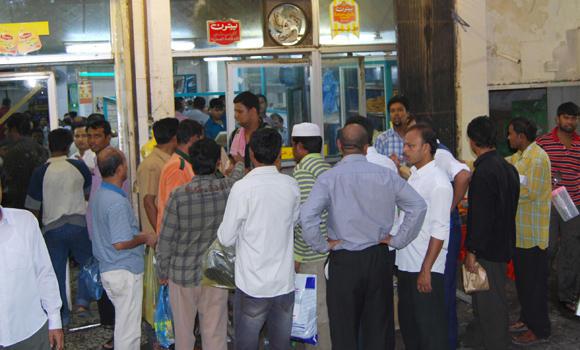
Jeddah, May 3: Saudi banks are considering limiting the amount of money expatriates send home, a bank official told Arab News. This is to comply with Ministry of Labor regulations being phased in as part of the Nitaqat program.

These regulations would see banks prevent expatriate workers from transferring sums more than their monthly income and freezing the accounts of workers who have not rectified their status.

However, Talat Hafiz, secretary-general of media and education for Saudi banks, told Arab News that banks have no intention to freeze accounts. “The banks cannot take such action. It is not their business to decide on these matters. The only party authorized to take such action is Saudi Arabian Monetary Agency,” he said.

“Saudi banks report to SAMA. So far we have not blocked anyone from opening an account, even those not licensed to work in the Kingdom.”

Adel Al-Hawwar, senior executive vice-chairman of retail banking at the National Commercial Bank, told Arab News that “it's unlikely that the banks will take this step at present. There is a system to protect wages, and it is meant to protect the rights of workers. It is also meant to ensure companies pay the salaries of workers as stated in their contracts.”

Hattab Al-Enezi, spokesman for the Ministry of Labor, told Arab News that the system of wage protection will start with large companies employing 3,000 employees and more. “Then we'll gradually move to companies that employ fewer people. Each company will be given two months to comply with the decision,” he said. “There is ongoing coordination between the Ministry of Labor and SAMA to keep checking on whether or not employers are complying with the regulations regarding worker payment and wage protection and other matters,” he added.

Comments

Add new comment

  • Coastaldigest.com reserves the right to delete or block any comments.
  • Coastaldigset.com is not responsible for its readers’ comments.
  • Comments that are abusive, incendiary or irrelevant are strictly prohibited.
  • Please use a genuine email ID and provide your name to avoid reject.
News Network
April 18,2020

Dubai, Apr 18: Saudi Arabia has reported 1,132 new coronavirus cases, taking the total number of confirmed COVID-19 patients to 8,274, the Ministry of Health revealed on Saturday.

The ministry has also announced five more deaths from the virus, taking to 92 the Kingdom’s death toll.

Recoveries
As for recoveries, 280 new recoveries were reported, pushing the total number of patients recovered to 1,329.

The ministry revealed that 79 per cent of today’s cases are expatriates and that 65 per cent of the cases were detected through intensified and active COVID-19 screening in densely-populated areas.

A total of 201 patients of Saturday’s cases have contracted the disease due to being in contact with existing cases, the ministry added.

The new infected cases have been placed under complete isolation and they are receiving necessary medical care, an official from the ministry said.

He affirmed that medical teams are intensifying efforts and screening tests in workers' neighbourhoods and accommodations in order to limit the spread of the disease.

Comments

Add new comment

  • Coastaldigest.com reserves the right to delete or block any comments.
  • Coastaldigset.com is not responsible for its readers’ comments.
  • Comments that are abusive, incendiary or irrelevant are strictly prohibited.
  • Please use a genuine email ID and provide your name to avoid reject.
Agencies
August 2,2020

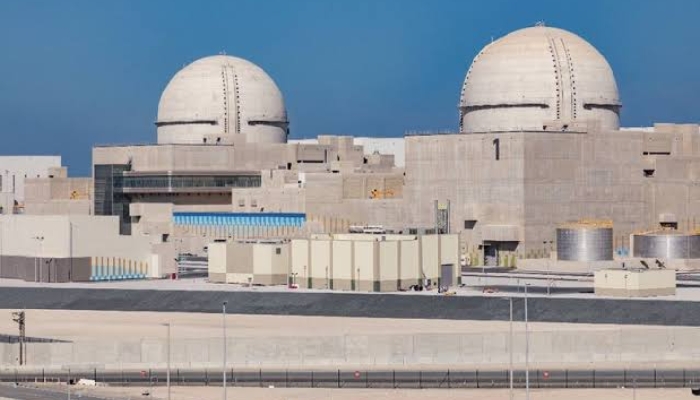
Dubai, Aug 2: The United Arab Emirates (UAE) announced on Saturday that it has started operations in the first of four reactors at the Barakah nuclear power station - the first nuclear power plant in the Arab world.

Emirates Nuclear Energy Corporation (ENEC), which is building and operating the plant with Korea Electric Power Corporation (KEPCO) said in a press release that its subsidiary Nawah Energy Company "has successfully started up Unit 1 of the Barakah Nuclear Energy Plant, located in the Al Dhafrah Region of Abu Dhabi".

That signals that Unit 1, which had fuel rods loaded in March, has achieved "criticality" - a sustained fission chain reaction.

"The start-up of Unit 1 marks the first time that the reactor safely produces heat, which is used to create steam, turning a turbine to generate electricity," said ENEC.

Barakah, which was originally scheduled to open in 2017, has been dogged by delays and is billions of dollars over budget. It has also raised myriad concerns among nuclear energy veterans who are concerned about the potential risks Barakah could visit upon the Arabian Peninsula, from an environmental catastrophe to a nuclear arms race.

Paul Dorfman, an honorary senior research fellow at the Energy Institute, University College London and founder and chair of the Nuclear Consulting Group, has criticised the Barakah reactors' "cheap and cheerful" design that he says cuts corners on safety.

Dorfman authored a report (PDF) last year detailing key safety features Barakah's reactors lack, such as a "core catcher" to literally stop the core of a reactor from breaching the containment building in the event of a meltdown. The reactors are also missing so-called Generation III Defence-In-Depth reinforcements to the containment building to shield against a radiological release resulting from a missile or fighter jet attack.

Both of these engineering features are standard on new reactors built in Europe, says Dorfman.

There have been at least 13 aerial attacks on nuclear facilities in the Middle East - more than any other region on earth.

The vulnerability of critical infrastructure in the Arabian Peninsula was further laid bare last year after Saudi Arabia's oil facilities at Abqaiq and Khurais were attacked by 18 drones and seven cruise missiles - an assault that temporarily knocked out more than half of the kingdom's oil production.

On Saturday, Dorfman reiterated his concern that there is no regional protocol in place to determine liability should an accident or incident at Barakah result in radioactive contamination spreading from the UAE to its neighbours. 

"Given Barakah has started up, because of all the well-rehearsed nuclear safety and security problems, it may be critically important that the Gulf states collectively evolve a Nuclear Accident Liability Convention, so that if anything does go wrong, victim states may have some sort of redress," Dorfman told Al Jazeera. 

The UAE has substantial oil and gas reserves, but it has made huge investments in developing alternative energy sources, including nuclear and solar.

Experts though have questioned why the UAE - which is bathed in sunlight and wind - has pushed ahead with nuclear energy - a far more expensive and riskier option than renewable energy sources.

When the UAE first announced Barakah in 2009, nuclear power was cheaper than solar and wind. But by 2012 - when the Emirates started breaking ground to build the reactors - solar and wind costs had plummeted dramatically.

Between 2009 and 2019, utility-scale average solar photovoltaic costs fell 89 percent and wind fell 43 percent, while nuclear jumped 26 percent, according to an analysis by the financial advisory and asset manager Lazard.

There are also concerns about the potential for Barakah to foment nuclear proliferation in the Middle East - a region rife with geopolitical fault lines and well-documented history of nuclear secrecy.

The UAE has sought to distance itself from the region's bad behaviour by agreeing not to enrich its own uranium or reprocess spent fuel. It has also signed up to the United Nation's nuclear watchdog's Additional Protocol, significantly enhancing inspection capabilities, and secured a 123 Agreement with the United States that allows bilateral civilian nuclear cooperation.


Comments

Add new comment

  • Coastaldigest.com reserves the right to delete or block any comments.
  • Coastaldigset.com is not responsible for its readers’ comments.
  • Comments that are abusive, incendiary or irrelevant are strictly prohibited.
  • Please use a genuine email ID and provide your name to avoid reject.
Agencies
June 29,2020

Protests condemning the Israeli plan to annex parts of the occupied West Bank are set to take place in the United States and Europe on the same day prime minister Benjamin Netanyahu plans to begin the process.

The demonstrations will be held on Wednesday in Chicago, San Diego, Brooklyn, Los Angeles and San Francisco. Other Western cities will also witness similar protests, including Toronto, Madrid and Valencia.

Students for Justice in Palestine, Jewish Voice for Peace, and American Muslims for Palestine are among the pro-Palestinian groups organizing the protests.

The Samidoun Palestinian Prisoner Solidarity Network, one of the organizers, urged "direct actions and popular mobilizations in [Palestinian] refugee camps, cities and villages," and professed "loyalty to the martyrs" on its call for the events.

Another group, Al-Awda or the Palestinian Right to Return Coalition, decried "72 years of genocide, ethnic cleansing and dispossession" of Palestinians.

It also tied their demonstrations to the protests against anti-black racism in the US and beyond.

"We demand the defunding and dismantling of US police alongside the defunding and dismantling of Zionist colonialism and racist Israeli apartheid," Al-Awda said on its website.

Netanyahu has set July 1 as the date for the start of cabinet discussions on the annexation plan.

He has been driven ahead by US President Donald Trump, who unveiled a “peace” plan for the Middle East in January that effectively sidelines the Palestinians altogether.

The plan, which Trump himself has described as the “deal of the century,” envisions Jerusalem al-Quds as “Israel’s undivided capital” and allows the Tel Aviv regime to annex settlements in the occupied West Bank and the Jordan Valley. The plan also denies Palestinian refugees the right of return to their homeland, among other controversial terms.

The Palestinians want the West Bank as part of a future independent Palestinian state with East Jerusalem al-Quds as its capital.

Comments

Add new comment

  • Coastaldigest.com reserves the right to delete or block any comments.
  • Coastaldigset.com is not responsible for its readers’ comments.
  • Comments that are abusive, incendiary or irrelevant are strictly prohibited.
  • Please use a genuine email ID and provide your name to avoid reject.