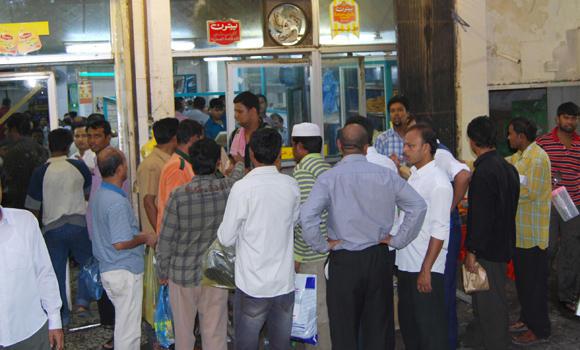
Limits on expat bank transfers ‘under study’

May 3, 2013

Bank_transfers

Jeddah, May 3: Saudi banks are considering limiting the amount of money expatriates send home, a bank official told Arab News. This is to comply with Ministry of Labor regulations being phased in as part of the Nitaqat program.

These regulations would see banks prevent expatriate workers from transferring sums more than their monthly income and freezing the accounts of workers who have not rectified their status.

However, Talat Hafiz, secretary-general of media and education for Saudi banks, told Arab News that banks have no intention to freeze accounts. “The banks cannot take such action. It is not their business to decide on these matters. The only party authorized to take such action is Saudi Arabian Monetary Agency,” he said.

“Saudi banks report to SAMA. So far we have not blocked anyone from opening an account, even those not licensed to work in the Kingdom.”

Adel Al-Hawwar, senior executive vice-chairman of retail banking at the National Commercial Bank, told Arab News that “it's unlikely that the banks will take this step at present. There is a system to protect wages, and it is meant to protect the rights of workers. It is also meant to ensure companies pay the salaries of workers as stated in their contracts.”

Hattab Al-Enezi, spokesman for the Ministry of Labor, told Arab News that the system of wage protection will start with large companies employing 3,000 employees and more. “Then we'll gradually move to companies that employ fewer people. Each company will be given two months to comply with the decision,” he said. “There is ongoing coordination between the Ministry of Labor and SAMA to keep checking on whether or not employers are complying with the regulations regarding worker payment and wage protection and other matters,” he added.

Comments

Add new comment

  • Coastaldigest.com reserves the right to delete or block any comments.
  • Coastaldigset.com is not responsible for its readers’ comments.
  • Comments that are abusive, incendiary or irrelevant are strictly prohibited.
  • Please use a genuine email ID and provide your name to avoid reject.
News Network
February 5,2020

The Organisation of Islamic Cooperation (OIC) has said it rejects US President  Donald Trump 's recently unveiled Middle East plan.

The 57-member body, which held a summit on Monday  to discuss the plan in Saudi Arabia's Jeddah, said in a statement that it "calls on all member states not to engage with this plan or to cooperate with the US administration in implementing it in any form".

Requested by the Palestinian leadership, the meeting of the body came two days after the Arab League rejected Trump's so-called "deal of the century", saying: "It does not meet the minimum rights and aspirations of Palestinian people."

Addressing a pro-Israel audience at the White House with Israeli Prime Minister Benjamin Netanyahu by his side, Trump on Tuesday described his long-delayed plan for resolving the Israeli-Palestinian conflict as a "win-win solution" for both sides.

The US president said his proposed deal would ensure the establishment of a two-state solution, promising Palestinians a state of their own with a new capital in Abu Dis, a suburb just outside Jerusalem. Trump also said Jerusalem would be the "undivided capital" of Israel. The Palestinians want both occupied East Jerusalem and the West Bank to be part of a future state.

Palestinian leaders, who were absent during the announcement and had rejected the proposal even before its release, denounced the plan as "a new Balfour Declaration" that heavily favoured Israel and would deny them a viable independent state.

The OIC said in a statement on Twitter on Sunday that its "open-ended executive committee meeting" at the level of foreign ministers would "discuss the organisation's position after the US administration announced its peace plan".

With member states from four continents, the OIC is the second-largest intergovernmental organisation in the world after the United Nations, with a collective population reaching more than 1.8 billion.

The majority of its member states are Muslim-majority countries, while others have significant Muslim populations, including several African and South American countries. While the 22 members of the Arab League are also part of the OIC, the organisation has several significant non-Arab member states, including Turkey, Iran and Pakistan. It also has five observer members, including Russia and Thailand.

Iran 'barred'

Meanwhile, Iran on Monday accused its regional rival Saudi Arabia of blocking its officials from attending the OIC meeting.

"The government of Saudi Arabia has prevented the participation of the Iranian delegation in the meeting to examine the 'deal of the century' plan at the headquarters of the Organization of Islamic Cooperation," Fars news agency quoted Abbas Mousavi, spokesman for Iran's foreign ministry, as saying.

Mousavi said Iran - one of the countries to strongly condemn Trump's plan - had filed a complaint with the OIC and accused its regional rival of misusing its position as the host for the organisation's headquarters.

There was no immediate comment from Saudi officials.

Following the unveiling of Trump's plan, the Saudi foreign ministry expressed appreciation for Trump's efforts and support for direct peace negotiations under Washington's auspices, while state media reported that King Salman had called Palestinian President Mahmoud Abbas to reassure him of Riyadh's unwavering commitment to the Palestinian cause.

The announcement of Trump's plan drew mixed responses from Arab states.

Observers said the reaction was indicative of the division among Arab countries and their inability to prioritise the Palestinian people's plight over domestic economic agendas and political calculations in relation to the Trump administration.


Comments

Add new comment

  • Coastaldigest.com reserves the right to delete or block any comments.
  • Coastaldigset.com is not responsible for its readers’ comments.
  • Comments that are abusive, incendiary or irrelevant are strictly prohibited.
  • Please use a genuine email ID and provide your name to avoid reject.
Agencies
July 23,2020

Abu Dhabi, Jul 23: Muslims in the United Arab Emirates have been asked to perform Eid Al-Adha prayers at home even as mosques will be allowed to operate at an increased capacity of 50 percent from Aug. 3.

Mosques in the UAE have been operating at 30 percent capacity after they reopened on July 1.

Announcing the move, Dr. Saif Al Dhaheri, the official spokesman for the National Emergency, Crisis and Disasters Management Authority, stated that after assessing the situation and coordinating with the concerned authorities, it was decided that Eid Al-Adha prayers would be conducted in homes and takbeers broadcast through visual and audio means.

He also announced that the Emirates Fatwa Council has recommended that donations and sacrifices should be to official charitable causes in the country only.

Al Dhaheri advised the public to donate during this time to the official charitable bodies in the country with sacrifices and donations, through smart applications concerned with sacrifices or through slaughterhouses outlined by the local authorities that guarantee the application of precautionary and preventive measures and provide remote services without the need to enter livestock markets or slaughterhouses.

Al Dhaheri stressed the need to avoid family visits and gatherings, and replace them using electronic means of communication or phone contact, as well as refraining from distributing Eid gifts and money to children and individuals during this occasion recommending to instead use of electronic alternatives.

Al Dhaheri pointed out that it is necessary to avoid visiting pregnant women, children and those with chronic diseases who are most vulnerable to COVID-19 and not to allow them to leave the home and avoid going out to public places to preserve their health and safety.

Comments

Add new comment

  • Coastaldigest.com reserves the right to delete or block any comments.
  • Coastaldigset.com is not responsible for its readers’ comments.
  • Comments that are abusive, incendiary or irrelevant are strictly prohibited.
  • Please use a genuine email ID and provide your name to avoid reject.
Agencies
June 5,2020

Dubai, Jun 5: A new set of coronavirus guidelines for UAE hotels has been published by the National Emergency Crisis and Disasters Management Authority.

The guidelines, released late Thursday, require all employees to be tested for Covid-19 before reopening, and to be re-tested every 15 days.

Hotels are expected to provide an infrared thermometer and thermal camera, with employee temperatures to be tested several times per working day.

Any guest or employee showing coronavirus symptoms will not be permitted to enter hotel facilities, the guidelines stress.

Hotels must also leave a 24-hour gap between guests leaving a room, and the next guests arriving.

Facilities such as restaurants, cafes, gyms, swimming pools and beaches in hotels will resume operation under a minimum capacity.

Customers must have their temperatures taken before they enter.

The working hours of restaurants and cafes will be from 6am until 9pm, allowing four people to sit at the same table with 2.5 metres left between tables. Menus must be sterilised after each use.

Comments

Add new comment

  • Coastaldigest.com reserves the right to delete or block any comments.
  • Coastaldigset.com is not responsible for its readers’ comments.
  • Comments that are abusive, incendiary or irrelevant are strictly prohibited.
  • Please use a genuine email ID and provide your name to avoid reject.