



Lok Sabha Elections 2014: 40% polling recorded, violence in some states

April 24, 2014

Lok_Sabha_Elections

New Delhi, Apr 24: Nearly 40% of the electorate cast their vote today in the first seven hours of polling in 117 constituencies in 11 states and Union Territory of Puducherry in the sixth phase of Lok Sabha elections, amid stray incidents of violence which left a policeman dead in Assam and 13 others injured in other states.

The fate of 2076 candidates will be decided by 18 crore voters in the polls in which stakes are high for Congress, BJP and number of other parties like AIADMK, DMK, NCP and Shiv Sena.

Prominent candidates in the fray include Mulayam Singh Yadav, Sushma Swaraj, Dayanidhi Maran, A Raja, Salman Khurshid and Shahnawaz Hussain.

In all elections to 349 of the 543 Lok Sabha constituencies will be completed in today's exercise in the nine-phased poll. Polling for the remaining 194 seats will be held on April 30 (89 seats), May 7 (64) and May 12 (41). Counting of votes will take place on May 16.

Polling was stopped in five polling booths in Assam after violence in Kokrajhar Parliamentary seat left a policeman dead and one injured.

Officials said a Border Security Force (BSF) platoon deployed in village Balapra and Harbhanga for poll security duties opened fire to save election officials and police personnel after a group of 40 people tried to capture a booth.

Violence was also reported in Dausa in Rajasthan where a mob of 50 people tried to entered a polling booth in Satha, leading the ITBP to open 14 rounds of fire in the air. Five persons including four photojournalists were injured in Dausa when irate villagers clashed with security forces.

The photojournalists were part of a media team covering the polling in Dausa constituency and were going to Satha village from Mahua town. In Uttar Pradesh, over 36.62% voters exercised their franchise in the first six hours in 12 seats to decide the fate of 188 candidates.

Three persons were injured following a clash between RLD and BJP supporters in Daulatpur village in Mathura. Both sides opened fire and indulged in brickbatting, police said. In Jharkhand, four Congress workers were injured in a clash with supporters of the Marxist Coordination Committee during polling in Dhanbad Lok Sabha constituency.

An estimated 28.03% polling was registered in the initial hours in four Lok Sabha constituencies of Jharkhand. An incident of stone pelting was also reported at a booth in Anantnag Parliamentary seat in south Kashmir, which had witnessed an attack on political workers recently.

Voter turnout was impressive in Tamil Nadu which witnessed about 40% of the electorate exercising franchise till noon. Chief Minister J Jayalalithaa, MDMK founder Vaiko, Union Minister in the PMO V Narayanasamy seeking re-election in the Union Territory of Puducherry, Tamil actors Rajnikant and Kamal Haasan were among the early voters.

Expelled DMK leader M K Alagiri, Union Finance Finance Minister P Chidambaram, DMK Treasurer M K Stalin and Kanimozhi were other promiment personalities who exercised their right.

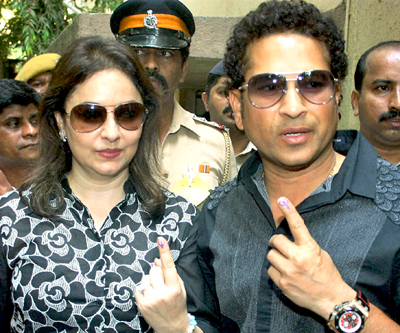
Maharashtra witnessed top corporate honchos and Bollywood celebrities making a beeline to cast their vote.

Nearly 15% turnout was recorded in the first few hours in 19 seats across Maharashtra in the third and final phase of elections in the state. In the financial capital Mumbai, captains of industry, including Adi Godrej and Anil Ambani, were among the early birds from India Inc to cast their votes.

Bollywood stars Aamir Khan, Rekha, Vidya Balan, Sunny Deol, Sonam Kapoor added a dash of glamour to the voting process by casting their vote in different booths in Mumbai. Over 34% voter turnout was recorded in ten Lok Sabha seats in Madhya Pradesh where voters will decide the fate of 118 candidates including Sumitra Mahajan and Congress leader Meenakshi Natarajan.

An impressive voter turnout was recorded in West Bengal where nearly 51% votes were cast till noon in six Parliamentary constituencies in the second phase of the five-phase election to decide the fate of 78 candidates. While over 37% voting was recorded till noon during final phase of polling in Assam's six Lok Sabha seats, around 37% polling was recorded till 1 PM in seven Lok Sabha constituencies in Bihar.

In Rajasthan, an average 29% voting was registered during the initial hours in five Parliamentary constituencies. About 35% of electorate cast their votes in the first three hours of polling in seven Lok Sabha constituencies of Chhattisgarh.

After starting out on a dull note, polling picked up in most parts of Anantnag constituency in Jammu and Kashmir, but remained affected in Pulwama district. Polling was briefly stopped at a polling station in Koil in Pulwama after some persons pelted stones on the booth, prompting police to fire warning shots.

Comments

Add new comment

  • Coastaldigest.com reserves the right to delete or block any comments.
  • Coastaldigset.com is not responsible for its readers’ comments.
  • Comments that are abusive, incendiary or irrelevant are strictly prohibited.
  • Please use a genuine email ID and provide your name to avoid reject.
News Network
March 29,2020

Mumbai, Mar 29: Virologist Minal Dakhave Bhosale led from the front to create India's first coronavirus testing kit even when she was in the last stage of her pregnancy.

Bhosale's efforts paid the price with her team delivering the testing kit in a record time of six weeks.

Bhosale gave birth to a baby girl just a day before submitting the kit to the authorities for evaluation.

"It was like giving birth to two babies," Bhosale told PTI over the phone.

The virologist said both the journeys - that happened in parallel - were not without challenges.

"There were complications in the pregnancy while work on the test kit was on. The baby was delivered through cesarean," she said.

Bhosale said she felt that it was the right time to serve the people to help them in combating the coronavirus threat.

"I had been working for five years in this field and if I don't work in emergency situations when my services are needed the most, then what is the use?" she said.

Though Bhosale was not able to visit the office due to the pregnancy, she was guiding a team of 10 persons working on the project at Mylab Discovery in Pune.

The strong bonds forged with the team over the years and their support made it possible, she said.

Company's co-founder Shrikant Patole said just like drug discovery, test kits too go through a lot of quality checks to improve the precision.

He credited Bhosale for the success of the project.

The COVID-19 testing kit delivered by Bhosale's team will reduce the time taken for delivering a result to 2.5 hours from the prevalent practice of eight hours.

A pioneering approach to testing without compromising on the results was adopted, Bhosale said.

The Maylab test kit will cost Rs1,200, a quarter of Rs 4,500 per kit that the government has been spending on testing so far.

"I'm happy that I could do something for the country," Bhosale said.

As of Friday, only 27,000 of the 1.3 billion people were tested for the virus in the country.

According to experts, high scale testing is essential because it alone can ensure an early diagnosis of COVID-19 and lower down the fatalities.

The company is confident of ramping up the capacity at its plant in Lonavala to deliver 100,000 kits a week, Patole said.

He said the authorities are helping the company, including giving priority for shipping of the raw materials.

Comments

Add new comment

  • Coastaldigest.com reserves the right to delete or block any comments.
  • Coastaldigset.com is not responsible for its readers’ comments.
  • Comments that are abusive, incendiary or irrelevant are strictly prohibited.
  • Please use a genuine email ID and provide your name to avoid reject.
News Network
April 24,2020

Kozhikode, Apr 24: A four-month-old baby girl, who had tested positive for COVID-19 and suffering from congenital heart disease, died in a hospital here in Kerala early Friday after suffering a cardiac arrest, officials said.

This is the third COVID-19 death and the first infant fatality in the state where two elderly people had succumbed to the disease earlier.

The baby was admitted to the Medical College Hospital here on April 21 with history of fever, cough, breathing difficulties and seizure after being treated at two other hospitals and the end came at 6 am, a medical bulletin said.

State Health Minister K K Shailaja said doctors had made maximum efforts to save the life of the child, whose family belonged to Payyanad near Manjeri in Malappuram district.

"Preliminary information which we have is that there has been some primary contact", she told reporters in Thiruvananthapuram.

The protocol for COVID-19 cases would be followed for the baby's last rites, the Minister added.

As of Thursday, the total active COVID-19 cases in the state stood at 129.

The bulletin said on arrival at the hospital on Tuesday the baby was in shock and had respiratory failure.

"She was resuscitated, mechanically ventilated and appropriate antibiotics for pneumonia and supportive measures to correct shock were started", it said adding the baby, however, continued to remain sick.

"Even though there was no history of any high or low risk contact or any epidemiological links as the child comes from SARI (Sever Acute Respiratory infection) criteria, she was admitted to the COVID-ICU and swab was taken and she tested positive", the bulletin said.

Contact tracing of those who had come in contact with the child was in progress.

Mallapuram District Medical Officer (Health) Dr Sakeena K said the child was having severe health issues from its birth itself and was admitted to a private hospital in Manjeri near here with breathing problem.

As her condition worsened, the baby was shifted to another hospital and later to the medical college hospital.

"The baby was having chest deformity and Atrial Septal Defect by birth which developed into severe health issues, the official added.

Comments

Add new comment

  • Coastaldigest.com reserves the right to delete or block any comments.
  • Coastaldigset.com is not responsible for its readers’ comments.
  • Comments that are abusive, incendiary or irrelevant are strictly prohibited.
  • Please use a genuine email ID and provide your name to avoid reject.
Agencies
June 15,2020

New Delhi, Jun 15: Average temperature of India experienced a rise of 0.7 degree Celsius, along with decline in rainfall, significant increase in frequency of very severe cyclonic storms and droughts in over a decade due to human activities, the Ministry of Earth Sciences in its research report said.

The contentions were made in a report issued by the ministry on the impact of climate change. It will be published by Union Minister Harsh Vardhan on June 19.

According to the report, "Since the middle of the twentieth century, India witnessed rise in temperature; decrease in monsoon; rise in extreme temperature and rainfall, droughts, and sea levels; and increase intensity of severe cyclones.

The report, prepared by researchers of the Centre for Climate Change Research, a cell under The Ministry's Indian Institute of Tropical Meteorology, Pune, further stated that there is compelling scientific evidence that human activities have influenced these changes in regional climate.

India's average temperature has risen by around 0.7 degrees Celsius during 1901-2018, it said, adding that the rise is largely on account of GHG-induced warming and partially offset by forcing due to anthropogenic aerosols.

It states that the average temperature over India is projected to rise by 4.4 degrees Celsius, while the intensity of heat waves is likely to increase by 3-4 times by the end of the century.

In the 30-year period between 1986 and 2015, temperatures of the warmest day and the coldest night of the year have risen by about 0.63 degrees Celsius and 0.4 degree Celsius.

According to the report, by the end of the century, the temperatures of the warmest day and the coldest night are projected to rise by approximately 4.7 degrees Celsius and 5.5 degrees Celsius, respectively.

Alarmingly, sea surface temperature of the tropical Indian Ocean has also risen by one degrees Celsius on average during 1951-2015.

"The frequency of very severe cyclonic storms during the post-monsoon season has increased significantly (+1 event per decade) during the last two decades (2000-2018)," it added.

This came in the backdrop of Cyclone 'Amphan' and 'Nisarga' which made landfalls on May 20 and June 3 and killed several people, flattened villages, and destroyed farms.

"This is the first-ever climate change assessment report for India. This report will be very useful for policy makers, researchers, social scientists, economists, and students," said M. Rajeevan, secretary, the Ministry of Earth Sciences.

Besides this, the report also highlighted various other unnerving data on climate change in the country. Both the frequency and extent of droughts have increased significantly during 1951-2016.

The overall decrease of seasonal "summer monsoon rainfall" during the last 6-7 decades has led to an increased propensity for droughts over India.

"In particular, areas over central India, southwest coast, southern peninsula and north-eastern India have experienced more than 2 droughts per decade, on average, during this period. The area affected by drought has also increased by 1.3 per cent per decade over the same period."

The Hindu Kush Himalayas (HKH) also experienced a temperature rise of about 1.3 degree Celsius during 1951-2014.

Several areas of the Himalayas have experienced a declining trend in snowfall and also retreat of glaciers in recent decades. By the end of the twenty-first century, its annual mean surface temperature is projected to increase by about 5.2 degree Celsius.

The summer monsoon precipitation from June to September over India has also declined by around 6 per cent from 1951 to 2015, with notable decreases over the Indo-Gangetic Plains and the Western Ghats, the report further states.

Comments

Add new comment

  • Coastaldigest.com reserves the right to delete or block any comments.
  • Coastaldigset.com is not responsible for its readers’ comments.
  • Comments that are abusive, incendiary or irrelevant are strictly prohibited.
  • Please use a genuine email ID and provide your name to avoid reject.