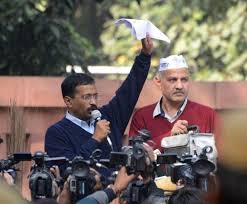
Lt Guv played 'key role' in defusing AAP, Centre stalemate

January 22, 2014

aravind

New Delhi, Jan 21: Delhi Lieutenant Governor Najeeb Jung played a "key role" in ending the stalemate between the Aam Aadmi Party (AAP) government and the Centre by getting the two sides to reach a compromise on issues involving Delhi Police, a source said.

"The Lt Governor played a key role in defusing the situation," said a government source.

Jung made discreet inquiries at his end and reportedly found some damaging information against the police officials whom the Delhi government wanted penalised, the source added.

As to the withdrawing of the dharna, the source said that Jung had sought a commitment from Kejriwal that he would agree with the formula devised by him "to end the stalemate".

Kejriwal's two-day dharna outside Rail Bhavan here was today withdrawn after the Lt Governor "partially agreed" to the government's demand of action against five Delhi Police officers for alleged dereliction of duty.

As the proposal reached the government, Chief Minister Arvind Kejriwal and the members of AAP's Political Affairs Committee (PAC) held an hour-long closed door meeting at Press Club following which the CM announced his decision to call off the dharna.

Kejriwal, his cabinet and party colleagues and AAP supporters had gone on a dharna over their demand for the suspension of three SHOs and two ACPs in connection with three separate cases.

One of those involved the gangrape of the Danish woman in the national capital while the second case deals with the alleged burning of a woman by her in-laws over dowry.

The third matter is related to an alleged prostitution and drug ring in Malviya Nagar and Khirki Extension and the refusal of police there to undertake a raid against those reportedly involved in the racket when Delhi Law Minister Somnath Bharti had sought their intervention for the same.

Under the compromise agreed by AAP, the SHO of Malviya Nagar and the PCR van in-charge at Paharganj, where the Danish woman was gangraped last week, have been sent on leave.

AAP sources, meanwhile, said that "senior officers" of Delhi Police had met a Delhi minister in the morning with a view to ending the "deadlock".

Comments

Add new comment

  • Coastaldigest.com reserves the right to delete or block any comments.
  • Coastaldigset.com is not responsible for its readers’ comments.
  • Comments that are abusive, incendiary or irrelevant are strictly prohibited.
  • Please use a genuine email ID and provide your name to avoid reject.
News Network
March 16,2020

Mar 16: An investigation into Coffee Day Enterprises Ltd., initiated by its board after the death of founder V.G. Siddhartha, is likely to conclude that at least Rs 2,000 crore is missing from its accounts, according to people familiar with the matter.

The months-long probe following the suicide of Siddhartha in July examined the financial transactions of India’s largest coffee chain and its dealings with dozens of private companies owned by the entrepreneur. The draft report, running more than a hundred pages, points to thousands of rupees that have gone missing, said the people, asking not to be named because the details aren’t public. It also details hundreds of transactions between the founder’s listed and personal businesses that were not conducted at arm’s length, they said.

Though the report is in its final stages, the precise details could change before its release, expected as early as this week, the people said. The missing funds could total more than Rs 2500 crore, one person said.

“The investigation report is still a work in progress, and not finalized,” a spokesman for the company said. “The board of directors and the company are unaware of its content at this point of time. Hence it would be premature to speculate on the investigation findings.”

The priority for management and Siddhartha’s family “is to keep the business running in a challenging environment and meet all stakeholder commitments, including 30,000 jobs associated with the group,” the spokesman added.

The disappearance of the 59-year-old founder last year stunned India’s business community. He had last been seen telling his driver he was going for an evening walk along a bridge in southern India; his body was found by local fishermen two days later. A letter delivered to Coffee Day’s board and employees, which appeared to be signed by Siddhartha, described massive debts and complained of pressure from lenders and tax authorities. It claimed he bore sole responsibility for the company’s financial transactions.

The probe began about a month later when the company brought in Ashok Kumar Malhotra, a retired senior official from India’s federal enforcement agency, to investigate. A senior lawyer practicing in India’s top court is assisting, the company said in a regulatory filing at the time.

The publicly traded Coffee Day was supposed to be India’s answer to Starbucks Corp. More than 1,500 of its Café Coffee Day outlets blanketed cities and highways, with affordable options for the country’s aspiring middle classes. The chain’s tagline: “A lot can happen over coffee.”

But the empire has been battered since the founder’s death. Its shares plummeted about 90% and its market value dropped to about $80 million. Trading was suspended in February.

India’s regulators are tracking the situation and may use the company’s final report as part of a deeper dive into its internal affairs, the people said. Coffee Day showed about Rs 2400 crore in cash and cash equivalents on its balance sheet as of March 2019, the most recent figures the company has issued.

After the death of Siddhartha however, the company faced a severe liquidity crunch and had “zero cash in the bank,” according to one of the people. It struggled with day-to-day expenses and paying salaries has been a strain, the person said.

The draft report details personal guarantees by Siddhartha for loans taken by Coffee Day, and his unsecured loans at high interest rates from local money lenders, the people said. It also probes Coffee Day’s defaults to coffee growers and other vendors, they said.

A related issue is that coffee estates owned by Siddhartha and several employees had been used as collateral for bank loans. The report found that valuations for properties were inflated to get the loans, one person said.

Investigators have examined several theories about what happened to the company’s money, including whether Coffee Day was manipulating its finances to show cash and profit and whether Siddhartha was taking cash out of the listed company to pay off a large investor to whom he had guaranteed a return, the person said. From the filings of his listed and private companies, the entrepreneur’s loans had totaled more than Rs 10,000 crore, and he had been squeezed by borrowing to repay interest on earlier loans, the person said.

In the letter purportedly from Siddhartha, the entrepreneur said he had tried his best but failed as an entrepreneur. “I am solely responsible for all mistakes,” the letter read. “Every financial transaction is my responsibility. My team, auditors and senior management are totally unaware of all my transactions. The law should hold me and only me accountable, as I have withheld this information from everybody including my family.”

As the report nears release, Coffee Day is finalizing a deal with Blackstone Group Inc. for real estate assets. A large tranche of the payment is due in about a week, one person said.

Coffee Day said it is working to reduce its debt load by divesting non-core enterprises.

“The aim is to save employment and preserve this iconic Indian brand,” the spokesman said.

Comments

Add new comment

  • Coastaldigest.com reserves the right to delete or block any comments.
  • Coastaldigset.com is not responsible for its readers’ comments.
  • Comments that are abusive, incendiary or irrelevant are strictly prohibited.
  • Please use a genuine email ID and provide your name to avoid reject.
Agencies
June 22,2020

Mumbai, Jun 22: After downgrading India's outlook to negative from stable, Fitch Ratings on Monday revised the outlook on nine Indian banks to negative.

The outlook on the Long-Term Issuer Default Ratings (IDR) was revised to negative from stable due to the banks' high dependence on the Centre to re-capitalise them.

Accordingly, the IDR outlook of the Export-Import Bank of India, the State Bank of India, the Bank of Baroda, the Bank of Baroda (New Zealand), the Bank of India, the Canara Bank, the Punjab National Bank, ICICI Bank and Axis Bank Ltd have been downgraded to negative.

"At the same time, Fitch has affirmed IDBI Bank Limited's (IDBI) IDR while maintaining the outlook at negative," Fitch said in a statement.

The rating actions follow Fitch's revision of the outlook on the 'BBB-' rating on India to negative from stable on June 18, due to the impact of the escalating coronavirus pandemic on India's economy.

"The IDRs for all the above Indian banks are support-driven and anchored to their respective SRFs," the statement said.

"They are based on Fitch's assessment of high to moderate probability of extraordinary state support for these banks, which takes into account our assessment of the sovereign's ability and propensity to provide extraordinary support."

According to the statement, the negative outlook on India's sovereign rating reflects an increasing strain on the state's ability to provide extraordinary support, due to the sovereign's limited fiscal space and the significant deterioration in fiscal metrics due to challenges from the COVID-19 pandemic.

"The rating action does not affect the banks' Viability Rating (VR). EXIM does not have a VR as its role as a policy bank makes an assessment of its standalone credit profile less meaningful."

Comments

Add new comment

  • Coastaldigest.com reserves the right to delete or block any comments.
  • Coastaldigset.com is not responsible for its readers’ comments.
  • Comments that are abusive, incendiary or irrelevant are strictly prohibited.
  • Please use a genuine email ID and provide your name to avoid reject.
Agencies
August 5,2020

Ayodhya, Aug 5: Prime Minister Narendra Modi on Wednesday recalled the significance of the path of 'maryada' associated with Lord Ram in the backdrop of the situation created by COVID-19 and emphasised the importance of social distancing and wearing face masks.

He said that the current situation demands 'maryada' should be 'do gaz ki doori, mask hai zaroori' and exhorted everyone to follow it.

In his speech after laying the foundation stone of the Ram Temple in Ayodhya, the Prime Minister said the temple of Lord Ram will inspire and guide humans for ages to come.

He said that the path of `maryada' followed by Lord Ram is all the more necessary today in the situation created by COVID-19.

"The `maryada' (need) today is do gaj ki doori, mask hai jaroori (keep distance of two yards, wear mask). The Almighty may keep all the citizens healthy and happy, this is my prayer. The blessings of Mother Sita and Shri Ram be always there on the citizens," he said.

The Prime Minister termed the occasion as historic and said that India is starting a glorious chapter when people across the country are excited and emotional to have finally achieved what they had been waiting for centuries.

Comments

Add new comment

  • Coastaldigest.com reserves the right to delete or block any comments.
  • Coastaldigset.com is not responsible for its readers’ comments.
  • Comments that are abusive, incendiary or irrelevant are strictly prohibited.
  • Please use a genuine email ID and provide your name to avoid reject.