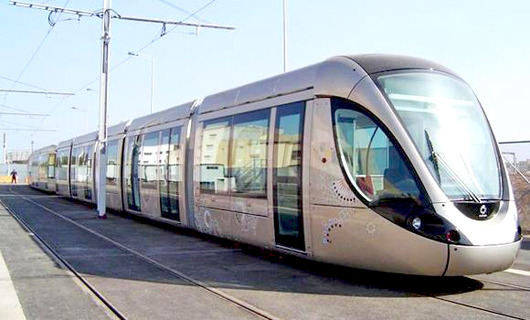
Madinah to Rabigh train trial run after holy month

May 29, 2015

Jeddah, May 29: Ninety six percent of the Haramain High Speed Rail Project in Jeddah and Makkah has been completed.

The contractors would by the end of this year complete bridges along the railway line in Jeddah, including those removed three years ago in preparation for the project, such as the Briman, Palestine and King Abdullah bin Abdulaziz Road bridges, sources said.

Madinah train

All work, including construction of bridges and extension of rails, is on schedule, said the sources. The Saudi Railways Organization has been working with the Saudi Electricity Company and National Water Company to provide services to stations.

Trial runs of the high-speed train between Madinah and Rabigh are scheduled to take place after Ramadan, while trials between Jeddah and Makkah has been postponed to the beginning of 2016. The train between Madinah and Rabigh will be operational by the end of 2015, and between Makkah and Jeddah by the end of 2016.

Sources said some of the construction is the responsibility of the Jeddah Municipality, while the Ministry of Transport is overseeing construction of the bridges. Bridges will have no traffic lights or stop signs to ensure smooth traffic flow.

The Saudi Electricity Company had announced in April 2011 contracts with national and international companies worth SR1.75 billion for six electricity and power transmission lines as part of the Haramain Rail project, as well as engineering, design, and supply of six core switching stations and double circuit electric power transmission lines.

Work would also include communications and connectivity capabilities between the central and western regions.

Comments

Add new comment

  • Coastaldigest.com reserves the right to delete or block any comments.
  • Coastaldigset.com is not responsible for its readers’ comments.
  • Comments that are abusive, incendiary or irrelevant are strictly prohibited.
  • Please use a genuine email ID and provide your name to avoid reject.
News Network
January 6,2020

Dubai/Washington, Jan 6: Tens of thousands of Iranians thronged the streets of Tehran on Monday for the funeral of Quds Force commander Qassim Suleimani who was killed in a US air strike last week and his daughter said his death would bring a "dark day" for the United States.

"Crazy Trump, don't think that everything is over with my father's martyrdom," Zeinab Suleimani said in her address broadcast on state television after US President Donald Trump ordered Friday's strike that killed the top Iranian general.

Iran has promised to avenge the killing of Qassim Suleimani, the architect of Iran's drive to extend its influence across the region and a national hero among many Iranians, even many of those who did not consider themselves devoted supporters of the Islamic Republic's clerical rulers.

The scale of the crowds in Tehran shown on television mirrored the masses that gathered in 1989 for the funeral of the founder of the Islamic Republic, Ayatollah Ruhollah Khomeini.

In response to Iran's warnings, Trump has threatened to hit 52 Iranian sites, including cultural targets, if Tehran attacks Americans or US assets, deepening a crisis that has heightened fears of a major Middle East conflagration.

The coffins of the Iranian general and Iraqi militia leader Abu Mahdi al-Muhandis, who was also killed in Friday's attack on Baghdad airport, were passed across the heads of mourners massed in central Tehran, many of them chanting "Death to America".

One of the Islamic Republic's major regional goals, namely to drive US forces out of neighbouring Iraq, came a step closer on Sunday when the Iraqi parliament backed a recommendation by the prime minister for all foreign troops to be ordered out.

"Despite the internal and external difficulties that we might face, it remains best for Iraq on principle and practically," said Iraqi caretaker Prime Minister Adel Abdul Mahdi, who resigned in November amid anti-government protests.

Iraq's rival Shi'ite leaders, including ones opposed to Iranian influence, have united since Friday's attack in calling for the expulsion of US troops.

Esmail Qaani, the new head of the Quds Force, the Revolutionary Guards' unit in charge of activities abroad, said Iran would continue Suleimani's path and said "the only compensation for us would be to remove America from the region."

ALLIES AT FUNERAL

Prayers at Suleimani's funeral in Tehran, which will later move to his southern home city of Kerman, were led by Iran's Supreme Leader Ayatollah Ali Khamenei. Suleimani was widely seen as the second most powerful figure in Iran behind Khamenei.

The funeral was attended by some of Iran's allies in the region, including Ismail Haniyeh, the leader of Palestinian group Hamas who said: "I declare that the martyred commander Suleimani is a martyr of Jerusalem."

Adding to tensions, Iran said it was taking another step back from commitments under a 2015 nuclear deal with six major powers, a pact from which the United States withdrew in 2018.

Washington has since imposed tough sanctions on Iran, describing its policy as "maximum pressure" and saying it wanted to drive down Iranian oil exports - the main source of government revenues - to zero.

Talking to reporters aboard Air Force One on the way to Washington from Florida on Sunday, Trump stood by his remarks to include cultural sites on his list of potential targets, despite drawing criticism from US politicians.

"They're allowed to kill our people. They're allowed to torture and maim our people. They're allowed to use roadside bombs and blow up our people. And we're not allowed to touch their cultural sites? It doesn't work that way," Trump said.

Democratic critics of the Republican president have said Trump was reckless in authorizing the strike, and some said his comments about targeting cultural sites amounted to threats to commit war crimes. Many asked why Soleimani, long seen as a threat by US authorities, had to be killed now.

Republicans in the US Congress have generally backed Trump's move.

Trump also threatened sanctions against Iraq and said that if US troops were required to leave the country, Iraq's government would have to pay Washington for the cost of a "very extraordinarily expensive" air base there.

He said if Iraq asked US forces to leave on an unfriendly basis, "we will charge them sanctions like they've never seen before ever. It'll make Iranian sanctions look somewhat tame."


Comments

Add new comment

  • Coastaldigest.com reserves the right to delete or block any comments.
  • Coastaldigset.com is not responsible for its readers’ comments.
  • Comments that are abusive, incendiary or irrelevant are strictly prohibited.
  • Please use a genuine email ID and provide your name to avoid reject.
News Network
February 28,2020

Riyadh, Feb 28: Saudi Arabia on Thursday (Feb 27) suspended visas for visits to Islam's holiest sites for the "umrah" pilgrimage, an unprecedented move triggered by coronavirus fears that raises questions over the annual hajj.

The kingdom, which hosts millions of pilgrims every year in the cities of Mecca and Medina, also suspended visas for tourists from countries with reported infections as fears of a pandemic deepen.

Saudi Arabia, which so far has reported no cases of the virus but has expressed alarm over its spread in neighbouring countries, said the suspensions were temporary. It provided no timeframe for when they will be lifted.

"The kingdom's government has decided to take the following precautions: suspending entry to the kingdom for the purpose of umrah and visit to the Prophet's mosque temporarily," the foreign ministry said in a statement.

"Suspending entry into the kingdom with tourist visas for those coming from countries, in which the spread of the new coronavirus (COVID-19) is a danger."

The move comes as Gulf countries implement a raft of measures, including flight suspensions and school closures, to curb the spread of the disease from people returning from pilgrimages to Iran.

Even as the number of fresh coronavirus cases declines at the epicentre of the disease in China, there has been a sudden increase across the Middle East.

Since its outbreak, the United Arab Emirates has reported 13 coronavirus cases, Kuwait has recorded 43, Bahrain has 33 and Oman is at four cases.

Iran has emerged as a major hotspot in the region, with 19 fatalities from 139 infections - the highest death toll outside China, where COVID-19 originated.

While no cases have been reported in Saudi Arabia, one citizen is reported to be infected in Kuwait along with four Saudi women in Bahrain - all of whom had returned from Iran.

'UNPRECEDENTED' MOVE

The umrah, which refers to the Islamic pilgrimage to Mecca that can be undertaken at any time of year, attracts millions of devout Muslims from all over the globe each year.

There was no clarity over how the move would affect the annual hajj pilgrimage due to start in late July.

Some 2.5 million faithful travelled to Saudi Arabia from across the world to take part in last year's hajj - one of the five pillars of Islam.

The event is a key rite of passage for Muslims and a massive logistical challenge for Saudi authorities, with colossal crowds cramming into relatively small holy sites.

"This move by Saudi Arabia is unprecedented," Ghanem Nuseibeh, founder of London-based risk consultancy Cornerstone Global Associates, told news agency.

"The concern for Saudi authorities would be Ramadan, which starts at the end of April, and hajj afterwards, should the coronavirus become a pandemic."

The holy fasting month of Ramadan is considered a favourable period by Muslim pilgrims to perform the umrah.

Saudi Arabia's custodianship of Mecca and Medina - Islam's two holiest sites - is seen as the kingdom's most powerful source of political legitimacy.

But a series of deadly disasters over the years has prompted criticism of the Sunni kingdom's management of the pilgrimage.

In September 2015, a stampede killed up to 2,300 worshippers - including hundreds of Iranians - in the worst disaster ever to strike the pilgrimage.

The pilgrimage forms a crucial source of revenue for the government, which hopes to welcome 30 million pilgrims annually to the kingdom by 2030.

De facto ruler Crown Prince Mohammed bin Salman's Vision 2030 reform plan seeks to shift the economy of Saudi Arabia - the world's top crude exporter - away from oil dependency towards other sources of revenue, including religious tourism.

Comments

Whether this virus is also created by Allah the powerful? If yes then Muslims need not fear, they should continue to go the Mecca, on the Non-muslims should fear because allah hates them. &


And if the Virus not created by Allah, then Who created it?  Is there anyone else other than Allah?


You Fool Go-vind...there is no logic in your statement.

will you touch burning fire for 2 min if you are fearless...foolish right


GOD is not magic...its logical


God never helped any Human beigh with magic to conver to his religion,

he would have done then all will be worshipping him alone..


this is test for all human being


he created all human beign and he loves every human being but he loves only those who good to another human.


screem how ever you want..but muslim population will increase 100%.

please check your health before cursing other.


So-called powerfull GOD saved all human beign when they sincierly prayed also you.


the more you hate ISLAM the more it become powerful.


HINUD is not religion but it is geographical name

RAM is not god but he is king of ayodya same human beign

Phophet Mohammed Pbuh is not GOD but he is messanger of GOD

Veda says na thasya parathima asti- there is no image of GOD but you make some photo and worship.

the biggest sin in front of GOD which will never be forgiven is  worshipping Idol.

God is one not multi...if god is mutli then there is no meaning in justics


Love human being automatically God loves you


Govind
 - 
Friday, 6 Mar 2020

Fools.. Why they fear virus. If somebody ask them, they say we have fear only on Allah. They should go there.. they should be infected and population should decease. Let their so-called powerful god save them

Logical Indian
 - 
Friday, 6 Mar 2020

Muslims fear only Allah and no body else. then why this fear for the virus. They should trust allah fully and allow pilgirms. "Allah o akbar"

Abdul Rahman
 - 
Friday, 28 Feb 2020

Mecca to b spelled Makkah.

Makkah is the correct spelling

Add new comment

  • Coastaldigest.com reserves the right to delete or block any comments.
  • Coastaldigset.com is not responsible for its readers’ comments.
  • Comments that are abusive, incendiary or irrelevant are strictly prohibited.
  • Please use a genuine email ID and provide your name to avoid reject.
News Network
May 11,2020

May 11: Saudi Arabia will triple its value-added tax rate and suspend a cost of living allowance for state workers, it said on Monday, seeking to shield finances hit by low oil prices and a slump in demand for its lifeline export worsened by the new coronavirus.

Historic oil output cuts agreed by Riyadh and other major producers have given only limited support to prices after they sank on oversupply caused by a war for petroleum market share between the kingdom and its fellow oil titan Russia.

Saudi Arabia, the world's largest oil exporter, is also being hit hard by measures to fight the new coronavirus, which are likely to curb the pace and scale of economic reforms launched by Crown Prince Mohammed bin Salman.

"The cost of living allowance will be suspended as of June 1, and the value added tax will be increased to 15% from 5% as of July 1," Finance Minister Mohammed al-Jadaan said in a statement reported by the state news agency. "These measures are painful but necessary to maintain financial and economic stability over the medium to long term...and to overcome the unprecedented coronavirus crisis with the least damage possible."

The austerity measures come after the kingdom posted a $9 billion budget deficit in the first quarter.

The minister said non-oil revenues were affected by the suspension and decline in economic activity, while spending had risen due to unplanned strains on the healthcare sector and the initiatives taken to support the economy.

"All these challenges have cut state revenues, pressured public finances to a level that is hard to deal with going forward without affecting the overall economy in the medium to long term, which requires more spending cuts and measures to support non-oil revenues stability," he added.

The government has cancelled and put on hold some operating and capital expenditures for some government agencies, and cut allocations for some reform initiatives and projects worth a total 100 billion riyals ($26.6 billion), the statement said.

Central bank foreign reserves fell in March at their fastest rate in at least 20 years and to their lowest since 2011, while oil revenues in the first three months of the year fell 24% from a year earlier to $34 billion, pulling total revenues down 22%.

"The reforms are positive from a fiscal side as greater adjustment is essential. However, the tripling of VAT is unlikely to help that much in 2020 revenue wise with the expected fall in consumption," said Monica Malik, chief economist at Abu Dhabi Commercial Bank.

She said she kept unchanged her deficit forecast of 16.3% of GDP for this year, which already factors in a greater than previously announced spending cut.

About 1.5 million Saudis are employed in the government sector, according to official figures released in December.

In 2018, Saudi Arabia's King Salman ordered a monthly payment of 1,000 riyals ($267) to every state employee to compensate them for the rising living costs after the government hiked domestic gas prices and introduced value-added tax.

DIFFICULT TIMES

A committee has been formed to study all financial benefits paid to public sector employees and contractors, and will submit recommendations within 30 days, the statement said.

In late 2015, when oil prices fell from record highs, the kingdom slashed lavish bonuses, overtime payments and other benefits once considered routine perks in the public sector.

In a country without elections and with political legitimacy resting partly on distribution of oil revenue, the ability of citizens to adapt to such reforms is crucial for stability.

"Tripling the VAT will test the limits of the balance between revenues and consumption as the economy dives into a deep recession. The move will impact consumption and could also lower the expected revenues," said John Sfakianakis, a Gulf expert at the University of Cambridge.

"These are pro-austerity and pro-revenue moves rather than pro-growth ones," he said.

Hasnain Malik, head of equity strategy at Tellimer, said the VAT rise could bring about $24-$26.5 billion in additional non-oil fiscal revenue. The rise would hit consumer spending further but was a needed step towards fiscal sustainability, he said.

Comments

Add new comment

  • Coastaldigest.com reserves the right to delete or block any comments.
  • Coastaldigset.com is not responsible for its readers’ comments.
  • Comments that are abusive, incendiary or irrelevant are strictly prohibited.
  • Please use a genuine email ID and provide your name to avoid reject.